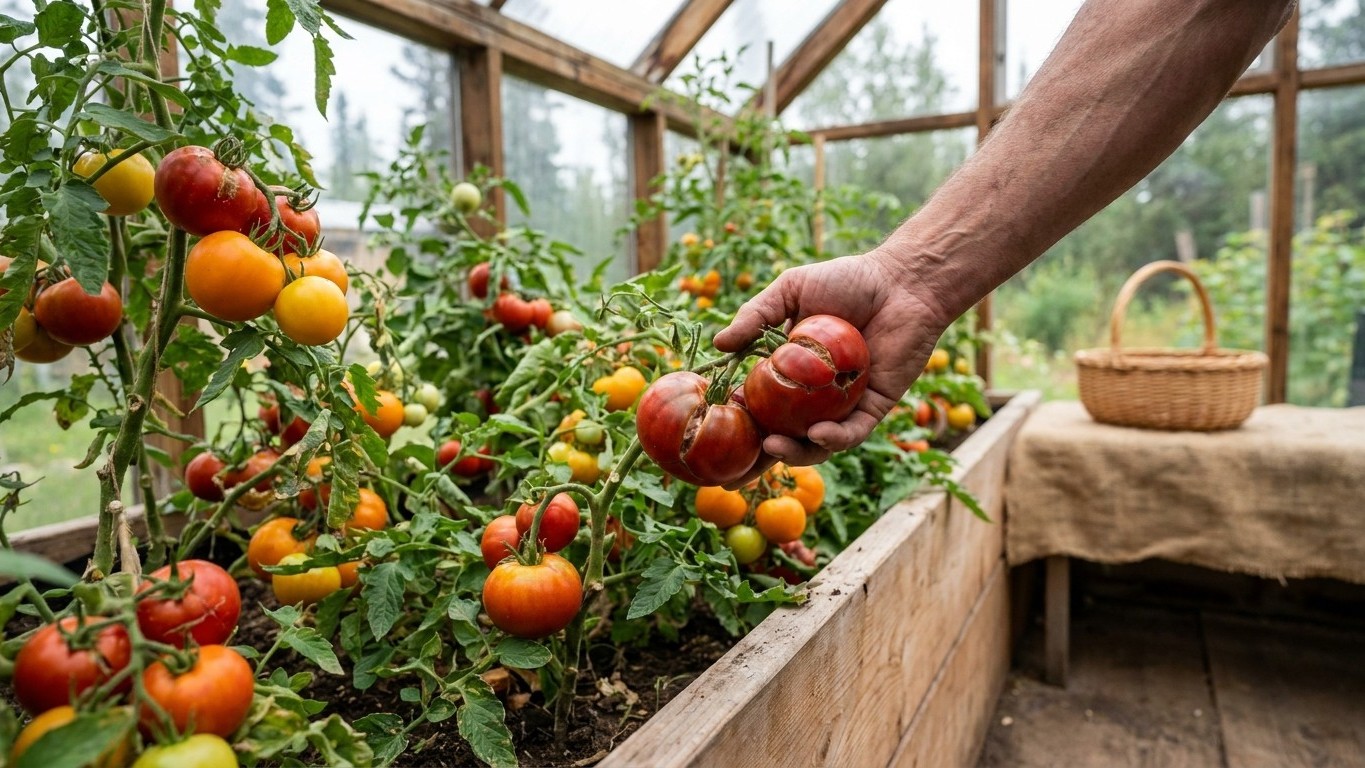

Yes — a handful of tomato varieties can ripen fully in an Alaska yard, but only the fast ones, and only if you count backward from your first fall freeze before you fall in love with a seed packet. The number that decides this for you is days to maturity: add it to a mid-to-late-May transplant date, and if ripe fruit doesn’t land at least a month before autumn’s first freeze, that variety isn’t worth the space. So before choosing anything, find your local frost-free window and work backward from it.
What this comes down to in Alaska

Anchorage’s frost-free season runs about 143 days in an average year, according to NOAA NCEI’s 1991-2020 normals for station USW00026451, and every tomato variety you grow here has to fit inside that window as a transplant, not a direct-seeded crop. The basics of growing tomatoes in Alaska are settled; the question left is which cultivar actually has time to ripen. The short answer is that days to maturity is the single number that matters most, more than flavor, more than fruit size, because a variety that needs 85 days is working with barely a third of the margin that a 55-day variety has.
The table below lines up eight cultivars from our catalogue database by that number, along with the transplant window this frost data allows and the approximate margin each one leaves before Anchorage’s first fall frost. All figures assume a mid-May to late-May transplant, the range this climate data supports, and count forward from there rather than from seed.
| Variety | Days to maturity | Growth habit | First ripe fruit | Margin before fall frost |
|---|---|---|---|---|
| Sakura | 55 | Indeterminate | Mid July | ~64 days |
| Sun Gold | 57 | Indeterminate | Late July | ~62 days |
| Jasper | 60 | Indeterminate | Late July | ~59 days |
| Amalfi | 68 | Determinate | Early August | ~51 days |
| Cherokee Purple | 72 | Indeterminate | Early August | ~47 days |
| Tiren | 75 | Indeterminate | Early August | ~44 days |
| San Marzano II | 78 | Indeterminate | Mid August | ~41 days |
| Amish Paste | 85 | Indeterminate | Mid August | ~34 days |
Sakura

Sakura needs about 55 days from transplant, the shortest on this list. It’s a cherry tomato bred for eating fresh off the vine, carrying intermediate resistance to nematodes and high resistance to Tomato Mosaic Virus and two races of fusarium wilt. Set out mid-May to late May, it ripens by mid-July with roughly 64 days of margin before Anchorage’s first fall frost, more cushion than almost anything else in this list.
Sun Gold

Sun Gold matures in about 57 days and produces small, sweet cherry tomatoes with high resistance to Tobacco Mosaic Virus and fusarium wilt race 1. Transplanted mid-May to late May, first fruit arrives late July, about 62 days ahead of the fall frost window.
Jasper

Jasper runs 60 days to maturity and carries high resistance to late blight, a disease that thrives in the cool, damp nights common to coastal Alaska summers, plus intermediate resistance to early blight. Set out mid-May to late May, first ripe fruit lands late July with about 59 days of margin before frost.
Amalfi

Amalfi is a determinate paste tomato, meaning the plant stays compact and ripens most of its fruit in one flush rather than trickling it out all season, useful when the season itself is short. It matures in about 68 days, with intermediate resistance to late blight, early blight and nematodes, and first fruit is ready early August, about 51 days ahead of frost.
Cherokee Purple

Cherokee Purple is a 72-day heirloom beefsteak with no listed disease resistance, so it leans harder on a cooperative summer than the hybrids around it on this list. Set out mid-May to late May, first ripe fruit lands early August with about 47 days of margin, workable most years but tighter than the shorter-season varieties above.
Tiren

Tiren takes about 75 days and carries high resistance to verticillium wilt, tomato mosaic virus and fusarium wilt race 1, worth knowing if tomatoes have grown in the same bed for several seasons. First fruit arrives early August, about 44 days ahead of frost.
San Marzano II
San Marzano II takes about 78 days, the classic Italian paste shape for sauce and canning, with no listed disease resistance. It finishes mid-August, leaving about 41 days of margin, workable in an average year but the kind of variety that struggles when spring runs late.
Amish Paste
Amish Paste is the longest-season variety here at 85 days, a meaty heirloom paste tomato good for canning. First ripe fruit doesn’t show until mid-August, so the margin before Anchorage’s first fall frost shrinks to about 34 days, the thinnest cushion on this list, and it’s the variety most likely to still be carrying green fruit when the weather turns.
Working it out for your own garden
The frost window is the starting point, but the subtraction still has to be done for whatever cultivar you’re actually growing, because the margin shifts with how early or late the season runs. Start with NOAA NCEI’s 1991-2020 normals for Anchorage: last spring frost falls May 3 to May 12, first fall frost falls September 22 to October 1, station USW00026451. Soil stays cold under that long daylight, so tomatoes go in as hardened-off transplants rather than direct-seeded starts, generally mid-May to late May once night temperatures allow it. For the full method behind picking that exact transplant date, see Tomato Planting Dates in Alaska: Counting Back From Your Frost Window.
A worked example, and one that cuts it close
From the transplant date, add the cultivar’s days to maturity, counted from transplant, not from seed. Take Sun Gold at 57 days: from a mid-May to late-May transplant, first ripe fruit lands late July, with roughly 62 days still on the clock before frost. Even a slow, cool August leaves room to bring the crop in.
Now run the same math on Amish Paste, at 85 days. From that same transplant window, first ripe fruit doesn’t show up until mid-August, and the margin before frost drops to about 34 days. That’s still positive in an average year measured at Anchorage, but a spring that pushes transplanting to the back of the window, or a frost that lands on the early side of the September 22 to October 1 range, eats into that margin fast. This is the arithmetic that separates a variety worth growing outdoors from one better started earlier under cover or skipped in favor of something shorter-season.
What changes across the state
Every figure above comes from the NOAA weather station at Anchorage, and Anchorage is one of the mildest inhabited parts of the state. The USDA’s Plant Hardiness Zone Map, using 1991-2020 normals, puts Alaska anywhere from zone 1a to zone 8a depending on where you stand, a spread wide enough that a variety comfortable outdoors in one part of the state may need a greenhouse in another. That range reflects real differences: coastal areas moderated by the ocean tend to run milder and wetter, the Interior sees a shorter frost-free season with colder winters and hotter, drier summer days, and the far north compresses the growing season further still.
Elevation matters too. A garden a few hundred feet higher than a nearby valley floor often sees frost settle in earlier in fall and linger later in spring, shrinking the growing window. A gardener outside the Anchorage area should treat these frost dates as a template and get the equivalent figures for their own area from their local extension office before locking in a variety.
The mistakes this state punishes

A short growing season doesn’t forgive delay, and a few habits cost gardeners here more than they would somewhere with a longer summer.
- Setting transplants out during a warm spell before the soil has actually warmed, which stalls growth for a week or two that a short season can’t spare.
- Choosing a long-season heirloom like Amish Paste or Brandywine without first checking whether its margin actually clears the frost window this year is shaping up to be.
- Skipping hardening off entirely, which sets a transplant back further here than it would in a milder climate with more days to recover.
- Missing the point in the season when a pest problem actually shows up; see Tomato Pests in Alaska: Which Ones Actually Show Up Here for what to watch for and when.
The fix for most of these is the same: work the arithmetic before you buy seed, not after the plants are already in the ground and running out of summer.
Checking this against your county
The Anchorage figures are a starting point, not an instruction for the whole state. Before you commit a garden bed to a longer-season variety, check the current frost data and variety guidance for your own area with the University of Alaska Fairbanks Cooperative Extension Service, which maintains county-level offices and a tomato-specific guide. A grower in the Interior or further north should expect a noticeably tighter window than what’s calculated here.
Common questions
Can I just start my tomatoes indoors earlier to grow a longer-season variety?
Starting seed earlier indoors doesn’t change when you can safely move a plant outdoors. The transplant date is set by soil temperature and the last spring frost, and days to maturity is counted from that transplant date, not from when you sowed the seed.
Do cherry tomatoes really ripen that much faster than the big slicers?
Generally, yes. Sakura and Sun Gold need 55 to 57 days from transplant, while a large heirloom like Amish Paste needs 85, a difference of roughly a month that translates directly into how much margin you have before fall frost.
What happens if a tomato doesn’t finish ripening before frost hits?
Green, mature-sized fruit can still ripen indoors on a windowsill or in a paper bag, though the flavor is never quite the same as a vine-ripened tomato. Picking the whole plant and hanging it upside down in a garage or shed ahead of a hard frost is the usual fallback for a crop that’s running behind.
Is it worth Growing Tomatoes in a high tunnel instead of outside?
A high tunnel or greenhouse buys extra weeks on both ends of the season by keeping frost off the plants and warming the soil faster in spring, which matters most for the longer-season varieties on this list. Check with your local extension office for what’s realistic to build and maintain in your specific area before betting a long-season variety on one.