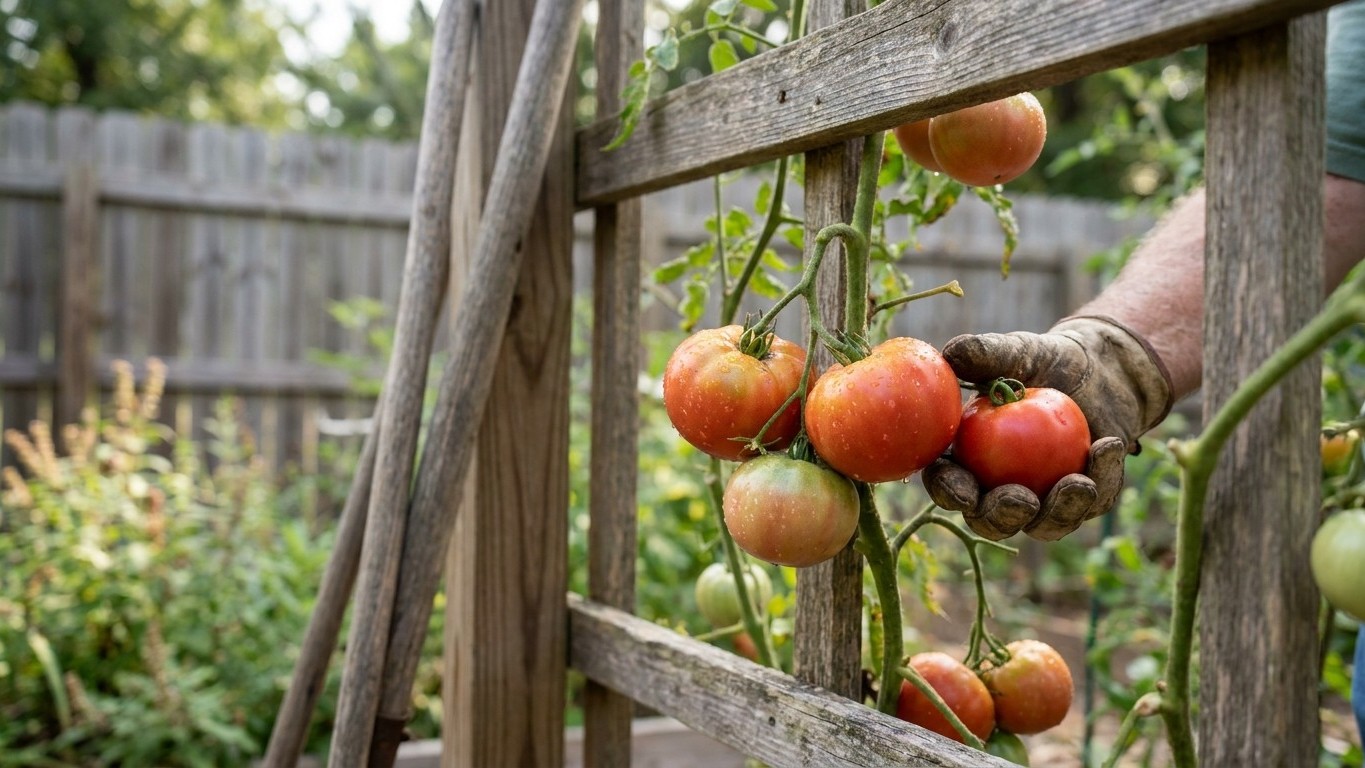

Arkansas’s growing season, measured at Little Rock by NOAA’s 1991-2020 climate normals, stretches from mid-March to early-to-mid November: roughly eight months of frost-free time, long enough to outlast the days-to-maturity printed on almost any tomato seed packet. That changes the real question from “will this ripen in time” to “which cultivar’s disease resistance and fruit type fit a long, humid Southern summer.” Pick a variety for its resistance package and its use in the kitchen first, and let days-to-maturity settle the order you plant them in.
What this comes down to in Arkansas

Sakura ripens in about 55 days from transplant, the fastest tomato on this list, and that number matters here because Arkansas gives you a narrow window — late March to mid April — before summer heat and shortening days start working against fruit set. Sun Gold and Supersweet 100 follow close behind at 57 and 60 days, both carrying disease resistance suited to soil that’s grown tomatoes before. Pick by days-to-maturity first, and the calendar takes care of itself.
Sakura
Sakura needs about 55 days from transplant, the shortest of any cultivar here, and produces small, glossy red grape tomatoes in long clusters. Set out between late March and mid April, the transplant window this frost calendar allows, and expect first ripe fruit in early June. It carries intermediate resistance to nematodes and high resistance to tomato mosaic virus and two races of fusarium wilt, useful in soil that has grown tomatoes before.
Sun Gold
Sun Gold matures in about 57 days and produces small, round cherry tomatoes with thin, glossy tangerine-orange skin and a sugary, almost tropical flavor. It resists both tobacco mosaic virus and fusarium wilt race 1, both rated high, which matters where tomatoes go into the same bed year after year. Set out late March to mid April and expect fruit by early June, with most of the summer still ahead of it.
Supersweet 100
Supersweet 100 needs about 60 days and bears small, round, deep red cherry tomatoes in heavy clusters through the season. Its high resistance to verticillium wilt and fusarium wilt race 1 helps it hold up in clay soils that carry these pathogens over winter. Set out in the same late March to mid April window, it should ripen by early June.
Amalfi
Amalfi is a determinate plum tomato, elongated with smooth deep red skin, bred for sauce rather than slicing, and it reaches about 68 days from transplant. It carries intermediate resistance to late blight, early blight, and nematodes, a useful combination given how often an Arkansas summer turns humid enough to favor blight. Set out late March to mid April, it should ripen by mid June.
Cherokee Purple
Cherokee Purple is a beefsteak heirloom with dusky brick-red to purplish-pink skin and darker, deeply lobed shoulders, needing about 72 days from transplant. It carries no listed disease resistance, so it leans more on rotation and airflow to get through the season’s fungal pressure. Even so, at 72 days it ripens by late June with over four months of season left.
Big Beef Plus
Big Beef Plus is a large, round, bright red beefsteak slicer maturing in about 72 days, bred with intermediate resistance to nematodes and high resistance to gray leaf spot and tomato mosaic virus. That resistance package makes it a steadier bet than Cherokee Purple in a bed with a history of leaf spot. Set out late March to mid April, it should ripen by late June.
San Marzano II
San Marzano II is a classic paste tomato, long and cylindrical with a pointed blossom end and thick red flesh, built for canning and sauce rather than eating fresh. At 78 days from transplant it ripens later, around late June, but the frost-free window at Little Rock still leaves more than four months of season after that.
Amish Paste
Amish Paste is the slowest cultivar here at about 85 days, an oxheart-shaped paste tomato with slightly ribbed shoulders and a meaty, low-water interior good for sauce. Set out at the same late March to mid April window, it reaches first ripe fruit around early July, still with roughly four months left before the first fall freeze near Little Rock. It’s proof that in Arkansas, choosing a slow paste tomato is a flavor decision, not a race against the calendar.
| Variety | Days to maturity | Habit | Fruit use | Notable resistance |
|---|---|---|---|---|
| Sakura | 55 | Indeterminate | Fresh eating, grape | Fusarium wilt, tomato mosaic virus |
| Sun Gold | 57 | Indeterminate | Fresh eating, cherry | Tobacco mosaic virus, fusarium wilt |
| Supersweet 100 | 60 | Indeterminate | Fresh eating, cherry | Verticillium wilt, fusarium wilt |
| Amalfi | 68 | Determinate | Sauce, canning | Late blight, early blight, nematodes |
| Cherokee Purple | 72 | Indeterminate | Fresh eating, slicing | None listed |
| Big Beef Plus | 72 | Indeterminate | Fresh eating, slicing | Gray leaf spot, tomato mosaic virus |
| San Marzano II | 78 | Indeterminate | Sauce, canning | None listed |
| Amish Paste | 85 | Indeterminate | Sauce, canning | None listed |
Working it out for your own garden
Start from the frost window, not a fixed calendar date. NOAA’s NCEI normals put Little Rock’s last spring freeze between March 12 and March 28, but that’s the 32°F threshold, the point at which a tomato plant dies outright. NWS Little Rock uses a lighter 36°F threshold for tender plants, and that pushes the safe transplant date out to April 3 in an average year, with the equivalent fall date around October 31. That’s why every cultivar above shares the same set-out window, late March to mid April: it splits the difference between losing weeks of season and risking a cold snap on young plants.
Running the arithmetic
Take Sun Gold as the worked example. It needs about 57 days from transplant to first ripe fruit. Transplant in the late March to mid April window, add 57 days, and first fruit lands in late May to early June, matching the catalog’s own figure. Measure forward to NOAA’s fall freeze window at Little Rock, November 7 to November 20, and there are roughly five months of harvest left after that first tomato, room enough for a second flush.
Run the same math on the slowest cultivar here, Amish Paste at 85 days, and it still ripens by early July with about four months of season left. In a Northern state that 85-day figure would be a real constraint. In central Arkansas it isn’t, because the frost-free window measured at Little Rock runs close to eight months. Push the arithmetic further, to a hypothetical 100-day or 110-day tomato, the kind sometimes sold as a slow heirloom canning type, and it would still finish in September with weeks to spare. The real ceiling on variety choice in Arkansas isn’t the fall freeze, it’s the stretch of summer heat that shuts down fruit set on any tomato, fast or slow, long before frost is a factor. That’s a separate problem from days-to-maturity, worth tracking against your own garden’s sun exposure and watering rather than against the frost calendar.
What changes across the state
Every figure above is measured at or near Little Rock, and Arkansas is not one climate. USDA’s Plant Hardiness Zone Map puts the whole state across zones 6b to 8a, a spread wide enough on its own to show that a single frost date can’t describe both the Ozark highlands and the Delta lowlands. Elevation is the biggest swing factor within the state: the higher ground of the northwest sees cooler nights, which typically pushes the last spring freeze later and the first fall freeze earlier than the Little Rock normals suggest. Gardeners there should lean toward the later end of the late March to mid April transplant window rather than the earlier one.
The Delta lowlands in the east and the warmer river valleys tend to run the other way, with an earlier spring warm-up, so the soil there may be workable and the light-frost risk gone before the Little Rock average would suggest. Proximity to a large river or reservoir moderates temperature swings in both directions, softening a late spring cold snap and delaying the first light frost in fall, though by how much shifts from year to year and isn’t something one climate normal can capture.
Southern Arkansas, closer to the Gulf’s moderating influence, generally sees a longer frost-free season than the Little Rock figures show, which gives the slower paste tomatoes and beefsteaks like Amish Paste and San Marzano II even more cushion before frost. The practical upshot is that the margins worked out in this article are conservative for the southern half of the state and optimistic for the higher elevations of the northwest, so treat the Little Rock numbers as a starting point to adjust from, not a fixed rule.
The mistakes this state punishes

The most common mistake is planting into cold soil after a warm spell in late February or early March. A run of 70-degree days can trick a gardener into setting transplants out weeks before the light-frost threshold NWS Little Rock puts around April 3 in an average year. Cold soil stalls root growth even when the air doesn’t freeze, and a plant set out too early often ends up smaller by June than one started three weeks later into warmer ground.
The second mistake is choosing a slow-maturing heirloom for its flavor and skipping the disease resistance question entirely. Cherokee Purple and San Marzano II carry no listed resistance genes, and a humid Arkansas summer is exactly the condition that lets early blight, gray leaf spot, and the wilts build up in the soil year over year. That’s not a reason to skip them. It’s a reason to rotate them out of the same bed and pair them with mulch and airflow rather than leaning on genetics the way a Big Beef Plus or Amalfi already can.
High resistance to tomato mosaic virus does nothing against an insect problem, and pest pressure follows its own calendar, covered separately in Tomato Pests in Arkansas: Which Ones Actually Show Up Here. Check that before assuming a slow decline in an otherwise resistant variety is disease rather than something chewing on it.
Checking this against your county
The frost dates and margins here come from one NOAA station near Little Rock, and they’re a starting point, not an instruction for every county in the state. Before locking in a variety list or a set-out date, check with the University of Arkansas System Division of Agriculture’s extension service, which keeps county-level guidance and can confirm whether your local frost history runs earlier or later than the Little Rock normals used here. That’s worth doing especially in the higher elevations of the northwest or the far southern counties, where seasonal margins can shift by more than a week in either direction. If you haven’t worked out your own transplant window yet, the arithmetic is laid out step by step in Tomato Planting Dates in Arkansas: Counting Back From Your Frost Window, worth doing before committing to a slow paste tomato over a quick cherry.
Common questions
Do I need to pick a short-season tomato variety in Arkansas?
Not really. NOAA’s normals put the frost-free window at Little Rock at roughly eight months, long enough for even an 85-day paste tomato like Amish Paste to ripen with months to spare. Season length matters far more in Northern states than it does here.
What’s the real difference between determinate and indeterminate for someone in Arkansas?
It’s a harvest style choice, not a season length one. Determinate varieties like Amalfi ripen a concentrated crop over a few weeks, which suits canning, while indeterminate ones like Sun Gold, Cherokee Purple, and San Marzano II keep setting fruit until frost, which suits a state with a season this long.
Can I grow a tomato variety that isn’t on this list?
Yes. Take its days-to-maturity from the seed packet and run it against the local transplant window the same way as for Sun Gold and Amish Paste. Catalog figures shift by a week or two depending on the season, so treat them as approximate, not exact.
My tomato plants stalled after transplanting even though there was no frost. Why?
Cold soil is the usual culprit. Soil temperature lags behind air temperature, so a warm afternoon doesn’t mean the ground four inches down has caught up, and roots stall even when the air never gets near freezing. Wait for a run of consistently warm days rather than transplanting on the strength of one warm afternoon, especially ahead of the April light-frost date NWS Little Rock uses.