
Six pests turn up in Arkansas tomato patches almost every year, arriving in a fairly fixed order as the season runs its course. Cutworms and flea beetles hit at transplant, aphids build through spring, stink bugs and hornworms move in once fruit is setting, and spider mites take over during the hottest, driest weeks of summer. NOAA’s 1991-2020 climate normals put the last spring freeze at Little Rock between March 12 and March 28, and the first pest pressure of the year lands within a few weeks of whichever date you actually get plants in the ground. Walk the row and check stems and leaf undersides twice a week from transplant through midsummer.
What this comes down to in Arkansas

Six pests show up in almost every Arkansas tomato patch, and they arrive in roughly the same order every year: cutworms and flea beetles at transplant, aphids through spring, stink bugs and hornworms once fruit sets, spider mites in the hot dry stretch of summer. None of it is exotic — it’s the long humid season here that lets ordinary bugs build up generation after generation before frost finally shows up. Start walking your rows now, checking stems and the undersides of leaves twice a week, and you’ll catch each one right as it moves in.
The six below are listed in the order they typically appear, not by how much damage they do. Some, like flea beetles, matter mostly to young seedlings and fade in importance later. Others, like stink bugs, barely register until fruit is already on the vine.
Cutworms

Cutworms are the reason a healthy transplant can be lying flat on the ground the morning after you set it out. The caterpillar hides in the soil during the day and feeds at night, chewing through the stem right at the soil line. A cardboard or foil collar pushed an inch into the soil around each new transplant stops this cold, and it’s the single most reliable fix for this pest.
Flea Beetles

These show up on young plants within days of transplant, chewing tiny round holes that make the leaf look like it was hit with buckshot. Established plants shrug off flea beetle feeding, but a seedling can lose enough leaf area to stall. A floating row cover kept on until plants are a few inches tall keeps them off without spraying anything.
Aphids

Aphids cluster on new growth and the undersides of leaves, sucking sap and leaving behind a sticky residue that can turn black with sooty mold. A light infestation rarely hurts a mature plant, but a heavy one curls and yellows new leaves. A firm spray of water knocks most colonies down, and insecticidal soap handles what’s left without touching the ladybugs and lacewings that will otherwise do the job for you.
Stink Bugs

Stink bugs pierce the fruit to feed, leaving hard, pale, cloudy spots just under the skin that show up even on fruit that looks fine from the outside. They move into gardens from surrounding weeds and field crops right around the time fruit starts to size up. Keeping the area around the garden mowed and weed-free removes their staging ground, and hand-picking adults off the plant works for a home-garden scale infestation.
Tomato Hornworm

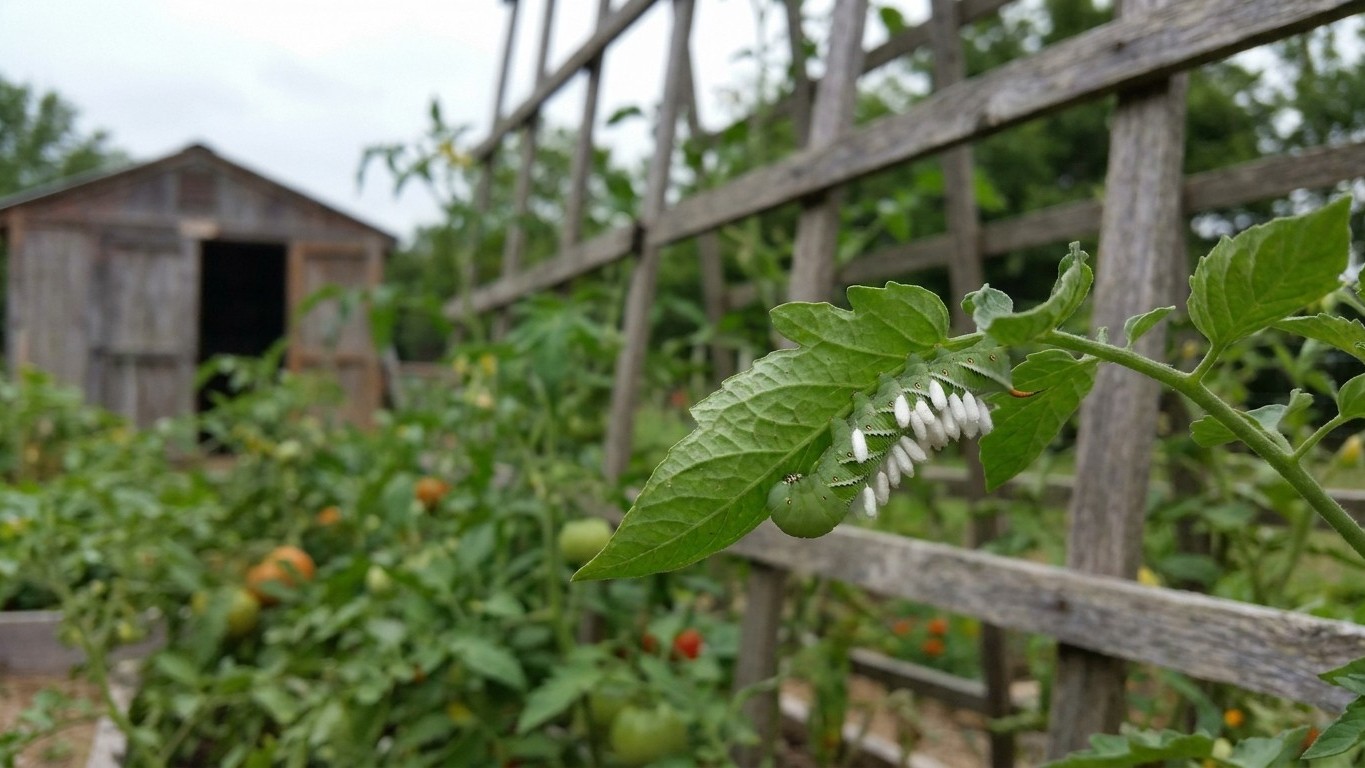
This is the pest most gardeners actually see, because it’s hard to miss once it’s full grown. The caterpillar strips foliage fast and will chew into green fruit if left alone. Bacillus thuringiensis (Bt) sprayed on foliage kills feeding hornworms without harming bees, and hand-picking works fine on a small planting. If you find one carrying small white rice-grain-like cocoons on its back, leave it. Those are parasitic braconid wasp eggs, and that caterpillar is already finished.
Spider Mites

Spider mites thrive in hot, dry weather and are easy to miss until the damage is done, since the mite itself is barely visible without a hand lens. Leaves develop a fine pale stippling first, then fine webbing on the undersides as the population builds. Regular watering reduces plant stress that invites them, and insecticidal soap or a labeled miticide knocks back an active infestation.
Working it out for your own garden
Identifying a tomato pest correctly matters more than treating it fast, because the wrong treatment at the wrong time can wipe out the beneficial insects that would otherwise handle the problem for you. The fastest way to narrow it down is to work through three questions in order: when in the season it is, where on the plant the damage shows up, and whether you can find the insect itself or only its damage.
How to tell which pest you have
Timing rules out more than half the list immediately. Damage on a transplant in its first two weeks in the ground is almost always cutworms or flea beetles, not stink bugs or hornworms, which don’t appear until fruit is forming. Damage that shows up in the hottest, driest stretch of summer, with no visible insect and a fine pale speckling on the leaves, points to spider mites before anything else.
Location on the plant narrows it further. A severed stem at soil level is cutworm work. Shot-holes in leaves are flea beetles. Clustered insects on new growth are aphids. Cloudy spots under the skin of the fruit itself are stink bugs, not a disease. A table like this one is worth keeping taped inside the garden shed:
| Pest | When it appears | Where damage shows | What to look for |
|---|---|---|---|
| Cutworms | First two weeks after transplant | Stem at soil line | Plant severed and lying flat, curled caterpillar in soil nearby |
| Flea beetles | Transplant through early growth | Leaf surface | Small round shot-holes, tiny jumping beetle |
| Aphids | Spring through early summer | New growth, leaf undersides | Clustered soft-bodied insects, sticky residue |
| Stink bugs | Once fruit sets | On the fruit | Hard cloudy spots under the skin, shield-shaped bug nearby |
| Hornworm | Midsummer | Foliage and green fruit | Large green caterpillar, stripped leaves, dark droppings on soil |
| Spider mites | Hot, dry stretches of summer | Leaf undersides | Pale stippling, fine webbing, no visible insect |
If you’re still not sure what you’re looking at, take a photo and check it against your county extension office before spraying anything broad-spectrum. The step of matching a transplant date to the frost window, covered in Tomato Planting Dates in Arkansas: Counting Back From Your Frost Window, also determines how early cutworms and flea beetles become a risk for you specifically.
What changes across the state
The frost dates and pest timing above are measured at or near Little Rock, and Arkansas is too big a state for one point on the map to stand in for all of it. The Ozark Plateau and Ouachita Mountains in the north and west sit at higher elevation than the central river valley, which tends to push both the last spring freeze and the buildup of insect populations a little later in the year. Higher, cooler ground means cutworm and flea beetle pressure at transplant time, but it also means each pest gets a shorter run before fall cold shuts things down.
The Arkansas Delta in the east is lower, flatter, and holds heat and humidity longer into fall. That longer warm season is exactly the kind of stretch that lets aphids and spider mites run through extra generations, and the Delta’s heavy row-crop acreage of soybeans and cotton gives stink bugs a large source population to move out of once those crops mature and dry down. A home garden near those fields can see a heavier stink bug wave than one further from row-crop country.
South Arkansas, closer to the Gulf’s influence, tends to warm up earlier and stay humid longer than the north of the state. That earlier warmth means pest activity generally starts sooner in the south than in the north, even though the state-wide numbers cited here are all anchored to Little Rock. If you garden well outside central Arkansas, treat every timing note in this article as a starting estimate and adjust based on what you actually see on your own plants, not by the calendar alone.
The mistakes this state punishes

The most common mistake is reaching for a broad-spectrum insecticide the moment a hornworm or an aphid colony shows up. That kills the parasitic wasps and lady beetles that would otherwise have kept the population in check on their own, and it often makes the next generation worse, not better. Treat only what’s actually doing damage, and reach for Bt or insecticidal soap before anything broader.
The second mistake is skipping the cutworm collar because the transplant looks sturdy. Size doesn’t protect a young tomato plant from a cutworm working at the soil line at night. The fix costs a few seconds per plant and it’s cheap insurance against replanting the whole flat.
The third is choosing a long-season variety without checking whether it actually clears the season here. A tomato that needs 85 days from transplant, like Amish Paste, still finishes with plenty of margin before the first fall freeze at Little Rock, but stacking a long-season variety on top of a late transplant date narrows that margin fast. If you’re still deciding what to grow, Tomato Varieties That Ripen in Time in Arkansas works through which cultivars fit which part of the season. Getting that choice right also shortens the window that pests like stink bugs and hornworms have to work on your fruit, since a plant that finishes earlier is exposed for fewer weeks.
The fourth is ignoring weeds and volunteer plants at the edge of the garden. Cutworms, stink bugs, and aphids all overwinter or build up in weedy ground nearby, and a clean buffer strip around the vegetable bed removes a lot of that pressure before it ever reaches the tomatoes. This one step covers three pests at once, which makes it worth the half hour it takes each spring.
Checking this against your county
Every figure in this article is anchored to Little Rock, and pest arrival timing shifts with elevation, humidity, and how close a garden sits to row-crop farmland, as covered above. Before you spray anything, or if an insect on your plant doesn’t match the descriptions here, contact your county office of the University of Arkansas Division of Agriculture Cooperative Extension Service. They can confirm an identification and point you to the specific control recommendations for your county rather than a state-wide average. The step that comes right before this one, matching your transplant date to your own frost window, is covered in the guide to growing tomatoes in Arkansas if you haven’t worked through it yet.
Common questions
Do I have to spray every year for hornworms even if I don’t see damage yet?
No. Spray or hand-pick only once you actually find a caterpillar or fresh stripped foliage. Spraying Bt on a schedule regardless of whether hornworms are present wastes product and doesn’t prevent the next generation from arriving.
What’s leaving small round holes in my tomato leaves overnight?
If the holes are small and round on established leaves, that’s most likely flea beetles rather than anything nocturnal. Check for the tiny jumping beetle on the leaf surface during the day to confirm before treating.
Are ladybugs actually enough to control aphids on their own?
Often, yes, on a small home planting, especially if you avoid broad-spectrum sprays that would kill the ladybugs along with the aphids. A heavy, fast-building colony on new growth may still need a spray of water or insecticidal soap to knock numbers down before the ladybugs catch up.
Can I tell a disease from a pest just by looking at the leaves?
Sometimes, but not always. Stippling with fine webbing points to spider mites, while yellowing without any webbing or visible insect is more likely a foliar disease. If you’re unsure, a clear photo sent to your county extension office is faster and more reliable than guessing from a description online.