
Connecticut’s tomato pests track the length of the growing season, which NOAA’s 1991-2020 climate normals put at roughly the stretch between the Bridgeport-area frost dates of April 2 to April 12 in spring and October 28 to November 10 in fall. Flea beetles and aphids move in as soon as transplants go into the ground. Hornworms, stink bugs, and spider mites build through mid to late summer as fruit sets and the weather turns hot and dry. Check new transplants weekly from the day you plant them, since the earliest damage is also the cheapest to stop.
What this comes down to in Connecticut

Connecticut gardeners deal with a fairly short, predictable list of tomato pests rather than a rotating cast. The six below are the ones that show up reliably in home gardens across the state, and they arrive in roughly the same order every year relative to the local frost window. Knowing which one you’re looking at matters more than knowing every pest that theoretically exists, because the fix for a flea beetle is nothing like the fix for a hornworm. If you’re still getting transplants established, it’s worth finishing up growing tomatoes in Connecticut before pest pressure becomes the main problem, since a stressed, underwatered plant draws more insects than a healthy one.
Flea beetles

These show up first, often within days of setting transplants outside. The tiny, shiny beetles jump when you brush the leaf, leaving behind a scatter of small round holes that make the foliage look like it was hit with buckshot. Damage is mostly cosmetic on established plants but can stunt or kill young seedlings outright. A floating row cover over transplants until they start flowering keeps the beetles off without spraying anything.
Aphids

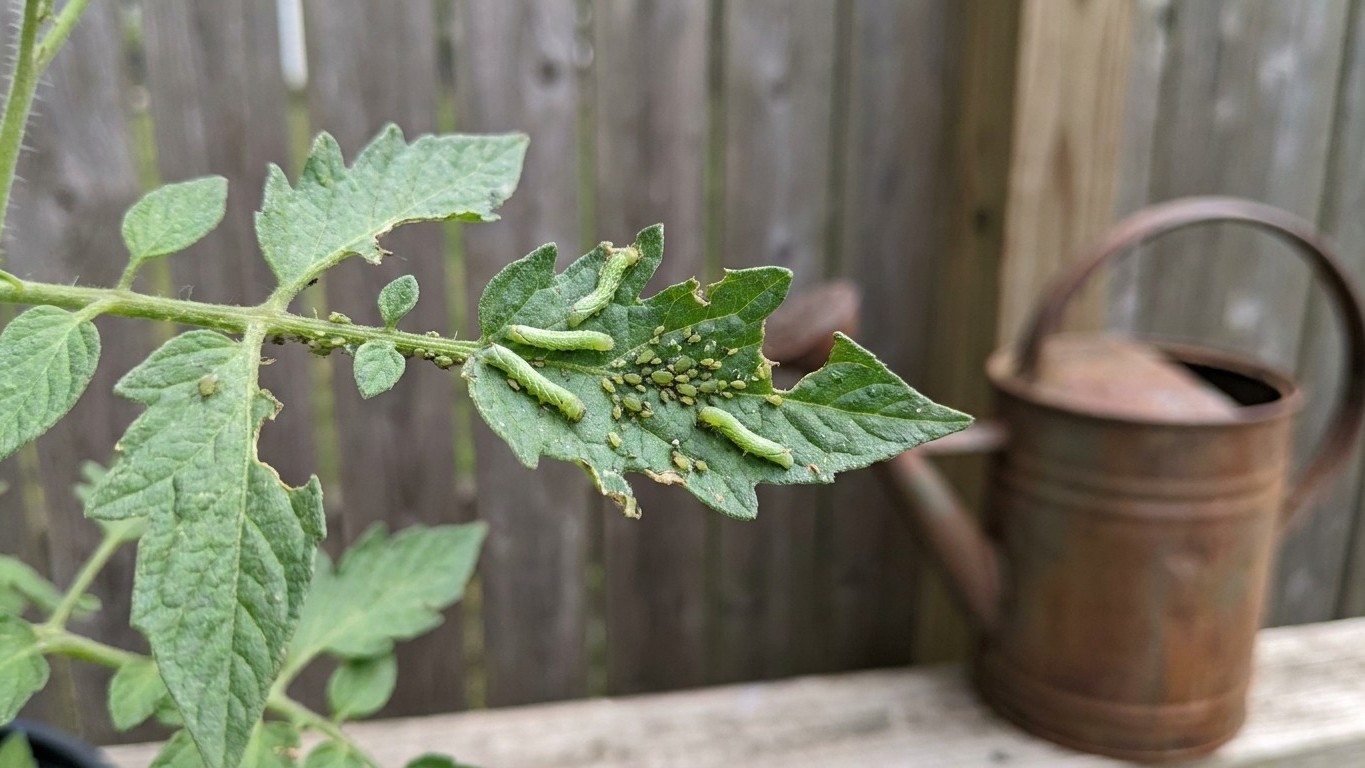
Aphids cluster on the undersides of leaves and on soft new growth as the weather warms into late spring. They pierce the plant tissue to feed on sap, which curls and yellows the leaves and leaves behind a sticky honeydew that draws ants and can grow sooty mold. A strong spray of water knocks most colonies down, and insecticidal soap handles the rest. Heavy, unchecked infestations can also spread viruses between plants, which is one reason resistant cultivars matter as much as the aphids themselves.
Colorado potato beetle

Adults appear in late spring, laying clusters of orange eggs on the undersides of leaves. The humpbacked, spotted larvae do the real damage, chewing large ragged holes through foliage fast enough to defoliate a young plant in days. Hand-picking adults and larvae works well in a small garden, and spinosad is effective if the infestation gets ahead of you.
Tomato hornworm

This one is easy to miss until the damage is already done, since the caterpillar’s green color blends perfectly with the foliage it’s eating. Look for stripped branches and the dark, pellet-shaped droppings it leaves on leaves below its feeding site. Hand-picking is effective once you spot one, and Bacillus thuringiensis (Bt) sprays kill the caterpillars without harming most beneficial insects.
Stink bugs

Stink bugs move in as fruit starts to ripen in mid to late summer, piercing the skin to feed and leaving cloudy, discolored patches just beneath it. The damage is often mistaken for a fruit disorder rather than an insect problem, since the bug itself is usually long gone by the time the blotch shows up. Removing nearby weedy hosts and hand-picking when you see them cuts numbers down; broad-spectrum sprays tend to do more harm than good here since they also kill the bugs’ natural predators.
Two-spotted spider mite

Mites thrive in hot, dry stretches late in the season, especially on plants already stressed by drought. Fine webbing and a dusty yellow stippling on the leaves are the giveaway, and heavy infestations can bronze and drop foliage fast. Consistent watering during dry spells does more to prevent an outbreak than any spray, and insecticidal soap or horticultural oil knocks down an active infestation.
Working it out for your own garden
Most of these pests get misidentified at least once, and the fastest way to sort them out is to match three things: the time of year, the plant part that’s damaged, and the size of the culprit. A pest showing up in the first few weeks after transplanting is almost always a flea beetle or an aphid. Anything doing large-scale leaf damage from mid-summer on is more likely a hornworm or a Colorado potato beetle larva. Damage that appears directly on the fruit itself, rather than the leaves, points to stink bugs.
A quick comparison
| Pest | Typical timing | Plant part hit | Key identifying feature |
|---|---|---|---|
| Flea beetles | Right after transplanting | Leaves (seedlings) | Small round shot holes, beetle jumps when touched |
| Aphids | Late spring onward | Leaf undersides, stem tips | Clustered, soft-bodied, sticky honeydew |
| Colorado potato beetle | Late spring to early summer | Leaves | Striped adults, spotted humpbacked larvae |
| Tomato hornworm | Mid to late summer | Leaves, green fruit | Large green caterpillar, dark droppings below |
| Stink bugs | Mid to late summer | Ripening fruit | Cloudy blotch beneath the skin |
| Spider mites | Hot, dry stretches, late summer | Leaves | Fine webbing, yellow stippling |
If you’re not sure whether the pest pressure lines up with your own planting schedule, it helps to check it against Tomato Planting Dates in Connecticut: Counting Back From Your Frost Window, since a transplant set out earlier than the local frost window allows will hit flea beetle season while it’s still small and vulnerable, and a late transplant pushes fruit-feeding pests like stink bugs closer to the point where you’d rather just be harvesting.
What changes across the state
The frost dates above come from Bridgeport, a coastal station on Long Island Sound and the mildest reference point NOAA’s climate normals give for the state. Pest timing shifts with that same coastal-to-inland gradient. Areas near the shoreline warm up earlier in spring and hold heat later into fall, which stretches the active window for aphids, stink bugs, and spider mites on both ends. Inland and northwest Connecticut, sitting mostly in USDA zones 6a to 7b according to the USDA Plant Hardiness Zone Map, freezes earlier in fall and thaws later in spring, compressing that same window.
Elevation plays a role too. Gardens up in the hills of Litchfield County tend to see a slower ramp-up of aphids and flea beetles in spring simply because the soil and air warm more slowly, and a shorter, cooler summer can mean spider mites never build to the levels they reach in a hot, dry lowland garden near the coast. None of this changes which pests show up, just how early they arrive and how long they stay active. A gardener in the Connecticut River valley or along the shoreline should expect to start scouting earlier than someone gardening at elevation in the northwest hills, even in the same growing season.
The mistakes this state punishes

The single most common mistake is treating flea beetle damage on a seedling the same way you’d treat it on a mature plant, which is to say ignoring it. A full-grown tomato plant shrugs off shot-hole damage. A three-week-old transplant with the same damage can be set back for good, and Connecticut’s frost-bound season doesn’t leave room to recover from a slow start.
The second mistake is reaching for a broad-spectrum insecticide the moment something shows up. Sprays that kill stink bugs also kill the parasitic wasps and ladybugs that would otherwise keep aphids in check, which tends to trade one problem for a worse one a few weeks later. Hand-picking, row covers, and targeted products like Bt for hornworms or insecticidal soap for aphids and mites solve the specific problem without wiping out the insects doing free pest control on your behalf.
The third is choosing fruit and timing without factoring in disease pressure that pests help spread, particularly aphid-vectored viruses. Some cultivars carry built-in resistance to viruses like Tobacco Mosaic Virus or Tomato Mosaic Virus, which matters more in a state where aphids are active for months rather than weeks. Checking Tomato Varieties That Ripen in Time in Connecticut before ordering seed lets you weigh that resistance alongside days to maturity, rather than picking a variety on flavor alone and hoping the pests stay away.
- Cover transplants the day they go in, not after the first bite mark appears
- Hand-pick hornworms and Colorado potato beetle larvae before spraying anything
- Water consistently through dry spells to keep spider mites from building up
- Remove weedy hosts near the garden before stink bugs move in on ripening fruit
Checking this against your county
The frost dates and pest timing here are anchored to Bridgeport, and your own county can run earlier or later depending on elevation and distance from the coast. UConn Extension, the state’s land-grant university extension service, maintains county offices and current tomato pest guidance that accounts for those local differences. Before you settle on a treatment plan, it’s worth checking your findings against your county office through UConn Extension, especially in a year when a pest shows up earlier or heavier than usual.
Common questions
Why do my tomato leaves have tiny holes but I never see any bugs?
That’s almost always flea beetles, which feed and jump away the instant the plant is disturbed. Check early in the morning or evening when they’re less active, or look closely at the leaf edges where the beetles tend to cluster while feeding.
Is it worth spraying for hornworms if I only see one or two?
No, hand-pick them instead. A hornworm population rarely explodes the way aphids or mites do, and picking off the one or two you find is faster and cheaper than mixing up a spray for a small problem.
Can I just plant a resistant variety and skip pest control entirely?
No, and this is a common mix-up. The disease resistance bred into cultivars protects against specific fungal and viral diseases, not against the insects themselves. You’ll still need to scout for and manage the pests directly, even on a resistant variety.
Do ladybugs actually help with my aphid problem?
Yes, both adult ladybugs and their larvae eat aphids in large numbers, which is one more reason to avoid broad-spectrum insecticides that kill them along with the pest you’re targeting. A garden with a healthy ladybug population often needs no aphid treatment at all.