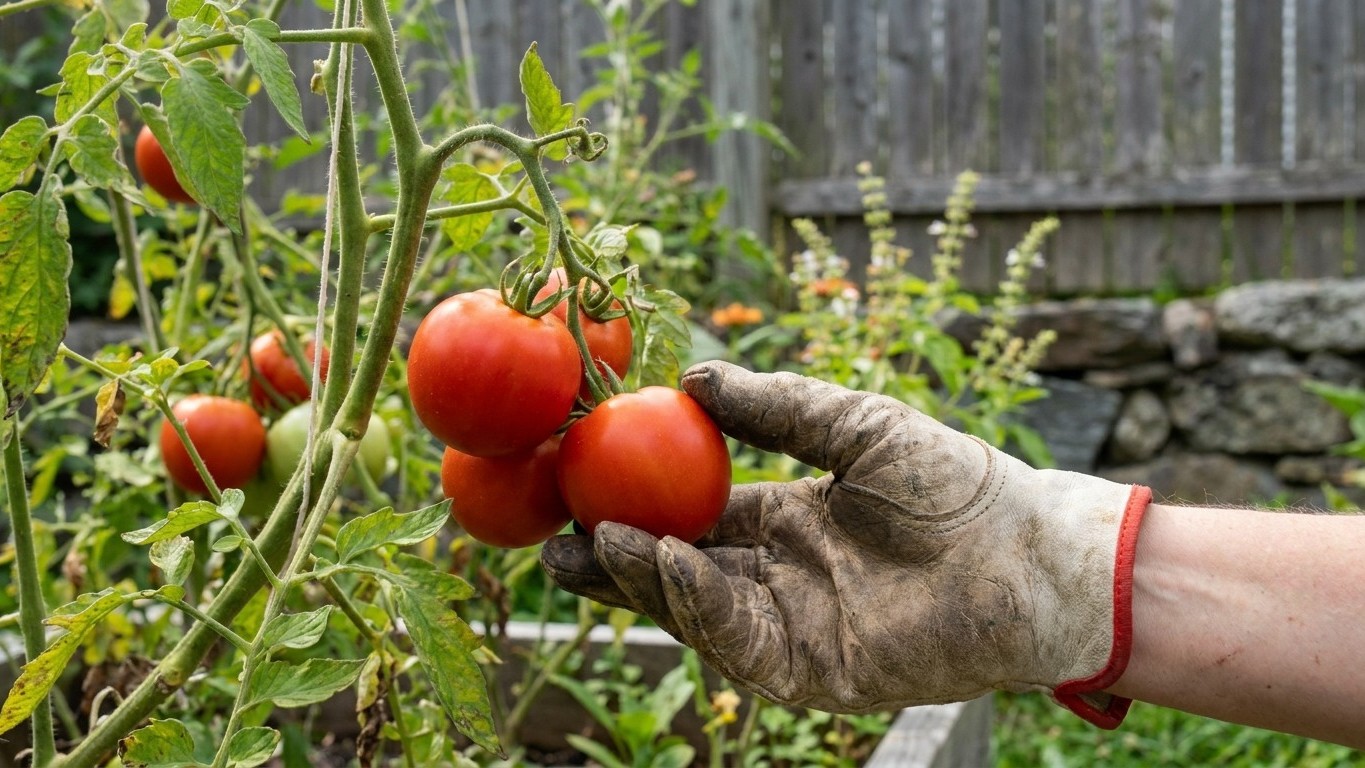

Connecticut gardeners can safely set tomato transplants outside once the last frost risk has passed, and NOAA’s 1991-2020 climate normals, measured at the NCEI station near Bridgeport, put that window at April 2 to April 12. That figure comes from the mildest part of the state, so inland and higher-elevation gardens should plan on a later date. Start seedlings indoors now if you haven’t, and hold off transplanting until the soil itself has warmed rather than going strictly by the calendar.
When to plant Tomatoes in Connecticut

Mid to late April is when tomato transplants can safely go into the ground around Bridgeport, with inland gardeners waiting another week or two behind that. Work backward from there and seed-starting indoors lands somewhere in mid-February to mid-March, depending on how close you are to the coast. That timing isn’t arbitrary — it’s built around frost-tender seedlings, cold Connecticut soil, and the six to eight weeks a tomato needs under light before it’s sturdy enough to transplant.
Starting seeds indoors
Tomato seedlings need six to eight weeks under light before they’re sturdy enough to transplant. Because tomatoes are frost-tender and slow to establish in cold soil, most gardeners wait one to two weeks past the last-frost window before setting plants out, rather than planting on the frost date itself. That pushes the realistic transplant window at Bridgeport to roughly mid to late April, and later still inland. Counting back six to eight weeks from that transplant window lands seed-starting indoors somewhere in mid-February to mid-March for coastal and central Connecticut, with gardeners further inland shifting a week or two later on both ends. Gardeners farther north in Maine work with an even tighter version of this same math, as covered in Growing Tomatoes in Maine.
Sow two seeds per cell in a seed-starting mix, thin to the stronger seedling, and keep trays under fluorescent or LED grow lights for 14 to 16 hours a day. A sunny windowsill alone rarely supplies enough light in a Connecticut February or March, and seedlings that stretch toward one window end up leggy with weak stems that flop over once they’re outside.
Hardening off and transplanting out
Give seedlings about a week of graduated outdoor exposure before they go into the ground for good. A rough sequence looks like this:
- First couple of days: an hour or two in dappled shade, out of wind
- Middle days: half a day in fuller sun, brought back in overnight
- Final days: full sun and left out overnight if no frost threatens
Skipping this step is the single most common reason a transplant sits stalled for two weeks after planting instead of growing.
When you do transplant, bury the stem up to the first set of true leaves. Tomatoes root along a buried stem, so a deep-set transplant builds a sturdier root system than one planted at the same depth it grew in the cell. Cold, wet soil in early April does more damage to a young plant than a light frost does, since roots largely stop growing once soil drops into the low 50s Fahrenheit, and the plant simply sits without putting on size.
Soil and site preparation
Tomatoes want at least six to eight hours of direct sun a day, more if the site allows it. A spot shaded until mid-morning by a house or tree line will still produce fruit, just later and smaller than one open to full sun from breakfast onward.
Choosing a site
Pick ground that drains well after a hard rain. Tomatoes tolerate a range of soil textures but sulk in standing water, and wet feet during a cool Connecticut spring can set plants back for weeks. Raised beds or mounded rows solve this on the state’s heavier clay-loam soils, and they warm up faster in spring than flat ground does, giving roots a head start even before the frost window has fully closed.
Rotate the bed. Avoid planting tomatoes, peppers, potatoes or eggplant in ground that grew any of those crops in the previous two years, since all four share vulnerability to the same soilborne diseases, including Verticillium and Fusarium wilt, which persist in soil long after the plant is gone.
Preparing the bed
Work compost or aged manure into the top six to eight inches of soil a few weeks before transplanting, not on planting day itself. Fresh, undecomposed organic matter ties up nitrogen as it breaks down, competing with young roots right when they need it most. A soil test through UConn Extension’s soil lab shows where your pH and nutrients actually stand instead of guessing, since Connecticut soils tend toward acidic under most native cover and often need lime to bring pH into a range tomatoes prefer.
Don’t work wet clay soil just because the calendar says it’s time. Squeeze a handful: if it forms a slick ribbon instead of crumbling apart, it’s too wet to dig or till without wrecking its structure for the rest of the season. Wait a few days after rain and test again before breaking ground.
Leave 24 to 36 inches between plants and at least three feet between rows so air moves through the canopy once plants fill in. Tight spacing looks efficient in April, but by midsummer it traps humidity against the leaves, the exact condition that favors early and late blight.
Varieties that suit Connecticut
Connecticut’s growing season is bounded on one end by that variable spring frost window and on the other by the first fall frost, which UConn Extension can help pin down for your specific county. Between those two dates, days to maturity matters more than any other catalogue number, since an 85-day paste tomato started late has far less margin for a cool, wet spring than a 60-day cherry type does.
| Variety | Days to maturity | Habit | Notable resistance |
|---|---|---|---|
| Sakura | 55 | Indeterminate | Nematodes (Int.), Tomato Mosaic Virus (High), Fusarium Wilt races 1,2 (High) |
| Sun Gold | 57 | Indeterminate | Tobacco Mosaic Virus (High), Fusarium Wilt race 1 (High) |
| Supersweet 100 | 60 | Indeterminate | Verticillium Wilt (High), Fusarium Wilt race 1 (High) |
| Jasper | 60 | Indeterminate | Late Blight (High), Early Blight (Int.) |
| Juliet | 60 | Indeterminate | Late Blight (Int.), Early Blight (Int.) |
| Amalfi | 68 | Determinate | Nematodes (Int.), Late Blight (Int.), Early Blight (Int.) |
| Big Beef Plus | 72 | Indeterminate | Nematodes (Int.), Gray Leaf Spot (High), Tomato Mosaic Virus (High) |
| Cherokee Purple | 72 | Indeterminate | None listed |
| Tiren | 75 | Indeterminate | Verticillium Wilt (High), Tomato Mosaic Virus (High), Fusarium Wilt race 1 (High) |
| Granadero | 75 | Indeterminate | Nematodes (Int.), Verticillium Wilt (High), Tomato Mosaic Virus (High) |
| San Marzano II | 78 | Indeterminate | None listed |
| Celebrity Plus | 78 | Determinate | Nematodes (Int.), Gray Leaf Spot (High), Tomato Mosaic Virus (High) |
| Brandywine | 78 | Indeterminate | None listed |
| Amish Paste | 85 | Indeterminate | None listed |
Cherry and salad types
Sun Gold, a small round tomato that ripens to a bright orange-gold, needs 57 days from transplant and carries high resistance to Tobacco Mosaic Virus and Fusarium Wilt race 1. Counting from a mid to late April transplant at Bridgeport, that puts first ripe fruit somewhere from early to late June, though catalogue day counts run a week or two longer in a cool season. Sakura, red and round at 55 days, adds intermediate nematode resistance and high resistance to Tomato Mosaic Virus and two races of Fusarium wilt, useful in a bed that’s grown tomatoes before. Jasper, a red cherry tomato also at 60 days, carries high resistance to late blight and intermediate resistance to early blight, the two diseases most likely to show up during a humid Connecticut August. Juliet, a small oblong red grape tomato at the same 60 days, offers intermediate resistance to both.
Paste and sauce tomatoes
San Marzano II is the classic long, narrow, red paste tomato for sauce, at 78 days with no listed disease resistance, so it rewards a clean bed and good airflow more than the others on this list do. Amalfi, a determinate paste type at 68 days, carries intermediate resistance to both late blight and early blight. Granadero and Tiren, both around 75 days, add Verticillium wilt and Tomato Mosaic Virus resistance for a garden with a history of either problem. Amish Paste runs longest at 85 days and carries no listed resistance, so it suits an earlier transplant date more than a late one.
Slicers for the table
Celebrity Plus, a determinate red slicer at 78 days, resists nematodes, gray leaf spot and Tomato Mosaic Virus, a solid choice for a gardener who wants one heavy flush rather than a slow trickle all summer. Big Beef Plus, indeterminate at 72 days, carries the same three resistances and keeps producing until frost. Cherokee Purple, a large dusky pink-purple beefsteak, and Brandywine, a large pink beefsteak with distinctive potato-leaf foliage, are both indeterminate heirlooms at 72 and 78 days with no listed disease resistance. They trade that resilience for flavor, and reward the extra care of good spacing and a clean, mulched bed.
What to plant alongside
Companion planting is part folklore and part real horticulture, and it’s worth knowing which claim is which before handing over garden space to a pairing.
Good neighbors
Basil earns its spot as a tomato companion for a practical reason rather than a mystical one. It stays low, doesn’t compete much for light, and most cooks want a pot of it near the kitchen door regardless. Borage and other open-flowered herbs draw in pollinators and predatory insects that help against aphids and hornworms, though the common claim that they improve tomato flavor specifically doesn’t hold up under any real testing. Marigolds have a genuine, tested effect against certain root-knot nematodes when grown as a cover crop the season before tomatoes go in, but scattering a few among already-planted tomatoes for pest control is mostly cosmetic. Low, fast crops like lettuce or spinach, harvested and gone before the tomato canopy closes in, put ground to use that would otherwise sit bare and weedy through May and June.
Keep away
Skip planting tomatoes near potatoes, eggplant and peppers. The four share the same vulnerability to Verticillium and Fusarium wilt and to late blight, so grouping them concentrates disease pressure in one spot rather than spreading the risk across the garden. Corn attracts the corn earworm, which is the same insect as the tomato fruitworm, so growing the two side by side gives that pest an easy hop between crops. Fennel is worth keeping at a distance too. It’s one of the few pairings with a well-documented allelopathic effect, slowing tomato growth when planted nearby, rather than the vague “doesn’t get along” claims made about most other supposed enemies.
Watering, feeding and support
Consistent moisture matters more than total volume. Tomatoes given a deep soak twice a week develop sturdier, deeper roots than ones given a shallow sprinkle every day. Irregular watering, a dry week followed by a heavy rain, is what produces blossom end rot and cracked fruit in most home gardens, not a shortage of calcium in the soil.
Watering and mulching
Water at the base of the plant rather than overhead. Wet foliage left standing overnight is one of the easiest ways to invite early and late blight into a Connecticut garden, especially during a humid stretch of July or August. A three-inch layer of straw or shredded leaf mulch, put down once soil has warmed, holds moisture, keeps fungal spores from splashing up onto lower leaves during rain, and noticeably cuts down the watering schedule the plant would otherwise need.
Feeding
Go light on nitrogen once plants start flowering. A tomato fed heavily with a high-nitrogen fertilizer all season grows into a lush, dark green bush loaded with leaves and disappointingly few tomatoes, since the plant is putting its energy into foliage instead of fruit. Switch to a fertilizer formulated for tomatoes, or a low-nitrogen blend higher in phosphorus and potassium, once the first flower clusters appear, and feed every two to three weeks through the season rather than dumping it on all at once.
Staking, caging and pruning
Indeterminate varieties, which make up most of the list here, from Sun Gold to Brandywine, keep growing and setting fruit until frost and need real support, not the flimsy wire cones sold as tomato cages. A sturdy stake driven a foot into the ground, or a cattle-panel trellis, carries the weight of a full-grown, fruit-loaded plant far better. Determinate types like Celebrity Plus and Amalfi grow to a set size and stop, so a standard cage is usually enough for them.
Suckering, pinching out the small shoots that form in the joint between the main stem and a branch, keeps indeterminate plants from turning into an unmanageable tangle and improves airflow through the canopy, which matters for the same blight reasons as spacing and mulch do. Prune lightly and often rather than removing a large amount at once, which stresses the plant and opens bigger wounds for disease to enter.
Common problems

Most tomato failures trace back to water, airflow or a disease already living in the soil, and reading the symptom correctly saves a season instead of guessing at a fix.
Blossom end rot

A sunken, leathery, dark brown to black patch forms on the bottom of the fruit, opposite the stem, usually on some of the first tomatoes of the season. It’s caused by inconsistent watering interrupting calcium uptake inside the plant, not a shortage of calcium in the soil, so the fix is a steady watering rhythm and mulch rather than a calcium spray.
Fruit cracking

Concentric rings or radial splits open near the top of the fruit, usually after a heavy rain follows a dry spell, because the fruit swells faster than the skin can stretch. Even, regular watering is the main defense, and varieties described as crack-resistant, like Sakura, hold up better than most.
Leaf curl

Upper leaves curl upward and inward, usually without any discoloration, most often after a stretch of heat and dry wind or sometimes after heavy pruning. Physiological leaf curl like this rarely hurts the crop and reverses on its own once conditions ease. Curling paired with yellowing or mottled color is a different problem, and it points toward a virus rather than heat stress.
Verticillium and Fusarium wilt

Lower leaves yellow and wilt, often on just one side of the plant at first, working upward as the season goes on, and the plant can collapse even in wet soil. Both fungi live in the soil for years, which is why crop rotation and resistant varieties matter more than any spray once symptoms appear. Several varieties, including Sun Gold, Supersweet 100, Sakura, Tiren and Granadero, carry high resistance to one or both.
Tomato hornworm

A large, pale green caterpillar with white diagonal stripes and a single horn near its tail end, often three to four inches long, can strip a branch bare in a couple of days and is usually spotted from its black droppings before the worm itself turns up. Hand-picking works fine at home-garden scale, and a hornworm covered in small white cocoons is best left alone, since a parasitic wasp is already finishing the job.
Aphids

Small, soft-bodied insects, green or black and barely an eighth of an inch long, cluster on new growth and the undersides of leaves, leaving a sticky residue behind. A strong jet of water knocks most colonies down, and a healthy population of ladybugs usually keeps them from building back up.
Poor fruit set
Flowers form and drop without setting fruit, most often when nighttime temperatures run too warm or too cool for pollen to stay viable, or when a plant has been pushed too hard with nitrogen. It usually corrects itself as conditions moderate later in the season. Gardeners in far hotter climates, covered in Growing Tomatoes in Arizona, deal with this same blossom drop from extreme heat far more often than Connecticut growers do.
Pests that actually show up in Connecticut
Connecticut’s pest list runs long, but most of it never touches a tomato plant. Striped cucumber beetle, squash vine borer and squash bug are cucurbit pests, after squash, cucumber and melon vines rather than tomato foliage. Lily leaf beetle stays on true lilies and fritillaria, and allium leafminer works through onions, garlic and leeks. If you grow those crops alongside your tomatoes, watch for them separately, but on the tomato bed itself, four pests on the state’s list actually matter, according to fact sheets from the UConn Extension Home and Garden Education Center.
Cutworms show up first, usually within days of setting out transplants. A seedling that was upright the evening before is found toppled and severed right at the soil line, with the top of the plant lying nearby untouched. The fix is mechanical: slide a paper cup collar or a piece of cardboard tube around each stem at planting, pushed an inch into the soil, and the cutworm can’t reach the stem to chew through it.
Colorado potato beetle chews ragged holes in leaves, working from the edges inward, and you’ll find the yellow-orange, black-striped adults or their humpbacked reddish larvae clustered on the underside of foliage. Check plants weekly through summer and knock beetles and eggs into a bucket of soapy water. Hand-picking, kept up consistently, controls small home plantings without any spray.
Four-lined plant bug leaves small, sunken, dark spots scattered across upper leaf surfaces, damage that looks worse than it is. It’s a spring and early summer feeder, and because it moves fast and feeds briefly, sprays rarely catch it in time. The damage stays cosmetic and the plant grows out of it, so most Connecticut gardeners just let it pass.
Brown marmorated stink bug is the one to watch on the fruit itself. It leaves cloudy, discolored patches or a corky, pithy area just under the skin where it pierced the fruit to feed, often not obvious until you slice the tomato open. Adults show up mid to late summer and there’s no reliable home spray once they’re established, so exclusion with row cover during fruit set is the more realistic defense than trying to treat an active population.
Harvest and end of season
Pick tomatoes once they’ve reached full color and give slightly under gentle pressure, not rock hard. A tomato pulled at first blush and ripened on the counter develops nearly as much flavor as one left on the vine, since most sugar development happens after the fruit begins turning color at all.
Ripening and storage
Never refrigerate a tomato you plan to eat. Cold breaks down the compounds responsible for flavor and turns the flesh mealy, so keep ripening and ripe fruit on the counter, out of direct sun, instead. A tomato picked fully green will still ripen indoors, though it won’t develop the same depth of flavor as one that ripened at least partway on the plant.
As frost approaches
Connecticut’s fall frost date varies enough by county and elevation that it’s worth checking with UConn Extension for a figure specific to your area rather than guessing from a statewide average. When a hard frost is forecast, pick everything showing any blush of color, since fruit that far along will still ripen indoors over the following weeks if wrapped individually in newspaper and kept in a cool, dark spot. Fruit that’s still fully green and hard when frost hits rarely colors up well and is better used for fried green tomatoes or relish than held for ripening.
Pull spent plants at the end of the season rather than letting them break down in place, especially any that showed blight or wilt symptoms over the summer. Leaving diseased foliage in the bed over winter gives the same fungal spores a head start on next year’s crop.
Local help
UConn Extension is the best source for county-level frost dates, soil testing and pest alerts specific to your part of Connecticut, since the Bridgeport-based figures in this guide run milder than most of the state. Reach their office through the UConn Extension website before finalizing a planting date, especially if you garden inland or at higher elevation. For other crops and season planning across the state, our Connecticut guides cover the same county-by-county differences.
Where to Go Next
Everything above comes down to timing, and Connecticut’s timing is oddly hard to pin down. Bridgeport’s own frost dates shift by a week and a half depending on the year, which is exactly the problem worked through in Tomato Planting Dates in Connecticut, a page that counts backward from that April 2 to April 12 window to figure out when seedlings should actually go in the ground. That same shifting frost window is what defines the growing season in the first place — Bridgeport runs roughly 200 frost-free days between spring and the October 28 to November 10 fall freeze — and it’s the reason some tomatoes make it to harvest here and others don’t, a question covered in Tomato Varieties That Ripen in Time in Connecticut. And because that same stretched-out season shapes which insects have time to build up populations, it’s worth checking Tomato Pests in Connecticut to see which ones actually show up here rather than guessing from what shows up in gardening advice written for other climates.
Common questions
Is it too late to plant tomatoes if I missed the window in April?
No, tomato transplants from a garden center can go in through May and often into June in most of Connecticut, especially with a fast-maturing variety like Sakura or Jasper. You’ll just push the first harvest back and want to watch the fall frost date more closely at the other end of the season.
Should I cover my tomato plants if a late frost is in the forecast after I’ve already transplanted?
Yes, cover them. A bedsheet, row cover fabric or an overturned bucket set over each plant before dark, and removed the next morning, is usually enough to get a young transplant through one cold night. A hard freeze does more damage than a light frost, so don’t assume the plant will simply shrug it off.
Can I grow tomatoes in containers instead of in the ground?
Yes, and a determinate variety like Celebrity Plus or Amalfi generally does better in a pot than a sprawling indeterminate one. Use a container of at least 15 to 20 gallons, since a smaller pot dries out fast enough on a hot day to trigger blossom end rot and stunted growth.
Why are the bottom leaves on my tomato plant turning yellow?
It depends on the pattern. A few lower leaves yellowing and dropping as the plant ages and shades them out is normal and not worth worrying about. Yellowing that spreads upward, especially paired with wilting on one side of the plant, points toward Verticillium or Fusarium wilt instead, and no spray will reverse that once it’s established.
How many tomato plants do I actually need?
Two to four plants per person covers fresh eating for most households, and that number goes up fast if you’re planning to can or freeze sauce. A single indeterminate plant like Big Beef Plus or Brandywine, properly staked and fed, can produce for months once it gets going, so it’s easy to overplant and end up with more tomatoes than any household can use by August.