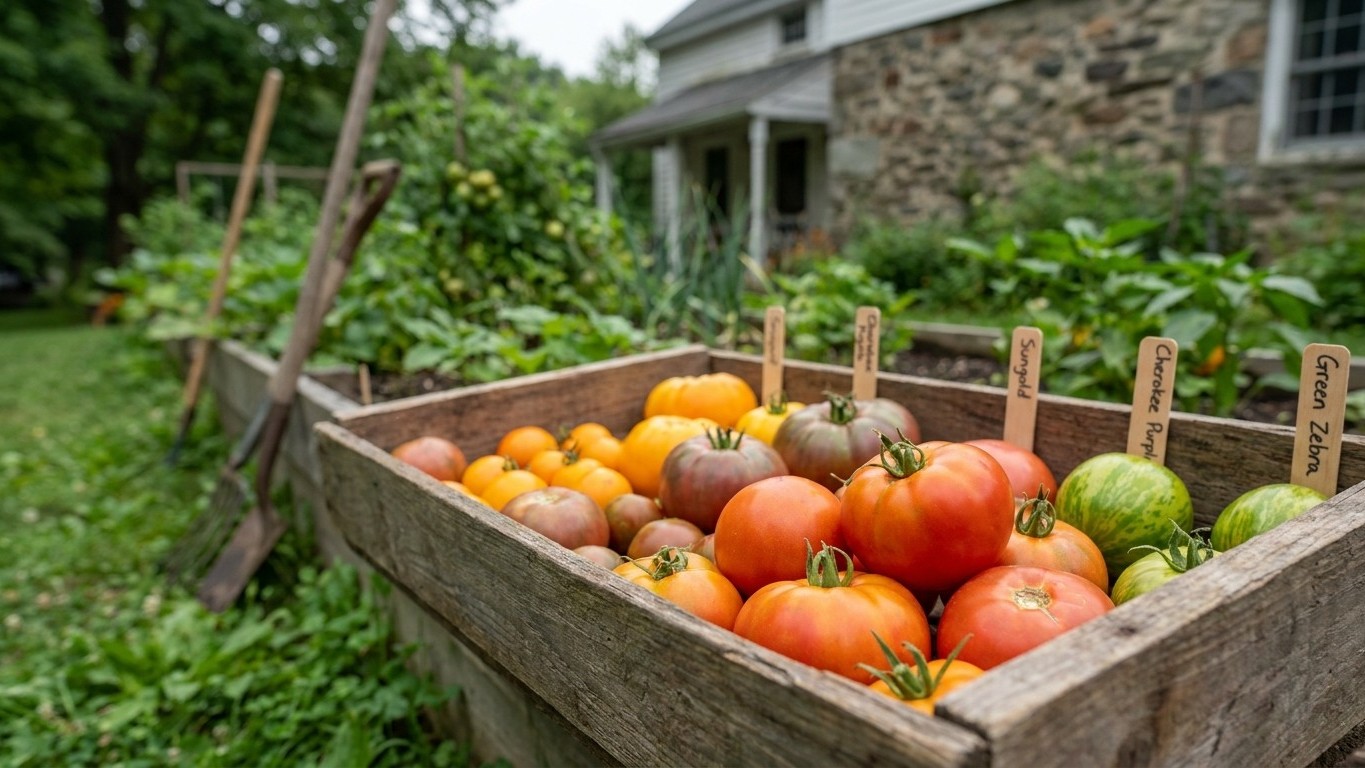

Most tomato varieties on the market will Ripen in Time in Connecticut, because NOAA’s 1991-2020 climate normals put Bridgeport’s frost-free season at roughly 200 days, running from an April 2 to April 12 last spring freeze to an October 28 to November 10 first fall freeze. Every cultivar named below finishes with a comfortable cushion at that reference point. The one thing to check before you buy seed is the days-to-maturity printed on the packet against your own transplant date, not just the variety’s reputation.
What this comes down to in Connecticut

The Bridgeport frost window is the number that actually decides this list, not the seed packet’s cheerful “70 days” printed for gardeners in Georgia. Most days-to-maturity figures assume a longer, warmer stretch than this state hands you between a mid-April transplant and the first hard freeze. That gap is why some varieties everyone grows elsewhere simply run out of season here, while others, like Sakura Sakura at 55 days, finish with margin to spare.
The cultivars below are ordered from shortest catalogue days-to-maturity to longest, so you can see roughly where the line falls for your own garden. All of them share the same mid April to late April transplant window this state’s frost dates allow, worked out from that same Bridgeport range.
Sakura

Sakura needs about 55 days from transplant, the shortest number on this list. Set out mid April to late April, its first fruit should be ready by mid June, leaving roughly 130 days of margin before the Bridgeport frost window. It carries intermediate resistance to nematodes and high resistance to Fusarium wilt races 1 and 2 and tomato mosaic virus, a dependable pick if last year’s soil gave you any trouble.
Sun Gold

Sun Gold needs about 57 days and produces small, sweet, bright orange fruit that most gardeners grow for eating off the vine rather than for the kitchen. Set out in the same window, it should ripen by late June with about 128 days of margin. Its high resistance to tobacco mosaic virus and Fusarium wilt race 1 makes it a safe repeat in a bed that has grown tomatoes for several seasons running.
Supersweet 100

Supersweet 100 needs about 60 days and produces long clusters of small red fruit that keep coming until frost. It should start ripening by late June, roughly 125 days ahead of Bridgeport’s frost date, and its high resistance to verticillium wilt and Fusarium wilt race 1 suits a garden with a history of either disease.
Juliet
Juliet needs about 60 days and produces oblong grape tomatoes tough enough to resist splitting after a heavy rain, a real advantage in a humid Connecticut July. It ripens by late June with roughly 125 days of margin, and its intermediate resistance to late blight and early blight matters most in a wet season when both diseases move in early. These resistance codes matter against the same pressures covered in Tomato Pests in Connecticut: Which Ones Actually Show Up Here, which lists what actually turns up on Connecticut vines and when.
Jasper

Jasper also needs about 60 days and produces small, glossy red fruit on a vigorous indeterminate vine. Its high resistance to late blight is the reason to grow it over Sun Gold or Sakura in a year when blight pressure runs heavy, and it still finishes by late June with about 125 days of margin.
Amalfi

Amalfi is a determinate paste tomato needing about 68 days, producing oblong red fruit suited to sauce on a compact plant that suits a raised bed. It should begin ripening in early July, about 117 days ahead of frost, and its intermediate resistance to late blight, early blight and nematodes covers three of the more common pressures in a humid Connecticut summer.
Cherokee Purple

Cherokee Purple needs about 72 days and produces large, flattened fruit with dusky purple-pink skin and green shoulders, the heirloom slicer many gardeners grow tomatoes to get. It carries no listed disease resistance, so its roughly 113 days of margin before frost, not genetics, is what gets a full crop in.
Big Beef Plus
Big Beef Plus needs about 72 days and produces large, round, red slicing fruit on an indeterminate vine. Its intermediate resistance to nematodes and high resistance to gray leaf spot and tomato mosaic virus make it a steadier choice than Cherokee Purple in a bed with a history of leaf disease, while still ripening by early July with about 113 days of margin.
San Marzano II
San Marzano II needs about 78 days and produces long, cylindrical red fruit bred for sauce, with fewer seed cavities than a round slicer. It should ripen by mid July, about 107 days ahead of frost at the Bridgeport reference point, comfortable margin for a paste tomato some gardeners assume is too slow for New England.
Amish Paste
Amish Paste is the longest-season variety on this list at about 85 days, producing large, heart-shaped red fruit good for canning. Set out in the same mid to late April window, it should not begin ripening until mid July, leaving about 100 days of margin before frost, the tightest buffer of any cultivar here and the one most likely to run short in a cold or late spring.
| Variety | Days to maturity | Type | First ripe | Margin before Bridgeport frost |
|---|---|---|---|---|
| Sakura | 55 | Indeterminate cherry | mid June | 130 days |
| Sun Gold | 57 | Indeterminate cherry | late June | 128 days |
| Supersweet 100 | 60 | Indeterminate cherry | late June | 125 days |
| Juliet | 60 | Indeterminate grape | late June | 125 days |
| Jasper | 60 | Indeterminate cherry | late June | 125 days |
| Amalfi | 68 | Determinate paste | early July | 117 days |
| Cherokee Purple | 72 | Indeterminate heirloom | early July | 113 days |
| Big Beef Plus | 72 | Indeterminate slicer | early July | 113 days |
| San Marzano II | 78 | Indeterminate paste | mid July | 107 days |
| Amish Paste | 85 | Indeterminate paste | mid July | 100 days |
Working it out for your own garden
Every figure in the table above starts from the same two numbers. NOAA’s 1991-2020 normals put Bridgeport’s last spring freeze at April 2 to April 12 and its first fall freeze at October 28 to November 10. Subtract a cultivar’s days-to-maturity from that fall window, in words rather than picking a single calendar date, and you get the latest safe transplant date for that fruit to finish before frost.
A short-season example
Take Sakura, at 55 days from transplant. Set out in the mid April to late April window local nurseries use for tomatoes, the earliest transplants should set and begin ripening fruit by roughly mid June. Counting forward from a mid to late April transplant to the October 28 to November 10 frost window leaves well over four months, far more time than a 55-day cherry tomato needs.
A long-season example
Now take Amish Paste, the longest cultivar on this list at 85 days. The same mid to late April transplant puts its first ripe fruit in mid July, and counting forward to the Bridgeport frost window still leaves about 100 days to spare, the smallest cushion in this list. That cushion exists at Bridgeport’s relatively mild, coastal reference station. Push the same 85-day cultivar into a spring that runs two or three weeks cold, or into a garden well inland where NOAA’s data note the frost-free window runs shorter to begin with, and the cushion can shrink close to nothing before the fruit finishes.
- Find your own last spring freeze window from NOAA’s normals or your county extension office.
- Add the catalogue days-to-maturity to your earliest safe transplant date.
- Compare that ripening estimate against your first fall freeze window, not a single date.
- Hold back two to three weeks of margin for a cool or wet season.
The full week-by-week arithmetic for turning your own frost window into a transplant date is worked out in Tomato Planting Dates in Connecticut: Counting Back From Your Frost Window.
What changes across the state
Connecticut is not one climate, and Bridgeport is its mildest corner. USDA’s 2023 hardiness map, built on the same 1991-2020 normals, places the whole state between zone 6a and zone 7b, with the coast at the warmer end and the interior and northwest hills at the colder one. NOAA’s own caution on the Bridgeport data is direct about why: it is a Long Island Sound coastal station, and that body of water moderates temperature swings in a way inland Connecticut does not get.
Coastal versus inland
Move away from the Sound and two things happen at once. Spring warms up more slowly, so the last frost tends to linger later than Bridgeport’s April 2 to April 12 window suggests, and fall cools off faster, so the first frost often arrives before Bridgeport’s October 28 to November 10 range. Elevation compounds it. The Litchfield hills and the higher parts of the northwest corner sit at a real disadvantage next to a shoreline garden in Fairfield County, even though both fall inside the same statewide hardiness range.
None of this changes the days-to-maturity printed on a seed packet. What it changes is how much of that margin column in the table above you actually get to keep. A gardener in a sheltered coastal yard might see every figure in this article hold almost exactly. A gardener two or three counties inland at higher elevation should treat those same margins as generous estimates and lean toward the shorter end of this list rather than the longer one.
The mistakes this state punishes

Planting into cold soil
A warm stretch in April convinces a lot of gardeners to set transplants out early, but air temperature and soil temperature are not the same thing. Tomato roots stall in cold soil even when the air feels like tomato weather, and a transplant that sits and sulks for two weeks has already spent part of the margin this article calculated for it. Wait for the soil to catch up, not just the calendar, before setting out even a short-season cherry variety.
Choosing a long-season variety without margin to spare
Amish Paste and San Marzano II are both worth growing in Connecticut, but only where the site backs up the math. A shaded yard, a cool inland hollow, or a spring that runs late all eat into the 100 to 107 days of margin those two cultivars carry at Bridgeport. In a tighter site, a shorter-season paste tomato like Amalfi at 68 days gets the sauce crop home with room to spare.
Catalogue days-to-maturity figures are counted from transplant, not from seed, and they vary by a week or two between catalogues and between seasons. Treat the number on the packet as a starting point for the arithmetic above, not as a guarantee.
Checking this against your county
Bridgeport’s frost window is a starting point, not an instruction for the whole state. Your county’s cooperative extension office, reached through UConn Extension, can confirm frost timing closer to your own town and point you to the state’s current tomato disease and variety guidance. Check your county’s figures before you lock in a transplant date, especially if you garden inland, at elevation, or away from the moderating effect of the Sound.
Common questions
My nursery doesn’t sell any of the exact varieties on this list, what do I do?
Use the same arithmetic with whatever cultivar you find. Take its printed days-to-maturity, add it to your safe transplant date, and check the total against your first fall freeze window rather than assuming the variety will or won’t work based on its name alone.
Can I just plant early if the forecast looks warm?
Not safely. NOAA’s frost dates are a probability band, not a guarantee, and a warm stretch in early April can still be followed by a freeze inside that April 2 to April 12 window. Keep frost cloth on hand for transplants that go out at the early edge of the window.
Why do two seed catalogues list different days-to-maturity for the same tomato?
Trial conditions differ between growers and regions, so the number printed is an approximation rather than a fixed count. Expect a week or two of variation between sources, and count it from your transplant date, not from the day you started seed indoors.
Is it too late to plant tomatoes if I missed the mid-April window?
Usually not, especially for a short-season cherry tomato. A cultivar like Sakura or Sun Gold, with well over 120 days of margin at the Bridgeport reference point, has enough buffer to absorb a late start that a longer-season paste tomato does not.