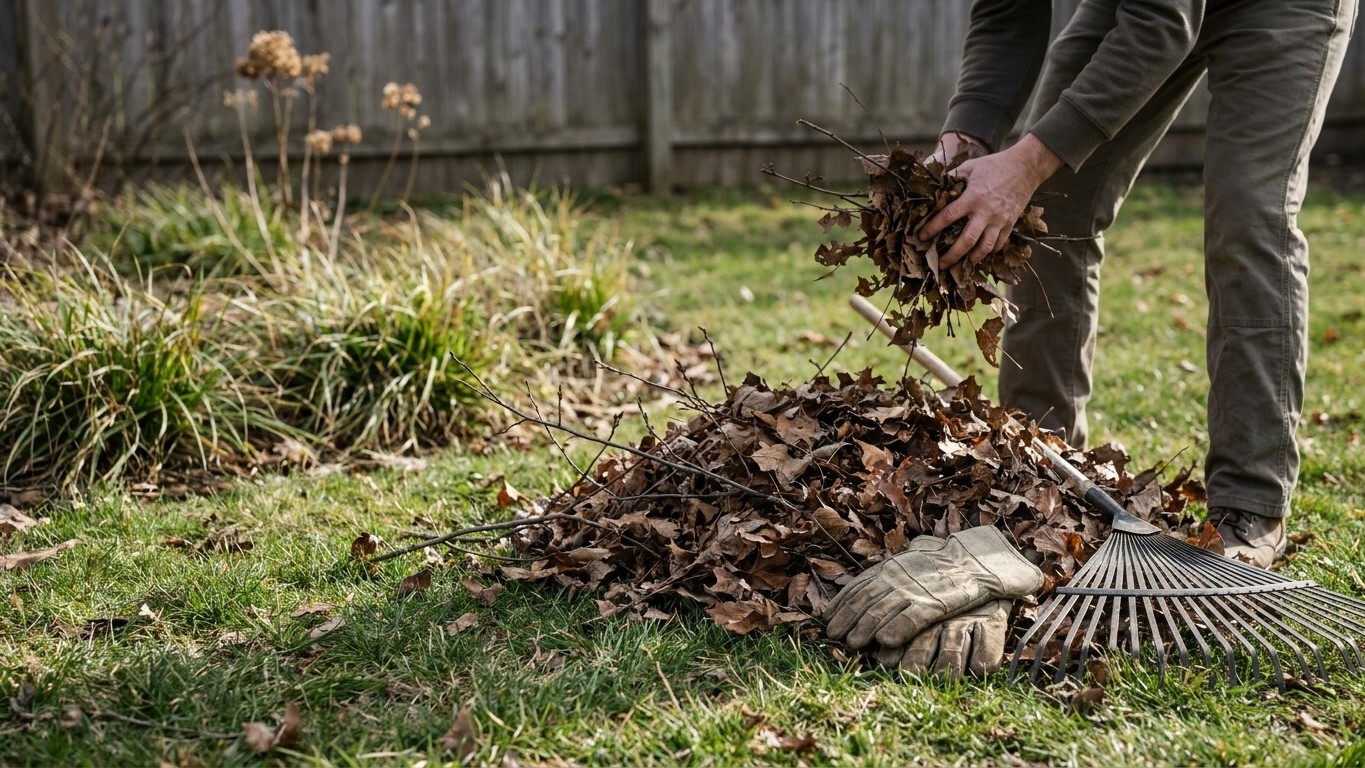

What actually comes first in spring lawn cleanup is your mower, not your rake — set the deck to the right height for your grass before you touch anything else, and the rest of the season falls into place behind it. Cool-season lawns like Kentucky bluegrass and perennial ryegrass want 2 to 3 inches; St. Augustinegrass wants 2.5 to 4 inches. Go check your mower’s deck height against your species right now, before you rake, feed, or dethatch a single patch.
Why this matters
A lawn does not show you a mistake the day you make it. Scalp a cool-season lawn in March, rake a wet warm-season lawn before it has greened up, or spread fertilizer on ground that’s still frozen underneath, and the lawn looks fine for two or three weeks. Then a hot dry spell hits and the roots that never recovered can’t keep up, and you get thinning or brown patches that look like disease but are really a spring mistake finally catching up with the plant.
That lag is the whole problem with spring cleanup. By the time you see the damage, the window to fix it cheaply has usually closed. A scalped lawn in April doesn’t get better by June, it gets a summer of stress on top of a spring injury. The fix at that point is patience and water, not a quick pass with more seed or more fertilizer.
The upside is that the sequence that avoids this is short and doesn’t cost anything extra. Mow at the right height, wait until the grass is actually growing before you feed or dethatch it, and leave alone anything you’re not sure about until you know your species. Doing less, correctly, beats doing more on the wrong week.
When to do it
Cool-season grasses, fine fescues, Kentucky bluegrass, perennial ryegrass, rough bluegrass, and tall fescue, do their strongest growing in spring and again in fall, and go semi-dormant in summer heat, per Penn State Extension and Clemson’s HGIC 1214. Warm-season grasses, bermudagrass, zoysiagrass, St. Augustinegrass, centipedegrass, bahiagrass, carpetgrass, and seashore paspalum, do the opposite: they’re dormant and tan-brown through winter and don’t hit their growth stride until late spring into summer, per Clemson HGIC 1214.
That single fact decides your spring cleanup order. A cool-season lawn is already growing when the calendar says “spring cleanup,” so raking, light dethatching, and the first mowings can start as soon as the ground has firmed up and dried out. A warm-season lawn is often still brown at that point. Working it, raking hard, aerating, or feeding it, before it has actually broken dormancy and greened up wastes effort and can pull up living crowns along with the dead blades.
The tell to watch for isn’t a date on a calendar, it’s the grass itself. Cool-season lawns show new green growth pushing through old blades. Warm-season lawns show green shoots emerging from the base, not just a color change on old leaf tissue, which can happen from a warm spell without real growth underneath. Clemson publishes species-specific maintenance calendars, HGIC 1215 for centipedegrass, HGIC 1216 for bermudagrass, HGIC 1217 for zoysiagrass, HGIC 1218 for St. Augustinegrass, and HGIC 1219 for tall fescue, that lay out the task order for each species across the year. For the exact dates in your county, both cool-season and warm-season growers should check their own state extension’s spring calendar rather than go by a neighboring state’s normals; frost dates and green-up timing genuinely differ by region. If you’re planning what comes after cleanup, the same logic carries into Fall Lawn Care: The Season That Decides Next Summer, since fall is the mirror-image task for cool-season lawns.
How to do it

Start with the mower, not the rake
Set your mower to the height range for your actual species before you cut anything. Clemson’s HGIC 1214 and Penn State Extension publish these ranges:
| Grass | Season | Mowing height | Drought tolerance |
|---|---|---|---|
| Fine Fescues | Cool | 2.5–3.5 in | Good |
| Kentucky Bluegrass | Cool | 2–3 in | Fair |
| Perennial Ryegrass | Cool | 2–3 in | Fair |
| Tall Fescue | Cool | 2.5–3.5 in | Fair |
| Bermudagrass | Warm | 0.75–1.5 in | Excellent |
| Zoysiagrass | Warm | 0.75–2 in | Good |
| St. Augustinegrass | Warm | 2.5–4 in | Good |
| Centipedegrass | Warm | 1.5–2 in | Fair |
For the first cut of the season, mow at the low end of that range once to clear away winter-flattened blades, then move up to the normal height for the rest of the season. HGIC 1205, Clemson’s mowing lawns fact sheet, is the reference for keeping blade sharpness and cutting frequency in line with these heights all season, not just in spring.
Raking and dethatching
Rake only to remove matted leaves or the kind of thick, spongy thatch layer that keeps water from reaching soil, not just to tidy up loose grass blades. A hard dethatching pass on a lawn that hasn’t started active growth yet does more harm than the thatch itself. If you’re deciding whether the lawn needs mechanical help beyond raking, Core Aeration: When a Lawn Needs It and When It Does Not covers how to tell compacted soil from a thatch problem, since they look similar from the surface but call for different tools.
Fertilizer and weed control
Do not feed a lawn before it is actively growing, cool-season or warm-season, since the plant can’t use nitrogen it isn’t drawing on for growth yet. Clemson’s HGIC 1201, Fertilizing Lawns, sets out application rates in pounds per 1000 square feet by species and season, and that fact sheet is the reference to use rather than a generic bag rate, since warm-season and cool-season grasses are fed on different schedules relative to their own green-up.
What goes wrong
Scalping is the most common spring mistake, cutting a lawn that’s grown tall over winter down to height in one pass instead of stepping it down. The tell is a lawn that looks stripped and pale for a week, then develops thin, weak patches by early summer instead of filling back in. The fix is to never remove more than about a third of the blade in one cut, which usually means two mowings a week or so apart rather than one.
Working wet soil is the second. Raking, aerating, or even walking heavy equipment over saturated ground compacts it, and compacted soil doesn’t show its damage until the dry stretch weeks later when roots can’t push through it and the grass wilts faster than the lawn around it. Wait until soil crumbles rather than smears when you squeeze a handful.
Feeding too early wastes fertilizer and can push weak, leggy growth on a plant that isn’t ready for it. On cool-season lawns this shows up as excess top growth with a thin root system, visible by early summer as the first real heat stress hits. On warm-season lawns, an early feed before green-up mostly just feeds weeds that are ahead of the turf.
Herbicide timed to the calendar instead of to the grass causes a different failure: pre-emergent herbicide put down after weed seeds have already germinated does nothing, and post-emergent herbicide sprayed on a dormant or stressed lawn can injure the turf along with the weed. Either mistake becomes visible within two to four weeks, as a flush of weeds the pre-emergent should have stopped, or as yellowing turf where a post-emergent product was applied too hot or too dry.
How this changes across the country
A grower in Pennsylvania, working with cool-season turf like Kentucky bluegrass or tall fescue, is doing full spring cleanup work, mowing, light raking, feeding once growth is underway, right as the lawn hits its spring growth peak, per Penn State Extension’s guidance on these species. A grower in South Carolina working centipedegrass or St. Augustinegrass is often still watching for green-up at that same calendar point, since Clemson’s HGIC 1214 places warm-season growth later in the season, and jumping the gun on cleanup tasks there means working ground the grass hasn’t woken up on yet.
The transition zone, the band of the country where neither a purely cool-season nor a purely warm-season answer fits cleanly, is where this gets harder to generalize. Tall fescue is the cool-season option Clemson’s HGIC 1214 lists as suited to a broader climate range than bluegrass, with good drought tolerance and fair wear tolerance, which is part of why it shows up so often in transition-zone lawns instead of a straight warm-season or cool-season choice. A lawn in that band may have patches of each type, and treating the whole yard on one timeline guarantees you’ll cleanup the wrong half at the wrong time.
The practical takeaway is the same regardless of region: identify the species before you set a date. A bag of fertilizer or a rental dethatcher doesn’t know what state you’re in, but your grass does, and it will tell you when it’s ready if you check for new growth at the crown rather than going by what the calendar says a “spring lawn” should look like.
Common questions
My lawn is still brown, is it dead or just dormant?
Most likely dormant, especially if it’s a warm-season species like bermudagrass or centipedegrass that hasn’t broken winter dormancy yet. Tug on a few blades; dead grass pulls free easily from the crown, while dormant grass stays anchored even when the top growth looks tan and dry.
Can I mow before the first fertilizer application?
Yes, mowing and fertilizing aren’t linked to each other on a schedule, they’re each tied to whether the grass is actively growing. Mow whenever the grass has grown past the top of its recommended height range, and hold off on fertilizer until you see real new growth, per Clemson HGIC 1201’s guidance on timing feed to active growth.
Is it too late to do spring cleanup if I missed the early window?
Cleanup tasks aren’t a one-shot window that closes; raking, mowing to height, and light dethatching are still worth doing once the grass is growing, just avoid stacking several stressful tasks, like dethatching and fertilizing and a hard mow, into the same week on a lawn that’s playing catch-up.
Should I bag or leave the grass clippings from the first mow?
Bag the first mow if there’s a heavy mat of winter-killed blades, since that material can smother new growth the way thatch does. After that, per Clemson’s HGIC 1205 mowing guidance, clippings from a properly mowed lawn, cut so no more than about a third of the blade is removed, can be left to break down and return nutrients to the soil.