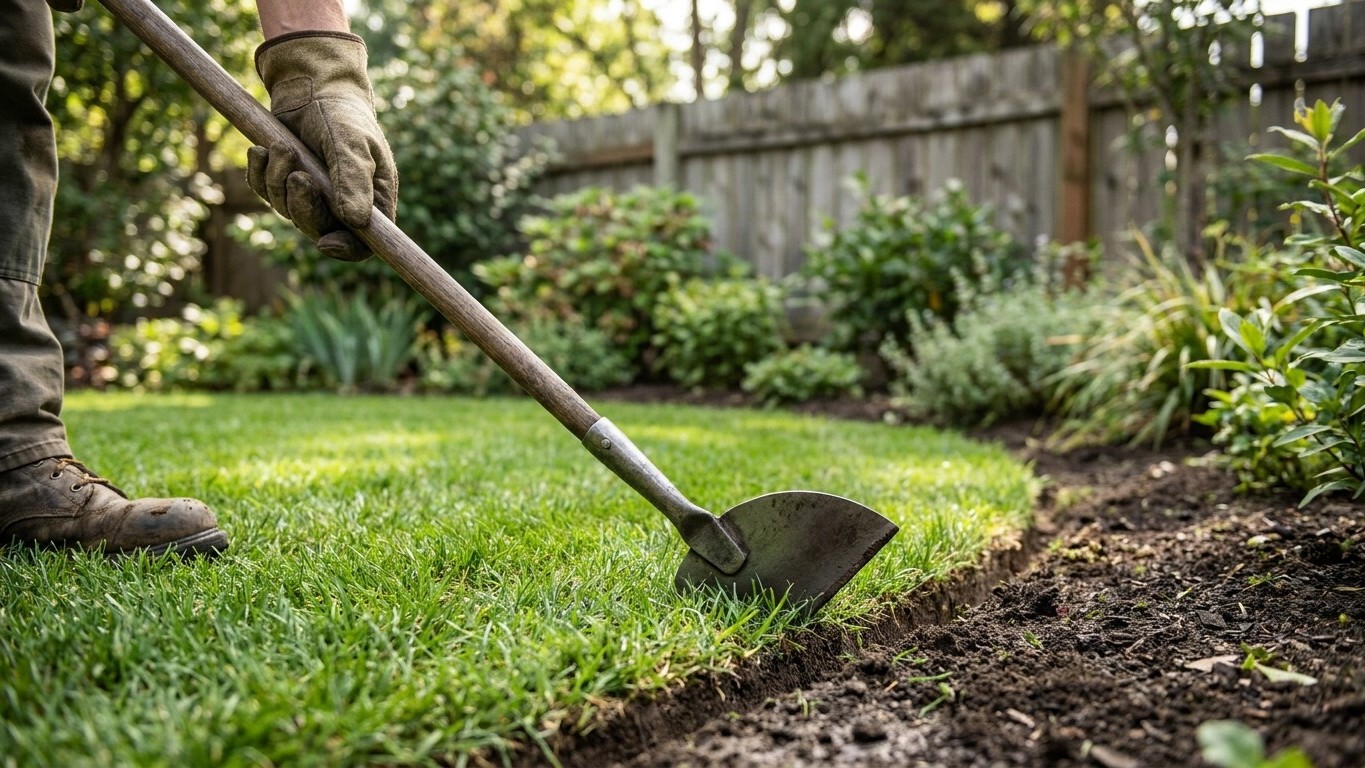

Edging is the cut you make where lawn meets bed, walk, or driveway, and it’s what tells the eye a yard is cared for rather than just mowed. There’s no single extension-published edging depth or date, because edging is a design decision, not a plant-health measurement like mowing height or fertilizer rate. The one thing that matters most: match your timing to whether your grass is cool-season or warm-season, since cutting into a dormant warm-season lawn’s crown does more damage than the same cut on actively growing cool-season turf.
Why this matters
Skip edging for a season and the lawn doesn’t announce it right away. Grass runners creep over a walkway edge a fraction of an inch at a time, and a bed line goes fuzzy so slowly that you stop noticing until the whole yard reads as untended. By the time the blur is obvious, the grass has usually rooted into the mulch or gravel it invaded, so the fix is no longer a quick trim. It’s digging out rooted runners, which takes an afternoon instead of twenty minutes.
The same delay works against you when you cut too aggressively. Slice a trench edge too deep, or too close to a tree’s root flare, and you won’t see the stress until weeks later, when that stretch of lawn thins or the tree’s bark shows a wound line at soil level. A lawn mowed low, like Bermudagrass at 0.75 to 1.5 inches per Clemson Cooperative Extension’s HGIC 1214, tends to hide an edging misstep faster than a tall-cut species like St. Augustinegrass, mowed at 2.5 to 4 inches by the same source, where a torn edge stands out against that longer leaf blade for weeks.
An edge also does structural work, not just visual work. A cut or installed edge keeps grass rhizomes and stolons from pushing under a paver base or into a garden bed, which means less time later spent pulling grass out of the daylilies. Get the edge right once and it holds most of the season. Skip it, and you’re re-establishing the line from scratch every time, usually at the worst part of the growing season to be disturbing turf.
When to do it
Edging timing follows the grass’s growing season, not the calendar, and cool-season and warm-season lawns run on opposite growing seasons. Cool-season species such as Kentucky Bluegrass, Perennial Ryegrass, Fine Fescue, Rough Bluegrass, and Tall Fescue do their growing in spring and fall, per Penn State Extension and Clemson Cooperative Extension’s HGIC 1214. Warm-season species such as Bermudagrass, Zoysiagrass, St. Augustinegrass, Centipedegrass, Bahiagrass, Carpetgrass, and Seashore Paspalum grow through the heat of summer and go dormant, not dead, once temperatures drop.
Cut an edge into a cool-season lawn during its spring or fall growth flush and the wound closes fast, because the grass is actively producing new tissue at the crown. Cut the same line in the middle of summer heat stress or the depth of winter dormancy, and the cut edge sits open, vulnerable to weeds moving into the bare strip. Warm-season lawns work in reverse: their active window is summer, and an edge cut while Bermudagrass or Zoysiagrass is dormant only heals once growth resumes, so a straight line cut in the dead of winter can still look ragged well into the following spring.
None of the extension sheets referenced here publish a specific edging date, because edging isn’t a planting or fertilizing operation with a soil-temperature trigger. What they do publish are maintenance calendars built around each species’ growing season. Clemson Cooperative Extension’s HGIC 1216, HGIC 1217, HGIC 1218, HGIC 1215, and HGIC 1219 lay out season-by-season tasks for Bermudagrass, Zoysiagrass, St. Augustinegrass, Centipedegrass, and Tall Fescue respectively, and edging fits most naturally into whichever months those calendars mark as active growth. If you’re not sure which side of the calendar your species falls on, check your own state’s extension maintenance calendar for the exact months, since active growth timing shifts by a few weeks from one region to the next even within the same grass type.
The same seasonal logic carries into the fall cleanup you do before the ground freezes. Edging is one of the jobs worth finishing before you move on to winterizing the lawn for the year, rather than leaving a fresh cut open right as growth stops.
How to do it

Two methods produce a clean line: a cut edge made with a half-moon edger, a spade, or a power edger, and an installed edge, a physical strip of steel, aluminum, brick, or plastic set into a trench. A cut edge needs redoing as grass regrows across it through the season. An installed edge holds its line for years but costs more upfront and needs a proper trench to stay straight.
Cutting the line
Set a string line between two stakes along the border you’re cutting, or use a hose to mark a curve, then follow it with the edger. Work the blade to a depth of about 4 to 6 inches where turf meets bed, walk, or driveway, angling the cut slightly so the lawn side sits a touch higher than the bed side. That angle keeps mulch from washing onto the grass and keeps grass runners from pushing the other way into the bed.
Basic tools for the job:
- Half-moon edger or a flat spade, for a hand-cut straight or curved line
- String line and two stakes, to keep a long run straight
- Power edger with a straight blade, for extensive walk or driveway borders
- Steel, aluminum, or plastic edging strip, if installing a permanent barrier instead of re-cutting each time
- Rubber mallet, for driving stakes or setting strip edging into the trench
Matching the edge to the mow height
The finished edge should sit level with, or a little below, the height you already mow that grass, so the transition from turf to bed doesn’t leave a visible step or a ragged fringe. Clemson Cooperative Extension’s HGIC 1214 lists Bermudagrass at 0.75 to 1.5 inches and St. Augustinegrass at 2.5 to 4 inches, and that gap in mowed height is also a gap in how forgiving each grass is at the edge. The shorter-cut Bermudagrass line reads crisp for longer between trims, while a St. Augustinegrass edge, cut at nearly three times that height, blurs faster simply because there’s more leaf blade hanging over the line.
Once the edge is cut, keep the strip clean by trimming it back every time you mow rather than letting several weeks of growth build up before the next pass. If you’re feeding the lawn on a schedule already, a sharp edge also makes it obvious where granules have drifted onto pavement, one more reason to treat fertilizing a lawn and edging as related jobs rather than separate ones.
For an installed edge, dig a trench matched to the product’s depth, tamp the base so the strip doesn’t heave with frost, and backfill both sides so the top sits flush with the surrounding soil. This step assumes the lawn itself is already established and healthy going into the project, the kind of groundwork covered under general lawn care, since edging a struggling or bare lawn just draws attention to the bare patches.
What goes wrong
Cutting too deep or too often
A trench cut deeper than necessary, especially near a tree, can slice through surface roots, and you won’t see the damage until the tree shows stress weeks or a season later. The same over-cutting along a lawn edge widens the trench year after year until what started as a clean line becomes a shallow ditch that collects water and mulch. The tell is a trench visibly wider this year than it was last spring, worth checking before the season’s first cut.
Edging a dormant warm-season lawn
Cut a fresh line into Bermudagrass, Zoysiagrass, or Centipedegrass while it’s dormant and brown, and the cut looks fine for weeks, since a dormant lawn hides damage the way a healthy one hides nothing. The trouble shows only once growth resumes, when that section of the edge is slower to green up than the rest of the lawn, because you cut through crown tissue with no active growth available to repair it. Brown is not dead in a dormant warm-season lawn, but a cut into brown, dormant turf still wounds it the same as a cut into green turf. It just heals on the lawn’s schedule, not yours.
Letting wear tolerance work against you
Edges along a walkway or driveway take foot traffic the rest of the lawn never sees, and species with poor wear tolerance show it first at the border. Penn State Extension rates Fine Fescue and Rough Bluegrass as poor for wear, and Clemson Cooperative Extension’s HGIC 1214 rates Carpetgrass and Centipedegrass the same way, which means an edge cut into any of those four species along a high-traffic path thins out faster than the same cut in a wear-tolerant species like Bermudagrass or Zoysiagrass, rated excellent and very good respectively by HGIC 1214. The thinning shows up as bare soil right at the border, usually within the same season the edge was cut.
How this changes across the country
A cool-season grower and a warm-season grower are edging on opposite clocks. In cool-season regions where Kentucky Bluegrass, Perennial Ryegrass, Fine Fescue, and Tall Fescue dominate, lawns grow most in spring and fall, per Penn State Extension and Clemson Cooperative Extension, so an edge cut during those windows heals while the grass is actively pushing new tissue. In warm-season regions where Bermudagrass, Zoysiagrass, St. Augustinegrass, Centipedegrass, and Bahiagrass dominate, per Clemson Cooperative Extension’s HGIC 1214, the growing season runs through summer heat, and that’s when a cut edge heals fastest.
Pennsylvania, within Penn State Extension’s service area, sits solidly in cool-season turf territory, so Kentucky Bluegrass, Perennial Ryegrass, and Fine Fescue lawns there follow the spring-and-fall edging window described above. South Carolina, covered by Clemson Cooperative Extension, spans both a warm-season coastal plain, where St. Augustinegrass and Centipedegrass are common, and an upstate transition zone where Tall Fescue often takes over from those same warm-season species. That split within a single state is a smaller version of the transition zone problem nationally: the growing season that governs when to edge changes not just state to state, but county to county within a state.
Regional grass choice also changes how demanding the edge itself is. Shade tolerance and drought tolerance, both published by Clemson Cooperative Extension’s HGIC 1214, explain why an edge suited to one yard fails at the border of another:
| Grass | Shade tolerance | Drought tolerance | Wear tolerance |
|---|---|---|---|
| St. Augustinegrass | Excellent | Good | Fair |
| Zoysiagrass | Excellent | Good | Very good |
| Bermudagrass | Very poor | Excellent | Excellent |
| Bahiagrass | Poor | Excellent | Good |
| Carpetgrass | Fair | Very poor | Poor |
A shaded bed edge under trees, common in yards using St. Augustinegrass along the coastal South or Zoysiagrass further up the transition zone, holds its line better than a sunny, high-traffic border planted in Carpetgrass, which HGIC 1214 rates very poor for drought tolerance and poor for wear, since a stressed lawn heals a fresh edge more slowly no matter when you cut it. Bahiagrass, common in the same warm-season regions, trades that wear resistance for poor shade tolerance instead, so an edge that runs from open lawn into a tree line is the first place it thins out.
Common questions
Do I have to edge every time I mow?
No. A cut edge holds its line for several mowing cycles before it needs re-cutting, and running the edger every single time just wears the trench wider than it needs to be. Trim the fringe with a string trimmer between full re-cuts and save the half-moon edger for when the line has visibly blurred.
Can a string trimmer do the whole job?
A string trimmer held vertically can maintain an edge once it’s cut, but it doesn’t create the initial trench the way a half-moon edger or power edger does. Use the trimmer for upkeep between cuts, not for establishing the line in the first place.
What’s the difference between edging and trenching?
Edging cuts a shallow line between turf and bed to define the border. Trenching, the deeper dig used to install a permanent steel or plastic strip, goes in once and is meant to outlast several seasons of mowing without redoing. Most home lawns only need the shallower cut edge unless the border sees heavy foot traffic or a lot of mulch washout.
Will cutting the edge kill the grass right at the border?
Not if the grass is actively growing when you cut it. A crown that’s producing new tissue, which happens during a cool-season lawn’s spring and fall growth or a warm-season lawn’s summer growth, recovers from an edging cut within the same season. Cutting into dormant, brown warm-season turf doesn’t kill it either, but the recovery waits until growth resumes.