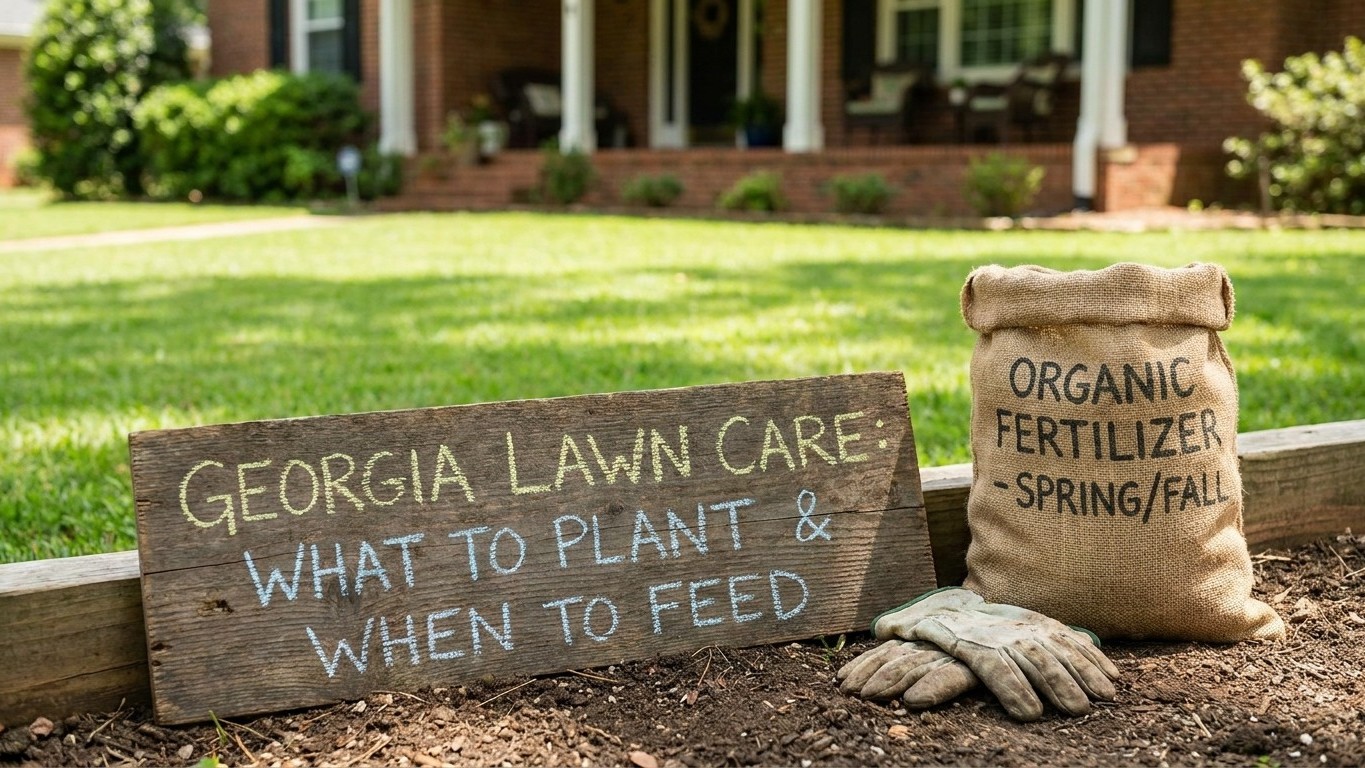

Your yard can grow one great lawn, not two — and the choice comes down to which season you’re willing to sacrifice. Georgia’s summers get hot enough to punish a cool-season grass like tall fescue by August, but winters stay mild enough that a warm-season grass like bermuda or zoysia sails through untouched. So before you buy seed or sod, decide which trade you can live with: a lawn that stays green all winter but struggles in July, or one that thrives in summer heat and goes tan and dormant from November to March. Pick that first — everything else, timing included, follows from it.
Which grass belongs in Georgia

Atlanta’s 35.8 days a year of 90°F or hotter, per NOAA’s 1991-2020 climate normals, is enough heat stress to thin out a cool-season lawn by August most years. Its 34.3°F average low in the coldest month, from that same NOAA record, is mild enough that a warm-season grass rarely loses its stand to winterkill. Put those two numbers side by side and you get a state where cool-season and warm-season grasses both grow, and neither one thrives without a cost attached.
The trade-off, not a winner
Clemson Cooperative Extension’s HGIC 1214 fact sheet lists Tall Fescue, Kentucky Bluegrass and Perennial Ryegrass as the cool-season options for this region, and Zoysiagrass and Bermudagrass as the warm-season ones. A cool-season lawn in Georgia is almost always tall fescue, since it tolerates heat better than bluegrass or ryegrass, and it stays green through winter and looks its best in spring and fall. It thins, wilts and sometimes looks half-dead during the hottest stretch of summer, the same stretch that produces those 35.8 days above 90°F. A warm-season lawn of bermudagrass or zoysiagrass does the opposite: it powers through July heat without blinking, then turns tan and dormant from the first hard frost through early spring, a look many homeowners mistake for a dead lawn rather than a sleeping one.
Neither choice is wrong. It depends on how much irrigation and fungicide you’re willing to put into keeping a cool-season lawn alive through August, against how much brown turf you can tolerate on the front yard from November to March. Gardeners moving from a state where one grass simply wins, the way cool-season lawns dominate without that trade-off in Kentucky Lawn Care: What to Plant and When to Feed It, sometimes expect the same certainty here. Georgia doesn’t offer it, and working out which trade-off suits your yard is easier once you’ve compared the options laid out in this Georgia lawn Best grass guide, or mapped the year ahead with a Georgia lawn Calendar.
One more wrinkle: the Atlanta figures above are measured at the airport, in the middle of the state’s warmest urban microclimate. North Georgia and the mountains run cooler with harder winters, which tips the balance further toward cool-season grass. The coastal plain in the south runs hotter and more humid, which tips it toward warm-season grass. Gardening well outside metro Atlanta means weighting this trade-off accordingly, not assuming the Atlanta numbers describe your yard exactly.
When to seed or sod here
Clemson Cooperative Extension’s HGIC 1203 fact sheet gives the standard planting windows for this region: warm-season grasses go in around May, once soil has warmed, and cool-season grasses go in mid to late September. Which window applies to you depends entirely on which grass you’re planting, not on the calendar month alone.
Cool-season: seed ahead of the first fall frost
Seeding tall fescue, perennial ryegrass or Kentucky bluegrass means giving the seedlings enough weeks in warm soil to root before growth slows for winter. NOAA’s 1991-2020 climate normals put Atlanta’s first fall freeze, the point where a 32°F reading becomes 30 to 70 percent likely, somewhere between November 13 and December 1. Counting back from that range points toward a September sowing window, which is why HGIC 1203 lands on mid to late September rather than October. North Georgia and the mountains freeze several weeks earlier than Atlanta, so a fescue lawn up there needs to go in earlier within that same window. The coastal plain runs milder and can push later.
Warm-season: wait for warm soil, not just a warm week
Bermudagrass and zoysiagrass, whether seeded, sprigged or laid as sod, need soil that has already warmed and a low risk of a late cold snap setting back new growth. Clemson’s May window assumes that warm-up has already happened. The figures available here don’t give a single reliable last-frost date for spring, and it’s worth saying that plainly rather than guessing: check with your county extension office for how late a cold snap has run in your specific area before trading a safe May planting for an earlier one.
Sod, for either grass type, tolerates a slightly off date better than seed does, since it arrives with an established root system already attached. Seed is cheaper but needs a wider margin either side of the recommended window to get established before stress hits it, whether that stress is a late spring frost on warm-season seed or a hard summer heat spell on cool-season seed sown too late into fall.
The feeding calendar that fits this climate
Nitrogen timing follows the grass’s growing season, not the wall calendar, and getting this backwards is the most common feeding mistake on a transition-zone lawn.
Cool-season lawns: feed going into fall
A tall fescue, bluegrass or ryegrass lawn does its real growing in spring and fall, not summer, so nitrogen applied in September, around the same time as fall overseeding, builds the root reserves that carry the lawn through the following summer’s heat. Clemson Cooperative Extension’s HGIC 1219 Tall Fescue Maintenance Calendar lays out the full month-by-month schedule, including exact rates in pounds of actual nitrogen per 1,000 square feet at each date, and it’s worth following that calendar directly rather than a single number repeated out of context, since the rate changes from one month to the next. Feeding a fescue lawn heavily in June, when it’s already struggling with heat, pushes leaf growth the plant can’t support and makes brown patch worse.
Warm-season lawns: feed once they’re actively growing
Bermudagrass and zoysiagrass do the opposite. They’re dormant or barely growing through winter and don’t want nitrogen until they’ve fully greened up and started active growth in late spring. Clemson’s HGIC 1216 Bermudagrass Maintenance Calendar and HGIC 1217 Zoysiagrass Maintenance Calendar both hold off on the first feeding until the lawn is visibly growing, then keep applications going through summer while the grass puts out new leaf and stolon growth, tapering off well before the first fall frost so the lawn hardens off instead of pushing soft new growth into winter.
| Grass type | Active growth | Feed when | Full calendar |
|---|---|---|---|
| Tall fescue (cool-season) | Spring and fall | September, into fall growth | HGIC 1219 |
| Bermudagrass (warm-season) | Late spring through summer | After full green-up, through summer | HGIC 1216 |
| Zoysiagrass (warm-season) | Late spring through summer | After full green-up, through summer | HGIC 1217 |
The rate itself deserves attention: Clemson’s calendars express it in pounds of actual nitrogen per 1,000 square feet, not pounds of a bagged fertilizer product, which usually contains far less than 100 percent nitrogen by weight. Doing that math from the guaranteed analysis on the bag before you spread is what keeps a habit of “one bag a month” from turning into far more nitrogen than the calendar ever called for. A soil test is also what tells you whether nitrogen is even the limiting nutrient this year, or whether phosphorus, potassium or a pH correction with lime matters more.
Mowing height and watering here
Mowing height and watering both come down to the same principle: work with the grass’s growing pattern instead of against it, and never cut more than the plant can regrow quickly.
Mowing height
Keep tall fescue at 3 to 4 inches, the height Clemson’s HGIC 1219 calendar recommends for the species in this region, since a taller blade shades its own roots and holds up better through summer stress despite being a cool-season grass in a hot climate. Bermudagrass and zoysiagrass, by contrast, are mowed low, generally 1 to 2 inches, because both spread by stolons and rhizomes rather than relying on tall leaf blades to compete with weeds. Whatever the species, the one-third rule applies across the board: never remove more than a third of the leaf blade in a single cut, or you strip carbohydrate reserves the plant needs for root growth and force it to spend the next few weeks recovering instead of growing.
Watering
An inch of water a week, from rain and irrigation combined, is the common baseline figure for an established lawn of either grass type. Georgia’s humidity changes how that inch behaves more than the amount itself. Heavy clay soil common across much of the Piedmont holds water longer and can go a day or two past a scheduled watering without stress, while sandy coastal-plain soil drains fast and may need that same inch split into two lighter waterings instead of one. The 35.8 days a year Atlanta spends above 90°F, per NOAA’s climate normals, is worth planning around directly too: on the hottest stretches, water early in the morning rather than in the evening, since grass that stays wet overnight in Georgia’s humidity is exactly the setup that produces the fungal problems covered next. A dormant warm-season lawn in winter needs little to no supplemental water at all. Save the inch-a-week habit for the months the grass is actually growing.
What goes wrong on lawns in Georgia

Georgia’s specific mix of humidity, heat and mild winters produces a predictable short list of failures, and most of them get misread as something worse than they are.
Brown patch in humid summers

A humid summer night is exactly what the fungus behind brown patch needs: warm, wet turf held that way for hours by dew or a late watering. It shows up as roughly circular patches of tan, blighted grass, sometimes with a faint smoky ring around the edge visible in early morning light, most often on tall fescue mowed too short or watered in the evening. The heat alone doesn’t cause it. Humidity combined with wet turf overnight does, which is why watering in the morning does more to prevent brown patch than any fungicide.
Summer dormancy mistaken for death

A bermudagrass or zoysiagrass lawn that stops getting rain during a hot, dry stretch will often go uniformly tan across the whole yard rather than dying in patches. That’s dormancy, not death. The grass has shut down leaf growth to survive, and the crown just below soil level stays alive. Tug on a few blades. If they come up easily with soft, dark, rotted roots attached, something is actually dead. If they resist and the base still looks pale and firm, the lawn is waiting out the dry spell and will green back up once rain or irrigation returns.
Weeds that don’t stop in a mild winter

A coldest-month average low of 34.3°F, per NOAA’s climate normals for Atlanta, rarely delivers the sustained hard freeze that would knock back winter annual weeds like henbit and chickweed. Both keep germinating and spreading through a Georgia winter on any lawn that’s thin or dormant, which describes most warm-season lawns from November through April. A state with a real hard freeze, like the winters covered in North Dakota Lawn Care: What to Plant and When to Feed It, simply stops that growth for several months. Georgia’s mild winter doesn’t offer the same break, so a pre-emergent herbicide timed for early fall gets ahead of the problem rather than fighting it once it’s already up.
Local help
A soil test is the cheapest way to stop guessing at fertilizer rates, and the University of Georgia Cooperative Extension runs one through its county offices, along with lawn-specific advice for your exact location, since conditions inside the state vary more than a single page can cover. Find your county office through UGA Extension and ask for both a soil test and a recommendation sheet for whichever grass species you’re maintaining, cool-season or warm-season, since the two get different guidance from the same office.
Common questions
Can I have both warm-season and cool-season grass in the same yard?
Mixing the two as permanent lawn in the same area doesn’t work well, since they green up and go dormant at opposite times and end up looking patchy year-round. The one common exception is overseeding a dormant bermudagrass lawn with annual ryegrass for winter color, then letting it fade out as the bermudagrass wakes up in spring.
My new sod turned yellow a week after laying it. Did I get a bad batch?
Probably not. Yellowing in the first week or two is usually transplant shock from root disturbance during harvest, and it corrects itself with consistent watering while new roots establish into the soil below. Sod that’s still yellow after several weeks of proper watering is a different problem, often poor soil contact or a section that dried out before it rooted.
I missed the fall window for fescue seed. Can I seed in spring instead?
You can, but it’s a harder path. Spring-seeded fescue has only a few months of root growth before Georgia’s summer heat arrives, so it goes into that first stressful summer with a shallower root system than a lawn seeded the previous fall. If spring is your only option, expect to water more carefully through the first summer and accept some thinning.
Do I need to dethatch my lawn every year?
Not necessarily, and it depends on the species. Bermudagrass and zoysiagrass build up thatch faster because of how they spread and often need dethatching every year or two, while tall fescue, which doesn’t spread the same way, usually needs it far less often. Check thatch depth by cutting a small wedge out of the lawn and looking at the brown layer between the green blades and the soil before assuming you need the job at all.
My bermudagrass turned black after a hard freeze. Is it dead?
Blackened, mushy-looking leaf blades after a hard freeze are usually just frost damage to the top growth, not death of the plant, and normal winter dormancy already has the lawn tan and inactive by that point anyway. The crown and roots below soil level are what matter, and they typically survive a Georgia winter given how mild the coldest-month averages run here. If large sections stay bare well into the following summer’s growing season, that’s worth investigating as a separate problem rather than assuming the freeze itself killed the lawn.