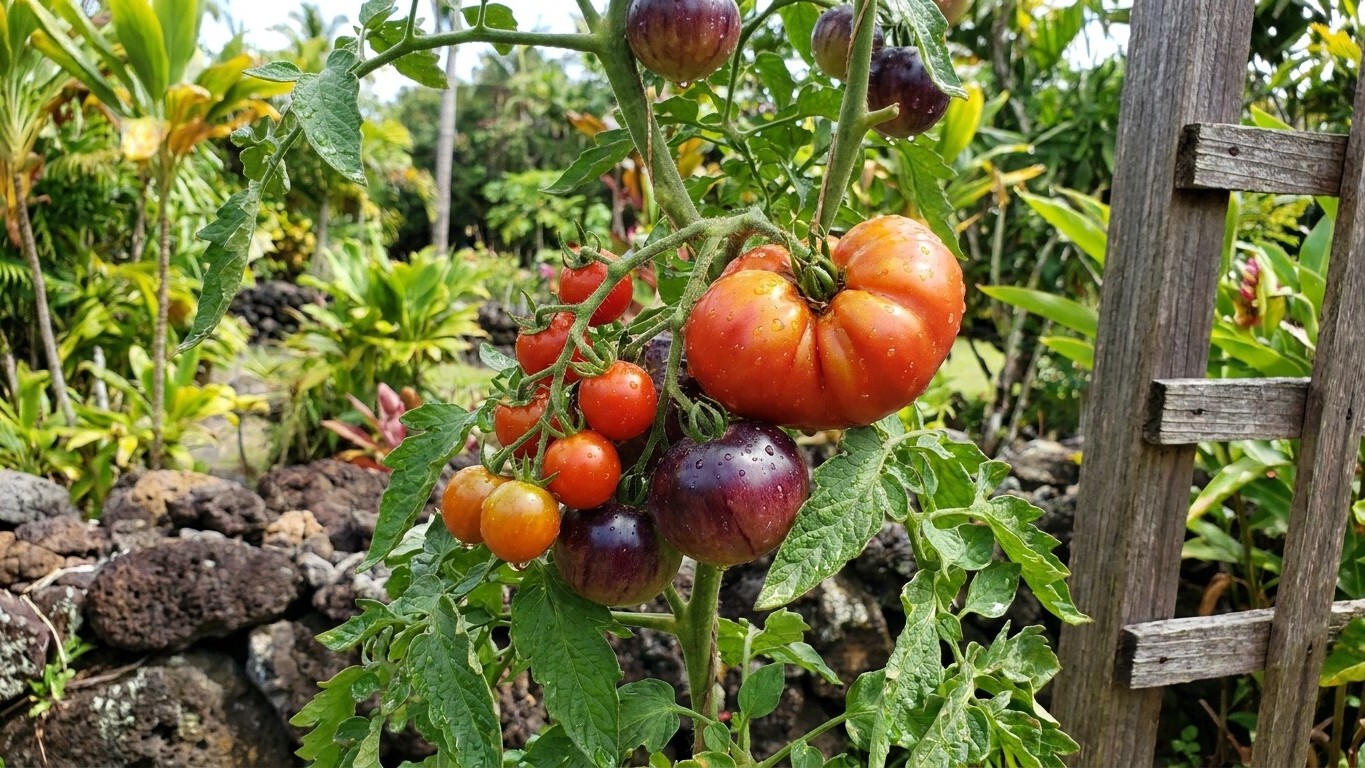

In Hawaii, the tomato that “ripens in time” isn’t racing a frost, because your garden doesn’t get one. It’s racing the rain and the fungus that comes with it once the wet season settles in. So the number that matters is days to maturity: the shorter that number, the more of your harvest you get to pick before disease pressure builds against you. Start there — pull the days-to-maturity and disease-resistance listing off whatever seed packet or catalog page you’re holding right now, and weigh it against how wet and how high up your own yard actually sits.
What this comes down to in Hawaii

Because there is no frost season anywhere people garden in this state, the tomato calendar that works for the mainland does not apply here. NOAA’s 1991-2020 normals for the Honolulu station flag every freeze percentile as not computable, since the threshold never happens. Frost exists only on the summits of Mauna Kea, Mauna Loa and Haleakala, thousands of feet above any vegetable bed. What actually limits a Hawaii tomato crop is rainfall, elevation and whether the garden faces windward or leeward, not a frost window.
That shifts the whole “ripen in time” question onto the variety itself. A short-season cherry tomato can be picked before the wet months build up fungal and bacterial pressure, while a long-season heirloom is exposed to that pressure for a month or more longer. Below are catalogue-sourced cultivars from shortest to longest days to maturity, so you can see where your own garden’s tolerance for risk lines up.
Sakura

Sakura reaches its first ripe fruit around 55 days from transplant, the shortest of any tomato in this lineup. It is a cherry type, good for snacking and salads, and it carries intermediate resistance to nematodes plus high resistance to Tomato Mosaic Virus and two races of Fusarium Wilt. In a state where extended wet spells favor soil-borne disease, that combination of speed and resistance makes it one of the safer bets for a first planting.
Sun Gold

Sun Gold matures at around 57 days from transplant and produces small, bright orange cherry fruit prized for sweetness. It carries high resistance to Tobacco Mosaic Virus and to one race of Fusarium Wilt. Its short season means it clears most of its harvest before disease pressure has time to build, which matters more in Hawaii’s humid lowlands than almost anywhere on the mainland.
Supersweet 100

Supersweet 100 finishes at around 60 days from transplant, another cherry type bred for very long fruit clusters. It resists Verticillium Wilt and one race of Fusarium Wilt, both high. It is a reliable second short-season option if you want a cherry tomato with a different flavor profile than Sakura or Sun Gold, and its speed gives it the same wet-season advantage.
Jasper

Jasper also matures around 60 days from transplant and is notable for high resistance to Late Blight along with intermediate resistance to Early Blight. That blight resistance is worth weighing seriously here, since fungal disease is the main thing standing between a Hawaii tomato plant and a full harvest once the rains set in.
Amalfi

Amalfi is a determinate plum tomato maturing at around 68 days from transplant, useful for sauce and canning. It carries intermediate resistance to nematodes, Late Blight and Early Blight. That broader, if lower-grade, disease package makes it a reasonable middle-season choice where a cherry tomato’s small fruit size is not what the kitchen wants.
Cherokee Purple

Cherokee Purple is a heirloom slicer maturing at around 72 days from transplant, with dusky purple-pink skin and rich, sweet flesh. It carries no listed disease resistance, which is the tradeoff for its flavor. In a wetter garden that long, unprotected season raises real risk of losing fruit to disease before it fully colors.
Big Beef Plus
Big Beef Plus matures at around 72 days from transplant and produces large, smooth red slicing tomatoes. It carries intermediate resistance to nematodes and high resistance to Gray Leaf Spot and Tomato Mosaic Virus. That resistance package makes it a steadier choice than an unprotected heirloom slicer of similar days to maturity.
Granadero
Granadero is an indeterminate paste tomato at around 75 days from transplant, with intermediate resistance to nematodes and high resistance to Verticillium Wilt and Tomato Mosaic Virus. It suits gardeners who want Roma-style fruit for sauce but are not willing to give up as much disease protection as an unprotected heirloom paste type would cost them.
Amish Paste
Amish Paste is the longest-season cultivar in this list, at around 85 days from transplant, producing large, irregular, oxheart-shaped paste fruit. It carries no listed disease resistance. That long, exposed season is exactly the combination this climate punishes hardest, and it is worth reading closely in the next section before planting it.
| Variety | Days to maturity | Fruit type | Key disease resistance |
|---|---|---|---|
| Sakura | 55 | Cherry | ToMV, Fusarium 1 & 2 (High); Nematodes (Int.) |
| Sun Gold | 57 | Cherry | TMV, Fusarium 1 (High) |
| Jasper | 60 | Cherry | Late Blight (High), Early Blight (Int.) |
| Amalfi | 68 | Plum | Nematodes, Late Blight, Early Blight (Int.) |
| Big Beef Plus | 72 | Beefsteak | Gray Leaf Spot, TMV (High); Nematodes (Int.) |
| Granadero | 75 | Paste | Verticillium, TMV (High); Nematodes (Int.) |
| Amish Paste | 85 | Paste | None listed |
Working it out for your own garden
Because there is no fall frost to count back from here, the useful arithmetic runs the other direction: start at transplant day and add the catalogue’s days-to-maturity figure to see how long your plant is exposed before you get a harvest. That exposure window is what matters, since Hawaii’s growing risk comes from cumulative wet-season disease pressure building over weeks, not from a single cold snap ending the season outright.
A short-season example
Take Sakura at around 55 days from transplant. Set out transplants and count forward: by roughly eight weeks you have ripe fruit, and the plant has spent under two months exposed to whatever rain and humidity your particular site gets. Because USDA’s 2023 hardiness map puts the state in zones 9a through 13a with no winter shutdown, that eight-week window can, in principle, be timed almost any month. The practical question becomes whether you have picked a stretch with less rain, which is a rainfall and elevation question. Check the Tomato Planting Dates in Hawaii: Counting Back From Your Frost Window page for how to work that timing out.
A long-season example
Now take Amish Paste at around 85 days from transplant, roughly a month longer exposed than Sakura. That extra month is exactly the stretch where fungal and bacterial disease, described in more detail on the Tomato Pests in Hawaii: Which Ones Actually Show Up Here page, has more time to build against a plant that carries no listed resistance. The variety is not wrong to grow. It is simply a higher-risk choice in a wetter garden, and a safer one in a drier, leeward spot.
What changes across the state
The Honolulu station figures behind USDA’s 9a-13a range describe one reference point on Oahu, and conditions shift fast as you move across islands. Elevation is the biggest driver. Higher slopes run cooler and wetter, which slows fruit set and stretches out the effective days to maturity beyond what the seed packet promises, while low coastal gardens warm faster and push a short-season cherry tomato through its cycle closer to the catalogue number.
Windward versus leeward exposure matters just as much. Windward slopes, the ones facing into the trade winds, catch far more rain through the year, which raises the disease pressure this whole page has been weighing against days to maturity. Leeward coasts, in the rain shadow of the island’s mountains, run drier and give a longer-season variety like Amish Paste or Cherokee Purple a better chance of finishing clean.
None of this changes which cultivar reaches maturity fastest, since that is a fixed catalogue figure. What it changes is how much risk you are taking on by growing a longer-season variety in your particular spot, and whether the eight to twelve week window a fast cherry tomato needs actually lands in a dry stretch where you garden.
The mistakes this state punishes

The most common mistake is importing a mainland mental model: waiting for a “last frost” that will never come, then rushing to fit everything into a compressed summer that Hawaii does not have. There is no frost-based planting window to protect you from a bad decision here, so the discipline has to come from matching variety to rainfall instead.
The second is choosing a long-season, disease-unprotected heirloom, such as Cherokee Purple or Amish Paste, for a windward or higher-elevation garden that stays wet for weeks at a stretch. Both are excellent tomatoes and both carry no listed resistance, so a wet 78 to 85 day season gives fungal disease a long run at an unprotected plant. Growing them on a drier leeward site, or backing them up with a short-season cherry tomato like Sakura or Sun Gold, hedges that risk.
The third mistake is treating a warm stretch mid-rainy-season as a green light. Soil that has been saturated for weeks stays cool and disease-loaded even after a few sunny days, and transplanting into it gives young roots a rough start regardless of variety.
Checking this against your county
Every figure on this page is a Honolulu-area reference point, and conditions on Hawaii Island, Maui, Kauai or the windward side of Oahu will differ from it, sometimes sharply. Before committing a bed to a particular cultivar, check with your county office of the University of Hawaii’s College of Tropical Agriculture and Human Resources extension service for local rainfall patterns and disease pressure specific to your elevation and coast. For the general framework behind these choices, the growing tomatoes in Hawaii guide is the place to start.
Common questions
Can I plant tomatoes in Hawaii any month of the year?
In most lowland gardens, yes, since there is no frost to force a single planting window. The limiting factor is rainfall and disease pressure, so picking a drier stretch for your area matters more than picking a particular month.
Why did my Cherokee Purple crack and rot before it ripened?
Heavy or uneven rain late in the fruiting stage is the usual cause, and Cherokee Purple carries no listed disease resistance to help it recover. A shorter-season, resistant variety like Big Beef Plus or Jasper tends to hold up better through the same wet spell.
Do short-season cherry tomatoes taste worse than the slow heirlooms?
Not because of speed itself. Sun Gold and Sakura are both bred for sweetness despite maturing in under 60 days, so a short days-to-maturity figure is not a flavor tradeoff on its own.
Is it worth growing a paste tomato like Amish Paste at all here?
It is, especially on a leeward or lower-elevation site with less sustained rain. On a wetter windward garden, Granadero or Amalfi give up some of the heirloom flavor but bring disease resistance that Amish Paste does not have.