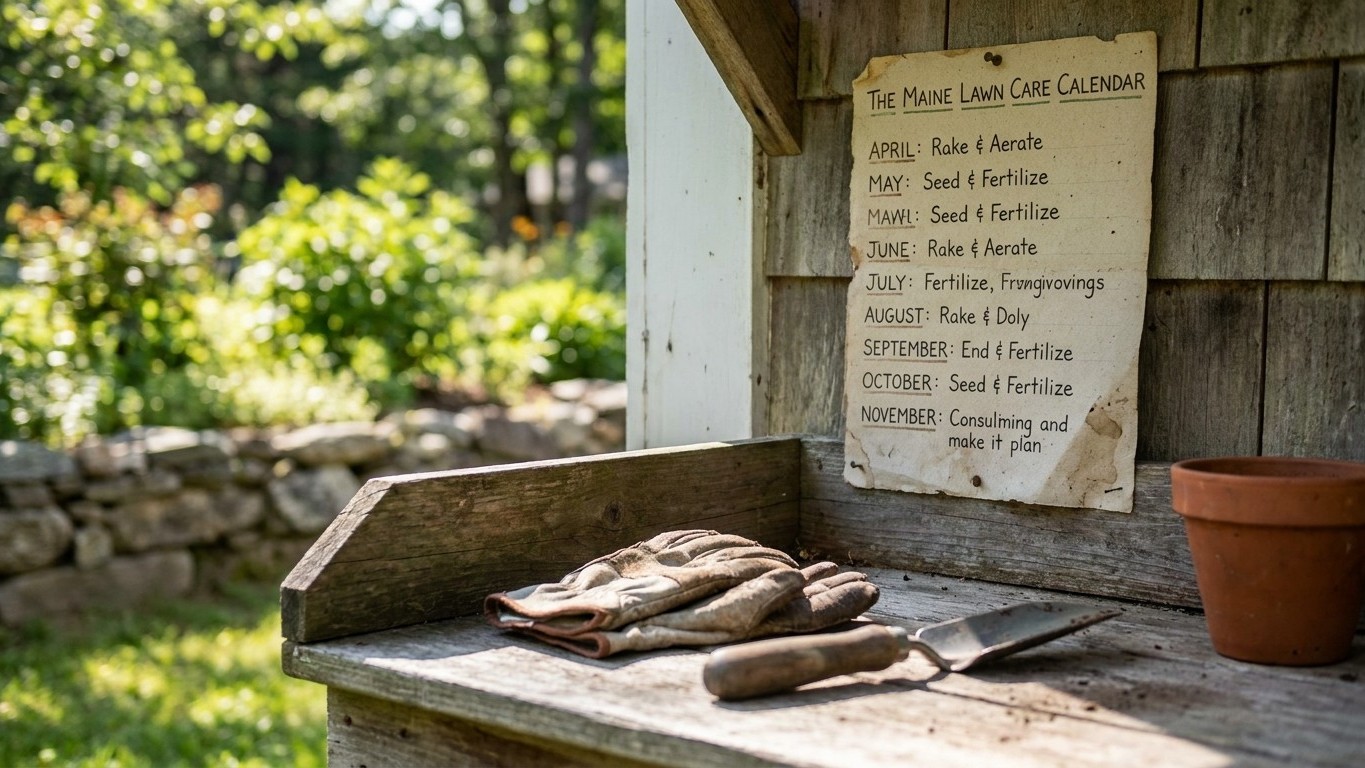

Maine falls in the cool-season lawn zone, the category The Homestead Post assigns using NOAA’s climate normals and Clemson Cooperative Extension’s season thresholds (HGIC 1214). That means the grass that actually survives here is Kentucky bluegrass, tall fescue, perennial ryegrass, fine fescue or rough bluegrass, never a warm-season species like Bermuda or zoysia. Near Portland, NOAA’s 1991-2020 normals put the first fall freeze between October 9 and October 21. Plan any fall seeding or feeding to land before that window opens, not after.
The short answer for Maine
What grass actually holds on in a Maine yard, and when do you feed or seed it? Kentucky bluegrass, tall fescue, perennial rye, fine fescue, or rough bluegrass are the only ones that make it through a Maine winter without dying back, and the whole year’s schedule bends around whichever one you’ve got. So before you touch fertilizer or seed, walk out and find out which grass is actually growing under your feet.
- Kentucky bluegrass
- Tall fescue
- Perennial ryegrass
- Fine fescue
- Rough bluegrass
A warm-season grass such as Bermuda or zoysia will not overwinter here. It needs a long stretch of heat this state does not reliably supply, so it thins out or dies over the first hard winter rather than just browning off. Most Maine lawns aren’t a pure stand of one grass either. It’s common to overseed with a Kentucky bluegrass and fine fescue blend, or a tall fescue and perennial rye mix, because a blend spreads the risk between species that green up and go dormant at slightly different points in the season.
That zone label is measured at one place, the NOAA weather station referenced near Portland, and coastal Maine runs milder than inland and northern counties. The whole state’s growing calendar should be read as a range, not a fixed date. What the calendar below depends on is which of those five cool-season species is already growing in your yard, since Clemson publishes a separate maintenance calendar for each species, not one calendar per state. If you haven’t settled on a grass yet, work out the choice before the timing, because the species decides the calendar, not the other way around. The Best Grass Seed for Maine Lawns lays out how those five options differ before you commit seed to the ground.
Working through the year

Clemson Cooperative Extension’s HGIC 1219 Tall Fescue Maintenance Calendar is the closest published guide to the actual work, and it applies directly if tall fescue is what’s growing in your yard. The other four cool-season species named above follow roughly the same shape, spring growth, a summer slowdown, a fall growth spurt, but check the specific rates against whichever grass you actually have before applying anything.
Spring
Mow as soon as the grass is growing steadily, and keep the blade high. HGIC 1219 sets tall fescue’s mowing height at 2.5 to 3.5 inches, and cutting shorter than that in spring weakens the root system going into summer. Hold off on nitrogen. Spring feeding pushes leaf growth at the expense of roots, and Clemson’s calendar reserves the heavier feeding for fall. If crabgrass has been a problem, a pre-emergent herbicide goes down before the soil warms into its germination window, not after seedlings are already up.
Summer
Cool-season turf slows down and can brown off in a dry, hot stretch. That’s dormancy, not death, and the grass greens back up once cooler, wetter weather returns. HGIC 1219 puts summer irrigation at roughly 1 to 1.5 inches per week where the lawn is watered at all, applied in one or two deep sessions rather than a light sprinkle every day, which only wets the top of the soil and encourages shallow roots. Keep mowing at the same 2.5 to 3.5 inch height. A taller blade shades the soil and slows moisture loss.
Fall
Fall is the main feeding season for every grass on this list. HGIC 1219 calls for nitrogen in split applications through the fall rather than one heavy feed, at roughly 1 pound of nitrogen per 1,000 square feet per application. Fall is also when core aeration and overseeding happen, both timed to give new seedlings several weeks of root growth before the ground freezes. Near Portland, NOAA’s 1991-2020 climate normals put the first fall freeze between October 9 and October 21, so aim to get seed down well ahead of that window, not inside it. Inland and northern Maine reach that freeze earlier, so back the whole fall schedule up accordingly.
Late fall and winter
A final mowing at the same height, a last light feeding once growth has mostly stopped, and then the lawn goes dormant under snow cover for the winter. Nothing else needs doing until spring growth resumes.
What changes across Maine
Every figure above is measured at or near Portland, and Portland is the mild end of this state’s climate. NOAA’s 1991-2020 climate normals put the first fall freeze there between October 9 and October 21, and that window shifts earlier as you move away from the coast.
Inland valleys and the western mountains lose their growing season from both ends. Elevation cools the air enough that frost arrives earlier in fall and lingers later in spring than it does along the coast, which means the whole fall feeding and overseeding schedule needs to move up rather than following a Portland-based date literally. Aroostook County, in the far north, runs a noticeably shorter season again, closer to a true northern climate than to coastal Maine’s.
The coast itself isn’t uniform either. Towns directly on the water, from Kittery up through Portland to Bar Harbor, get a moderating effect from the ocean that keeps both spring cold spells and fall frosts a little later than inland towns at the same latitude. Move even a few miles inland from the shoreline and that buffer weakens fast.
Because NOAA’s public data set names only the Portland freeze window, this page can’t put a number on the spring side of the season for the rest of the state. Treat spring green-up and the safe seeding window as starting later the farther you get from the coast, and confirm the actual local pattern before committing seed or fertilizer to the ground.
None of this changes which grasses work. The same five cool-season species are the right call from the coast to the county line, per Clemson HGIC 1214. What changes is only the calendar: read the dates above as the mild end of the state’s range, and shift every fall task earlier the farther inland or north your lawn actually sits.
The mistakes this climate punishes
Seeding a warm-season grass here is the fastest way to waste a bag of seed. Bermuda, zoysia, and centipede grass need a long run of heat that Maine’s cool-season zone doesn’t supply, and a stand that looks fine through summer will fail outright over its first winter, not just brown off. If a lawn looks patchy every spring no matter what’s done to it, check that the original seed mix was actually one of the five cool-season species named above.
Seeding at the wrong end of summer
Cool-season grass seed germinates poorly in high summer heat, and any seedlings that do come up are often too weak to survive the following stretch of hot, dry weather. Fall is the right window because the soil is still warm enough for germination while air temperatures are dropping, giving new grass weeks to root before dormancy. Seed put down instead in late spring or early summer, chasing warm soil, tends to fail by August.
Cutting too short in summer heat
Scalping a cool-season lawn during a hot, dry stretch removes the leaf area the plant needs to shade its own roots and slow moisture loss. The damage doesn’t always show immediately. A lawn cut to an inch and a half in July can look fine for a week, then brown out hard once the next dry spell hits, and it recovers slower than a lawn that was never cut that short to begin with. Stick to the 2.5 to 3.5 inch range HGIC 1219 sets for tall fescue through the hottest months, not just in spring.
Feeding too early or too heavy in fall
A single large nitrogen application right at the start of fall pushes soft, leafy growth that hasn’t hardened off by the time frost arrives, which raises the risk of snow mold and winter injury. Splitting that feeding into smaller applications spread across fall, as HGIC 1219 recommends, gives the grass time to convert that nitrogen into root and stem rather than a rush of tender top growth right before the ground freezes.
Checking this against your county
Every date and rate on this page is anchored to Portland’s climate data or to a single-species maintenance calendar published outside Maine. Before committing to a fall seeding date or a fertilizer schedule, check it against your county’s actual conditions through the University of Maine Cooperative Extension at extension.umaine.edu, which fields county-level questions on lawn and soil through its network of county offices.
If you’re just getting the rest of your yard organized around this schedule, Maine Lawn Care covers the steps that come before a seasonal calendar matters at all, from soil testing to initial grass selection.
Common questions
Can I seed my lawn in spring instead of waiting for fall?
You can, but it’s the harder route for cool-season grass. Spring seedlings have to compete with weeds like crabgrass right from the start, and they only get a few months of root growth before summer heat and drought stress arrive, compared to a full fall-to-spring stretch for grass seeded in autumn. Fall remains the more reliable window for the five cool-season species that actually work in Maine.
My lawn is still brown patches in April, is it dead?
Probably not. Cool-season turf comes out of winter slowly, and matted, gray-pink patches are often snow mold rather than dead grass, a fungal issue that shows up under snow cover and mostly grows out once the lawn is raked lightly and starts actively growing again. Give it a few weeks of normal spring mowing before assuming a patch needs reseeding.
How short can I cut before the first frost in fall?
Drop the mowing height gradually over the last few cuts of the season rather than scalping it in one pass, ending a bit shorter than the 2.5 to 3.5 inch summer range so matted leaf blades don’t trap moisture under snow and invite the same snow mold mentioned above. Stop mowing once growth has effectively stopped for the year.
Is it worth overseeding every fall or just when the lawn looks thin?
Tall fescue in particular benefits from being overseeded most falls, since it’s a bunch-type grass that doesn’t fill in bare spots on its own the way a spreading species can. Kentucky bluegrass and the fine fescues spread more on their own, so they need overseeding less often, mainly when a section has been damaged rather than as a yearly routine.