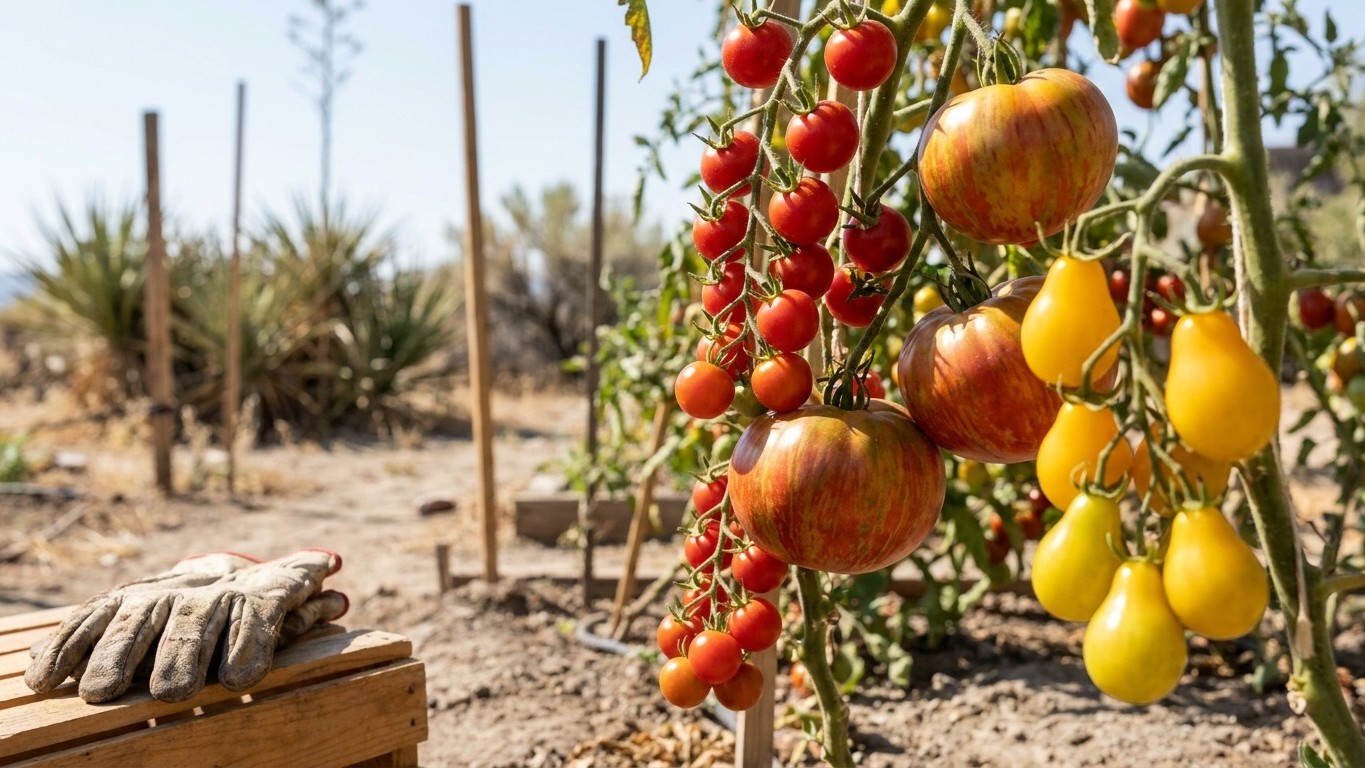

Nevada’s tomato season is long enough near the low desert for almost any variety, but that answer flips at elevation. NOAA’s 1991-2020 climate normals put the last spring freeze near Las Vegas between January 7 and February 1 and the first fall freeze between December 8 and December 23, an unusually mild window that does not apply in Reno, Carson City, or anywhere with real elevation. Start by finding your own county’s frost dates through UNR Extension, then match a cultivar’s days-to-maturity number against what’s left of your season.
What this comes down to in Nevada

Near Las Vegas, that January-to-February spring freeze and December fall freeze give the low desert one of the longest frost-free stretches in the country. Gardeners there can set transplants out early and still have months of margin before the season closes. The catch is that this figure comes from a low-elevation desert airport shaped by urban heat. It is not usable as a statewide planting guide: Reno, Carson City, and any county at elevation freeze months earlier in fall and later in spring, which changes which cultivars actually fit. The fix is the same wherever you garden: pick a named variety, know its catalogue days-to-maturity, and check it against your own frost dates rather than a Las Vegas one.
Sakura

Sakura is one of the fastest tomatoes worth growing here, reaching first ripe fruit about 55 days after transplant. It’s a small, round, glossy red cherry tomato meant for eating out of hand rather than sauce. Using the Las Vegas frost window, a late January to mid February transplant puts first fruit by mid April, leaving roughly 241 days of margin near Las Vegas, more room than almost any garden in the state will need.
Sun Gold

Sun Gold needs about 57 days from transplant to first fruit, nearly as fast as Sakura. The fruit is a small, bright golden-orange cherry with thin, glossy skin, produced in long clusters and known for being very sweet. Set out in the same late January to mid February window, it ripens by mid April near Las Vegas with about 239 days of margin before frost there.
Juliet

Juliet takes about 60 days from transplant and carries intermediate resistance to both Late Blight and Early Blight, useful in a wet spring. The fruit is a small, oblong, deep red grape tomato good for salads or roasting whole. Near Las Vegas, transplanting in the late January to mid February window gives first ripe fruit by mid April and about 236 days of margin before the fall freeze there.
Amalfi

Amalfi runs about 68 days from transplant and is a determinate paste tomato, so the whole crop ripens over a shorter stretch, useful for anyone canning in batches. It carries intermediate resistance to Nematodes, Late Blight, and Early Blight. Set out in the same window, it reaches first ripe fruit by late April near Las Vegas, with about 228 days of margin before frost there.
Cherokee Purple

Cherokee Purple takes about 72 days from transplant, longer than the cherry types but still well within the low desert’s window. It’s a large, ribbed, beefsteak-shaped heirloom with dusky pink-purple skin and green shoulders when ripe, prized for flavor over yield. It carries no listed disease resistance, so it’s worth watching closely once fruit sets. Set out late January to mid February, it ripens by late April near Las Vegas with about 224 days of margin before frost there.
Celebrity Plus

Celebrity Plus needs about 78 days from transplant, the longest on this list along with San Marzano II. It’s a determinate slicer with smooth red skin, bred for reliable yield, and carries resistance to Nematodes, Gray Leaf Spot, and Tomato Mosaic Virus. Transplanted late January to mid February, it reaches first ripe fruit by early May near Las Vegas, with about 218 days of margin before frost there, still comfortable in that climate but the tightest of this group.
San Marzano II
San Marzano II also runs about 78 days from transplant and is the classic canning paste tomato, long, narrow, and pointed at the blossom end. It’s indeterminate, so it keeps setting fruit through the season rather than ripening all at once. Set out in the late January to mid February window, it reaches first ripe fruit by early May near Las Vegas, with roughly 218 days of margin before frost there, the same tight end of the range as Celebrity Plus.
| Variety | Days to maturity | Habit | Best for |
|---|---|---|---|
| Sakura | 55 | Indeterminate | Fresh eating, salads |
| Sun Gold | 57 | Indeterminate | Snacking, sweetness |
| Juliet | 60 | Indeterminate | Salads, roasting whole |
| Amalfi | 68 | Determinate | Canning, sauce |
| Cherokee Purple | 72 | Indeterminate | Fresh slicing, flavor |
| Celebrity Plus | 78 | Determinate | All-purpose slicing |
| San Marzano II | 78 | Indeterminate | Canning, paste |
Working it out for your own garden
The method matters more than any single date, because it still works after a cold year or a move across the state. Start from your own last and first frost dates, not the Las Vegas ones, then work backward from the fall side: a variety needs its full days-to-maturity count sitting inside the frost-free window, plus a couple of extra weeks of buffer since cooler fall temperatures slow ripening near the end of the season anyway. A range minus a number of weeks gives another range, never a single day, so don’t round it down to one.
- Find your county’s last spring and first fall frost dates through UNR Extension rather than assuming the Las Vegas figures apply
- Subtract two to three weeks of buffer from the fall frost range for slower fall ripening
- Compare what’s left against the cultivar’s catalogue days-to-maturity, counted from transplant
- If the margin is thin, choose a shorter-season variety rather than gambling on an early fall
An example that finishes with room to spare
Take Sakura, at 55 days from transplant. Near Las Vegas, NOAA’s 1991-2020 normals put the last spring freeze between January 7 and February 1, which allows a late January to mid February transplant date. Counting 55 days forward lands first ripe fruit around mid April. The first fall freeze near Las Vegas runs December 8 to December 23, so Sakura finishes with roughly 241 days to spare there, an enormous cushion by any standard.
An example that runs out of room
Now take a 78-day variety like San Marzano II and imagine a garden at real elevation, where the frost-free season is far shorter than the Las Vegas figure. The transplant date there comes weeks or months later than late January, because the last spring freeze is later at elevation, and the first fall freeze arrives weeks or months earlier than December. Counting 78 days forward from a later transplant date can land past a much earlier fall freeze, especially once the fall-ripening buffer is subtracted. That’s the line: the same cultivar that clears its Las Vegas margin by 218 days can miss its window entirely a few hundred miles and several thousand feet away, which is exactly why the Tomato Planting Dates in Nevada: Counting Back From Your Frost Window guide walks through the arithmetic county by county.
What changes across the state
Nevada spans USDA hardiness zones 4a to 10a, according to the USDA’s 2023 Plant Hardiness Zone Map, which is a wider range than almost any other state carries. That single fact says more than any date range could: a garden in the low desert around Las Vegas and a garden in a high mountain valley are not the same climate, and neither is the same as a Reno backyard within sight of the Sierra.
Elevation and latitude do most of the work
Elevation is the biggest single factor. Every rise in elevation pushes the last spring freeze later and the first fall freeze earlier, which is why the Las Vegas normals, taken at a low-elevation desert airport, are an extreme rather than a baseline. Latitude adds to that: northern Nevada sits closer to the Sierra Nevada and its weather systems, while the southern tip around Las Vegas is true low desert. Proximity to a large body of water like Lake Tahoe moderates temperature swings nearby, in the same way any large lake buffers the ground around it, though the effect fades quickly with distance.
None of this changes the method from the section above, only the numbers you plug into it. A gardener in a high valley should expect a much shorter frost-free window than the Las Vegas figures suggest, and should lean toward the shortest cultivars, such as Sakura or Sun Gold, rather than the 78-day varieties that only make sense where the season runs long.
The mistakes this state punishes

The most common one is trusting a warm stretch in late winter as a sign the season has started. A run of 70-degree days in February near Las Vegas does not mean the last freeze has passed, since NOAA’s own 1991-2020 window for that freeze runs all the way to February 1, and a garden at elevation can see a false spring even earlier relative to its real last frost. Transplants set into soil that hasn’t caught up get stunted even if they survive the cold snap that follows.
The second mistake is picking a 78-day variety like Celebrity Plus or San Marzano II in a part of the state where the season doesn’t support it. Both finish comfortably near Las Vegas, with well over 200 days of margin, but that margin shrinks fast once the local frost window is months tighter. Anyone gardening at elevation should treat the shorter cultivars, Sakura, Sun Gold, or Juliet, as the safer default and treat the longer ones as a bonus only if the season allows it.
The third is ignoring pest timing while focused on frost dates. Some pests arrive on a predictable calendar of their own regardless of how the frost window shakes out, and missing that window costs a crop just as surely as planting too early does. The Tomato Pests in Nevada: Which Ones Actually Show Up Here guide covers which ones actually show up in this state and when to start watching for them.
Checking this against your county
Every figure here is a starting point measured at or near Las Vegas, not an instruction for the whole state. Before you commit to a variety or a set-out date, confirm your own county’s frost dates through UNR Extension, since a Reno garden and a Las Vegas garden are working with entirely different calendars despite sharing a state line. If you haven’t already worked through the basics of growing tomatoes in Nevada, that’s the better starting point before narrowing down to a specific cultivar.
Common questions
Can I really grow a 78-day tomato in Nevada?
Near Las Vegas, yes, with well over 200 days of margin according to the frost-window calculation in this guide. At elevation, in Reno, Carson City, or a high mountain valley, check your own county’s frost dates first, since a 78-day variety can run out of season where the Las Vegas figures don’t apply.
What’s the difference between determinate and indeterminate for timing purposes?
A determinate variety like Celebrity Plus or Amalfi sets a fixed number of trusses and ripens most of its crop over a shorter window, useful if you want a batch to can at once. An indeterminate variety like Sun Gold or San Marzano II keeps growing and setting fruit until frost stops it, so it spreads the harvest out but also needs the season to stay open longer.
Do these days-to-maturity numbers count from seed or from transplant?
Catalogue days-to-maturity are counted from transplant date, not from seed. Add several weeks for starting seed indoors and growing a transplant to a plantable size before that clock even starts.
Why does my neighbor’s tomato ripen faster than the catalogue says?
Catalogue figures are averages and can shift by a week or two either way depending on the season, the plant’s exposure to heat, and how it was hardened off before transplanting. Treat the number as a planning range, not a guarantee, and use it mainly to compare varieties against each other rather than to predict an exact ripening day.