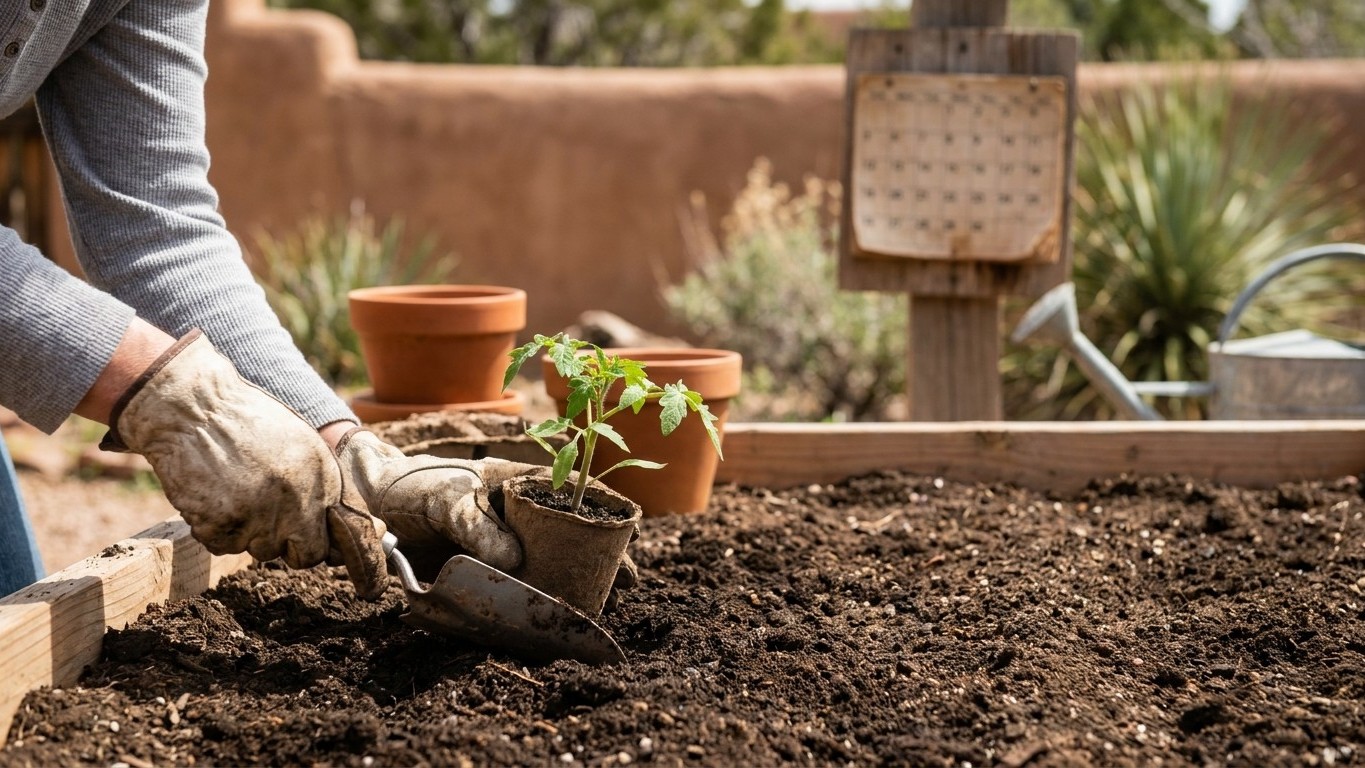

New Mexico’s tomato calendar isn’t set by a single date — it’s set by a window, and a stubborn gap inside that window. Albuquerque’s last spring freeze can land anywhere from March 31 to April 12, and that spread alone shifts your seeding date by two full weeks. But the real decider is what happens after the frost risk clears: cold soil still stunts roots even under a clear, freeze-free sky, which is why the safe transplant day almost never matches the frost day.
What this comes down to in New Mexico

In and around Albuquerque, NOAA’s 1991-2020 normals place the last spring freeze at March 31 to April 12, and the first fall freeze at October 29 to November 9. Everything else here is arithmetic built on that window: how many weeks before the last frost to start seed indoors, how many weeks after it to trust soil and night air enough to transplant, and how many days that leaves before the first fall freeze ends the season.
The safe transplant date is not the frost date itself. Tomatoes die outright in a frost and get stunted badly by cold soil even without one, so gardeners in this region generally wait until the window has closed and soil has actually warmed, rather than racing out the day the calendar clears March 31. That gap between “frost is now unlikely” and “the soil is genuinely warm enough for roots to grow” is where a lot of early transplants lose weeks they never get back.
The fall side of the calculation matters just as much. With Albuquerque’s first fall freeze arriving between October 29 and November 9, the usable season for a warm-season crop like tomatoes runs to roughly six months in a typical year, and less in a garden whose own frost record runs earlier than the airport’s. That season length is exactly what decides whether a given cultivar has time to ripen, the subject of Tomato Varieties That Ripen in Time in New Mexico, and the frost math is what those cultivar choices are built on.
Working it out for your own garden
Start from the two frost dates, never from one fixed date pulled out of the range. As a general rule that holds in any state, tomato seed is started indoors about six to eight weeks before the transplant date. Counting eight weeks back from Albuquerque’s last-freeze window of March 31 to April 12 gives another range, not a single day: roughly early to mid February for the earliest sowings, later still if your garden runs colder than the reference station. Subtract from the range, never from a single day picked out of it, that’s the step that turns a reasonable estimate into invented precision.
Running the numbers on real cultivars
Take ‘Early Girl‘, a catalog standard at roughly 50 days to maturity from transplant. Add 50 days to each end of Albuquerque’s frost window and you land on a harvest window of roughly late May to early June, with the catalog’s own week-or-two slop pushing that later in a cool spring. That leaves the entire rest of the season, clear through the October 29 to November 9 first-fall-freeze window, for a second flush of fruit.
Now take a paste tomato like ‘San Marzano‘, commonly listed at around 80 days. The same addition puts first ripe fruit at roughly late June to early July, comfortable in a typical Albuquerque-length season, with real margin left before fall freeze arrives.
A long-season heirloom like ‘Brandywine‘, often listed at 90 to 100 days depending on the catalog, is where the line starts to show. Add that to the frost window and harvest lands in midsummer to late summer in Albuquerque itself, which still usually works there, but push the transplant date a few weeks later, as often happens while waiting for soil to actually warm, or garden in a county where frost runs a week or two earlier than the airport average, and that same cultivar’s harvest clock can run right up against, or past, the point where frost already ended the season locally.
| Cultivar | Catalog days to maturity | Approx. harvest window from Albuquerque’s frost dates | Margin before first fall freeze |
|---|---|---|---|
| ‘Early Girl’ | ~50 days | late May to early June | wide, several months |
| ‘San Marzano’ | ~80 days | late June to early July | comfortable in a typical season |
| ‘Brandywine’ | ~90-100 days | midsummer to late summer | thin to none with a late transplant or an earlier-frost county |
That’s the whole method: catalog days to maturity plus your local frost window equals a finish date you can check yourself, rather than one you take on faith from a seed packet. It’s the same arithmetic the Tomato Varieties That Ripen in Time in New Mexico page runs cultivar by cultivar, this is just how to do it for whatever variety you already have on hand.
What changes across the state
New Mexico spans USDA hardiness zones 4b to 9a on the USDA Plant Hardiness Zone Map’s current update, and that spread alone tells you the Albuquerque numbers above are a starting point, not a statewide fact. Elevation is the biggest driver: mountain valleys and high desert towns sit well above the Albuquerque reference station’s elevation, and cold air pools in those low spots on clear nights, pushing the last spring freeze later and pulling the first fall freeze earlier than anything the airport records.
The south of the state, sitting lower and closer to the warmer air masses moving up from Mexico and Texas, typically carries a longer frost-free stretch than the higher country to the north. The Rio Grande valley moderates temperatures somewhat along its own length, but a garden a few miles off the river, or partway up a canyon, can run noticeably colder overnight than one down in the irrigated bottomland nearby. None of this changes the method above, it changes which end of the range to lean toward, and how much extra cushion to build into a transplant date.
When your own frost history clearly runs later in spring or earlier in fall than Albuquerque’s normals, use that local record instead of the reference-city figure. That local gap is exactly what decides whether a given cultivar discussed on the Tomato Varieties That Ripen in Time in New Mexico page actually has time to finish where you garden, rather than where the airport does.
The mistakes this state punishes

The most common one is planting into cold soil after a warm early spell. New Mexico can throw a run of unseasonably warm days well before Albuquerque’s own last-freeze window of March 31 to April 12 has closed, and that warm stretch tempts gardeners into setting tomatoes out early. The freeze that follows kills exposed plants outright, and even a near-miss leaves survivors stunted for weeks. Wait for the frost window to close and for the soil itself to warm, not just for a few mild afternoons in a row.
The second is picking a variety on days-to-maturity alone, without checking that figure against the season the frost window actually allows. A 90-day heirloom can work fine through a long Albuquerque-area season and still fail in a higher, colder county where the effective frost-free period runs weeks shorter. That mismatch is exactly what the arithmetic in the section above is meant to catch before a whole season goes into a plant that never ripens.
The third mistake is specific to this state’s pest calendar rather than its frost calendar: missing the point in the season when a pest that shows up predictably first appears, and only noticing once the damage is visible. Scouting on a schedule catches far more than waiting for obvious symptoms, the specific pests to watch for and when they arrive are covered on the Tomato Pests in New Mexico: Which Ones Actually Show Up Here page.
Checking this against your county
Everything above is built on one reference station’s normals, and NOAA itself presents those figures as probabilities, not guarantees for any specific yard. Before committing a season’s worth of seedlings to a date, call your county’s extension office and ask for frost history specific to your area, and check New Mexico State University’s Cooperative Extension Service, found through aces.nmsu.edu, for its own tomato guidance. A five-minute call costs far less than a flat of transplants lost to a freeze the airport thirty miles away never recorded.
Common questions
Should I go by the Farmer’s Almanac frost dates instead of these ones?
You can, but be aware it’s a different method and often a different number entirely. NOAA’s 1991-2020 climate normals for the Albuquerque reference station are a named, checkable source; whichever source you use, treat it as a range for one location, not a guarantee for your yard.
What if I already transplanted and a late freeze is forecast?
Cover the plants overnight with row cover, an overturned bucket, or a frost blanket, and water the soil beforehand since moist soil holds heat better than dry soil. This is a rescue measure for an unexpected freeze, not a reason to ignore the frost window in the first place.
Can I just direct-seed tomatoes outside once frost danger passes?
Almost nobody does this in New Mexico, because direct-seeding burns weeks of the short growing season that a transplant already has behind it. Nearly every planting-date calculation, and every cultivar’s days-to-maturity figure on a seed packet, assumes you’re setting out an already-growing transplant, not a seed.
My tomato plants are flowering but not setting fruit in midsummer, is that a frost-date problem?
No, that’s almost always heat-related blossom drop, not anything to do with the spring or fall frost window.
Some gardeners also time this by the Moon: when to plant tomatoes by the moon, as almanac tradition rather than fact.