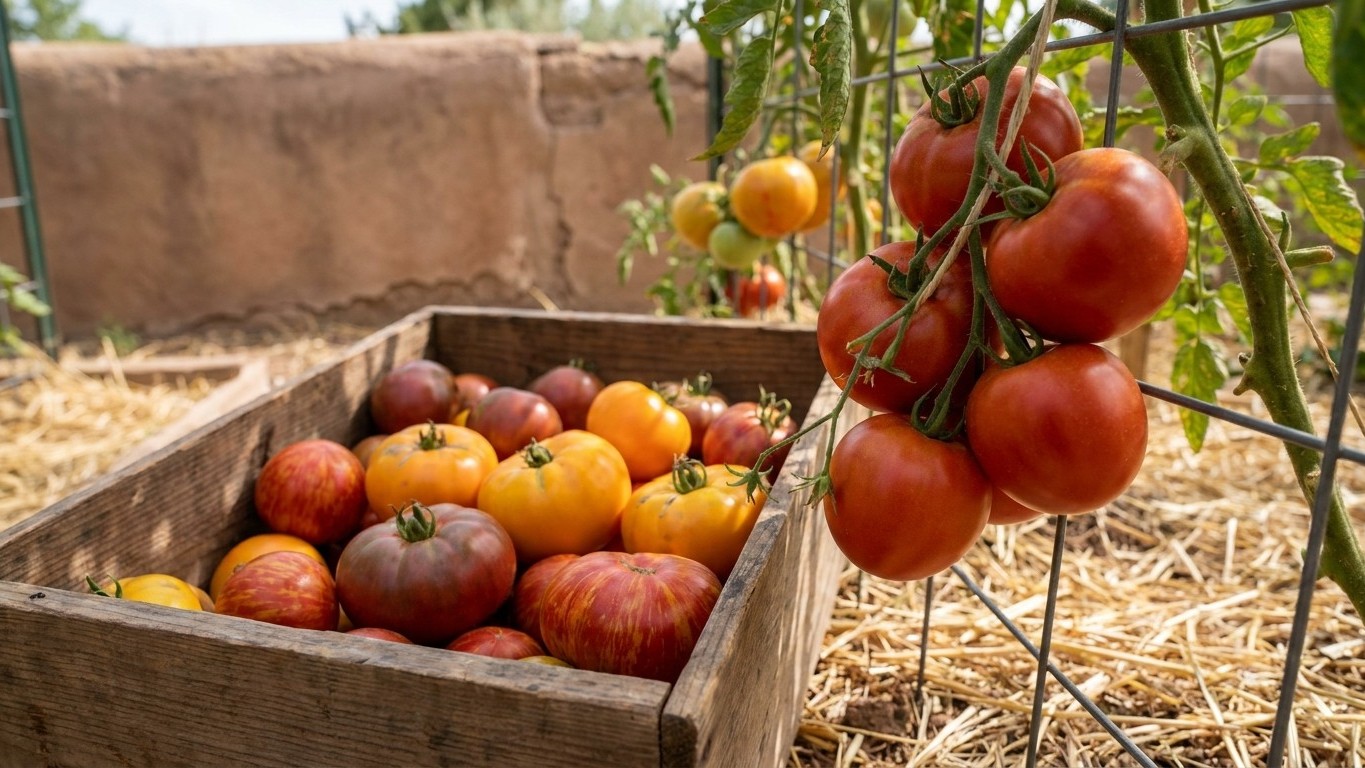

Six and a half to seven months — that’s the frost-free window Albuquerque works with, running from that last freeze in early April to the first one settling in around the end of October. Inside that window, a tomato’s days-to-maturity number is the only fact that matters: under 60 days and there’s margin to spare, but push toward 75 or 78 and a slow, wet week can strand green fruit right on the vine. Which varieties fall on which side of that line is the whole question here.
What this comes down to in New Mexico

This page picks up after you’ve settled the basics of growing tomatoes in New Mexico and narrows the question down to which named varieties actually have time to finish. In Albuquerque, NOAA’s 1991-2020 normals put the last spring freeze between March 31 and April 12, and the first fall freeze between October 29 and November 9, which gives the reference city a frost-free window of roughly six and a half to seven months. The deciding factor for any variety isn’t whether it can eventually ripen, it’s whether it ripens with enough margin left over that a cool, wet week doesn’t strand the last fruit still green on the vine. Anything under 60 days from transplant carries well over four months of margin here and is close to foolproof. Varieties running toward 75 or 78 days still work against Albuquerque’s own numbers, but they leave less room for a slow spring or a late transplant, so plant the long-season types first if you’re only going to risk a few plants on them.
The varieties below are ordered from shortest season to longest, so you can see roughly where your own garden’s margin runs out.
Sakura

Sakura is a bright red, round cherry tomato that reaches first ripe fruit in about 55 days from transplant, one of the fastest options in the catalogue. Its resistance to nematodes, tomato mosaic virus and two races of fusarium wilt makes it a dependable pick in a bed that has hosted tomatoes before. Set out mid April to late April in Albuquerque, it typically ripens by mid June with about 131 days of margin left before the first fall frost.
Glacier
Glacier is a small, red-orange, slightly ribbed tomato on a compact determinate plant, also ready around 55 days from transplant. It carries no listed disease resistance, so it suits fresh soil rather than a bed with a known wilt history. The short count and bushy habit make it a reasonable choice for a container or a small raised bed where space, not season length, is the real limit.
Sun Gold

Sun Gold is a golden-orange cherry tomato, thin-skinned and grown for sweetness rather than for slicing. At 57 days from transplant it ripens close behind the fastest varieties, and its resistance to tobacco mosaic virus and fusarium wilt race 1 adds some insurance in older tomato beds. Set out with the rest of the transplants in mid to late April, first fruit typically shows by late June.
Juliet
Juliet produces small, oblong, deep red grape tomatoes in long clusters and reaches first ripe fruit at about 60 days from transplant. Its intermediate resistance to both early and late blight is useful in a state where humid stretches later in summer can bring blight pressure. That combination of moderate speed and blight tolerance makes it one of the more forgiving indeterminate varieties for a first tomato bed.
Amalfi

Amalfi is a red, oblong plum tomato bred for sauce and paste, and its determinate habit means the crop ripens over a shorter stretch rather than trickling in for months. At 68 days from transplant it sits in the middle of this list, and its resistance to nematodes and to both early and late blight suits canning-focused gardeners who want the harvest concentrated. Albuquerque’s numbers give it about 118 days of margin before frost, plenty of room even in a slow spring.
Cherokee Purple

Cherokee Purple is a large, flattened beefsteak with dusky pink-purple skin and darker shoulders, grown for slicing rather than for disease tolerance since it carries none of the listed resistances. At 72 days from transplant it needs a full, uninterrupted season and does best where the soil has not recently carried a wilt problem. It still finishes with about 114 days of margin in Albuquerque, but a late transplant or a cold, wet start narrows that buffer fast on an unprotected variety like this one.
Big Beef Plus

Big Beef Plus is a large, round, deep red slicing tomato on an indeterminate vine, reaching first ripe fruit around 72 days from transplant. Its resistance to nematodes, gray leaf spot and tomato mosaic virus makes it a steadier performer than Cherokee Purple in a bed with a disease history. It shares the same 114 days of margin before frost in the reference city, comfortable as long as it goes in during the mid to late April window.
San Marzano II
San Marzano II is a long, narrow, red paste tomato with thick walls and few seeds, the classic choice for canned sauce. At 78 days from transplant it’s the longest-season variety on this list, and with no listed disease resistance it depends entirely on timing and soil health to finish well. In Albuquerque it still carries about 108 days of margin, but that margin shrinks fast for gardens with a later last frost or an earlier first one.
Celebrity Plus
Celebrity Plus is a medium-large, round, red slicing tomato on a compact determinate plant, also counted at 78 days from transplant. Its resistance to nematodes, gray leaf spot and tomato mosaic virus offsets some of the risk that comes with running the full length of the season here. Because it’s determinate, most of the crop ripens in a shorter window once it starts, which helps make up for its late start relative to the 55-day varieties.
| Variety | Days from transplant | Type | Best for | Notable resistance |
|---|---|---|---|---|
| Sakura | 55 | Indeterminate | Fresh eating, salads | Nematodes, TMV, Fusarium 1 & 2 |
| Glacier | 55 | Determinate | Containers, small beds | None listed |
| Sun Gold | 57 | Indeterminate | Snacking, fresh eating | TMV, Fusarium 1 |
| Juliet | 60 | Indeterminate | Grape tomatoes, sauce | Early & Late Blight (intermediate) |
| Amalfi | 68 | Determinate | Canning, paste | Nematodes, Early & Late Blight (intermediate) |
| Cherokee Purple | 72 | Indeterminate | Slicing | None listed |
| Big Beef Plus | 72 | Indeterminate | Slicing | Nematodes, Gray Leaf Spot, TMV |
| San Marzano II | 78 | Indeterminate | Sauce, paste | None listed |
| Celebrity Plus | 78 | Determinate | Slicing | Nematodes, Gray Leaf Spot, TMV |
Working it out for your own garden
The method behind every date above is simple enough to redo yourself. Take the transplant window, add the cultivar’s days to maturity, and check whether the result leaves a real margin before the first fall frost. Do this once and the numbers stay useful even if you garden somewhere colder than Albuquerque, or the transplant date shifts a week for any given year. For the full week-by-week breakdown of when to start seed indoors and when to move plants outside, see Tomato Planting Dates in New Mexico: Counting Back From Your Frost Window.
Counting forward from transplant
NOAA’s 1991-2020 normals put Albuquerque’s last spring freeze between March 31 and April 12, which is why the mid April to late April transplant window shows up against every cultivar on this list; growers wait a week or two past the freeze itself so the soil has time to warm. Add 55 days for a cultivar like Sakura and you land on a ripening window of roughly early to mid June, since a range plus a fixed number of days gives another range, not a single date. Add 78 days for a cultivar like San Marzano II and the window slides to roughly early to mid July.
Both of those still leave a wide gap before Albuquerque’s first fall freeze of October 29 to November 9. Subtract the ripening window from the frost window and you get the real margin, which is what decides whether a variety is safe, not the days-to-maturity number by itself. Sakura’s roughly 131 days of margin and San Marzano II’s roughly 108 days are both comfortable in the reference city, which is why every cultivar named above clears at least 100 days of margin there.
Where the same math fails
That margin shrinks fast once you leave the valley floor. A garden that sees its last frost run later than Albuquerque’s and its first fall frost arrive earlier is working with meaningfully less season, even though it’s still technically in the same state. Run that adjustment against a 78-day cultivar like Celebrity Plus or San Marzano II and a comfortable margin can turn into a tight one. Push the adjustment further, into a high-elevation garden in the mountains rather than the low desert, and a 78-day paste tomato can miss the window entirely, while a 55-day cherry type like Sakura or Glacier still finishes with room to spare. The practical rule is to reserve the long-season varieties for the warmest, most sheltered spot in the garden, and default to the 55 to 60 day types everywhere else.
What changes across the state
New Mexico spans one of the widest elevation ranges of any state in the Southwest, and the USDA Plant Hardiness Zone Map’s current data places it anywhere from zone 4b in the high mountain counties to zone 9a in the low desert valleys. That range alone tells you the Albuquerque numbers above are a starting point, not a forecast for Taos, Silver City, or the Pecos valley.
Elevation is the biggest driver. Gaining elevation tends to push the last spring frost later and the first fall frost earlier, which is why a mountain garden works with a noticeably shorter frost-free season than one in the Rio Grande valley near Albuquerque, even at similar latitude. A gardener at higher elevation should treat every days-to-maturity figure as needing more margin, not less, and lean toward the 55 to 60 day cultivars almost by default.
Latitude matters too, though less dramatically than elevation inside this state. The southern counties near the Rio Grande generally warm up earlier in spring and hold their heat later into fall than the northern high plains and mountain valleys, which sit closer to the cold end of the state’s zone range. None of this changes which cultivars exist or how many days they need, only how much margin your particular garden actually has to work with. A gardener near the southern border and one in a northern mountain valley are choosing from the same named list of varieties, but the second one is working against a much tighter deadline.
The mistakes this state punishes

The most common mistake is planting into cold soil right after a warm stretch fools everyone into thinking spring has arrived early. A run of unusually warm late-March days can feel like the season has turned, but the ground six inches down is often still cold enough to stall a young tomato plant for weeks, and that stall eats directly into the margin every variety above is counted on. Wait for the soil itself to warm, not just the air.
The second mistake is picking a long-season variety for a garden that can’t afford one. A 78-day cultivar like San Marzano II or Celebrity Plus works fine against Albuquerque’s own frost window, but the same plant set out two weeks late, or grown at an elevation where the season runs noticeably shorter, can end up with green fruit still on the vine when frost hits. If you aren’t certain your garden matches the reference city’s numbers, plant the 55 to 60 day varieties and treat anything past 70 days as a bonus crop rather than the backbone of the harvest.
- Transplanting as soon as the air feels warm, before the soil has actually caught up
- Filling the whole bed with long-season slicers and leaving no short-season backup for a cold spring
- Skipping the pest watch during the exact weeks that matter for this state, covered in Tomato Pests in New Mexico: Which Ones Actually Show Up Here
- Assuming the whole state shares Albuquerque’s frost dates instead of checking a local county source
Most of these mistakes trace back to timing decisions made from a single guessed date instead of a range and a method. Fix the method and the variety choice mostly takes care of itself.
Checking this against your county
Every figure above comes from the weather station at or near Albuquerque, and NOAA’s own normals treat it as a single reference point, not a state-wide guarantee. Your own county can run a week or two colder on both ends of the season, more at elevation, so treat the dates here as a starting point rather than an instruction to follow blindly.
Confirm your county’s own frost dates before you lock in a transplant date, and use New Mexico State University’s Cooperative Extension Service as the first stop for county-level advice and the state’s own tomato-growing publications. A short call to your local extension office will tell you more about your actual garden than any state-wide figure can.
Common questions
Can I grow a 90-day heirloom tomato in New Mexico?
No tomato variety runs past 78 days from transplant. Albuquerque’s own frost window gives roughly six and a half to seven months per NOAA’s normals, which is long enough for a 90-day variety on paper, but a slow, cool spring can delay transplanting by two or three weeks and eat straight into that margin, so sticking under 80 days is the safer bet almost everywhere in the state.
What about Edox, Valentine, or Supersweet 100, are those any good for a short season?

All three are fast options worth considering alongside the varieties detailed above. Edox shares Sakura’s 55-day count and the same nematode, tomato mosaic virus and fusarium wilt resistance, so the choice between them comes down to fruit type rather than season length. Valentine is a 55-day red grape tomato with intermediate resistance to early blight, and Supersweet 100 needs 60 days but adds verticillium wilt resistance that neither Sakura nor Edox carries.
Do I need to start tomato seeds indoors, or can I direct-sow outside?
The transplant windows assume started plants going into the ground, not seed sown directly outdoors. Direct-seeded tomatoes need extra weeks to reach the size a nursery transplant already has, and that extra time is exactly what a variety’s margin was calculated without, so starting indoors or buying transplants keeps the arithmetic above accurate.
My tomatoes set fruit but it’s staying green late in the season, what happened?
This usually means fruit set slowed during the hottest stretch of summer rather than anything being wrong with the plant, and the remaining green fruit is now racing the first fall frost. If frost is close, in Albuquerque’s case sometime between October 29 and November 9, pick the mature green fruit before it hits and let it finish ripening indoors on a counter rather than leaving it on the vine to gamble on the date.