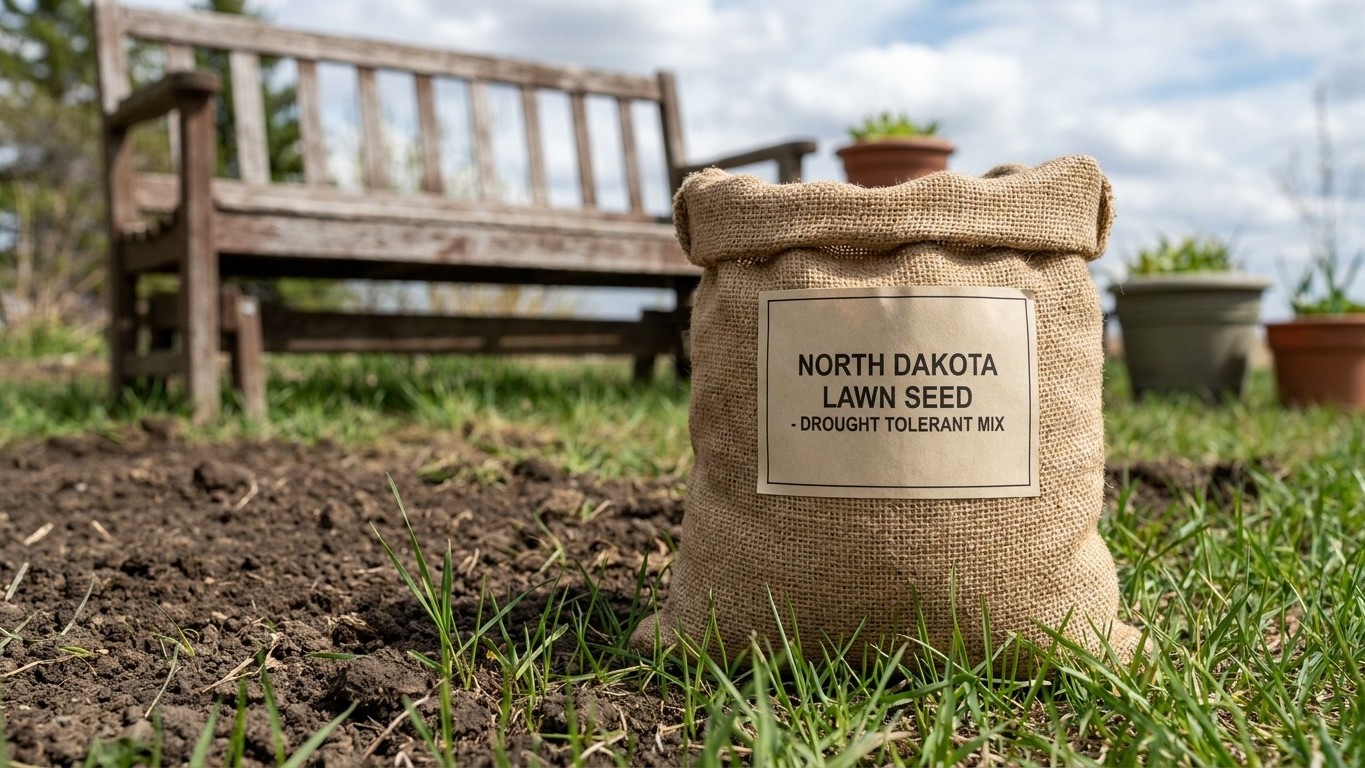

North Dakota lawns do best with cool-season grasses, and Kentucky bluegrass is the strongest single choice for most yards, usually blended with fine fescue and perennial ryegrass for faster cover and shade tolerance. NOAA’s 1991-2020 climate normals put the first fall freeze near Fargo at September 25 to October 5, and the whole seeding calendar works backward from that window. Check your own county’s frost record before you buy seed, then plant six to eight weeks ahead of it so the grass roots before growth stops.
The short answer for North Dakota
Kentucky bluegrass gets recommended so often in North Dakota that it starts to sound like the only answer, and for an open, sunny lawn it earns that reputation, spreading by rhizome to heal its own bare spots. But that same bluegrass sulks under mature elms, thins out fast where kids and dogs cut the same path daily, and struggles if you can’t water through a dry August. The right seed here depends on your actual yard, not the state’s favorite.
Among those five, Kentucky bluegrass is the default recommendation for open, sunny lawns because it spreads by underground rhizomes and repairs its own bare patches, something none of the others do on their own. But the right seed for your yard still depends on three things: how much direct sun the lawn gets, how much foot traffic it takes, and whether you can water it through a dry August. A shaded yard under mature elms leans toward fine fescue or rough bluegrass instead. A high-traffic yard with kids and dogs benefits from a bluegrass-ryegrass blend rather than straight bluegrass, since ryegrass establishes fast enough to hold the soil while the bluegrass fills in behind it.
This zone label describes the reference city of Fargo. Higher ground in the western part of the state, and anywhere north toward the Canadian border, runs colder than the Fargo normals suggest, so treat the zone assignment as a starting point and confirm it against your own site before you commit to a single species. For the full year of tasks that follow from this seed choice, see North Dakota Lawn Care.
Working through the year

Ranked for a typical North Dakota yard, from the safest default to the most situational choice, here is what each species costs you in exchange for what it gives.
Kentucky Bluegrass

This is the workhorse for open lawns. It spreads by rhizome, so it heals foot traffic and thin patches on its own over a season or two, and it holds up to the cold better than any other grass on this list. The cost is slow establishment: seed can take two to four weeks to show a stand, and a newly seeded bluegrass lawn needs more careful watering during that stretch than the faster species.
Tall Fescue

Tall fescue roots deeper than bluegrass, which makes it more forgiving through a dry August, and its coarser blade tolerates some foot traffic well. The trade-off is that it grows in bunches rather than spreading, so a bare patch stays bare until you overseed it. Clemson Cooperative Extension’s tall fescue maintenance calendar (HGIC 1219) lays out the mowing height, nitrogen timing, and overseeding schedule for this species in detail. It is written for a milder climate than North Dakota, so use it for the sequence of tasks, mow, feed, aerate, overseed, and shift the actual calendar dates earlier to match the Fargo frost window rather than following it month for month.
Fine Fescues

Fine fescue is the shade specialist. It needs less nitrogen and less mowing than bluegrass, which suits a low-input side yard, but it thins out fast under regular foot traffic and does not recover the way bluegrass does. Use it under trees or on a strip of lawn that gets more shade than sun for most of the day.
Perennial Ryegrass

Ryegrass germinates faster than any other grass on this list, often within a week, which is why it shows up in blends as the “nurse grass” that holds bare soil while slower species establish. Its weakness is winter survival: in the coldest years it can suffer more winterkill than bluegrass or fine fescue, so it works best as a minority partner in a blend rather than a lawn on its own.
Rough Bluegrass

Rough bluegrass, sold and labeled as Poa trivialis, wants constant moisture and shade. It spreads by shallow stolons across wet, shaded ground where almost nothing else will hold, but it thins badly the moment the soil dries out or the sun gets stronger than dappled shade. Reserve it for the damp shady corner under a downspout, not the rest of the yard.
| Species | Establishes | Cold tolerance | Spreads on its own | Best use |
|---|---|---|---|---|
| Kentucky Bluegrass | Slow (2-4 weeks) | Very good | Yes, by rhizome | Open, sunny lawns |
| Tall Fescue | Moderate | Good | No, bunch-type | Drought-prone sites |
| Fine Fescues | Moderate | Good | Limited | Shade, low input |
| Perennial Ryegrass | Fast (about 1 week) | Fair | No | Nurse grass in blends |
| Rough Bluegrass | Moderate | Fair | Yes, by stolon | Wet, shaded corners |
What changes across North Dakota
The Fargo normals cited above come from a single weather station in the Red River Valley, on the state’s eastern edge, and NOAA’s own data notes that suburban and rural ground away from that airport station typically sees its first fall frost earlier, sometimes by one to two weeks. That gap matters most in two parts of the state.
The western Missouri Plateau, the higher, rougher ground running toward the Badlands, sits at meaningfully greater elevation than the Red River Valley and cools off faster once autumn starts. A seed order timed to Fargo’s late-September to early-October frost window is likely to be a week or more too late for a lawn out there. The Turtle Mountains and other high ground near the Canadian border run the same way, colder and earlier than the valley floor.
The Red River Valley itself, flat and low relative to the rest of the state, is the one part of North Dakota where the Fargo figures apply most directly without adjustment. If you garden anywhere else, the safest approach is to treat the NOAA frost window as your latest safe seeding cutoff, not your target date, and to lean early rather than late when the two conflict. That difference in timing carries through the whole season, and it is worth checking against The North Dakota Lawn Care Calendar, Month by Month before you settle on a planting week.
The mistakes this climate punishes
Seeding cool-season grass too late in the year
Every species on the recommended list needs enough warm soil and daylight to root before the ground freezes. Seed thrown down in September without enough runway before the first fall frost near Fargo, September 25 to October 5 by NOAA’s normals, germinates into seedlings too small to survive winter. The damage does not show until the following April, when the seeded area comes back thin or bare while the established turf around it greens up fine.
Mowing too short in a hot, dry summer
A lawn scalped to save mowing trips loses the leaf area it needs to shade its own root zone. Through a hot, dry stretch this shows up within one to two weeks as a lawn that browns faster and recovers slower than a neighbor’s lawn cut a notch or two higher. The grass is not dead, it is dormant, but a short cut makes that dormancy deeper and the green-up slower once rain returns.
Treating a warm-season lawn like it belongs here
Bermudagrass, zoysia, and other warm-season species are built to green up from stolons and rhizomes once soil warms in late spring, and to go dormant at the first hint of cold. In a North Dakota winter that dormancy does not end. The grass simply does not survive, and any lawn seeded with a warm-season species here is a one-season lawn, not a perennial one, whatever the seed bag promises about drought tolerance.
Skipping fall overseeding on a thinning lawn
Cool-season grasses thicken up most reliably with an overseeding pass in late summer, timed to the same six-to-eight-week window ahead of the first fall frost used for a new lawn. Skip that window and a thinning lawn just keeps thinning, since the bare soil left behind by winterkill or summer stress does not fill in on its own without new seed making contact with soil in time to root.
Checking this against your county
Every figure above comes from a single reference point near Fargo, and the caution attached to it is not decorative: elevation, latitude, and distance from the Red River Valley all shift the real frost dates on your own property. Before you buy seed or set a mowing schedule, check current recommendations and local frost data through NDSU Extension, which tracks conditions by county rather than by a single airport station.
Common questions
Can I just seed a warm-season grass like Bermuda and see if it survives?
No, and this is not a marginal call. Warm-season species go fully dormant at the first hard freeze and do not resume growth in spring in a climate this cold, so the lawn dies over its first winter rather than surviving in weakened form.
Is spring or fall the better time to seed in North Dakota?
Fall is generally more reliable for cool-season grasses here, because seedlings root into cooling, moister soil and face less competition from weeds than a spring-seeded lawn does. Spring seeding works too, but the seedlings then have to survive the heat and dryness of their first summer, which is a harder test than a fall-seeded lawn faces.
My lawn is one big shady patch under old trees. Is bluegrass still my best bet?
Probably not on its own. Kentucky bluegrass wants at least several hours of direct sun to hold thick turf, and in deep shade it thins out over a season or two. Fine fescue tolerates shade far better and is the standard substitute for that spot, with rough bluegrass as a second option if the shaded area also stays consistently damp.
How do I know if my county’s frost dates are different from Fargo’s?
You will not know from a seed catalog or a national planting map, since those figures are averaged too broadly to reflect one county. NDSU Extension is the source to check for local conditions, and a longtime neighbor’s own planting dates are often a useful practical cross-check as well.