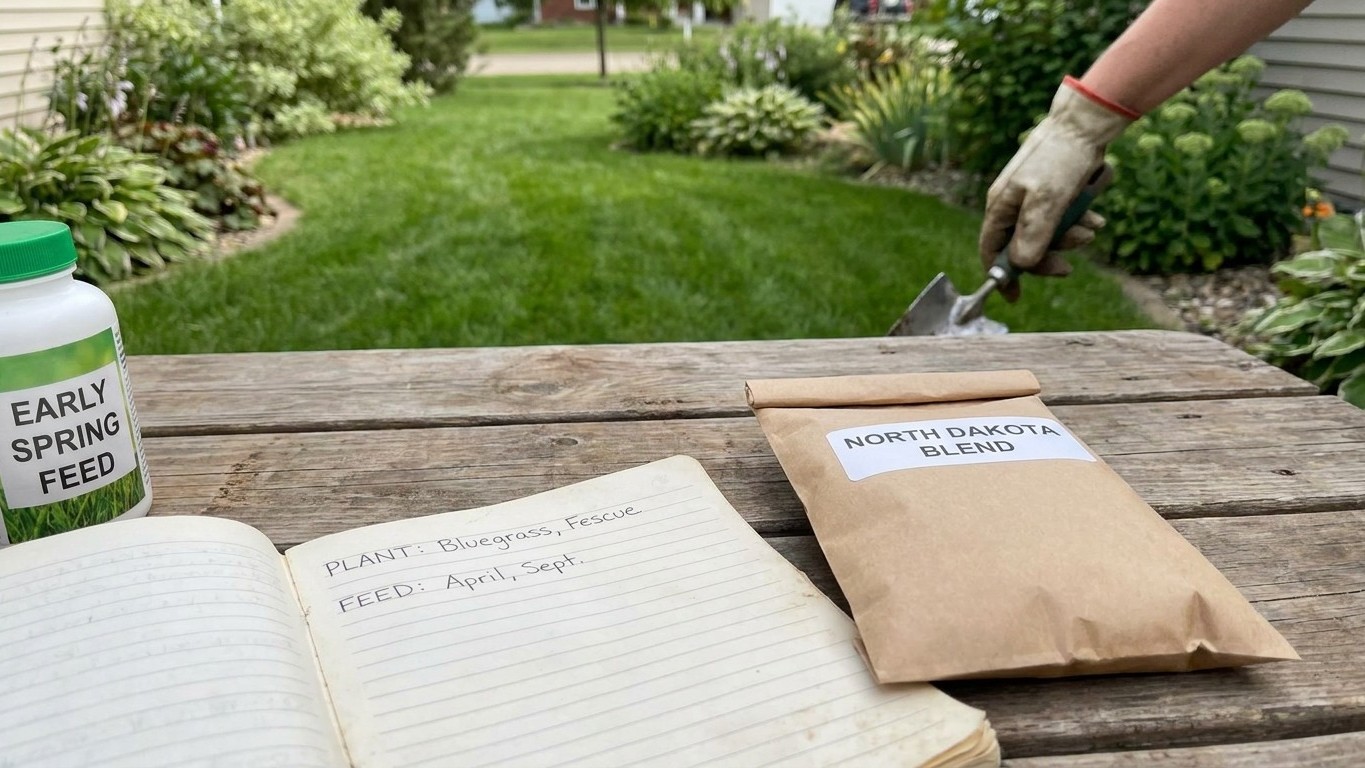

Zero point one degrees — that’s the average daily low in Fargo’s coldest month, and it’s the number that decides everything else in this guide. Warm-season grasses like Bermuda and zoysia, the kind that carry a Florida lawn through winter, simply don’t wake up from a freeze that deep. So while other states plant and feed on a warm-season calendar, North Dakota runs on cool-season grass alone, and the choice among them comes down to which ones actually hold a lawn together here.
Which grass belongs in North Dakota

The two numbers that decide this both come from NOAA’s 1991-2020 climate normals at the Fargo reference station: 11.7 days a year hit 90°F or hotter, and the coldest month averages a daily minimum of just 0.1°F. That second figure matters most. No warm-season grass survives a winter that cold, because Bermuda grass, zoysia and centipede grass all die out well before soil temperatures fall into single digits. A lawn in a state like Florida is built on those same warm-season species, planted and fed on an entirely different calendar because the ground there never freezes hard enough to kill them back.
That leaves the cool-season list, and Clemson Cooperative Extension’s HGIC 1214 guide to selecting a lawn grass names five species that hold up here: Kentucky bluegrass, tall fescue, perennial ryegrass, fine fescue, and rough bluegrass. Each has a different strength, which is why most North Dakota lawns end up as a blend rather than a single species.
- Kentucky bluegrass spreads by rhizomes and repairs its own bare spots, but it goes dormant fastest in dry heat.
- Tall fescue grows a deep root system and tolerates drought better than the others, though it grows in bunches rather than spreading.
- Perennial ryegrass germinates fast and is often mixed in to hold soil while slower species establish.
- Fine fescue handles shade and poor soil better than the rest, useful under trees.
- Rough bluegrass tolerates wet, shaded ground where the others thin out.
North Dakota’s answer is unusually clean. Not every state gets one: a reader in Ohio sits in a transition zone, where cool-season and warm-season grasses both struggle and neither is the obvious pick. Here, the cold settles it. Choose a bluegrass-fescue-ryegrass blend suited to the schedule laid out in The North Dakota Lawn Care Calendar, Month by Month, suited to the yard’s sun and soil, and skip anything sold as a warm-season lawn seed, however the packet markets it. For a closer look at how these species compare side by side, see this guide to North Dakota lawn Best grass options.
When to seed or sod here
Cool-season grasses go into the ground on a different calendar than warm-season turf. Clemson Cooperative Extension’s HGIC 1203 timing guide splits the year in two: warm-season lawns are seeded or sodded around May, once soil has warmed, while cool-season lawns go down in late summer to early fall, while soil is still warm but air temperatures are dropping. North Dakota’s lawn is the second kind, and the target date follows from the first fall frost, not the wall calendar.
NOAA’s 1991-2020 climate normals put the first fall freeze at the Fargo airport station between September 25 and October 5, in the 30 to 70 percent probability band for a 32°F reading. New cool-season seedlings need roughly six to eight weeks of growth before a hard frost stops them, so counting back from that window lands the seeding date somewhere in late July to late August, depending on which end of the frost window a given year falls on. Seed earlier in that stretch if the summer has run dry, later if it’s been wet, since soil moisture at planting matters more than hitting an exact date.
Sod follows the same seasonal logic but skips the germination risk: it can go down in spring or fall since it’s already rooted, but a fall install still gives roots more time to establish before winter dormancy than a spring one squeezed against summer heat. Either way, water new sod or seed daily until roots take hold, then taper off.
Spring seeding is possible but riskier here: a spring-sown lawn has to establish before the short hot stretch each summer, and weed pressure from crabgrass and foxtail runs higher on spring-seeded ground than on a lawn started in fall. Fall seeding is the more forgiving choice for most North Dakota yards. Because the September 25 to October 5 figure comes from a single airport station, a garden farther from Fargo, or at higher elevation, can see its own first frost a week or two earlier or later, so treat that window as a starting point and watch the yard’s own frost history.
The feeding calendar that fits this climate
Nitrogen timing follows the grass’s growing season, not the wall calendar, and that’s what trips up a lot of North Dakota lawns fed on a schedule copied from somewhere warmer. A cool-season lawn does most of its root growth in fall, when day length shortens and soil is still workable, so the heaviest feeding falls in September rather than midsummer. A warm-season lawn, by contrast, is fed as it comes out of dormancy in late spring, which is irrelevant here since this territory doesn’t grow warm-season turf at all.
Rates and windows, not a flat number
Clemson’s HGIC 1219 tall fescue maintenance calendar lays out a full-season feeding schedule for tall fescue lawns specifically, with pounds-of-actual-nitrogen rates for each application window rather than one number for the whole year. Follow the rates printed on that calendar rather than a flat number, because the right amount changes with the grass’s age, the mowing height it’s kept at, and how much nitrogen is already sitting in the soil, something only a soil test answers. A newly seeded lawn, an established lawn, and a lawn recovering from drought stress all call for different totals in the same September window.
For the other cool-season species grown here, Kentucky bluegrass, perennial ryegrass, fine fescue and rough bluegrass, the same fall-weighted principle applies even where a state-specific calendar isn’t published: put the bulk of the nitrogen down as the grass is rooting into fall, not while it’s fighting summer heat. A light application in early fall followed by a heavier one several weeks later, timed before growth slows for winter, does more for root reserves than one large feeding dumped on all at once in spring.
Skip nitrogen altogether during the short stretch of hot weather in mid-summer. With Fargo averaging only 11.7 days a year at or above 90°F under NOAA’s normals, that heat-stress window is brief, but it still falls in the same stretch when feeding does the least good, which is why most tall fescue calendars leave midsummer blank on purpose.
Mowing height and watering here
Cool-season grasses in this territory are cut taller than most warm-season lawns, and mowing height is one of the few levers a homeowner controls every single week. Kentucky bluegrass and perennial ryegrass are generally kept between 2.5 and 3.5 inches, tall fescue a bit taller at 3 to 4 inches, and the fine fescues can run slightly shorter in shade. Never remove more than one-third of the blade length at a single mowing, the standard rule across cool-season turf: scalping past that strips too much leaf area at once and forces the plant to draw on root reserves to recover, the same reserves it needs for the fall feeding push described above.
Watering through the short hot stretch
An inch of water a week, from rain and irrigation combined, is the common rule of thumb for cool-season turf in active growth. North Dakota rarely tests that figure the way a hotter state does. With only 11.7 days a year at or above 90°F at the Fargo station under NOAA’s 1991-2020 normals, evaporative demand stays modest for most of the summer, and a lawn on decent soil often gets by on less supplemental water than the same species would need farther south.
Two things push that number up locally: sandy soil, common in parts of the state, drains fast and needs more frequent, lighter watering rather than one deep soak, and any stretch that does reach the 90s pulls moisture out of the top few inches of soil quickly even if it’s brief. Water in the morning rather than evening, so blades dry before nightfall, and let the lawn show its own need. A cool-season lawn that’s short on water simply goes dormant and gray-brown rather than dying, and it greens back up once rain returns.
What goes wrong on lawns in North Dakota

The failures here follow directly from the two numbers that opened this piece: a long, hard winter and a short, mild summer, rather than the humid, disease-heavy summers that plague lawns further south or east.
Winter injury, not summer disease
Because the coldest month at Fargo averages a daily minimum of 0.1°F under NOAA’s 1991-2020 normals, the bigger risk to a North Dakota lawn is winter injury: crown damage from ice sheeting over the grass, or desiccation on exposed, snow-free ground during a cold, dry stretch. A lawn that looks dead in April is more often winter-damaged than actually dead, and most cool-season turf pushes new growth from the crown once soil warms, even after a rough winter.
Fungal disease that shows up as brown patch or dollar spot in humid climates is less common here, simply because the humid, hot nights that drive those diseases are rare at this latitude. Snow mold is the more likely fungal problem, appearing as matted, discolored patches right where snow sat longest into spring, usually along drifts and shaded fence lines.
Drought dormancy in the short hot stretch
During the brief run of 90-degree days each summer, cool-season turf that isn’t watered will brown off and stop growing. That’s dormancy, not death: the crown survives underground and the lawn resumes growth once temperatures drop and rain returns, usually within a couple of weeks.
- Thin, matted, gray or pink-tinged patches after snowmelt: likely snow mold, not a summer disease.
- Whole lawn browning in a dry, hot stretch: dormancy, not death, in cool-season turf.
- Bare patches that show up every spring in the same low spots: often ice damage or standing meltwater, not a pest.
- Weeds thickening in a lawn mowed too short the previous fall: thin turf going into winter recovers slower and gives weeds an opening.
Local help
A soil test through North Dakota State University’s Extension service is the fastest way to know whether a given yard actually needs the nitrogen rates in a general calendar, or less, since soil already carries some nutrients most calendars assume are missing. NDSU Extension also fields county-level questions on grass selection, timing, and problem diagnosis; find the local office through the NDSU Extension directory.
Common questions
Can I plant Bermuda grass if I find a cold-hardy variety?
No. The coldest-month minimum at Fargo runs to 0.1°F under NOAA’s 1991-2020 normals, and no Bermuda cultivar sold for home lawns survives that kind of winter cold. Stick to the cool-season species named above.
What if I miss the fall seeding window?
Wait for spring rather than seeding into a hard freeze. Spring-seeded cool-season lawns establish more slowly and face heavier weed competition than fall-seeded ones, but they still take, and a thin spring lawn can be overseeded again the following fall.
Why does my new lawn look thin the first spring after fall seeding?
That’s normal for cool-season grass in its first year. Kentucky bluegrass in particular spends its first season building roots and rhizomes below ground before it thickens up on top, so a lawn seeded one September often doesn’t look full until the second summer.
Do I need to water a dormant lawn in winter?
No. Cool-season turf under snow cover is dormant, not actively growing, and winter watering does nothing but risk ice forming on the crown. Resume watering once spring growth starts and the ground has thawed.
Can I patch a bare spot with a warm-season grass seed mix I found online?
No, it will die at the first hard freeze regardless of how the packaging is marketed. Patch bare spots with the same cool-season seed already growing in the rest of the lawn, ideally during the same late-summer to early-fall window used for full overseeding.