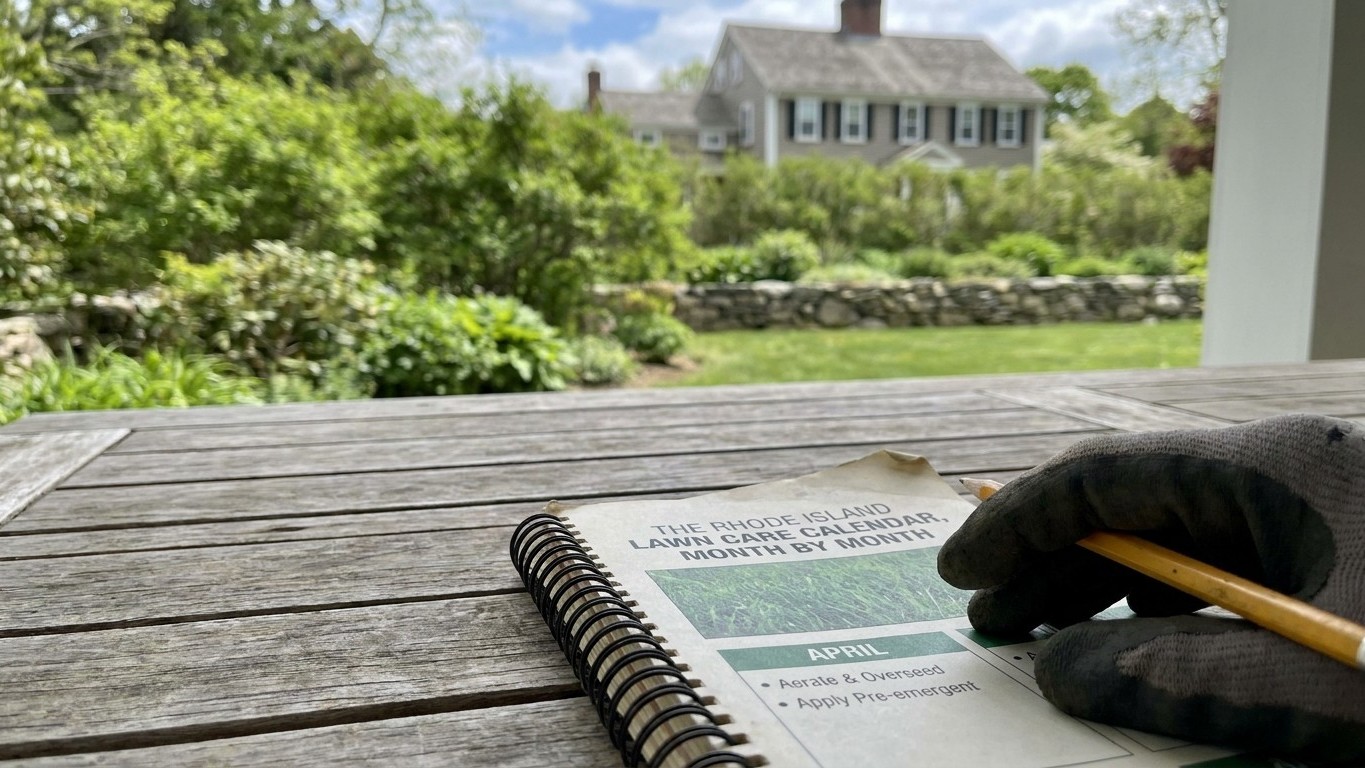

October 24 to November 3 is the frost window that decides almost everything else on this calendar, because fall seeding, fall fertilizing, and the last mow all get timed backward from those eleven days at the Providence airport station. Rhode Island falls in the cool-season zone, so the five grasses worth planting are Kentucky bluegrass, tall fescue, fine fescues, perennial ryegrass, and rough bluegrass — never bermudagrass or zoysia, no matter what the bag promises. Higher ground shifts the dates slightly; that’s next.
The short answer for Rhode Island
Rhode Island sits in the cool-season turf zone, the classification The Homestead Post assigns by reading climate normals against Clemson Cooperative Extension’s HGIC 1214 season tolerances, applied here to Providence as the reference city. Higher ground and the far corners of the state can lean slightly differently, which the next section covers. The five species that actually hold up here are Kentucky bluegrass, tall fescue, fine fescues, perennial ryegrass, and rough bluegrass, the cool-season lineup Clemson HGIC 1214 and Penn State Extension both list. Warm-season turf like bermudagrass or zoysia never gets a real footing in a New England winter, so a bag labeled for a Southern lawn is the wrong purchase regardless of the price on the shelf.
The other fixed point is the frost window itself. NOAA’s NCEI 1991-2020 normals put it at October 24 to November 3, measured at the Providence airport weather station, and that range, not a single date, is what fall seeding and fall fertilizing work backward from.
What this answer depends on: which of the five species you’re actually growing, since tall fescue and Kentucky bluegrass are worked on slightly different clocks even though both are cool-season, how sheltered or exposed your yard is, and how far you sit from Providence itself. If you haven’t settled on a species yet, The Best Grass Seed for Rhode Island Lawns walks through which of the five fits a given yard, and that decision should happen before the fall seeding window below, not during it. This calendar also assumes you’ve already handled the groundwork covered in our broader guide to Rhode Island lawn care, a soil test and a mower set up correctly, before layering a seasonal schedule on top.
Working through the year

Clemson Cooperative Extension’s HGIC 1219 Tall Fescue Maintenance Calendar sets out the mowing heights and nitrogen rates that apply to tall fescue as a species. Rhode Island growers can use those same rates, just shifted onto the state’s own frost window instead of South Carolina’s warmer one. If you’re growing Kentucky bluegrass or a fine fescue instead, the shape of the year is the same: most nitrogen goes down in fall, spring is about crabgrass control and light feeding, and summer is mostly about restraint.
Early spring
Start mowing once growth is active, and set the deck to 2.5 to 3.5 inches for tall fescue, the range HGIC 1219 calls for. A pre-emergent herbicide for crabgrass goes down early, before soil has fully warmed, not after crabgrass is already visible. Hold off on heavy nitrogen. HGIC 1219 weights most of the year’s feeding toward fall, and a lawn pushed hard with nitrogen in spring grows soft top growth at the expense of the root system it will need come summer.
Late spring into summer
Keep the mowing height steady or raise it slightly as heat builds. Water is the main lever through this stretch. About 1 inch per week, rain and irrigation combined, keeps cool-season turf from tipping into drought stress. If a hot, dry August turns the lawn brown anyway, that’s dormancy, not death. Cool-season grass browns under drought and greens back up once rain returns, so resist reseeding a lawn that’s simply resting.
Fall
This is where a cool-season lawn does its real work. Overseeding, aeration, and the bulk of the year’s nitrogen all land here, timed against the frost window. Seed needs roughly six weeks of mild weather to root before a hard freeze. Counting six weeks back from NOAA’s October 24 to November 3 window puts the safe seeding stretch in early to mid September for most of the state, earlier still if you’re farther inland or higher than Providence. Aeration, where thatch or compaction is a problem, works best right alongside overseeding so new seed has somewhere to root. HGIC 1219 calls for roughly 3 to 4 pounds of nitrogen per 1,000 square feet across the whole year for tall fescue, with the largest single dose going down in fall, since that’s when cool-season roots build the reserves that carry the lawn through next summer.
Winter close-down
Keep mowing until growth stops, and make the last cut of the season shorter than summer height, near the bottom of the 2.5 to 3.5 inch range, so the lawn doesn’t go into winter with long blades that mat under snow and invite snow mold. Stop fertilizing once growth has stopped. Nitrogen applied after the frost window closes feeds nothing but runoff.
| Season | Mowing height | Nitrogen | Key task |
|---|---|---|---|
| Early spring | 2.5-3.5 in. | Light or none | Pre-emergent for crabgrass |
| Summer | 3-3.5 in. | None | About 1 in./week water |
| Fall | 2.5-3 in. | Majority of the 3-4 lb annual total | Overseed, aerate |
| Winter close | Low end of range | None | Stop mowing and feeding |
What changes across Rhode Island
The October 24 to November 3 frost window is a Providence figure, measured at the airport station under NOAA’s NCEI normals, and it doesn’t hold everywhere in the state. Rhode Island is small, but the coast and the interior run different calendars.
Coastal towns, Newport, Narragansett, and the shoreline of Washington County, sit close to open water, which moderates temperature swings in both directions. Expect frost to typically arrive later than the Providence figure in a given fall, and the growing season to run somewhat longer, though no separate NOAA figure exists in the facts here for these towns, so treat this as a direction rather than a number.
Inland and northern Rhode Island, including the higher ground around Glocester, Foster, and the rest of Providence County’s northwest corner, cools faster once autumn sets in and typically sees frost arrive earlier than the airport average. This is the part of the state where pushing fall seeding to the late end of the calculated window carries the most risk.
Block Island, surrounded entirely by water, runs on its own clock again, generally milder than the mainland through both the spring warm-up and the fall cool-down.
Wherever you garden, treat the Providence figure as a starting point, not a guarantee. If you’re near the coast or up in the state’s northwest hills, watch your own ten-day forecast rather than the calendar date alone once you’re within a few weeks of a seeding or last-mow decision.
The mistakes this climate punishes
Rhode Island’s cool-season climate is unforgiving of a few specific habits, and each one shows its damage on a different schedule.
The most common is buying grass seed built for a warmer climate. Bermudagrass, zoysia, and St. Augustine are warm-season species that go dormant and brown at the first real cold, and unlike a cool-season lawn they don’t green back up in spring because they were never going to survive a Rhode Island winter as a perennial in the first place. If a bag doesn’t list Kentucky bluegrass, tall fescue, fine fescue, perennial ryegrass, or rough bluegrass as the species, it isn’t built for this state.
- Buying a warm-season or “Southern” seed blend: it dies over the first hard freeze, usually visible by late fall.
- Seeding cool-season grass in late spring instead of fall: young grass then has to establish straight through summer heat it isn’t built to handle.
- Scalping the lawn in July or August: a short cut in hot, dry weather stresses roots and shows up as thin, browned turf within weeks.
- Fertilizing heavily after the fall frost window closes: the grass has stopped growing, so the nitrogen sits on the soil or washes off instead of building roots.
Fertilizing on the wrong end of the calendar does damage that doesn’t show up right away. A spring-heavy feeding program pushes fast, soft top growth exactly when the lawn should be building roots for summer heat, and the cost shows up as wilting and disease pressure in July, weeks after the fertilizer went down. HGIC 1219’s fall-weighted schedule exists because tall fescue, like the state’s other cool-season grasses, does most of its root growth as air temperatures drop, not as they rise.
The last one is treating the calendar page as a fixed date instead of a window. Seed put down too close to, or after, the October 24 to November 3 frost range closes doesn’t get the six weeks it needs to root before winter, and a thin, patchy stand the following spring is the usual result, not something a quick spring reseeding fully repairs before summer stress hits again.
Checking this against your county
Every figure in this calendar traces back to one weather station in Providence and one maintenance calendar written for a different, warmer state. Your own county may run on a slightly different clock, especially if you’re on the coast or up in the northwest hills. The University of Rhode Island’s Cooperative Extension is the place to check anything local before locking in a seeding date, since they can speak to specific soils, drainage, and frost patterns county by county in a way a national average can’t. Find your local office through URI Cooperative Extension before committing to any date in this calendar.
Common questions
Can I still seed my lawn in October in Rhode Island?
It depends on how close you are to the frost window closing. NOAA’s Providence figure puts the first fall frost between October 24 and November 3, and seed needs about six weeks of mild weather to root, so seeding in October is already late for most of the state and risky in the colder northwest corner.
Why is my lawn still brown in early spring?
Cool-season grass green-up lags behind air temperature, so a lawn that looks brown in March or early April is often just not growing yet, not dead. If patches stay brown well after the rest of the lawn has greened, check for matted, moldy-looking spots, which usually points to snow mold from going into winter with the grass cut too long.
Do I need to aerate every year?
Most lawns don’t need it annually. Aeration matters most where soil is compacted or thatch has built up past about half an inch, and it pairs best with fall overseeding rather than being done on its own.
Can I mow through the winter if we get a warm stretch?
Only if the grass is actually growing, which is rare once the fall frost window has passed. A warm day alone doesn’t mean the lawn needs a cut, and mowing dormant turf mostly just risks scalping grass that isn’t putting out new growth to recover with.