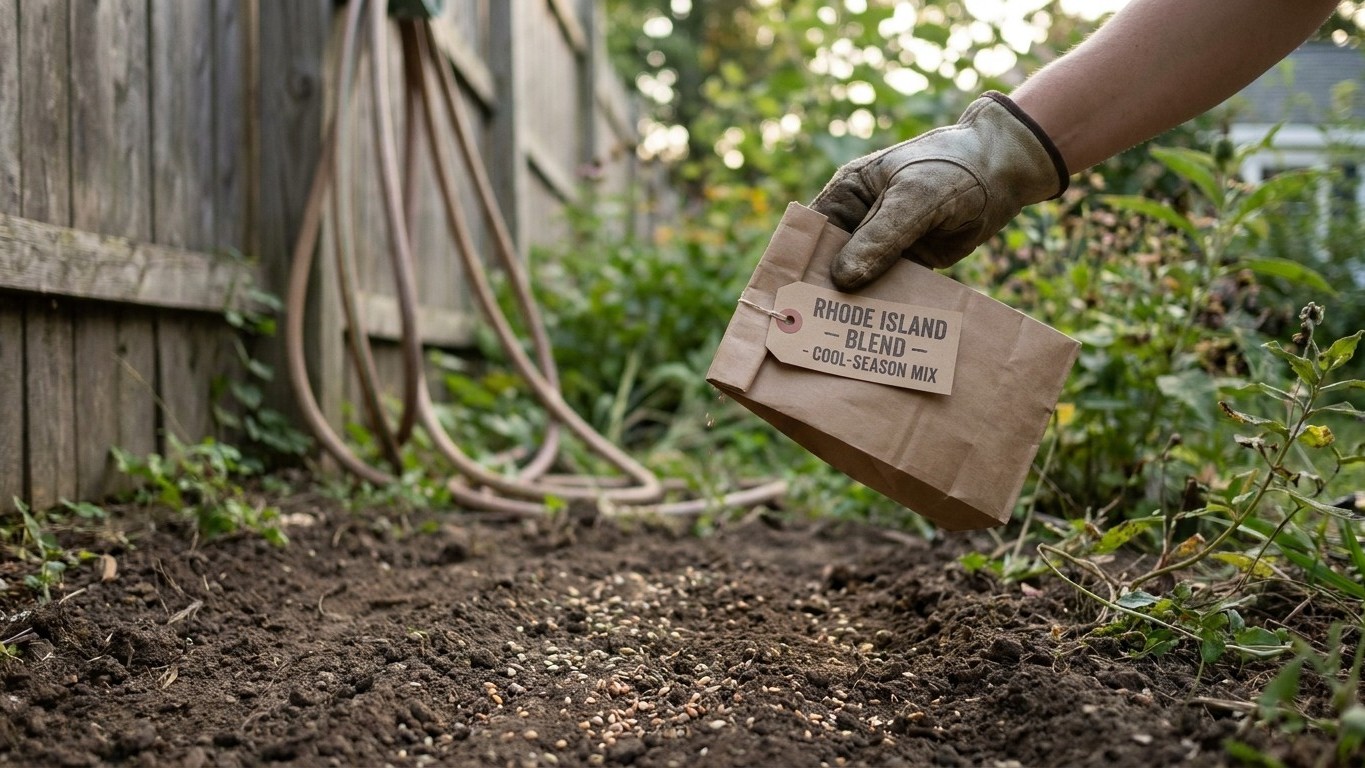

Rhode Island sits in the cool-season turf zone, so the seed that actually holds up here is tall fescue, Kentucky bluegrass, perennial ryegrass, fine fescue, or rough bluegrass, not a warm-season species. NOAA’s 1991-2020 climate normals put Providence’s first fall freeze between October 24 and November 3, which is the anchor date for working out when to sow. Buy seed now, but hold off putting it down until you’ve counted back from that frost window for your own county.
The short answer for Rhode Island
Providence’s climate line runs straight through this state’s lawns, not around them. Buy a bag labeled for New England and you’re guessing whether your yard sits on the milder coastal side of that line or the colder hill-town side — and that guess decides whether tall fescue takes hold or rots in a wet corner. Rhode Island doesn’t have one right grass seed. It has five, and which one you need, and when you sow it, comes down to that line and your own patch of ground.
For most yards, a blend built around turf-type tall fescue with some Kentucky bluegrass mixed in gives the best combination of drought tolerance and self-repair. Shaded side yards and the north side of a house do better on a fine fescue blend, and rough bluegrass earns its keep only in the wet, shaded low spots where nothing else survives, despite its weak wear tolerance elsewhere.
Which of the five you actually want depends on how much sun the site gets, how much foot and pet traffic it takes, how the soil drains, and how closely you can hit the fall sowing window. None of the five is wrong for this climate. What’s wrong is picking one that doesn’t match the site, or seeding it at the wrong time of year, which is where most lawns actually fail. Coastal towns and the state’s northern hill towns sit slightly either side of the Providence line, and that matters more for timing than for which species you buy.
Working through the year

If you haven’t already worked through soil testing and site prep, that groundwork is covered in Rhode Island Lawn Care and it’s worth doing before you buy a single bag of seed. Once the site is ready, the five species rank differently depending on what the yard actually asks of them.
| Species | Texture & color | Best site | Trade-off |
|---|---|---|---|
| Tall Fescue | coarse, dark green | full sun to light shade, high traffic | needs deep infrequent watering to hold its roots down |
| Kentucky Bluegrass | fine, blue-green | full sun | slow to germinate and thirstier than fescue |
| Perennial Ryegrass | fine, glossy dark green | full sun, high traffic | bunch-type, won’t fill bare spots on its own |
| Fine Fescues | very fine, thread-like | shade, low fertility soil | thins fast under heavy foot traffic |
| Rough Bluegrass | light green, shiny, creeping | wet, shaded ground | weak in drought, disappears in summer heat |
Tall Fescue

Tall fescue’s deep root system is what makes it the workhorse choice for a Rhode Island yard that sees kids, dogs, or a dry August. It germinates in a middle range compared to the other four, faster than bluegrass and slower than ryegrass, and it holds its color through short dry spells that would brown out a straight bluegrass lawn.
Kentucky Bluegrass

Kentucky bluegrass spreads by rhizomes, so it’s the only one of the five that fills in its own bare patches without reseeding. That self-repair comes at the cost of a slow germination and a higher water and fertility demand than tall fescue, which is why it’s usually blended rather than sown alone.
Perennial Ryegrass

Perennial ryegrass germinates faster than any of the other four cool-season species, which makes it useful for a quick fall overseed or a nurse grass while slower species establish. It grows in bunches rather than spreading, so any bare spot it leaves behind stays bare until you reseed it.
Fine Fescues

Fine fescue tolerates shade and low-fertility soil better than any of the other four, and it needs less nitrogen to look decent. It’s the wrong choice for a play area or a dog run, since its fine blades don’t recover well once foot traffic wears through the crown.
Rough Bluegrass

Rough bluegrass, sold as Poa trivialis, is a specialist for wet shaded ground where drainage is poor and sun is scarce. Move it into full sun or let a dry summer set in and it thins out fast, so it belongs only in the specific spots where nothing else will grow.
When to actually put seed down
Cool-season seed goes in the ground in late summer to early fall, not in spring, because fall gives seedlings cool nights and a long root-building stretch ahead of winter without the crabgrass competition and heat stress a June sowing runs into. NOAA’s 1991-2020 climate normals put Providence’s first fall freeze between October 24 and November 3. Counting back the six to eight weeks that cool-season seed needs to root in before frost lands the safe sowing window in early-to-mid September for lawns near Providence, and gardens elsewhere in the state should shift that window using their own county’s frost pattern rather than this one.
Clemson Cooperative Extension’s HGIC 1219 Tall Fescue Maintenance Calendar spells out mowing height, nitrogen rate, and aeration timing for a tall fescue lawn through the year. The rates themselves carry over, but the calendar dates are written for South Carolina, so shift every task on it to line up with Rhode Island’s later spring and earlier fall frost instead of Clemson’s dates. For the month-by-month version built around Rhode Island’s own dates, see The Rhode Island Lawn Care Calendar, Month by Month.
What changes across Rhode Island
Providence’s airport station, where NOAA takes its readings, sits close to sea level and close to Narragansett Bay, and both of those moderate its temperature swings. Inland and upland towns such as Burrillville, Foster, and Glocester run measurably colder at night, so their first fall frost typically lands earlier than the October 24 to November 3 window NOAA’s 1991-2020 normals record for Providence, often by one to two weeks. That pulls the safe seeding window for those towns earlier into late August rather than September.
Coastal and island communities run the other way. Newport, the South County shoreline, and Block Island stay milder into fall because the Atlantic holds its heat longer than inland ground does, so frost tends to arrive later than the Providence figure and the growing season stretches a bit longer at both ends. A lawn on Aquidneck Island or in Westerly can often hold a September sowing later into the month than one in the Blackstone Valley can.
None of this changes which five species work, since the whole state sits in the same cool-season zone. It changes only when you should act. Treat the Providence dates as a starting point and adjust by a week or two in either direction based on your own site’s elevation and distance from the water, rather than swapping in a different species.
The mistakes this climate punishes
Seeding cool-season grass in late spring or early summer is the single most common failure here. A May sowing can germinate just fine, but the seedling’s roots are still shallow when Rhode Island’s summer heat and dry spells arrive in July, and much of the stand dies before it ever reaches fall. The damage shows up as bare patches by August, not as an obvious failure at planting time.
Mowing too short during a summer dry spell is the second mistake. Cutting cool-season grass down to an inch or less in July strips away the leaf area the plant needs to keep photosynthesizing under heat stress, and the lawn goes from a healthy summer dormancy into actual die-back that needs reseeding come fall. A cool-season lawn browning in a July drought is not dead, it is dormant, and it usually greens back up once rain and cooler nights return, but only if it wasn’t scalped first.
Heavy late nitrogen, applied into November after growth has already slowed for the season, is the third mistake. It pushes soft leaf growth right before the ground freezes, which invites snow mold under any lingering snow cover and wastes fertilizer the plant can’t use once soil temperatures drop. The damage doesn’t show until the following spring, when matted gray or pink patches turn up as the snow melts back.
Planting a warm-season species here at all, whether from seed marketed as drought-tolerant somewhere else or sod bought out of state, is the last one. Rhode Island’s winters fall well outside where Bermuda, zoysia, or St. Augustine survive, so a warm-season lawn planted here simply doesn’t return the following spring, no matter how good it looked through its first summer.
Checking this against your county
Every figure above comes from the Providence station, and Rhode Island’s coastline, elevation changes, and urban heat differences are enough to shift a frost date by a week or two even within a single county. Before committing to a seeding weekend, check current conditions with URI Cooperative Extension, the state’s land-grant extension service, which tracks conditions county by county rather than from one airport reading.
Common questions
Can I just seed in spring instead of waiting for fall?
You can, but it’s a harder path. Spring-sown cool-season grass has to compete with crabgrass germination and then survive its first summer on shallow roots, so fall sowing near the Providence frost window generally establishes a stronger stand with less watering.
Will Kentucky bluegrass fill in bare spots by itself?
Yes, given time. It spreads through underground rhizomes, which is what lets it repair thin patches on its own, unlike perennial ryegrass or tall fescue, which grow in bunches and need reseeding to fill a bare area.
My lawn turned brown in August, is it dead?
Probably not. Cool-season turf goes dormant, not dead, under summer drought stress, and it typically greens back up once cooler, wetter weather returns in fall. Pull back the thatch and check for green at the crown before you assume you need to reseed.
Do I need a soil test before picking a grass seed blend?
It helps more than the seed choice itself in most cases. A soil test through URI Cooperative Extension tells you whether pH or nutrient levels are limiting growth before you spend money on seed that won’t perform any better than the soil underneath it lets it.