
Saskatchewan’s short growing season keeps some tomato pests from ever becoming a real problem, but the ones that do show up here follow a fairly predictable calendar tied to the frost window around Saskatoon. Knowing which insect you’re actually looking at, and when it’s likely to arrive, saves a lot of wasted spray and worry.
What this comes down to in Saskatchewan

With an average last spring frost around May 18 and an average first fall frost around September 18 at the Saskatoon SRC station, Saskatchewan tomato growers work with roughly four months of frost-free time, and that compressed window shapes which pests matter. Some insects that plague tomato growers farther south, like Colorado potato beetle populations that cycle through multiple generations, barely get through one generation here before the season ends. Others, tied to soil temperature and early transplant stress, hit right at the start and can undo weeks of indoor seed-starting in a single night.
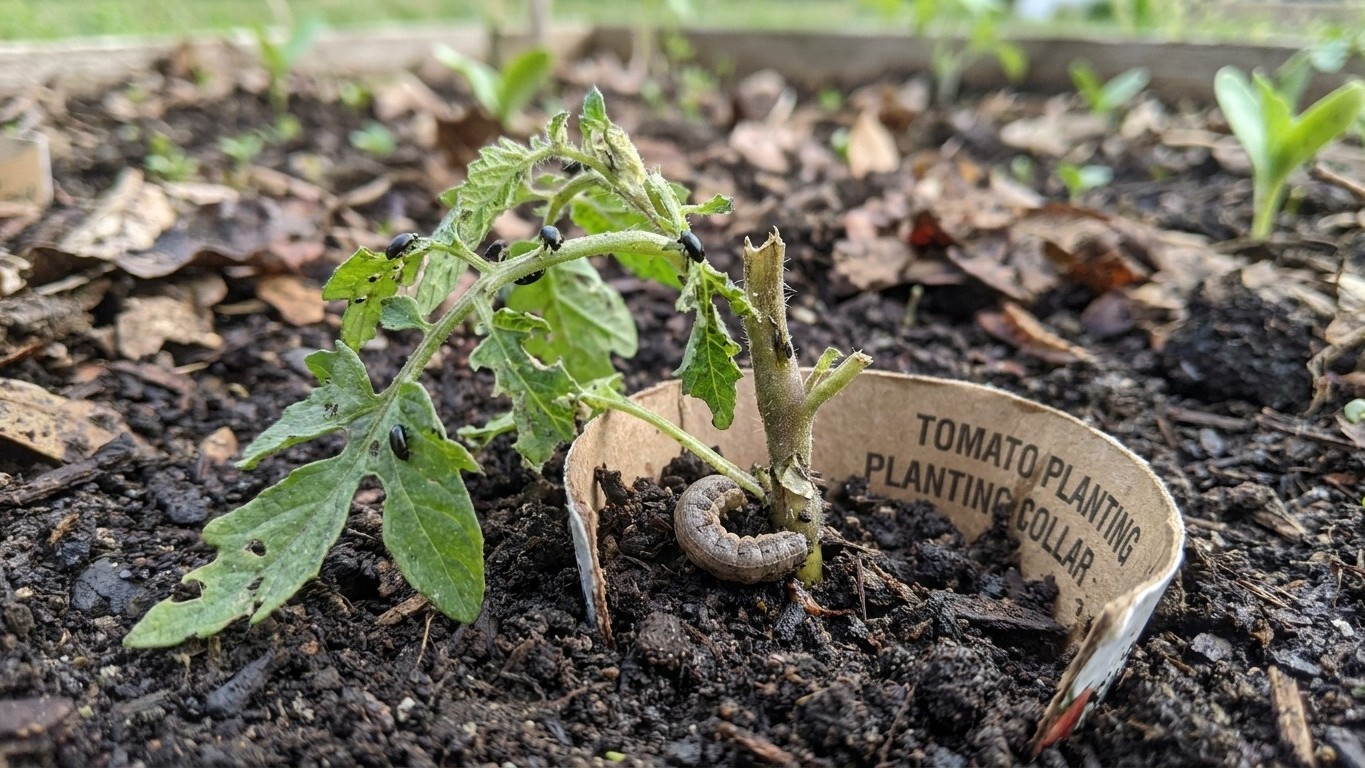
Cutworms
These are the larvae of several moth species, and the ones that matter are gray-brown, plump caterpillars about an inch long that curl into a tight C-shape when disturbed. They feed at night and sever young tomato stems right at the soil line, so a transplant that looked fine at dusk can be lying flat by morning. A cardboard or foil collar pushed an inch into the soil around each stem at planting stops them cold.
Flea beetles
Tiny, shiny black beetles, barely a sixteenth of an inch, that jump like fleas when you brush the leaves. Adults chew small round shot-holes through young leaves in late May and June, right after transplants go in. Established plants usually outgrow the damage, but seedlings can be set back hard. Row cover until plants have several true leaves is the most reliable defense.
Colorado potato beetle
Adults are round, hard-shelled, with black and cream stripes running lengthwise down the wing covers; the larvae are humpbacked, brick-red, and softer bodied. Both stages chew ragged holes through foliage, and a heavy larval infestation can strip a plant of leaves within days. Hand-picking adults and squashing the bright orange egg clusters on the underside of leaves keeps numbers down before the larvae hatch.
Aphids
Small, soft-bodied, pear-shaped insects, usually pale green but sometimes pink or black, clustered on new growth and the undersides of leaves. They pierce plant tissue and suck sap, causing curled or yellowed leaves and leaving behind sticky honeydew that attracts sooty mold. A strong jet of water knocks most colonies off, and it rarely takes more than that on a home garden scale.
Tarnished plant bug
A mottled brown, oval insect about a quarter inch long, active from mid-summer on. It feeds on developing flowers and young fruit, and the damage shows up later as sunken, discolored patches or misshapen “catfaced” fruit near the blossom end. There’s no easy spray fix for home gardens; keeping nearby weeds mowed removes the alternate hosts that build populations early.
Tomato hornworm
A large, pale green caterpillar, up to four inches long, with white diagonal stripes and a curved horn near the tail end. It shows up late in the season, if at all, and is uncommon this far north, but where it does appear it strips foliage fast and leaves dark green droppings on leaves below. Hand-picking is usually enough once you spot the chewed stems.
Working it out for your own garden
Figuring out which pest you’re dealing with starts with timing, not just appearance. If a transplant goes down flat with a clean-cut stem within the first week or two after the frost window closes in mid to late May, that’s cutworm behavior, not disease or drought stress. If instead the leaves are riddled with tiny round holes but the stem is intact, that’s flea beetles working on the same young plants during that same early window.
Mid-season damage calls for a different kind of check. Turn a leaf over. Clusters of small, slow-moving, pear-shaped insects mean aphids; a fine webbing with tiny moving specks (technically a mite, not an insect, but often mistaken for one) points somewhere else entirely and isn’t on this state’s list of common tomato problems. If you’re seeing chewed foliage and striped, hard-shelled beetles crawling on the leaf surface itself, along with round orange egg masses underneath, that’s Colorado potato beetle, and the window to act is before those eggs hatch into larvae.
Fruit damage needs its own logic. Sunken or discolored patches near the blossom end, on fruit that otherwise looks intact, usually trace back to tarnished plant bug feeding on the flower before the fruit ever formed, which means the fix (mowing nearby weeds) has to happen well before you see the symptom. A stripped section of foliage discovered in late summer, with dark pellet droppings on the leaves below, is worth a slow visual search along the stem: a hornworm’s green coloring blends in almost perfectly, and it’s often the droppings that give it away before the caterpillar does.
The common thread across all of these: match the damage pattern to the calendar. Early-season stem and leaf damage in Saskatchewan points to cutworms or flea beetles. Mid-season sap-feeding and chewing points to aphids or Colorado potato beetle. Late-season fruit blemishes and stripped foliage point to tarnished plant bug and, occasionally, hornworm. Working backward from when you see the damage narrows the list before you even need a close look at the insect itself.
What changes across the state
The Saskatoon SRC frost window is a starting reference, not a fact about the whole province, and pest pressure shifts with it. Southern grain-belt areas around Estevan and Weyburn warm up earlier in spring and hold heat longer into fall, which stretches the active window for insects like Colorado potato beetle and aphids by giving them more warm days to build numbers. Farther north, toward Prince Albert and beyond, the growing season runs shorter and cooler, which delays adult beetle emergence and cutworm moth flights by roughly a couple of weeks compared to the Saskatoon reference point, without changing which pests are present.
Elevation and exposure matter at a smaller scale too. Gardens in low-lying spots or frost pockets warm up more slowly in spring, which can actually work in a gardener’s favor against cutworms, since the moths that lay the eggs are somewhat tied to soil warming for egg-laying timing. Areas with more tree shelter or closer to larger water bodies tend to have milder overnight temperature swings, which can extend flea beetle activity slightly into early summer compared to open, wind-exposed plots where extremes of heat and cold knock populations back faster.
None of this changes which six pests actually show up in Saskatchewan tomato patches. It changes when they arrive and how long they stay active, and that’s exactly why a scouting schedule built around your own yard’s typical last frost, rather than the provincial average, will serve you better than a fixed date on a calendar.
The mistakes this state punishes
The single most common misstep is skipping the cutworm collar because the transplant “looks strong enough.” Saskatchewan’s compressed season means a plant lost to cutworms in early June often can’t be replaced with another transplant and still finish before the September frost window closes, so that one skipped step can cost the whole plant’s season, not just a setback.
A second mistake is treating flea beetle damage on young seedlings as cosmetic and ignoring it. In a longer growing region the plant might shrug it off with time to spare; here, a seedling that’s already behind schedule from a slow, cool spring doesn’t have the extra weeks to recover fully before frost.
The third is reacting to Colorado potato beetle only after larvae have already stripped visible foliage, rather than checking leaf undersides for the orange egg clusters earlier. By the time the damage is obvious, the most effective window for control, before hatching, has already closed. Checking leaf undersides every few days through June, rather than waiting for chewed leaves to catch your eye, catches the problem while it’s still manageable.
Checking this against your county
The Saskatoon SRC figures are a provincial reference point, not a promise for any one yard. Local frost timing, wind exposure, and even how close you are to a slough or shelterbelt can shift pest emergence by a week or two in either direction. For a check against conditions closer to home, Saskatchewan’s agriculture and agribusiness resources are the starting point, and your local extension or municipal agriculture office can speak to what’s actually being reported in gardens near you this season.
Common questions
Do I need to spray for pests every year in Saskatchewan?
No. Many home gardens go a whole season with only minor flea beetle or aphid pressure that resolves on its own or with a quick hose-down. Scouting first and treating only what you actually find beats a routine spray schedule.
Why don’t I see more Colorado potato beetles some years?
Adult beetles overwinter in the soil, and a colder or wetter fall combined with a slow spring warm-up (which happens more often in northern parts of the province than around Saskatoon) can delay or reduce emergence in a given year.
Are tomato hornworms actually common here?
Not especially. They’re a fixture farther south, and Saskatchewan’s shorter, cooler season means they show up less often and later, if at all. They’re worth knowing on sight, but they shouldn’t be the first suspect for chewed foliage here.
Can row cover alone handle most of these pests?
It works well against flea beetles and cutworm moths early in the season, but it has to come off once plants flower, since tomatoes need airflow and, for some varieties, pollinator access. After that, later-season pests like tarnished plant bug need a different approach, like weed management around the garden bed.