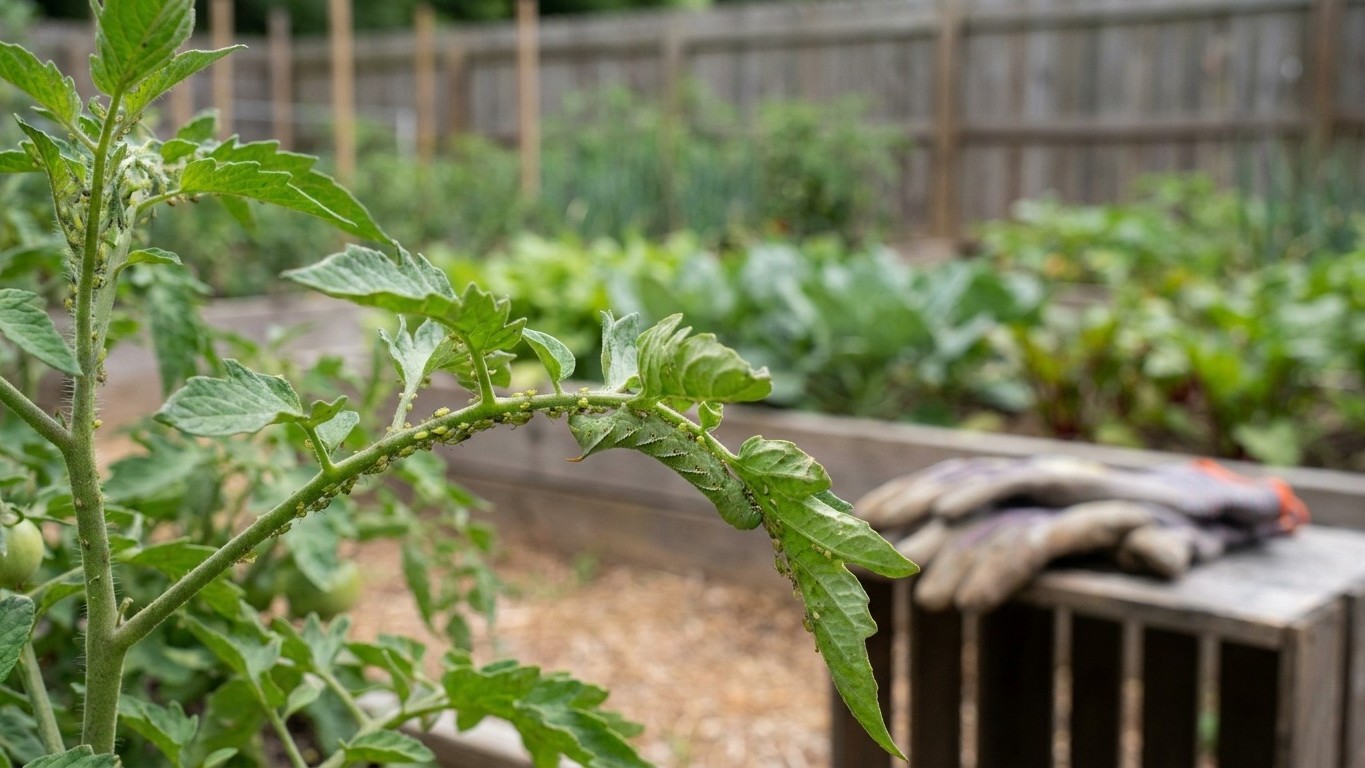

Tennessee’s tomato pests arrive on a rough calendar tied to the local frost window. Flea beetles show up on transplants near NOAA NCEI’s 1991-2020 Nashville last-frost window of March 31 to April 12, aphids and Colorado potato beetle build through late spring, and hornworms, stink bugs and fruitworm take over as fruit sets and ripens through summer into the October 28 to November 8 first fall freeze window. Walk the rows twice a week starting the week you transplant, because the pest doing the damage in April is never the one doing it in August.
What this comes down to in Tennessee

Six pests account for most of the tomato damage reported across the state, and they follow each other in a fairly consistent order rather than all showing up at once. Knowing which one you’re looking at matters more than knowing a pest exists at all, because the fix for a chewing insect and a sucking insect are not the same, and spraying the wrong one wastes a trip to the garden and kills off whatever was already eating your problem for you.
Flea beetle
These show up almost as soon as transplants go in the ground, right around the local last-frost window. They chew tiny round holes that make a leaf look like it went through a shotgun blast. Young transplants can be stunted or killed outright if beetle numbers are high; established plants usually shrug off light feeding. Floating row cover at transplant keeps them off entirely until the plant is big enough to outgrow the damage.
Aphid
Aphids build up through late spring and stay a background problem most of the season. Look for curled, sticky new leaves and a shiny film called honeydew coating the foliage below a cluster. Light infestations rarely need treatment since lady beetles and lacewings usually keep them in check; a strong water spray knocks down heavier colonies before they need anything stronger.
Colorado potato beetle
This one turns up on tomatoes as well as its namesake crop, usually as the weather warms into late spring. Both the striped adult and the red, spotted larva chew ragged holes through leaves and can strip a small plant fast. Hand-picking works if you catch it early; check the undersides of leaves for clusters of bright yellow-orange eggs and crush them before they hatch.
Tomato hornworm
Hornworms are the pest most gardeners actually see, because the caterpillar gets enormous before it’s done feeding, usually from mid to late summer. They strip whole branches of foliage overnight and leave dark green droppings the size of peppercorns on the leaves below. Hand-picking is effective since the caterpillar is easy to spot once you know to look, and the bacterial insecticide Bacillus thuringiensis kills it without harming the parasitic wasps that also prey on it.
Stink bug
Stink bugs move in as fruit starts ripening and feed by piercing the skin, which leaves hard, pale, cloudy spots under the surface called cat-facing. They’re easiest to catch by shaking a branch over a light-colored tray and seeing what drops out. Keeping the garden free of tall weeds nearby removes a lot of their staging ground before they move onto fruit.
Tomato fruitworm
Also called the corn earworm, this caterpillar bores a single clean hole straight into the shoulder of a ripening fruit and feeds inside, which means the damage is often invisible until you pick the tomato. It overlaps with hornworm season through summer. Picking off any fruit with an entry hole and checking plants near the end of the season, when moths are most active, catches most of the damage before it spreads to the next fruit.
Working it out for your own garden
The fastest way to identify a tomato pest in Tennessee is to work backward from the damage rather than forward from a bug you think you saw. Ask three questions in order: what part of the plant is hit, what does the damage pattern look like, and what time of the growing season is it. A pest page can list every insect that occurs in the state, but only your own plant tells you which one you actually have.
| Damage pattern | Where to look | Likely culprit |
|---|---|---|
| Small round shot holes in young leaves | Whole leaf surface, worst on new transplants | Flea beetle |
| Curled, sticky new growth | Undersides of top leaves and stem tips | Aphid |
| Ragged chewed leaf edges, yellow egg clusters | Leaf undersides | Colorado potato beetle |
| Stripped branches, peppercorn-sized black droppings | Mid to upper foliage | Tomato hornworm |
| Hard pale blotches under the skin of fruit | Ripening fruit, especially near the stem end | Stink bug |
| Single clean entry hole into the fruit | Shoulder of ripening fruit | Tomato fruitworm |
If the damage is on fruit rather than foliage, check whether it’s a hole with frass around it, which points to fruitworm, or a firm discolored patch with no opening at all, which is stink bug feeding rather than anything boring inward. If it’s on leaves, check the underside first: sucking insects like aphids almost always cluster there, while chewing damage from beetles and caterpillars shows up on both sides. Timing narrows it further, since the same damage pattern in April is almost never the same pest as in August. Anyone still working out when to put transplants in the ground in the first place should start with Tomato Planting Dates in Tennessee: Counting Back From Your Frost Window before worrying about pest pressure at all, since a plant set out too early into cold soil is weaker and draws pests faster regardless of which one shows up.
What changes across the state
The frost window and pest timing given here are measured at Nashville, and Tennessee is a long state with real differences in elevation and climate from one end to the other. NOAA NCEI’s caution on its own normals notes that East Tennessee and the Cumberland Plateau run cooler and later in spring than Nashville, which pushes back the point where soil warms enough for flea beetles and Colorado potato beetle to become active, and shifts the whole pest calendar later by a comparable stretch through summer.
USDA’s Plant Hardiness Zone Map puts the state’s range at zone 5b to 8a, which is a wide spread for one state and reflects real differences in winter severity between the higher elevations in the east and the milder river valleys further west. That matters for pests as much as for plant survival, because milder winter zones let more overwintering pupae and eggs survive to the next season, meaning gardeners in the warmer parts of the state can see earlier and heavier pressure from pests like flea beetles that overwinter in soil debris.
Distance from the state’s larger reservoirs and rivers also moderates local temperature swings enough to shift when a warm stretch turns into a hard freeze in spring, which in turn shifts the point at which it’s safe to set out transplants and start watching for early-season pests at all. None of this changes which pests occur here, only when each one becomes active enough to matter. A gardener in the eastern mountains working from a single Nashville-based date range should expect to be running about a week or two behind the pest activity, not ahead of it.
The mistakes this state punishes

The most common mistake is treating a warm stretch in March as permission to set transplants out early, when Nashville’s own frost window still runs through NOAA NCEI’s April 12 upper bound. Plants stressed by a late cold snap are slower to establish and noticeably more attractive to flea beetles, which target weak, slow-growing tissue over vigorous plants.
The second is reaching for a broad-spectrum insecticide the moment a hornworm shows up. That approach also kills the parasitic wasps and lady beetles already suppressing aphids and hornworm populations on the same plant, which tends to produce a worse outbreak two weeks later rather than a smaller one. Hand-picking hornworms and letting Bacillus thuringiensis handle the rest is slower but does not undo its own work.
The third is missing the fruitworm and stink bug window because attention shifts to harvest instead of scouting. Both pests do their damage on ripening fruit late in the season, right as the crop is finally producing, and a grower checking plants for ripeness rather than for pest entry holes misses the damage until the tomato is already cut open. A few of the following help avoid the worst of it:
- Hold transplants until the soil itself has warmed, not just the air.
- Scout the undersides of leaves before scouting the top.
- Check ripening fruit for entry holes and cat-facing at every picking, not just at the end.
Anyone choosing varieties for next season can also reduce some of this pressure up front by picking a cultivar suited to the length of the local growing season rather than a long-season variety that sits ripening in the garden through the worst weeks of fruitworm and stink bug activity; Tomato Varieties That Ripen in Time in Tennessee works through that trade-off in detail.
Checking this against your county
Everything above is a starting point built on Nashville’s own frost data, not a fixed schedule for the whole state. For a pest calendar and treatment thresholds specific to your county, contact your local office through University of Tennessee Extension, which tracks regional pest pressure more closely than a single statewide figure ever can. If you’re still working out the basics of the crop itself before worrying about what’s eating it, start with growing tomatoes in Tennessee and come back to pest control once plants are in the ground.
Common questions
What’s eating little round holes in my tomato seedlings overnight?
That pattern almost always points to flea beetles rather than a nighttime pest like slugs, since slug damage tends to be larger and more irregular with a slime trail left behind. Flea beetles feed during the day too, so check plants in full sun and look for the tiny beetles jumping when you brush the leaf.
Is it safe to touch a tomato hornworm?
Yes, the horn looks alarming but it doesn’t sting or bite. It’s just a soft protrusion, and the caterpillar is otherwise harmless to handle if you’d rather pick it off by hand than spray anything.
Will ladybugs take care of my aphid problem on their own?
Often, yes, if the infestation is caught early and you haven’t sprayed anything broad-spectrum recently that would have killed the ladybugs and lacewings already working on it. A heavier, established colony usually needs a knockdown with water or insecticidal soap before natural predators can keep pace.
My tomatoes have a leathery brown patch on the bottom, is that a pest?
No, a sunken leathery patch on the blossom end of the fruit is almost always blossom end rot, a watering and calcium-uptake problem rather than an insect. Pest damage from stink bugs shows up as harder, paler blotches under the skin without the sunken, dark leather texture, and fruitworm leaves an actual entry hole rather than a discolored patch.