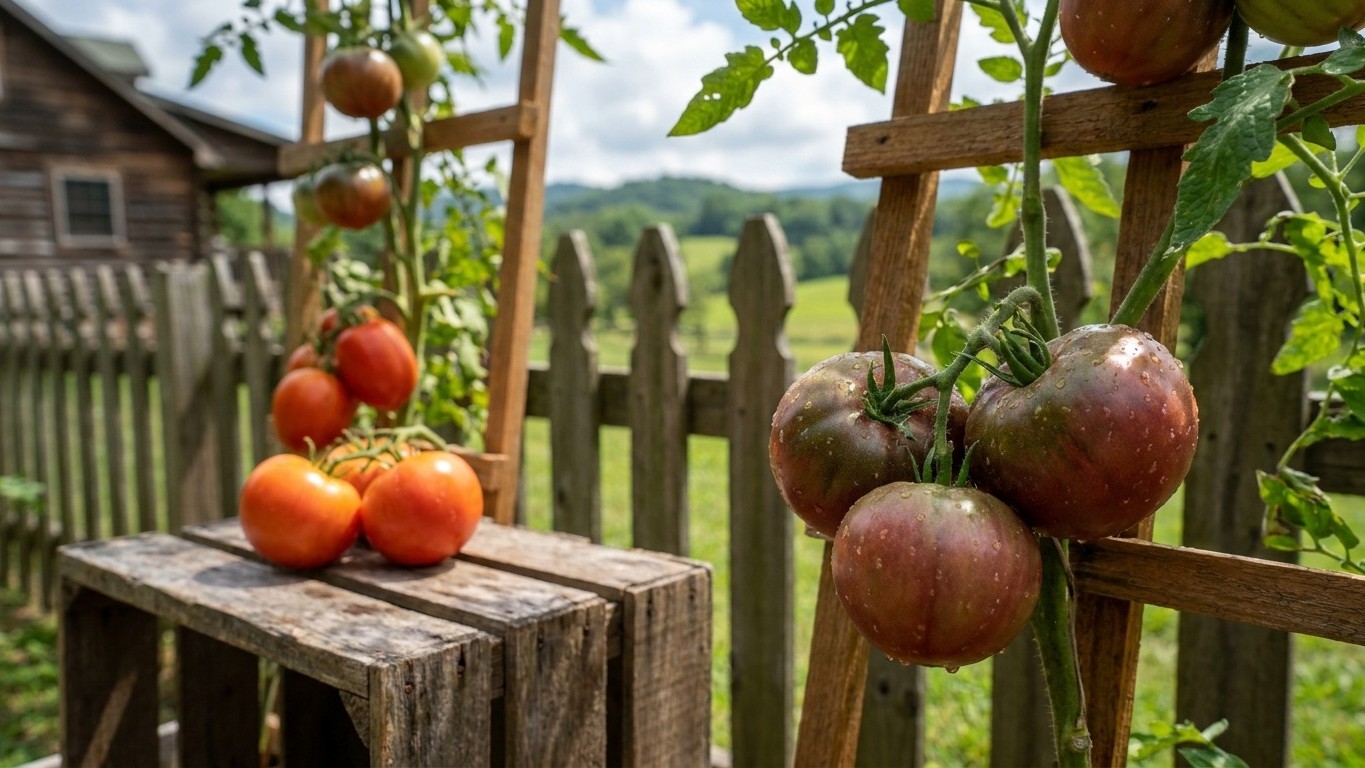

Nearly every catalogue tomato ripens with room to spare in Tennessee, provided the transplant goes in on time. NOAA’s 1991-2020 climate normals put Nashville’s last spring freeze between March 31 and April 12, and the first fall freeze between October 28 and November 8, which works out to somewhere between six and seven months of freeze-free growing. Check the days-to-maturity on the seed packet against that window before you buy, because the only real risk here is choosing a variety that outruns even that long a season.
What this comes down to in Tennessee

Yes — pretty much any tomato you’d want to grow will finish here, as long as it goes in the ground on time. Nashville runs six to seven months without a killing frost, from early April to late October, and that’s more breathing room than nearly every variety on a seed rack needs. The one thing to actually do: pull the days-to-maturity off the packet and hold it up against that window before you buy, because the only way to lose is picking something so long-season it can’t fit even inside that stretch.
The fourteen varieties below are ordered from shortest to longest days-to-maturity, all counted from transplant, and all set out in the mid-to-late-April window Nashville’s frost data allows. Catalogue day counts are approximate and shift by a week or two with the season, so treat “first ripe” as a range, not a date on the calendar. If your own transplant date isn’t settled yet, the full arithmetic behind it is covered in Tomato Planting Dates in Tennessee: Counting Back From Your Frost Window.
| Variety | Days to maturity | Habit | First ripe | Margin before fall frost |
|---|---|---|---|---|
| Sakura | 55 | Indeterminate | Mid June | 130 days |
| Edox | 55 | Indeterminate | Mid June | 130 days |
| Valentine | 55 | Indeterminate | Mid June | 130 days |
| Glacier | 55 | Determinate | Mid June | 130 days |
| Sun Gold | 57 | Indeterminate | Late June | 128 days |
| Juliet | 60 | Indeterminate | Late June | 125 days |
| Supersweet 100 | 60 | Indeterminate | Late June | 125 days |
| Amalfi | 68 | Determinate | Early July | 117 days |
| Cherokee Purple | 72 | Indeterminate | Early July | 113 days |
| Big Beef Plus | 72 | Indeterminate | Early July | 113 days |
| Tiren | 75 | Indeterminate | Early July | 110 days |
| Granadero | 75 | Indeterminate | Early July | 110 days |
| San Marzano II | 78 | Indeterminate | Mid July | 107 days |
| Celebrity Plus | 78 | Determinate | Mid July | 107 days |
Sakura

Sakura needs about 55 days from transplant, the shortest count on this list, and being indeterminate it keeps setting new clusters of small red cherry tomatoes all summer. It resists nematodes, tomato mosaic virus and both common races of fusarium wilt, useful in a bed that has grown tomatoes for years. Set out mid to late April, it should have first ripe fruit by mid June with about 130 days of margin before the earliest fall frost date.
Edox

Edox matches Sakura’s 55-day count and disease package almost trait for trait, which makes it a solid second short-season cherry if you want two sources rather than one seed line. The fruit is a smooth, glossy red cherry tomato on a tall vine. Same transplant window, same mid-June ripening, same 130-day cushion before frost.
Valentine

Valentine also finishes in about 55 days but carries a narrower resistance list, covering early blight at an intermediate level only. The fruit is a small, glossy red grape tomato rather than a round cherry, good for snacking or halving into salads. It carries the same wide margin as the other 55-day varieties, so the shorter resistance list matters more in a wet year than a dry one.
Glacier

Glacier is the one determinate plant among the 55-day group, setting most of its crop in a shorter window rather than producing all season. Fruit is small, red with an orange blush, on a compact bush with potato-leaf foliage that suits a container or a small raised bed. It carries no listed disease resistance, earning its place on speed rather than a defensive trait list.
Sun Gold

Sun Gold takes about 57 days and stays indeterminate all season, loading small, bright orange cherry tomatoes that are usually eaten straight off the vine. It resists tobacco mosaic virus and fusarium wilt race 1. First ripe fruit lands around late June with roughly 128 days of margin before the fall frost window opens.
Juliet

Juliet runs about 60 days and holds resistance to both early and late blight at an intermediate level, a useful pairing in a state where summer humidity keeps foliar disease pressure up. The fruit is a small, oblong red grape tomato that holds well on the vine and works for roasting as easily as snacking. Set out with the rest of the April batch, it should be producing by late June.
Supersweet 100
Supersweet 100 also needs about 60 days and stays indeterminate, loading long trusses with small, glossy red cherry tomatoes through the season. Its resistance covers verticillium wilt and fusarium wilt race 1, useful where soil-borne disease has shown up before. Margin before frost sits around 125 days.
Amalfi
Amalfi is the first true paste tomato on this list, needing about 68 days and staying compact as a determinate bush suited to a stake or a short cage. The fruit is oblong and dense-fleshed, meant for sauce rather than slicing. It carries resistance to nematodes, late blight and early blight, all at an intermediate level, a broader package than most of the shorter-season varieties above it.
Cherokee Purple
Cherokee Purple takes about 72 days and carries no listed disease resistance, making it the variety on this list most worth siting where air moves freely and foliage dries fast. The fruit is a large, flattened beefsteak with dusky purple-pink skin and darker shoulders, grown for slicing rather than sauce. With 113 days of margin before the Nashville-area frost window, it has plenty of time even without the resistance genetics newer hybrids carry.
Big Beef Plus
Big Beef Plus needs about the same 72 days as Cherokee Purple but with a much longer resistance list: nematodes, gray leaf spot and tomato mosaic virus. The fruit is a large, smooth, deep red beefsteak good for sandwiches and slicing. It is the more forgiving of the two 72-day varieties in a bed with a history of soil-borne trouble.
Tiren
Tiren runs about 75 days and packs resistance to verticillium wilt, tomato mosaic virus and fusarium wilt race 1, a heavier defensive load than most others here. Fruit is medium to large, round and deep red, useful for canning as well as fresh eating. With 110 days of margin before frost, the later start puts it at no real risk in a Nashville-area season.
Granadero
Granadero also needs about 75 days and adds nematode resistance to the verticillium and tomato mosaic virus protection it shares with Tiren. The fruit is an elongated, blocky red roma shape bred for paste and canning. Its 110-day margin leaves it comfortably inside the season even set out at the late end of the transplant window.
San Marzano II
San Marzano II is the longest classic paste tomato on this list at about 78 days, and being indeterminate it keeps producing its long, narrow, pointed fruit into fall rather than finishing all at once. It carries no listed disease resistance, so it depends more on spacing and airflow than the hybrids around it. Even at 78 days it still holds about 107 days of margin before the Nashville-area frost window.
Celebrity Plus
Celebrity Plus ties San Marzano II at 78 days but grows as a compact determinate bush, setting a concentrated crop of medium, smooth, red slicing tomatoes rather than trickling fruit in over months. Its resistance list, nematodes, gray leaf spot and tomato mosaic virus, is the broadest on this list. It is the latest variety here to start ripening and still finishes with well over three months of margin before frost.
Working it out for your own garden
How frost dates are calculated
The method is simple subtraction, and it survives a move to a different county even where the exact numbers above do not. Start from the fall frost window, October 28 to November 8 at the Nashville reference point per NOAA’s 1991-2020 normals, and count backward using the variety’s days-to-maturity plus a couple of weeks of buffer. A 78-day variety set out at the tail end of the mid-to-late-April transplant window ripens around mid July, which leaves roughly fifteen weeks of slack before the earliest date in the fall frost range.
Run the same arithmetic on a variety that isn’t on this list to see where the line actually falls. Take a hypothetical 100-day heirloom slicer, the kind sold for flavor rather than speed. Transplanted at the same mid-to-late-April date, it still ripens in late July, three months ahead of frost. Push that transplant back a full month, which happens easily in a cold, wet spring, and first fruit lands in late August. Still inside the window, but it is the kind of margin a single early cold snap in a rough year can eat into. Nothing on our named list runs past 78 days, which is exactly why none of these fourteen approach that edge case even in a difficult season.
To check any variety not listed here, write down its catalogue days-to-maturity, add 14 days as a buffer, and count forward from the latest date in your local transplant window rather than the earliest. If the result lands comfortably ahead of the earliest date in your fall frost range, the variety works. If it lands inside the frost range itself, drop it for a shorter one.
What changes across the state
Every figure here is measured at or near Nashville, and Tennessee stretches from the Mississippi River bottomlands in the west to the Appalachian ridges in the east, so treat that figure as a starting point rather than a fixed rule. Elevation is the biggest single factor inside the state. East Tennessee and the Cumberland Plateau sit higher and run cooler, which pushes the last spring freeze later and can bring the first fall freeze on sooner than the Nashville-area dates from NOAA’s 1991-2020 normals. A garden on the plateau should plan on setting transplants out later than the mid-to-late-April window used above, and on seeing frost arrive sooner in fall than the Nashville range suggests.
West Tennessee, closer to the Mississippi River and at lower elevation, tends to warm earlier in spring and hold heat longer into fall than the Nashville reference point. The practical effect on variety choice is that a longer-season paste tomato like San Marzano II or Celebrity Plus, which already carries well over three months of margin at Nashville, likely has extra room in the warmer western counties. In the cooler eastern counties the same margin shrinks, though for every variety on this list it should still hold, since even the tightest margin here, 107 days for the two 78-day varieties, is a wide buffer against a shift of a few weeks in either frost date.
None of this changes which cultivars exist or what their catalogue days-to-maturity are. It changes only the transplant date fed into the arithmetic, and by extension the ripening date that follows from it. Shift the calculation, not the variety, when you move to a different part of the state.
The mistakes this state punishes

The most common mistake in a season this long is treating “plenty of margin” as license to ignore the transplant date and set plants out during the first warm stretch, sometimes weeks before Nashville’s last-freeze window of March 31 to April 12 has actually closed. Soil that hasn’t warmed through yet stalls a young tomato even when the air feels warm for a few days, and a plant stunted for two weeks loses more time than most of the margin above ever gives back. Wait for the frost window to close, not for a warm afternoon.
The second mistake is picking a variety for its flavor reputation without checking its disease resistance against the specific bed it’s going into. A garden that has grown tomatoes in the same spot for years, and has seen wilt or nematode trouble before, is a poor fit for a resistance-free heirloom like Cherokee Purple or San Marzano II, when a comparable-season hybrid with a real resistance package, such as Big Beef Plus or Tiren, does the same job with less risk.
The third mistake is ignoring the pest calendar and finding out too late that a particular insect or disease has a narrow window when it actually does damage. Check Tomato Pests in Tennessee: Which Ones Actually Show Up Here before transplanting, so the resistance codes on the seed packet, and any spray plan, line up with what actually shows up in a Tennessee garden rather than a generic list, and connect that timing back to the basics laid out in growing tomatoes in Tennessee if you haven’t worked through them yet.
Checking this against your county
Every date and margin above is built from a single reference point near Nashville, and your county can run a week or more earlier or later depending on elevation and local terrain. Before locking in a transplant date, check with your local University of Tennessee Extension office, which tracks conditions specific to your county rather than a statewide average.
The extension service’s own tomato guidance also covers site-specific pest and disease pressure that a statewide varieties page like this one cannot, since that pressure changes with soil, past crops and local weather in a given year. Treat the figures here as the frost-window arithmetic, and treat your county office as the correction for everything local that arithmetic cannot see.
Common questions
Can I still plant tomatoes in June in Tennessee?
Yes, for a short-season variety. A 55-day cherry tomato like Sakura or Edox set out in June still has months of margin before the Nashville-area fall frost window of October 28 to November 8, though a 78-day paste tomato like San Marzano II or Celebrity Plus would be cutting it closer and is better started at the normal mid-to-late-April window.
Do determinate or indeterminate varieties ripen faster?
Days-to-maturity isn’t tied to growth habit. Glacier and Amalfi are both determinate and finish in 55 and 68 days, while Sakura and San Marzano II are both indeterminate and finish in 55 and 78 days. Growth habit changes whether the crop comes in over a few concentrated weeks or trickles in over the whole season, not how soon it starts.
Does a disease-resistant variety still need crop rotation?
Yes. The resistance codes on a seed packet, like the nematode or fusarium wilt resistance carried by Sakura, Edox and Big Beef Plus, cut the risk from those specific pathogens but don’t eliminate every soil-borne problem a tomato bed can pick up. Rotating tomato beds and checking with your county extension office about local soil pressure still matters even with a resistant variety.
Why did my “70-day” tomato take closer to 90 days to ripen?
Catalogue day counts assume a warm, well-hardened transplant going into warm soil, and a cool spring or a stressed seedling can push the real timeline two to three weeks past the catalogue number. That shows up more on a longer-season variety like Cherokee Purple or Tiren than on a fast 55-day cherry tomato, since there’s less slack to absorb the delay.