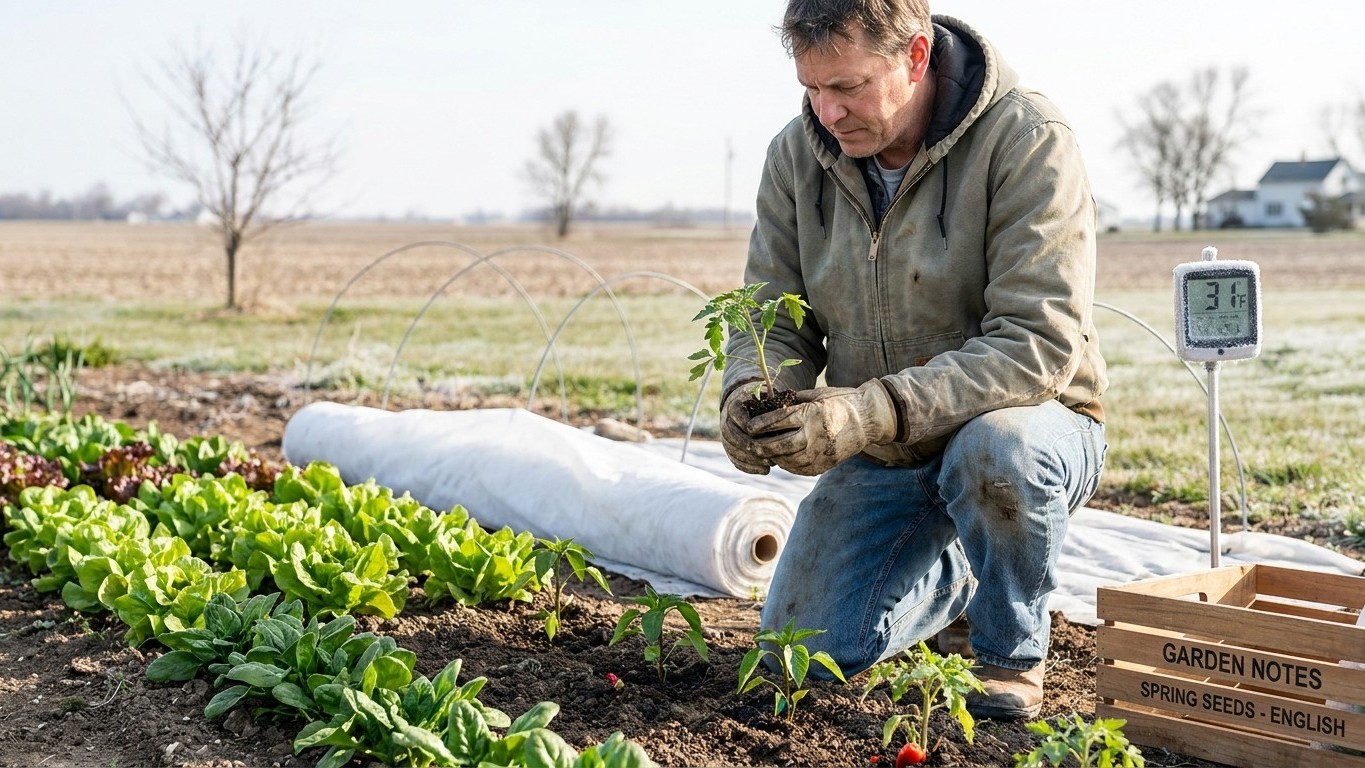

Illinois gardening comes down to one question: how many frost-free days do you actually get to work with? Between a hardiness range of zone 5a to 7b, a spring frost that lingers into late April in some years, and a fall frost that can arrive before Halloween, the state hands gardeners a season that’s generous by Midwest standards but still has hard edges on both sides.
How long your season really is

Three numbers set the boundaries here. The USDA Plant Hardiness Zone Map puts Illinois somewhere between 5a and 7b, a range built entirely on one measurement: the average coldest temperature a spot sees in a typical year. That’s a big spread for one state, and it means a garden near the Wisconsin border and one near the Kentucky line are working with different rulebooks even though they’re in the same state.
The other two numbers matter more for day-to-day planning. NOAA’s 1991-2020 climate normals put the last spring frost at the reference station between April 11 and April 22, and the first fall frost between October 24 and November 3. Stack those together and you get a frost-free window that runs somewhere between roughly 185 and 205 days, depending on which end of each range you land on in a given year. That’s the number that actually decides what you can grow. Not the zone, not the calendar month, that window.
What does 185 to 205 days rule out? Anything that needs a full 120 days from transplant to harvest and doesn’t tolerate any chill is a real gamble here, especially if you’re direct-seeding rather than starting indoors. Long-season melons, some pumpkin varieties bred for southern climates, and unprotected sweet potato harvests can all get caught by an early fall frost even in a decent year. On the other end of the spectrum, quick, cold-hardy crops make much better use of Illinois’s frost edges, and Growing Spinach in Illinois is a good example of a crop that can go in the ground well before the last frost and still finish long before summer heat sets in. Perennial crops fit this window too, and Growing Asparagus in Illinois shows how a hardy, early-season vegetable can take advantage of that same cool spring stretch year after year. Growing Pumpkins in Illinois means picking varieties that match your local frost window, and knowing When to Carve a Pumpkin in Illinois can also help you time your pumpkin planting so the harvest lines up with the season you actually want to use them for, and the same logic applies to Growing Potatoes in Illinois, where timing the planting date around your frost window makes a real difference in yield, to Growing Peppers in Illinois, where a slow start indoors is often what makes the difference between a full harvest and one cut short by frost, to Growing Carrots in Illinois, where a cooler-season crop like this one can actually help you make better use of the shoulder days at either end of the window, to Growing Beets in Illinois, another cold-tolerant crop that can fill those same edges, and to Growing Sweet Corn in Illinois, where getting the timing right matters just as much since this warm-season crop needs the frost-free window fully on its side, or to Growing Parsnips in Illinois, a root crop that actually benefits from a touch of frost late in the seasonarly and late-season gaps. That doesn’t mean don’t try them. It means build in a buffer, or start them under cover, rather than counting on the full window every single time.
Here’s the part that trips people up: those frost dates are averages, not promises. By definition, roughly half of all years will have a later spring frost or an earlier fall frost than the range given. NOAA calculates these as a 30 to 70 percent probability band, meaning there’s a real, non-trivial chance frost shows up outside those dates in any given year. Treating April 22 as a hard planting deadline, or October 24 as a guaranteed harvest cutoff, is where a lot of tomato plants meet an untimely end. Plan around the average, but keep a frost cloth or row cover on hand for the years that don’t cooperate.
What the summer does to a garden here
Heat doesn’t just make a garden grow faster up to a point, then it starts working against you. At the reference station, Illinois averages 14 days a year at or above 90F. That’s not an extreme number compared to the Deep South, but it’s enough to matter, because most heat-sensitive garden staples have a real ceiling. Tomato flowers commonly fail to set fruit once daytime highs push consistently past that 90F mark, and lettuce, spinach, and other cool-season greens bolt to seed and turn bitter under the same conditions.
Fourteen days doesn’t sound like much until you notice they tend to cluster in July and early August, right in the middle of the season everyone plans around. The practical effect is that Illinois gardens often run better as two productive stretches with a rough patch in between, rather than one smooth curve from May to October. Spring greens and peas do their best work before the heat arrives; tomatoes, peppers, and squash carry the summer; then a second round of lettuce, spinach, and other cool-season crops goes back in once the worst of the heat breaks in late August or September.
Winter sets the other boundary. The coldest month’s average daily minimum runs 18.8F, a figure that has nothing to do with how cold it gets on the worst night of the year and everything to do with what perennials, shrubs, and overwintering crops can reliably survive. That number is part of why the zone range spans from 5a up to 7b: a plant rated hardy to zone 6 might sail through most Illinois winters and still get killed back in a colder pocket of the state. Matching perennials to your actual zone, not the state’s average, is worth the five minutes it takes to look up.
What tends to go wrong in Illinois
University of Illinois Extension tracks the insect pressure home gardeners actually deal with, and a handful of names show up again and again. Japanese beetles arrive in midsummer and skeletonize leaves on everything from roses to raspberries, chewing through the tissue between veins and leaving a lacy, see-through look that’s hard to miss. Squash vine borers show up earlier, often in June, and their damage is sneakier: a healthy-looking squash or zucchini plant wilts suddenly because the larvae have been tunneling through the stem base the whole time. Squash bugs (Anasa tristis) tend to follow close behind, sucking sap from the same cucurbit family and causing leaves to yellow and collapse.
Colorado potato beetles are an early-season problem, showing up as soon as potato and eggplant foliage emerges and stripping leaves fast enough to stunt a young plant before it’s had a chance to establish. Extension has also flagged newer arrivals worth knowing about even if they’re not yet a fixture in every yard: jumping worms, confirmed in 49 of the state’s 102 counties, alter soil structure and reduce its ability to hold nutrients, while spotted lanternfly, first detected in Cook County in September 2023, is still expanding its range and worth reporting if spotted.
None of this is the full insect roster for the state, and pressure varies a lot by county and even by yard. It’s the short list of what a gardener here is genuinely likely to run into, worth knowing by name and by timing rather than guessing at a bug you’ve never seen before.
Where to check before you plant
Everything above is a state-level picture, and Illinois is long enough, north to south, that a state-level picture only gets you so far. A hardiness range of 5a to 7b and a frost window built from one reference station both average out real differences between the Chicago area and the southern tip of the state near Cairo. A planting calendar tuned to the state capital can run three weeks off at either edge of Illinois, which is enough to lose a spring planting to frost or miss a fall harvest window entirely.
University of Illinois Extension is the land-grant service built specifically to close that gap, with local offices in nearly every county tracking planting windows, pest pressure, and soil conditions for their specific area. That’s the resource worth checking before finalizing any planting date. Pair the two, and the numbers above turn from a general outline into an actual plan.
Digging Into Specific Crops and Care
The general climate picture only goes so far — the details change once you get down to what’s actually in the ground. Take planting garlic: it needs six to eight weeks of cold soil before a clove will split into a proper head instead of staying a single round bulb, and Illinois delivers that cold stretch without any help from the gardener, starting with a first fall frost that arrives on its own schedule. The lawn runs on a different clock entirely. Cool-season grass is what belongs in an Illinois yard, and feeding your lawn hard in September is the move, since the state’s short, cold winters and limited run of 90-degree days rule out warm-season turf from the start. Then there’s the tomato bed, which waits on frost risk rather than soil temperature — for the Chicago area, tomato planting dates are set against NOAA’s National Centers for Environmental Information figures on the last spring freeze, using the 1991-2020 climate normals as the baseline. Three different crops, three different clocks, all running on the same Illinois calendar.