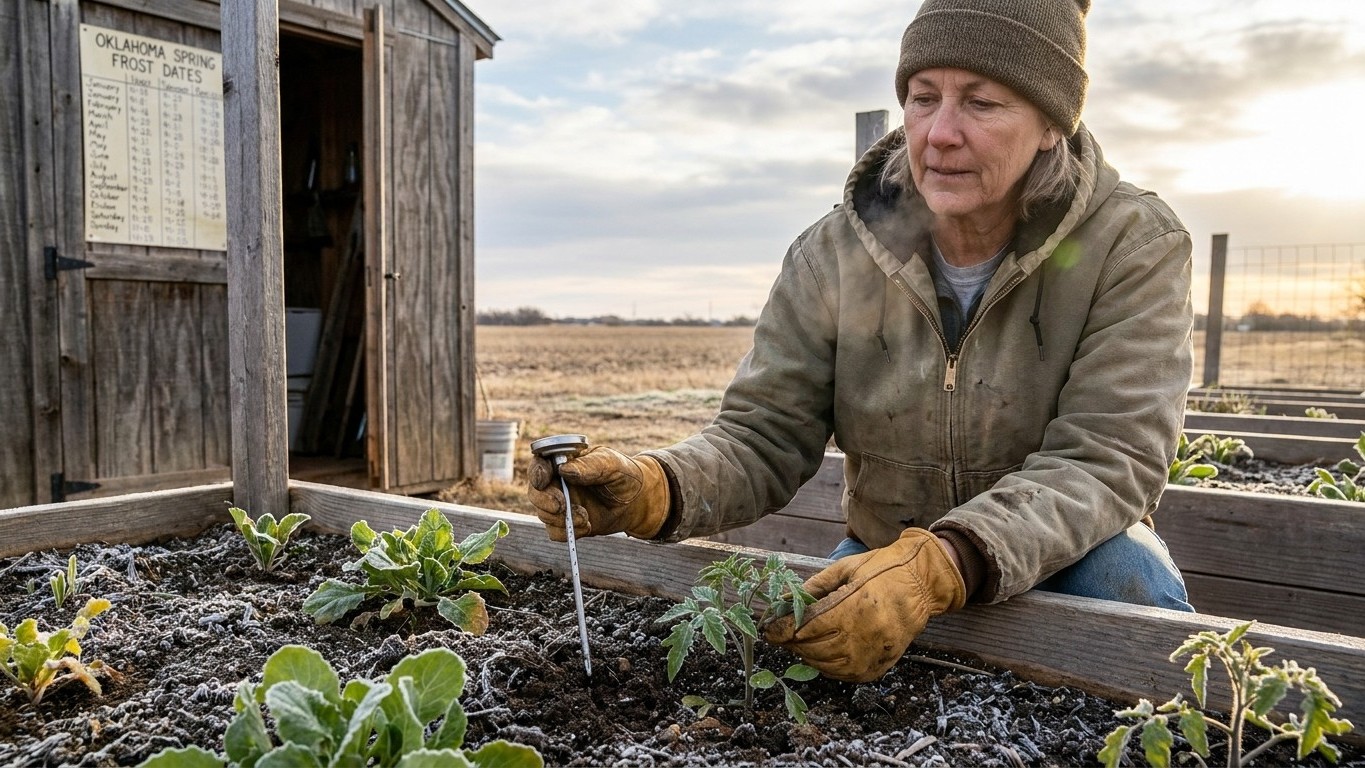

Oklahoma gives most gardeners a frost-free window of roughly six to seven months, but that number hides two different climates: a milder southeast and a colder, drier panhandle. Before picking varieties or planting dates, the season’s real shape matters more than the state’s reputation for heat.
How long your season really is

Three figures decide almost everything you can grow here. Oklahoma spans USDA hardiness zones 6a to 8a, the reference station near Oklahoma City sees its last spring frost between March 28 and April 10, and the first fall frost typically lands between October 29 and November 8. Put together, that’s the frost-free window a garden here can count on, and it’s the single number that should shape every planting decision you make.
| Figure | Value |
|---|---|
| USDA Hardiness Zone | 6a-8a |
| Average last spring frost | March 28 – April 10 |
| Average first fall frost | October 29 – November 8 |
What the window rules out
Six to seven months sounds generous, and compared to a lot of the country, it is. But that window is an average, not a promise. Half of all years, by definition, run shorter than average on one end or the other, sometimes both. A gardener chasing a 100-day melon or a slow-maturing winter squash that needs 110 days from transplant is betting on the better half of the record, not the safe half. Long-season crops aren’t impossible in Oklahoma. They’re a gamble, and treating them as a sure thing is how a September freeze wipes out a crop that was two weeks from ready. Perennial crops offer a different calculation altogether; a resource like Growing Asparagus in Oklahoma shows how a well-timed planting can settle into the state’s frost pattern for years instead of racing against a single season’s window.
The dates themselves come from one weather station, not from your yard. Suburban lots and rural fields tend to see the last spring frost arrive later and the first fall frost arrive earlier than the reference figures, often by one to two weeks, and more if you’re at higher elevation or in a low-lying spot where cold air pools. Treat March 28 to April 10 and October 29 to November 8 as a starting estimate, then watch your own soil and sky before you trust it.
What the summer does to a garden here
Oklahoma City averages 70.7 days a year at or above 90F. That’s not a description of a hot summer. It’s a measurable stretch of weeks where a garden’s chemistry changes. Somewhere around that 90F mark, tomato flowers stop setting fruit at all, lettuce and spinach bolt and turn bitter, and most cool-season crops simply shut down rather than struggle along; for tips on timing this cool-season crop around the heat, see this guide on Growing Spinach in Oklahoma. Heat-tolerant crops fare better through this stretch, among them sweet corn, which thrives in the summer warmth; see this guide on Growing Sweet Corn in Oklahoma. Peppers also hold up well; see this guide on Growing Peppers in Oklahoma for specifics, and vining crops like pumpkins can also handle the heat with the right timing, as covered in this guide on Growing Pumpkins in Oklahoma, while cool-season crops like potatoes and beets need careful timing around that heat, and root crops such as parsnips (see Growing Parsnips in Oklahoma) do best planted well outside that 90F stretch, and root crops such as carrots need similar planning, as covered in this guide on Growing Carrots in Oklahoma, as covered in this guide on Growing Beets in Oklahoma, as covered in this guide on Growing Potatoes in Oklahoma. Seventy days above that threshold isn’t a handful of bad afternoons. It’s close to ten weeks, often falling in one continuous block through July and August.
That reshapes what a “growing season” even means here. Instead of one long stretch from last frost to first frost, Oklahoma gardens tend to run in two acts: a spring push for cool-season crops that finishes before the heat locks in, and a second planting in late summer timed to mature after the worst of it breaks, using the fall shoulder before that October frost arrives. The middle of summer becomes maintenance and heat-tolerant crops only, not a planting window.
Winter cold matters too, even though it gets less attention than the heat. The coldest month at the reference station averages a daily minimum of 27.0F. That’s the number that decides whether a perennial, a fruit tree, or a herb you’re hoping to overwinter actually survives here, as opposed to just the average temperature of a cold month. A plant rated for zone 7 can look fine in a mild December and still not make it through a week where nighttime lows sit consistently near that 27F mark.
What tends to go wrong in Oklahoma
Oklahoma State University Extension’s home vegetable garden pest guidance points to a recurring cast of insects that show up on home gardens across the state, not an exhaustive list of everything that can bite a leaf. Four are worth knowing before you plant, because catching them early beats reacting late.
- Squash bug: shows up as squash and pumpkin vines start to run in early summer, feeding on stems and leaves until plants wilt and collapse.
- Corn earworm / tomato fruitworm: arrives as corn silks and tomato fruit begin forming in midsummer, boring directly into ears and fruit.
- Grasshoppers: build up through the hot, dry stretch of summer and can strip leaves off nearly anything in the garden once populations peak in July and August.
- Harlequin bug: targets cole crops like cabbage and broccoli, typically appearing in the cooler shoulder seasons of spring and fall when those crops are in the ground.
This isn’t the full list the extension service tracks. Stink bugs, leaffooted bugs, aphids, spider mites, Colorado potato beetle, and cucumber beetles all appear in their guidance too, and pressure shifts from one part of the state to another. None of this should read as a spray schedule. It’s a heads-up on what to look for and roughly when, so a damaged leaf doesn’t turn into a mystery.
Where to check before you plant
Oklahoma stretches across several degrees of latitude, and a single hardiness zone range from 6a to 8a tells you the state has real differences between its edges. The frost dates and heat figures above come from one reference station, useful as a baseline but not built to describe a county three hours away in either direction. A planting calendar tuned for the state capital can run three weeks off at the panhandle or in the southeast, and three weeks is the difference between a crop that beats the frost and one that doesn’t.
Oklahoma State University Extension is the land-grant service built to close that gap, and it’s worth using before you commit to a planting date. Its statewide site links to county extension offices that track local frost patterns, pest pressure, and soil conditions specific to your area, information no state-level average can replace. Calling or visiting your county office before the ground gets broken is the closest thing to a second opinion this kind of planning gets.
Where to Go Next, Crop by Crop
Knowing the season is only half the job — the other half is matching a specific plant to what that season actually does. If garlic’s on the list, the cold matters more than the calendar: planting dates, varieties and winter cold for garlic lays out why six to eight weeks below 40°F is the number that counts, not some generic Thanksgiving deadline, and why Oklahoma’s Arctic fronts usually take care of that without help. For the ground under everything else, what to plant and when to feed an Oklahoma lawn works through the split that most lawn advice ignores — seventy-plus days over 90°F paired with winters that still drop into the high 20s, a combination that rules out one-climate answers. And if tomatoes are the plan, planting dates, varieties and local pests for tomatoes is worth reading before trusting a transplant date, since the published last-freeze window comes from an airport thermometer, not the yard actually growing the plants. Start wherever the crop takes you.