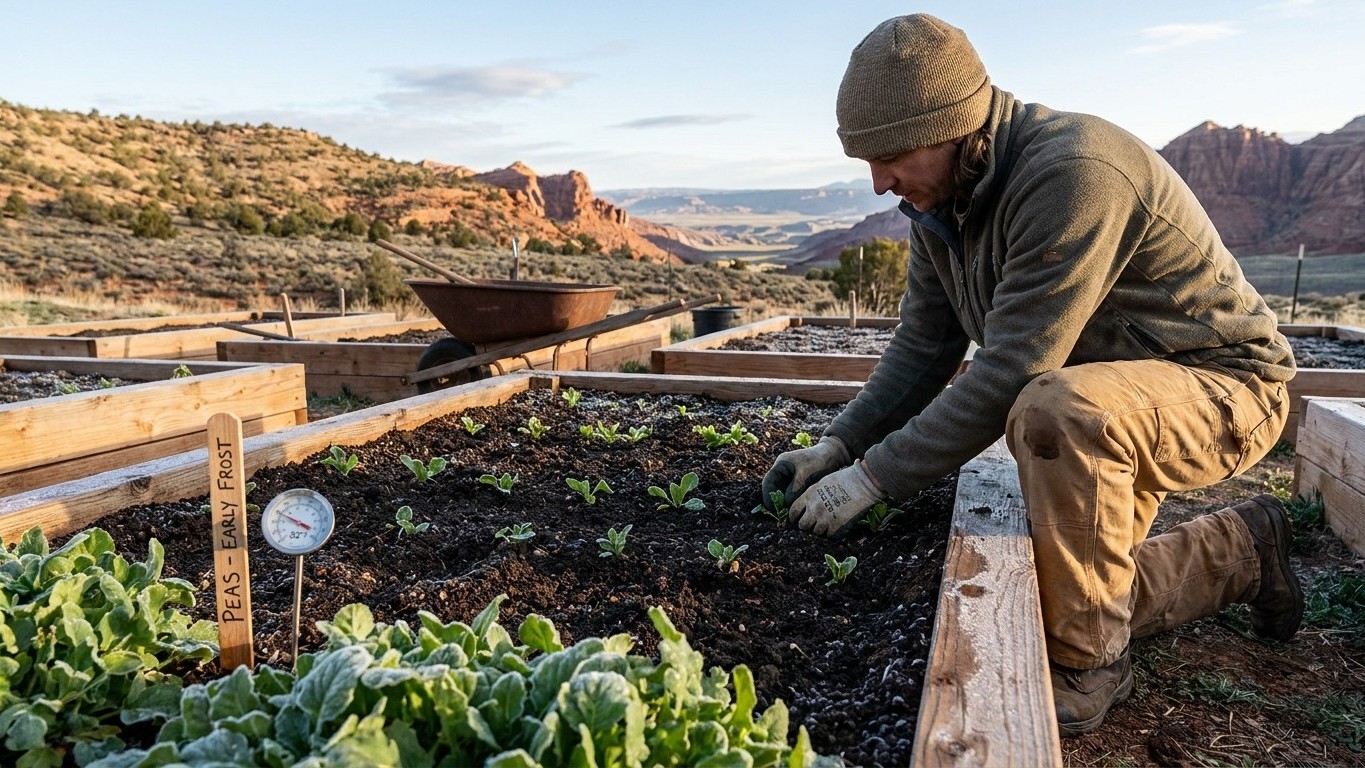

Utah gardening comes down to elevation and water more than luck. A frost-free window that can run under six months, summer heat that stalls cool-season crops for weeks, and winter cold that varies by 30 degrees between valley and bench mean the same seed packet behaves completely differently depending on where in the state you plant it. The numbers below come from the Salt Lake City reference station, the closest thing Utah has to a statewide baseline.
How long your season really is

Three figures decide almost everything a Utah gardener can realistically attempt. The USDA places the state across hardiness zones 4a to 9a, one of the widest ranges of any state in the country. At the reference station, the average last spring frost falls between April 12 and April 29, and the average first fall frost arrives between October 18 and October 29.
| Measure | Value |
|---|---|
| USDA hardiness zone (statewide range) | 4a to 9a |
| Average last spring frost | April 12 to April 29 |
| Average first fall frost | October 18 to October 29 |
Do the math on the tightest combination, a late spring frost paired with an early fall one, and the frost-free window shrinks to roughly 172 days. Take the earliest spring frost and latest fall frost instead, and you get closer to 200 days. That gap, nearly a month, is not a rounding error. It is the difference between a garden that ripens its last tomatoes comfortably and one that races the calendar every single year.
Either way, this rules out something specific: long-season crops that need 100 days or more to mature, planted directly from seed after the soil warms, leave almost no margin here. Some longer-season pumpkins, certain dry beans, and full-season melons fall into that trap unless started indoors weeks ahead or given a heat-holding trick like black plastic mulch — a constraint that makes Growing Pumpkins in Utah largely a matter of choosing the right variety for that window, and knowing When to Carve a Pumpkin in Utah depends just as much on getting that planting timeline right, much as Growing Potatoes in Utah hinges on timing seed potatoes to that same narrow frost window, and Growing Sweet Corn in Utah depends on the same tight calendar to reach full maturity before fall frost, a contrast with a perennial crop like Growing Asparagus in Utah, which is planted once and simply comes back within that same frost window year after year, or as Growing Peppers in Utah requires a jump-start indoors to beat the same short season, while by contrast Growing Spinach in Utah thrives precisely because it shrugs off cold and needs none of that head start, or as Growing Carrots in Utah is far more forgiving of that same tight window since it’s a quick-maturing, cool-season crop, much like Growing Beets in Utah which also thrives on that shorter cool-season timeline, and Growing Parsnips in Utah fits that same cool-season pattern despite needing a longer stretch in the ground. A 90-day crop direct-seeded in mid-May is cutting it close in a rough year, not comfortable in an average one.
The average itself deserves a second look, because it is not a guarantee. NOAA’s 30-70% freeze probability band means that in roughly three years out of ten, the last frost lands later than the range shown, or the first fall frost arrives earlier. Half of all years, by definition, run worse than the middle of that band. Treating April 29 as a hard, safe planting date, rather than a midpoint with real variance on both sides, is how tender transplants get burned in a state that regularly swings from snow to 80 degrees inside two weeks.
What the summer does to a garden here
Heat is not simply an asset for a Utah garden. At the reference station, temperatures climb above 90F on an average of 52.1 days a year, roughly seven to eight weeks concentrated between mid-June and early September. That threshold matters because plants respond to it directly: tomato blossoms drop and fail to set fruit once nighttime temperatures stay too warm and daytime highs push past 90F for stretches, lettuce and spinach bolt and turn bitter, and most cool-season greens simply stop producing anything worth harvesting.
The practical result is that a Utah growing season is rarely one long, uninterrupted stretch of production. It behaves more like two shoulder seasons bookending a dead middle. Spring gives you a window for lettuce, peas, spinach, and other cool-season crops before the heat arrives. Then comes the stretch where those same crops sulk or bolt, while heat-lovers like tomatoes, peppers, and squash take over, assuming they were transplanted early enough to set fruit before the worst of the 90-plus days hits. Fall reopens the cool-season window again, often producing better lettuce and greens than spring does, since the soil is already warm and the days are shortening rather than lengthening.
Winter cold is the other side of the equation. The coldest month’s average daily minimum sits at 24.2F at the reference station, a figure that has more to do with which perennials and shrubs survive the winter here at all than with how uncomfortable a January afternoon feels. Combined with the wide hardiness zone range across the state, it explains why a plant listed as hardy in a nursery catalog can thrive in one Utah yard and die outright thirty miles away at higher elevation.
What tends to go wrong in Utah
Utah State University Extension’s vegetable insect fact sheets point to a fairly short list of pests that actually cause the bulk of home garden damage, rather than the dozens of insects that theoretically exist. Knowing when each one shows up matters more than memorizing every possible bug.
- Onion thrips, described by USU Extension as the most injurious insect pest of onions in the state, build up during the hot, dry stretch of early to midsummer and leave onion leaves silvery, streaked, and stunted.
- Corn earworm, called the most destructive pest of sweet corn in Utah, arrives as ears silk out in mid to late summer, tunneling into the tip of the ear and ruining the top inch or two of kernels.
- Aphids (green peach, potato, melon, and cabbage types) show up early in spring on tender new growth and can persist through the whole season, curling leaves and coating them in sticky residue.
- Squash bugs and cucumber beetles appear as soon as squash, cucumber, and melon vines put out true leaves in late spring to early summer, wilting individual leaves and later whole vines.
- Tomato and tobacco hornworms turn up in mid to late summer, stripping tomato and pepper foliage fast enough that a plant can look half-defoliated within a few days.
This is not the complete roster. Spider mites, slugs and snails, grasshoppers, leafminers, and the imported cabbageworm and diamondback moth complex on cole crops all show up in Utah gardens too, and USU Extension’s fact sheets cover each in more detail. The point of naming these five is that a gardener scanning damaged leaves in June or July has a short, realistic list to check against, rather than a guessing game.
Where to check before you plant
Everything above is a state-level average built around one reference station in a mild valley. Utah spans several degrees of latitude and crosses hardiness zones from 4a to 9a, meaning a planting calendar tuned to Salt Lake City can run three weeks or more off the mark in a high mountain valley like Cache County or in the warmer low desert around St. George. Snow can still be on the ground in one part of the state while gardeners in another are already setting out tomatoes.
Utah State University Extension is the state’s land-grant extension service, and it publishes planting guides, pest fact sheets, and soil test resources tailored to specific regions rather than a single statewide date. Their site is available at extension.usu.edu, and every county in Utah has its own extension office that can confirm local frost dates, elevation-adjusted planting windows, and which pests are actually active in that county this season. That local check, not a statewide average, is what turns a rough plan into a garden that actually produces.