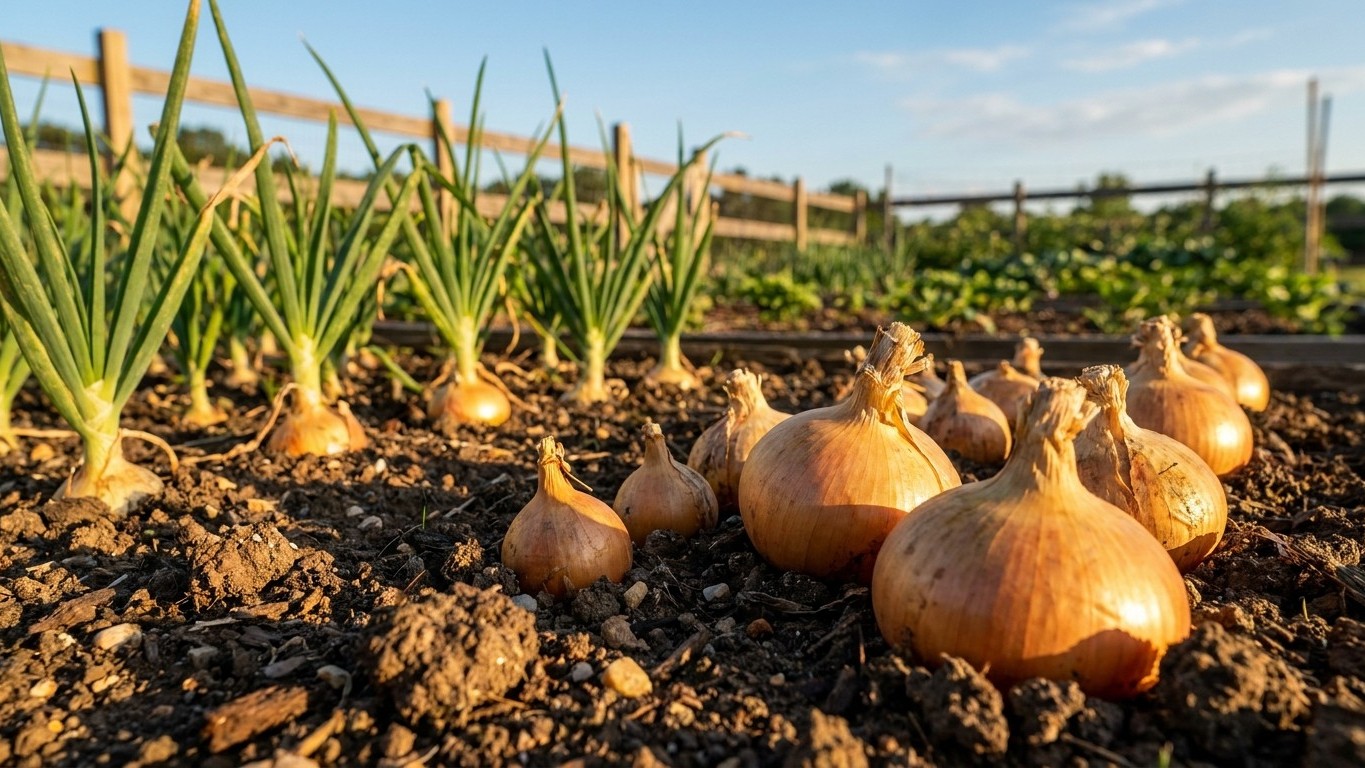

Onions bulb by day length, not by how warm it gets, and Montgomery’s longest day tops out at 14 hours and 19 minutes. That single number decides which onions can grow in an Alabama garden and which ones simply won’t, no matter how good the soil is or how carefully you plant them.
How long your longest day is

Montgomery sits at 34.64 degrees north latitude, and on the summer solstice its daylight runs 14 hours and 19 minutes, measured from the station coordinates NOAA uses for this region’s climate normals. That’s the whole story in one line: short-day onions, which start bulbing once the day reaches roughly 12 hours according to Clemson Cooperative Extension’s home garden guidance, get triggered early here and finish before the heat sets in. Intermediate-day types, which need something in the 12 to 14-hour range, also fit comfortably. Long-day onions, the ones bred for northern summers where daylight stretches to 15 or 16 hours, never get the signal they’re waiting for in Alabama. They just keep making leaves.
This is why the same onion set that bulbs beautifully in Minnesota can sit in an Alabama garden all season and produce nothing but green tops. The plant isn’t confused or unhealthy. It’s reading the sky, and the sky here never delivers the day length a long-day variety is built to respond to.
One caution matters more than it sounds like it should: Alabama is a big state, and 34.64 degrees is Montgomery’s latitude, not the state’s. Huntsville, up near the Tennessee line, sits closer to 34.7 degrees, barely different. But Mobile, down on the Gulf, is closer to 30.7 degrees, and its longest day is shorter still. If you garden near either edge of the state, look up your own latitude before you trust any of the ranges in this article. A few degrees can shift a variety from “fits comfortably” to “borderline” or the other way around. For most of Alabama, though, the 14-hour-19-minute figure from Montgomery is a reasonable stand-in, and it points squarely toward short-day and intermediate-day onions.
Which varieties bulb in Alabama
Twelve varieties documented on this site have a published latitude range that covers Montgomery’s 34.64 degrees outright, and you can see the full Best varieties onions Alabama breakdown for details, along with a When to Plant Onions in Alabama guide for timing your planting right. Among the short-day types: Gabriella, Madalyn, Red Rock, Red Sensation, Texas Grano 1015Y, Vidora, and White Castle. Among the intermediate-day types: Candy, Elsye, Expression, Scout, and Sierra Blanca. All of these are built to bulb somewhere in the 12 to 14-hour window Alabama’s summer actually delivers.
Six more sit close enough to the edge of their published range that they’re worth naming, but not promising. Cabernet, Calibra, Monastrell, and Red Long of Tropea are intermediate-day types listed from 35 to 45 or 46 degrees, just north of Montgomery. Bridger and Walla Walla Sweet are long-day varieties rated from 35 degrees up. Within a degree and a half of a published boundary, the number stops being a clean cutoff and starts being a gradient. These six may bulb in a warm Alabama summer, especially in the northern counties, but they’re a gamble rather than a safe bet, and a gardener trying one should treat it as an experiment, not a main crop.
The varieties that will disappoint you
Thirteen documented varieties are published for latitudes north of this one, some well north, and none of them belong in an Alabama garden: Ailsa Craig, Barolo, Blush, Frontier, New York Early, Patterson, Powell, Red Carpet, Red Long of Florence, Redwing, Rossa di Milano, Safrane, and Talon. These are long-day (and, in Red Long of Florence’s case, a northern intermediate-day) types rated from 38 degrees north on up, some as high as 60 or 65.
Plant one of these in Montgomery and here’s what actually happens, in order: the plant grows lush, dark green tops all spring, looking like the healthiest thing in the bed. Summer arrives, the day length peaks at 14 hours and 19 minutes, and nothing changes at the base of the plant. No bulb forms, because the day never reaches the 15 or 16 hours these varieties are waiting for. Then the heat and humidity that follow a Deep South summer start breaking the plant down from the inside, and the whole thing rots in place. If that sequence sounds familiar, it’s usually because someone planted a grocery-store bulb set of unknown origin, or ordered a variety bred for a Northern catalog without checking its day-length rating first.
| Status in Alabama | Varieties |
|---|---|
| Bulbs reliably here | Candy, Elsye, Expression, Gabriella, Madalyn, Red Rock, Red Sensation, Scout, Sierra Blanca, Texas Grano 1015Y, Vidora, White Castle |
| Borderline, may bulb | Bridger, Cabernet, Calibra, Monastrell, Red Long of Tropea, Walla Walla Sweet |
| Will not bulb, will rot | Ailsa Craig, Barolo, Blush, Frontier, New York Early, Patterson, Powell, Red Carpet, Red Long of Florence, Redwing, Rossa di Milano, Safrane, Talon |
When to plant onions in Alabama
Planting time follows straight from that day-length group, and it’s exactly why Alabama’s calendar looks nothing like a Northern seed packet’s instructions. Short-day and intermediate-day onions do best planted in fall here, so the plant has a whole mild winter to build root and leaf before the lengthening spring days flip the switch to bulbing. That’s the opposite of the spring-planting advice printed on sets meant for long-day regions, and it trips up a lot of gardeners who move south or order the wrong catalog.
Montgomery’s climate normals put the last spring frost between March 19 and April 3, and the first fall frost between November 2 and November 16, based on the 1991-2020 NOAA climate normals for station USW00003856. Those dates mark the 30 to 70 percent freeze-probability band, not a guarantee. A frost can arrive well before or after that window in any given year.
What that means for your onion bed
In practice, most Alabama gardeners set onion transplants or sets between mid-September and October, once summer heat breaks, aiming for the plants to be established well before that first-frost window in early to mid-November. A light frost rarely bothers young onion seedlings; they overwinter fine and resume growth as days lengthen toward spring, bulbing out well ahead of the last frost date the following year. If you’re gardening in a suburban yard away from the Montgomery airport station, plan on your own last frost landing later and your first fall frost arriving earlier, often by one to two weeks, more if you’re at any real elevation. That gives you a slightly shorter planting window than the airport numbers suggest, so err on the early side in fall rather than waiting for a calendar date that may not match your yard.
Sweet onions or onions that keep
What you’ll actually be able to grow in Alabama leans sweet, and it stays that way for the whole season you eat them. That’s not a matter of picking the right variety so much as a matter of chemistry. Pungency in an onion comes from volatile sulfur compounds, and those same compounds are what protect a bulb in storage. Short-day varieties, the ones that thrive under Alabama’s shorter summer days, tend to produce fewer of these compounds. University of Missouri Extension’s guidance on onion growing puts it plainly: sweet onions, as a rule, don’t store as well as pungent ones.
So a Southern garden trades one thing for another. What you get is a crop of tender, mild onions, good raw on a sandwich or sliced into a salad, ready to eat through late spring and into early summer. What you don’t get, at least not from these varieties, is an onion that’s still solid in the pantry come the following March. Sweet Southern types like Candy, Texas Grano 1015Y, or Vidora are built for eating fresh and soon, within a few weeks to a couple of months of harvest, not for six months in a mesh bag on a shelf.
Gardeners further north, growing long-day types under 15 and 16-hour summer days, end up with the reverse: sharper, more pungent onions loaded with the sulfur compounds that let a bulb sit through winter without going soft. That’s the trade a Northern pantry makes, sacrificing some sweetness for a supply that lasts into spring. Alabama’s growing conditions simply don’t let a gardener have both. If you want onions on hand in March, plan to preserve or use up your short-day harvest well before then, since holding out for a long-keeper here means fighting your own climate rather than working with it.