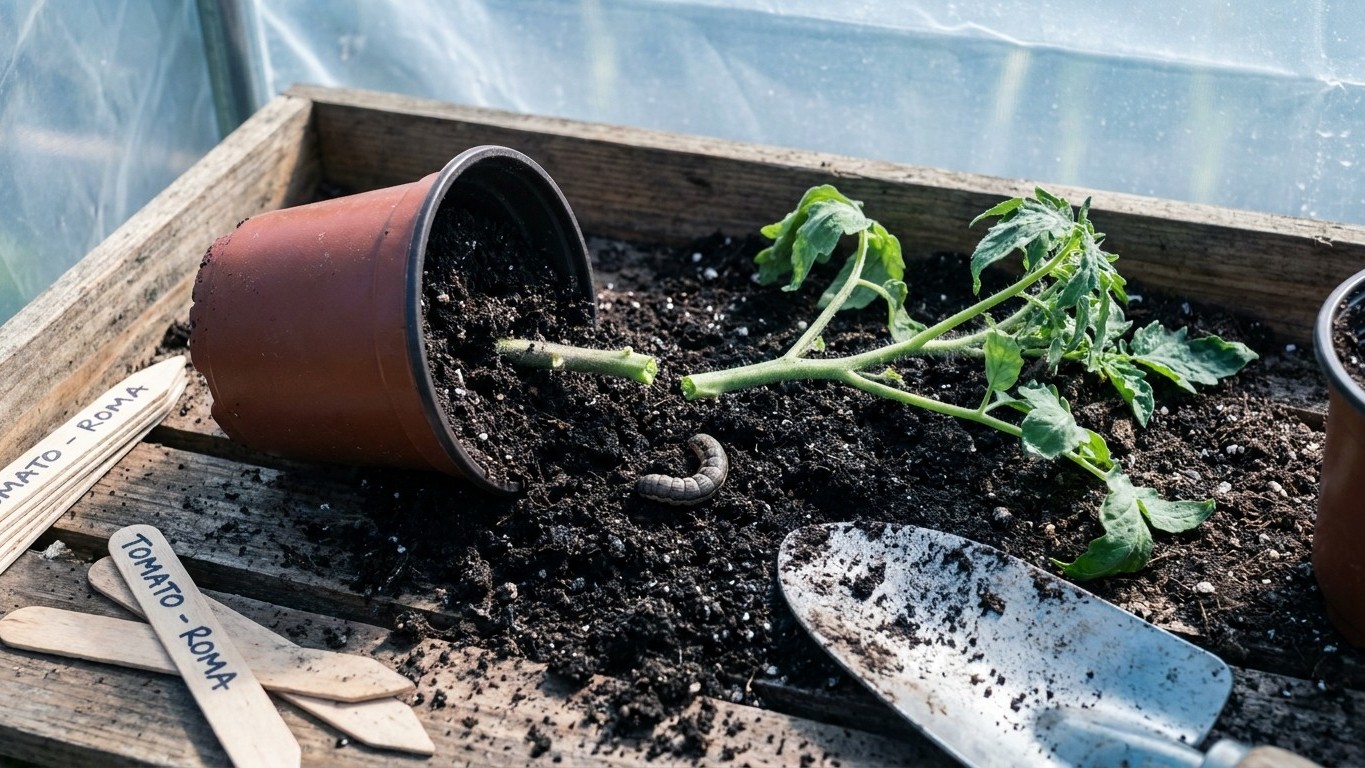

Real tomato pest pressure in Yukon is lighter than almost anywhere else covered on this site, because the growing season itself is so short. Bounded by a last spring frost averaging June 5 and a first fall frost averaging August 25 at Whitehorse A, gardeners here get roughly eleven weeks of frost-free growing, and that narrow window filters out most of the pests that plague tomato patches farther south. The ones that do show up are the ones that can finish their damage fast, or that survive the cold in soil, in weeds, or under cover in a greenhouse.
What this comes down to in Yukon

Tomato pests in Yukon are limited to a short list, and the frost window from Whitehorse A explains why. With only about eleven weeks between an average last spring frost of June 5 and an average first fall frost of August 25, many insects that need a longer season to build up populations south of the border simply run out of time here. That does not mean Yukon gardens are pest-free. It means the pests that matter are the fast, cold-tolerant, or greenhouse-adapted ones, and a large share of Yukon tomatoes are grown under some kind of cover (a hoop house, a cold frame, or a home greenhouse) precisely to stretch that short window, and covered plants bring their own set of visitors.
Cutworms
Cutworms are the first pest to worry about, and they hit right at transplant. The moth itself is unremarkable, but the larva is a plump, greasy-looking gray or brown caterpillar, about an inch long when full grown, that curls into a tight “C” when disturbed. It hides in the soil by day and feeds at night, and its signature damage is a young transplant sliced clean through at the soil line, sometimes toppled with the stem left lying next to the root. A cardboard or foil collar pushed an inch into the soil around each new transplant stops it cold, since the larva can’t climb over.
Flea beetles
Within a couple of weeks of transplanting, flea beetles show up on the leaves. They are tiny, shiny black beetles, barely a sixteenth of an inch long, that jump like fleas when the plant is disturbed. The adult beetle does the damage, chewing small round holes through the leaf surface that give the foliage a shot-hole, almost lace-like look. Young transplants take the worst of it because they have so little leaf area to spare. A floating row cover set immediately after transplanting, left on until the plants are established, keeps the beetles off without any spray.
Aphids
Aphids build up through the middle of the season, especially on plants growing under cover where it stays warm and still. They are small, soft-bodied insects, pale green to black depending on the species, clustered on the undersides of leaves and along tender new stems. Both nymphs and adults feed by piercing the plant and sucking sap, which curls and yellows the leaves and leaves behind a sticky honeydew that often grows a black sooty mold. A strong jet of water or a soap spray knocks populations down fast, and checking the undersides of leaves weekly catches an infestation before it spreads.
Slugs
Slugs are a late-season, cool-and-damp problem, and greenhouse-grown tomatoes see more of them than open-ground plants because the humidity stays high. The slug itself is soft, gray to brown, and shows up mostly at night or on overcast days, leaving a telltale silvery slime trail behind. The damage is ragged holes chewed into lower leaves and into fruit that touches the soil or the greenhouse floor. Beer traps set at soil level, or a barrier of diatomaceous earth around the base of each plant, are the standard low-effort fixes.
Working it out for your own garden
Naming a pest from a photo is one thing. Working out which one you actually have, in your own patch, takes a short process of elimination rather than a guess. Start with the calendar. If the damage shows up in the first week or two after transplanting and a seedling has been severed at the soil line overnight, that timing alone points to cutworms before you even find the larva. If instead the leaves develop small round holes within the same early window but the stem is untouched, that is the flea beetle’s shot-hole pattern, not a cutworm’s cut.
Next, check where on the plant the damage sits. Aphid damage concentrates on new growth and the undersides of leaves, with curling and a sticky residue you can feel between your fingers. Slug damage, by contrast, shows up as ragged chewing on lower leaves and on fruit near the ground, almost always with a slime trail somewhere nearby, since slugs rarely travel far without leaving one.
Then look for the culprit itself, at the right time of day. Cutworms and slugs are both night feeders, so a flashlight check after dark, an hour or two after sunset, will usually turn up the actual insect sitting near the damage. Flea beetles and aphids feed in daylight and are visible on the plant at any hour, which is a useful shortcut: if you see nothing at night but the damage keeps appearing, look again during the day.
A short mental checklist covers most cases:
- When did the damage appear relative to transplant date
- Where on the plant it is concentrated
- Whether a slime trail, sticky residue, or clean cut is present
- Whether the insect is visible by day or only after dark
Running through those four points in order will narrow a mystery pest down to one of the four covered here in most Yukon gardens, without needing to spray anything speculatively while you figure it out.
What changes across the state
Yukon is not one climate, and the Whitehorse A frost window is a starting reference, not a territory-wide guarantee. Elevation matters first: gardens sitting higher above a valley floor cool off faster on clear nights and tend to see frost, and the insects tied to warmer soil, arrive and disappear on a shifted schedule compared to a sheltered valley bottom. Distance from a large body of water works the other way, since a lake or a wide river moderates temperature swings nearby, which can keep aphid populations building a little longer into the season than they would on an exposed, wind-scoured site a few miles away.
The north-south spread across the territory matters too. Communities well north of Whitehorse run a noticeably shorter and cooler season, which pushes the useful window for outdoor tomatoes down further and makes greenhouse growing, with its associated slug and aphid pressure, even more the default than it already is around Whitehorse. South-facing slopes and sites with good air drainage, where cold air can flow away rather than pool overnight, buy a bit of extra frost-free time and can let flea beetles and aphids get a slightly earlier start than a low-lying, frost-prone garden a short drive away. None of these shifts come with a second precise date attached to them; they are directional adjustments a gardener makes by watching their own site over a season or two, not a number to plug into a calendar.
The mistakes this state punishes
The costliest mistake in Yukon is rushing a transplant into cold soil after a stretch of warm spring weather. A few sunny days does not mean the soil has caught up, and a transplant set out too early sits stressed in cold ground right when cutworms are most active, which is exactly the combination that leads to seedlings cut off at the base within days. Wait until the soil itself feels warm to the touch a few inches down, not just the air.
The second mistake is skipping a floating row cover in the first weeks after transplanting, on the assumption that flea beetles are a minor nuisance. On a young plant with only a handful of true leaves, shot-hole damage across even a third of the leaf area can set growth back for a week or more it can’t afford to lose in an eleven-week season.
The third mistake is letting greenhouse humidity run high without any slug control in place, especially once fruit starts touching warm, damp soil or flooring. A slug problem that starts small in a greenhouse rarely stays small, since the enclosed, consistently damp conditions are close to ideal for them, and by the time chewed fruit is obvious the population is usually already established. Traps or a diatomaceous earth barrier set early cost far less effort than dealing with an outbreak in August.
Checking this against your county
Yukon does not use a county system, so the equivalent step is checking with your own community’s growing conditions rather than a state-wide average. A microclimate a few miles outside Whitehorse, or a garden at higher elevation near Dawson or Watson Lake, can run its pest timing and frost dates noticeably differently from the Whitehorse A reference used here. For territory-wide growing guidance, Agriculture and Agri-Food Canada’s site is a solid starting point, and local garden clubs or community greenhouse groups often carry the most accurate, ground-level knowledge for a specific area.
Common questions
Do Colorado potato beetles or tomato hornworms show up in Yukon?
Neither is a recurring problem here. Both need a longer, warmer season than Yukon’s roughly eleven frost-free weeks provide to build up a damaging population, so they are not part of the pest list gardeners here typically deal with.
Should I spray preventively before I see any pests?
No. Spraying before a pest is identified risks harming beneficial insects for no benefit, and every pest covered here has a distinct, recognizable sign, so it is worth waiting for actual evidence before treating anything.
Are greenhouse-grown tomatoes more prone to pests than outdoor ones in Yukon?
For aphids and slugs, yes, since the warm, humid, sheltered conditions inside a greenhouse suit both of them well. For cutworms and flea beetles, outdoor transplants tend to see more pressure, since those pests are tied to open soil and early-season exposure.
What is the single most effective early step against these pests?
A cardboard collar at transplant time against cutworms, paired with a floating row cover for the first couple of weeks against flea beetles, handles the two earliest and most damaging threats before either has a chance to establish.