
Thirteen point four degrees is the number that decides this. That’s Portland’s coldest-month average low, and it’s cold enough to knock out any apple bred for milder winters before bloom timing even enters the conversation. Bloom timing is the second cut: a frost-free window as short as 161 days still covers moderate and short-season varieties, but nothing that blooms late or hangs fruit into late October. From there it’s site-specific — how cold your particular yard runs, how exposed the bloom is, how patient you are — which is why McIntosh and Cortland stay the safe bet for most of the state.
The short answer for Maine
Winter cold, not summer heat, is what decides which apple varieties survive in Maine. NOAA’s 1991-2020 climate normals put Portland’s coldest month at a mean daily minimum of 13.4°F, and that figure alone rules out apple varieties bred for mild winters further south. Bloom timing is the second filter. Portland’s last spring freeze falls between April 22 and May 1, and its first fall freeze between October 9 and October 21, per the same NOAA NCEI normals. Working from the latest possible spring freeze and the earliest possible fall freeze gives a frost-free window as short as 161 days. Working from the earliest spring freeze and the latest fall freeze stretches it to 182 days. Either way, that’s enough season for the moderate and short-season varieties named on this page, but it leaves no margin for a variety that blooms very late or still has fruit hanging in late October.
The right variety for a given yard depends on three things: how cold the site runs in January, how exposed the bloom is to a late frost, and how long you’re willing to wait for a full crop. A tree on a low-lying, frost-prone lot inland needs a hardier, earlier-blooming variety than the same tree on a hillside near the coast. McIntosh and Cortland are the safest general-purpose picks for most of the state, because they pair reliable winter survival with a bloom window that rarely collides with a late freeze. Before choosing a variety, the groundwork, from site selection to planting depth, is worth reading first: see Growing Apples in Maine.
Working through it

Rank Maine apple varieties by winter survival first, and everything else second. A tree that dies back in a hard January isn’t a variety choice, it’s a wasted decade. Once hardiness is settled, bloom timing decides whether an ordinary spring frost costs you the crop, and season length decides whether the fruit finishes before the first hard fall freeze. None of the varieties below run short on the winter chill Maine supplies. Coastal Maine’s dormant season alone is longer and colder than any of these trees need to break dormancy properly, so chill hours are never the limiting factor here. Cold survival and frost-timed bloom are what actually separate a good choice from a poor one.
| Variety | Harvest window | Bloom timing | What it costs you |
|---|---|---|---|
| McIntosh | Early to mid season | Mid | Scab-prone in wet years, needs a spray program or a resistant companion tree |
| Cortland | Mid season | Mid | Wide, spreading habit needs more room and pruning than a compact tree |
| Honeycrisp | Mid to late season | Mid to late | Uneven bearing year to year, and bitter pit if the tree grows too fast |
| Liberty | Mid season | Mid | Smaller, less uniform fruit than McIntosh or Honeycrisp |
| Northern Spy | Late season | Late | Slow to bear, often eight years or more before a full crop |
| William’s Pride | Early season | Early | Short storage life, best eaten within weeks of picking |
| Wealthy | Early to mid season | Early | Tart enough to need a purpose, cider or baking, not fresh eating alone |
| Duchess of Oldenburg | Early season | Early | Bruises easily and doesn’t keep, best used right off the tree |
Honeycrisp

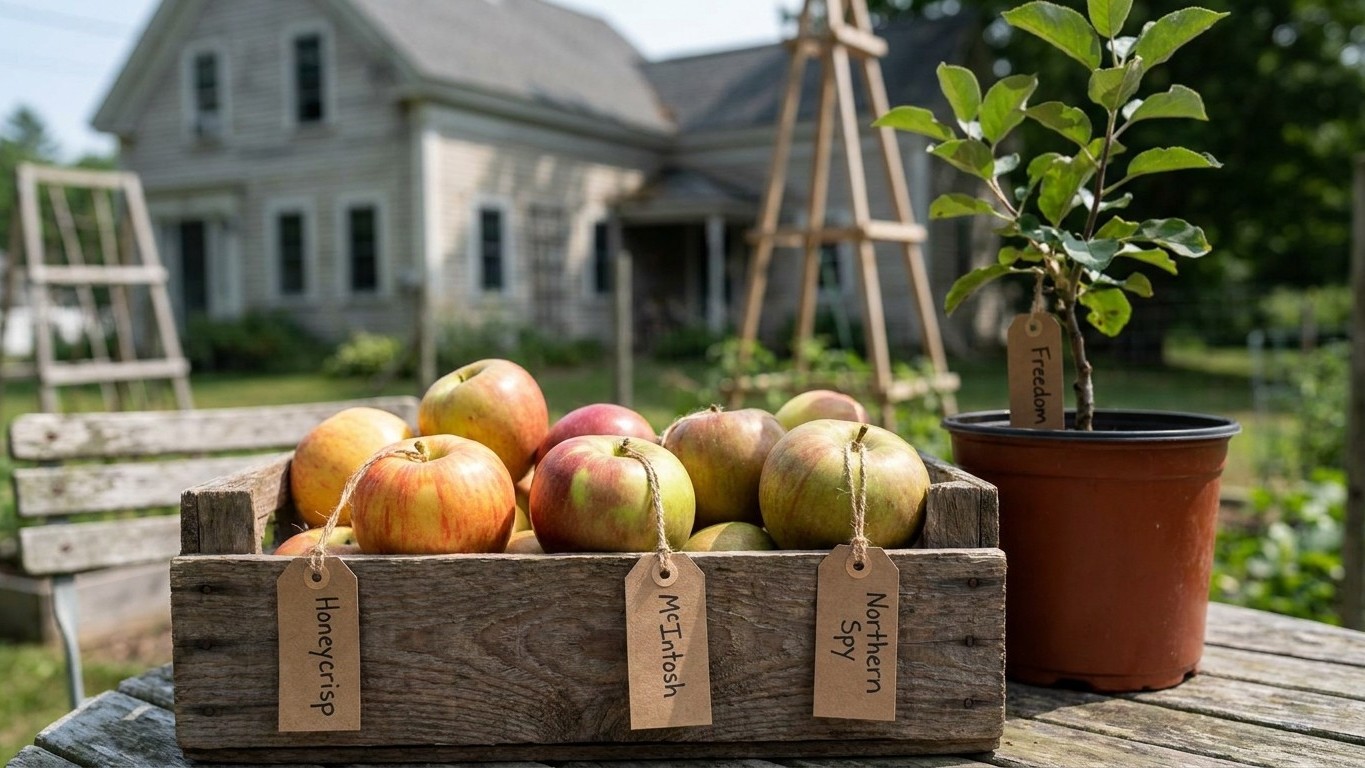
Honeycrisp survives Maine winters without trouble and produces the crisp, sweet-tart apple most people already recognize, but the tree is inconsistent. It alternates between heavy and light crops from year to year, and fruit that grows too fast after a wet stretch develops bitter pit, a disorder that shows up as sunken brown spots in the flesh. Thin the crop hard in a heavy year if you want the tree to hold up over the long run.
McIntosh

McIntosh is the apple most associated with Maine, and for good reason. It’s reliably hardy, and its mid-season bloom rarely overlaps with a late frost. Its main weakness is apple scab, a fungal disease that thrives in the state’s damp springs and shows as dark, rough lesions on leaves and fruit. Where scab has been a problem in the yard before, McIntosh needs either an annual spray program or a nearby companion planting of a scab-resistant variety like Liberty.
Cortland

Cortland shares McIntosh’s parentage and much of its hardiness, with flesh that browns slowly once cut, useful for a household that eats a lot of raw apple slices. The tree spreads wide rather than growing upright, so it needs more lateral space than a compact variety, and pruning has to keep the center open or fruit set drops off in the shaded interior branches.
Liberty

Liberty was bred specifically for disease resistance, and it shows. Scab, fire blight and cedar apple rust rarely take hold on this tree even without a spray schedule. The trade-off is a smaller, less uniform apple than McIntosh or Honeycrisp, with a flavor that’s good rather than exceptional. For a low-maintenance planting, or a yard near cedar trees where rust pressure runs high, that trade is worth making.
Northern Spy

Northern Spy is about as hardy as an apple gets, and its late bloom and late harvest let it dodge most spring frost risk entirely. The cost is patience. The tree is notoriously slow to start bearing, often eight years or longer before a full crop, and it tends to bear heavily every other year rather than every season once it does.
William’s Pride

William’s Pride ripens earlier than any variety on this list, which matters on a short-season inland lot where fall frost arrives ahead of Portland’s own range. It carries strong resistance to scab and fire blight, but the fruit softens fast in storage. Plan to eat or process it within a few weeks of picking rather than storing it through winter.
Wealthy
Wealthy was bred in Minnesota for exactly this kind of winter, and it tolerates cold that would damage less hardy trees. The apple itself is tart, better suited to cider, sauce or baking than eating fresh off the tree, and the tree bears an early, dependable crop that helps if a late frost has already thinned a more marginal variety nearby.
Duchess of Oldenburg
Duchess of Oldenburg is an old Russian variety that predates most of the others here, selected historically for exactly the cold Maine delivers. It ripens early and doesn’t keep, so treat it as a processing apple rather than a storage one, and pick it promptly since the fruit bruises easily and drops once fully ripe.
What changes across Maine
Every figure above comes from the Portland reference station, and Portland sits at the mild end of Maine’s climate range. Move inland or north and both frost dates move against you: spring frost lingers later, fall frost arrives earlier, and the frost-free window that runs 161 to 182 days near Portland contracts. NOAA’s own normals carry this caution directly, noting that inland and northern Maine run substantially later in spring and earlier in fall than the coast.
Aroostook County, in Maine’s far north, is the extreme case. Its growing season runs short enough that early-bloom, early-harvest varieties like William’s Pride, Wealthy and Duchess of Oldenburg carry less risk there than a late-season tree such as Northern Spy, which needs every day of a long fall to finish ripening. The western mountains add a second penalty on top of latitude, since cold air sinks into valley bottoms on clear nights, and a low-lying orchard site can run colder at bud break than a hillside planting a few hundred feet higher and a mile away.
The coast itself isn’t uniform either. Water close to shore, including the bays and inlets along the Midcoast and Down East, moderates both the spring warm-up and the fall cool-down, which is part of why Portland’s own frost window sits later in spring and earlier in fall than places just a short drive inland. A yard near open water gets more protection from a late frost than a yard a few miles up a river valley at the same latitude.
The mistakes this climate punishes
Four errors account for most failed apple plantings in Maine, and every one shows up as winter injury or an unfinished crop rather than a slow decline.
- Late-ripening variety on a short-season site: Northern Spy needs a full fall to finish, and planted inland where frost arrives ahead of Portland’s October 9 to October 21 range, it can be caught unripe.
- Nitrogen fed too late in summer: soft new growth that hasn’t hardened off is what winterkills at the first freeze, while older wood on the same tree survives untouched.
- Dwarfing rootstock chosen on size alone: some rootstocks used to keep a tree small are less cold-hardy than the variety grafted onto them, and the graft union is what fails first.
- Pruning cuts made in late fall or early winter: fresh wounds right before the coldest stretch of the year are where winter injury and disease both take hold.
The rootstock mistake is the hardest to spot, because it hides above ground for years. A dwarf tree can look healthy through several mild winters and then lose its root system or graft union in the one winter that actually tests it, long after the receipt and the tag are gone. Check a rootstock’s own cold tolerance before buying, separately from the fruiting variety’s rating, since a hardy apple grafted onto a tender rootstock is only as hardy as its weakest part.
Pruning timing compounds the same risk. Late winter, once the coldest weeks have passed but before the buds swell, is the safer window for cuts. That stage-by-stage timing is worth checking against The Maine Apple Calendar, Stage by Stage rather than against the date on the wall calendar.
Checking this against your county
Every figure on this page is anchored to Portland, and Portland is the mild edge of Maine, not the middle of it. Before planting, check your own county’s frost record and any local variety trial results against the UMaine Cooperative Extension, which maintains county offices across the state and tracks orchard performance under conditions Portland’s own numbers don’t cover. If your site sits in a river valley, at elevation, or well north of the coast, treat every date and range above as a starting point, not a schedule to plant by.
Common questions
Can I grow honeycrisp in Maine?
Yes, Honeycrisp survives Maine’s winters without special protection. It bears unevenly from year to year and needs the crop thinned hard to avoid bitter pit, so plant it as a second or third tree rather than your only one.
Do apple trees need a second tree to pollinate in Maine?
Most apple varieties need a different variety blooming nearby at the same time, since a single tree usually can’t pollinate itself. Two trees on this page with matching bloom windows, such as McIntosh and Cortland, work well together, while pairing an early bloomer like William’s Pride with a late one like Northern Spy risks missing the overlap entirely.
How long before a new apple tree bears fruit in Maine?
Most varieties on this page start bearing a light crop within four to six years of planting, with a full crop a few years after that. Northern Spy is the exception, often taking eight years or longer, which is the main cost of choosing it.
Will a late frost kill my apple blossoms?
An open blossom or a newly set fruit can be killed by a freeze that a tight, unopened bud would have survived. That’s why bloom stage matters more than the date on the calendar, and why an early fall frost after petal fall does far more damage than the same freeze a week earlier while buds are still closed.