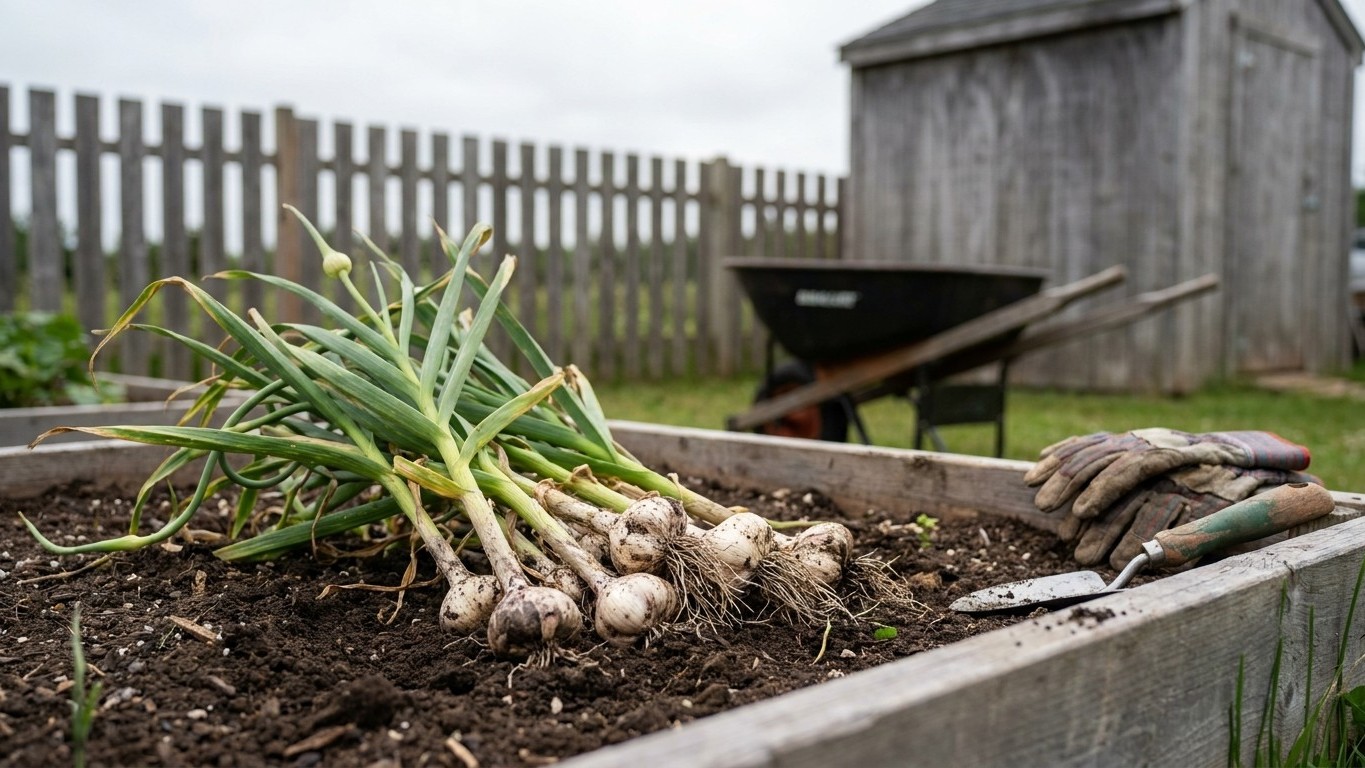

Garlic grown in Prince Edward Island gets all the cold it needs to split into a full head of cloves rather than staying a single round bulb. Environment and Climate Change Canada’s 1981-2010 climate normals put the average first fall frost at the Charlottetown A station at October 17, and the winter that follows runs long past the point any garlic variety requires. Growers can learn When to Plant Garlic in Prince Edward Island and set hardneck cloves in the ground in late September, three to four weeks ahead of that average frost, so they root before the soil locks up for winter.
Will garlic get the cold it needs in Prince Edward Island

A garlic clove doesn’t naturally split into a head unless it goes through a real stretch of cold after planting. That process, called vernalization, triggers the shift that turns one clove into many. Skip it, or cut it short, and the plant grows a single round bulb with no internal cloves at all, essentially a scaled-up version of what you planted. University of Georgia Extension publication C854 sets the benchmark at six to eight weeks with soil temperatures below 40°F, and that’s the number to check before committing to a hardneck variety anywhere.
- A single round, solid bulb with no internal cloves, sometimes called “rounding”
- Bulbs that finish small at harvest despite healthy top growth all season
- A hardneck variety behaving like softneck, with a soft, unscaped center
Why Prince Edward Island isn’t marginal on this point
What can be said plainly is that a Maritime Canadian winter, with ground frozen from December well into spring in most years and snow cover holding through much of that stretch, supplies vernalization cold many times over the six-to-eight-week floor. This isn’t a place where growers need to worry about a mild winter cutting the cold short, the way a grower in a state such as Growing Garlic in Indiana sometimes has to. A grower in a similarly cold Canadian province, covered separately in Growing Garlic in Quebec, faces the same abundance rather than the same shortage.
Because the cold is not in question here, the two workarounds that milder-climate growers rely on, pre-chilling cloves in a refrigerator for six to eight weeks before planting, or defaulting entirely to softneck types that skip the cold trigger, are optional rather than necessary on PEI. Hardneck garlic is the natural fit for this climate, and growers can plant it without any extra chilling step, choosing among the Garlic Varieties That Suit Prince Edward Island Winters that local growers have found reliable.
What actually threatens a PEI garlic crop is the opposite failure: cold that reaches exposed, shallow-planted cloves before they’ve rooted, or a freeze-thaw cycle that heaves a clove partway out of the ground over winter. Both are covered further down, under planting depth and mulch timing.
When to put the cloves in
Anchor the planting date on the season’s first frost, not on a fixed date circled on the calendar. Environment and Climate Change Canada’s 1981-2010 normals for Charlottetown A put the average first fall frost at October 17, and that figure is a midpoint, not a safe date. In one year out of two, frost actually arrives later than October 17, and in the other half it comes earlier. Treat the date as the center of a window, never as a line you can plant right up against.
Every variety from Inchelium Red to German White is set out in late September in this climate, which puts cloves in the ground roughly three to four weeks ahead of that average frost. That gap gives roots time to establish in soil that’s still workable, without enough warmth left in the season to push much leaf growth above ground. A clove that puts up several inches of green before winter risks losing that growth to the season’s first hard freeze, though the below-ground rooting isn’t threatened by a light frost the way top growth is.
What moves the date on this Island
The Charlottetown A station sits close to the water in Queens County, and its readings don’t describe the whole province. Low-lying inland ground away from the coast, in parts of Prince County and Kings County, tends to see its first frost earlier than the Charlottetown figure, sometimes by a couple of weeks in a frost-prone hollow. Higher, more open ground and locations right on the coast, where surrounding water moderates temperature swings, often run later than the Charlottetown average. Track what your own site has done in past years rather than relying on one station’s number, especially if your garden sits in a low frost pocket or right along the shore.
Which types suit Prince Edward Island
Hardneck and softneck garlic are not interchangeable choices here, they’re suited to two different winters. Hardneck varieties need real, sustained cold to perform well and to send up a scape, exactly what PEI’s winter supplies without effort. Softneck varieties tolerate mild winters that never deliver much chill, and in exchange they store for longer after curing. Since Prince Edward Island leans firmly toward hardneck-friendly winters, most Island growers plant hardneck as the main crop and keep softneck around for storage insurance.
Hardnecks for PEI’s winter
The hardneck varieties include Bavarian Purple, Blue Music, Chesnok Red, Duganski, Fall Festival, Georgian Crystal, Georgian Fire, German Red, German White, and Ivan. All are set out in late September in this climate, and all send up a scape in early summer that most growers cut to redirect energy into the bulb. Hardneck cloves also tend to be larger and fewer per bulb, which makes peeling faster at the cutting board if you’re putting up a winter’s worth of garlic.
Softnecks worth keeping in the rotation
The softneck varieties on the list, Inchelium Red, Lorz Italian, Early Red Italian, and Italian Late, don’t depend on a cold trigger the way hardneck does, but they take PEI’s winter without complaint and reward the grower with bulbs that keep in storage far longer than hardneck. A grower in a much milder climate, covered in Growing Garlic in Indiana, often plants softneck as the default because a mild winter can’t reliably vernalize hardneck. On PEI that’s not the constraint, so softneck here is a choice about storage life and clove count rather than a climate necessity.
| Variety | Type | Set out | Storage after curing |
|---|---|---|---|
| Georgian Fire | Hardneck | Late September | Shorter, use through winter |
| German White | Hardneck | Late September | Shorter, use through winter |
| Chesnok Red | Hardneck | Late September | Shorter, use through winter |
| Inchelium Red | Softneck | Late September | Longer, keeps toward spring |
| Lorz Italian | Softneck | Late September | Longer, keeps toward spring |
Soil and bed preparation
Garlic sits in the same patch of ground for close to ten months on PEI, through fall rain, winter freeze-thaw, and spring thaw, so drainage matters more here than almost anything else you do to the bed. A clove sitting in saturated, heavy soil rots before any disease organism gets involved. Where the Island’s clay-influenced soils hold water, raised beds or ridged rows solve most drainage problems without any other intervention.
Building the bed before planting
Work compost or well-rotted manure into the bed a few weeks ahead of the late-September planting date, rather than right before, so it has time to settle and stop competing with the cloves for nitrogen as it breaks down. Garlic prefers a loose, deeply worked bed, since compacted soil resists the root system that has to establish before winter sets in. Pull weeds and old crop residue out completely rather than turning them under, particularly if the previous crop was an onion-family plant, since several of the diseases covered below survive in soil debris.
Test soil pH before amending blindly. Garlic does best in soil that isn’t strongly acidic, and a lot of PEI ground, especially where it’s been in potatoes for several seasons, has drifted acidic enough to need lime. A soil test through the provincial extension service is the only reliable way to know where your own bed stands rather than guessing from a neighbor’s results.
Avoid a heavy nitrogen feed at planting. Garlic uses very little fertility going into winter, and a flush of nitrogen in fall only encourages the top growth you’re trying to avoid before frost. Save the bulk of any feeding for spring, once the plant is actively growing again, and rotate garlic away from any bed that grew onions, leeks or shallots in recent years to keep the same soil-borne pressures from building up in one spot.
What the climate here favours, and what it does not
The figures below come from UC IPM’s Pest Management Guidelines for Onion and Garlic (UC ANR Publication 3453), which publish soil-temperature ranges for the organisms behind the crop’s major rots. What follows compares those published ranges against the mean air temperature across PEI’s growing season, September through July, at the Charlottetown reference station. That’s an important gap to keep in mind: soil temperature lags air temperature, warming more slowly in spring and cooling more slowly in fall, and it swings far less from day to day than the air above it. Treat every count below as a tendency, not a soil reading and not a forecast.
Where the window opens
White rot, caused by the fungus Sclerotium cepivorum, has a published range of 50 to 75°F. Charlottetown’s growing-season air temperature means fall inside that band in three months, September, June, and July, the shoulder months right around planting and right around harvest. White rot’s sclerotia survive in soil for decades once introduced, so the practical response isn’t to fear those three months specifically, it’s to never plant garlic sets of unknown origin into a bed that’s never grown the crop before.
Fusarium basal rot (Fusarium oxysporum f. sp. cepae) has a broader range, 59 to 90°F, but only one growing-season month, July, lands inside it on the Charlottetown means. July is also close to when many varieties mature, which is one more reason to lift bulbs promptly once the leaves say they’re ready, rather than leaving them in warm, damp soil.
Where it stays closed, for now
Southern blight (Sclerotium rolfsii) has a published optimum of 86 to 95°F, and pink root (Setophoma terrestris) an optimum of 75 to 85°F. Neither range is touched by any growing-season month on the Charlottetown means. That’s genuinely reassuring, but it is not the same as immunity: outside its optimum, a pathogen already present in soil or on infected seed stock is simply less active, not gone. Both organisms travel on planting stock and tools regardless of climate, so the real defense is clean seed garlic and rotation away from onion-family crops, not the thermometer.
Getting it through the winter
Mulch is often the difference between a clove that roots cleanly and one that heaves halfway out of the ground by March. Lay it once the soil surface has started to firm up with the season’s cold, not right after planting, since mulching too early traps warmth the clove doesn’t need and can encourage the top growth you planted late to avoid. A loose layer of straw a few inches deep, spread before snow typically arrives, keeps temperature swings gentle through the freeze-thaw cycles that are common on the Island through winter and into early spring.
Depth does more work than mulch alone
Planting depth matters as much as anything laid on top. A clove set too shallow is far more exposed to repeated freezing and thawing, which physically works it upward out of the soil over a winter, breaking the roots that anchored it, exactly the failure described in the note above. Planting a full inch or so deeper than the seed supplier’s minimum gives real insurance against this on ground that freezes and thaws repeatedly rather than freezing once and staying frozen.
In spring, pull mulch back gradually rather than stripping it all at once, watching for the first green shoots to push through. Leaving too much mulch in place once growth starts holds moisture against the emerging shoot and invites rot at the base, while removing it all at once during a cold snap can expose new growth to a late frost it isn’t ready for. A partial pull-back, leaving a thin layer, splits the difference and is the practice most Island growers settle on.
Harvest and curing here
Lift garlic by reading the plant, not a date on the calendar. Watch for the lower leaves browning and dying back while the top five or six leaves stay green, since each leaf corresponds to a wrapper layer around the bulb, and a plant that’s lost too many leaves before you dig it will have thin wrappers that won’t store. The leaves, not the month, are the actual signal, though in most years on PEI that point arrives in the back half of summer.
Curing in a humid maritime summer
PEI’s summers run humid enough that garlic won’t cure properly outdoors in the open the way it might in a drier inland climate. Curing needs airflow more than heat, so a shaded, covered space with a fan running, a barn, porch, or open shed, works better than direct sun, which can scorch bulbs and cook the outer wrapper before the inside has actually dried. Lay bulbs in a single layer rather than a pile, since bulbs touching each other in a humid space are exactly where mold gets started.
Give the crop two to four weeks of curing before trimming roots and tops, checking the neck where the stem meets the bulb. It should feel dry and tight, not soft or damp, before you consider the bulb ready to trim and store. A bulb cured too fast, or in a space with poor airflow, is the most common way a season’s harvest gets lost after the hard part, growing it through an Island winter, is already behind you.
Local help
The Charlottetown A figures describe one station, and Prince County, Kings County, and the coastal edges of Queens County all run somewhat differently. For a planting window closer to your own soil, and for a proper soil test before you commit a bed to garlic for the winter, contact Prince Edward Island’s Department of Agriculture. They can also confirm current guidance on seed sourcing, since certified, disease-free seed garlic matters more than any variety choice covered above.
Common questions
Can I Plant Garlic in spring on PEI instead of fall?
You can, but don’t expect much of a harvest. Garlic planted in spring skips the long cold period that makes a clove divide, so most spring-planted stock lifts as a single round bulb rather than a full head, especially with hardneck varieties. Fall planting in late September is the standard approach here for a reason.
What happens if I plant too early in September?
Cloves planted well before the late-September window can push several inches of green top growth before the season’s first hard freeze, and that growth is usually lost to the cold. The plant generally recovers and still roots normally underground, but it’s a setback the plant doesn’t need, and it’s easy to avoid just by holding off a couple of weeks.
Can I use grocery store garlic instead of buying seed garlic?
You can plant it, but it’s a gamble on two fronts. Grocery garlic is often a variety not suited to being overwintered in a cold climate, and it’s rarely certified free of the soil-borne diseases covered above, including white rot, which can persist in a bed for decades once introduced. Certified seed garlic from a supplier costs more per clove but starts you clean.
Do I need to pull the mulch back completely in spring?
No, and stripping it all off at once is one of the more common mistakes. Pull it back gradually as green shoots appear, leaving a thin layer in place, so the bed still holds some moisture and buffer against a late frost while new growth gets started.
How do I tell if a variety is hardneck or softneck before I plant it?
Check the label or catalogue listing before you buy, since it isn’t obvious from the clove alone. Hardneck varieties send up a rigid central stalk, called a scape, that gets cut off in early summer, while softneck varieties never produce one and instead have a flexible, braidable neck, which is also why softneck keeps longer in storage.