
A clove of garlic pushed into Charleston-area soil this winter will feel something like 4.3 weeks below 40°F before spring warms things up — and full clove division asks for six to eight. That gap is the whole story for anyone here: too little cold and the bulb grows into a single round lump, fine on a plate but worthless as seed. Head inland toward the Piedmont, though, and the winters run colder, narrowing that shortfall considerably.
Will garlic get the cold it needs in South Carolina

The chill deficit
A garlic clove is not just a seed waiting to sprout. It needs a sustained stretch of cold after it goes in the ground to trigger division into the separate cloves that make up a full bulb. Skip that cold, or get too little of it, and the plant grows into a single round bulb that looks more like an onion than a head of garlic, fine to eat but useless as seed for next year.
NOAA’s 1991-2020 Climate Normals for the Charleston-area station put the region at roughly 4.3 weeks below 40°F across a typical winter. University of Georgia Extension’s publication C854 puts the requirement for full clove division at six to eight weeks below that same mark. The Charleston-area numbers land well short of what the crop wants, and that gap is the single most important fact for anyone Growing Garlic in this state.
The shortfall is not uniform everywhere in South Carolina. NOAA’s 1991-2020 normals used here come from a station near the coast, and Upstate South Carolina runs several weeks colder at both ends of the season, so the actual gap for a grower in the Piedmont is likely smaller than it is for a grower right on the coast, even though NOAA doesn’t publish that Upstate figure separately. Compare either end of the state to a genuinely cold-winter state like South Dakota, where the ground freezes hard for months and the six-to-eight-week requirement is met without any effort from the grower at all. South Carolina growers don’t have that built-in advantage.
Two ways to close the gap
The first workaround is to refrigerate the seed cloves before planting. Keep whole heads (don’t break them into cloves until just before planting) in a paper bag in the refrigerator for several weeks ahead of your planting date, which substitutes cold-storage time for the cold the ground itself won’t provide. This works for hardneck varieties that otherwise struggle here, and timing that refrigeration correctly means knowing When to Plant Garlic in South Carolina so growers can plan accordingly.
The second is to plant a type that doesn’t ask for as much cold in the first place. Softneck garlic evolved in milder climates and divides reliably with less chilling than hardneck garlic needs, which is exactly why it’s the type grown commercially across warm-winter states, and why choosing Garlic Varieties That Suit South Carolina Winters matters so much. Neither approach is foolproof. A clove that skips both the fridge and enough field cold will still often produce something to eat, just not a bulb worth saving as next year’s seed stock.
When to put the cloves in
Working Back From the First Frost
Anchor planting on the first fall frost, not on a date circled on a calendar. NOAA’s 1991-2020 Climate Normals put the first fall freeze near Charleston somewhere between November 20 and December 5, a two-week window rather than a single day. Garlic wants enough time in the ground before that freeze to root well, but not so much time that it pushes tall green top growth a hard freeze will burn back.
Working back from that window, the varieties available for this state are set out from late October through mid November, roughly two to five weeks ahead of the earliest expected frost. That gap is enough for roots to establish in soil that’s still workable, without leaving enough warm weeks behind it to force much leaf growth above ground before winter sets in.
Several things move that window earlier or later than the Charleston-area normal:
- Coastal, urban heat near Charleston itself runs milder than the airport station used for these normals, which can push safe planting a bit later than the general range.
- Upstate South Carolina’s higher elevation brings frost earlier and harder, favoring the front of the late-October start rather than waiting for mid-November.
- A low spot that collects cold air overnight, or ground near a large lake that moderates temperature swings, will shift the safe window on either side.
If the fall stays unusually warm and no frost has shown up by the time your calendar says it should, don’t wait on the weather forecast alone. Watch the soil instead. Garlic roots well once the top few inches have cooled off from summer’s heat, and Clemson Cooperative Extension’s county agents track that timing on the ground better than any statewide average can.
Which types suit South Carolina
Softneck: the safer bet
The chill shortfall described above settles this question more than personal taste does. Softneck garlic tolerates a mild winter and still divides reliably, which is exactly why it dominates commercial production across the mild-winter South, in states like Louisiana where winters run even milder than South Carolina’s. Softneck bulbs also store for months longer than hardneck bulbs once cured, an advantage in a humid climate where any garlic held past midsummer needs all the shelf life it can get.
From the closed list of varieties carried for this state, the softneck options are Early Red Italian, Inchelium Red, Italian Late, and Lorz Italian. All four go in during the same late-October-to-mid-November window described above, and all four ask less of the winter than a hardneck variety does.
Hardneck: possible, not simple
Hardneck garlic is not off the table, but it’s a bigger gamble here without the refrigeration step covered above. Hardneck types send up a flowering stalk called a scape, which gets cut off and eaten rather than left to flower, and many gardeners keep growing them anyway for a flavor they consider sharper and more distinct than softneck. From the available list, Bavarian Purple, Blue Music, Chesnok Red, Duganski, Fall Festival, Georgian Crystal, Georgian Fire, German Red, German White, and Ivan are all hardneck.
A grower in the Upstate, where winters run colder and longer than the Charleston-area normals used throughout this guide, has a better shot with these varieties than a coastal grower does. A coastal grower who wants to try a hardneck anyway should refrigerate the cloves for several weeks before planting rather than skip that step and hope for the best.
| Type | Cold needed to divide well | Storage after curing | Examples from the list |
|---|---|---|---|
| Softneck | Low, suits SC’s mild winters as-is | Long, holds well past midsummer | Inchelium Red, Lorz Italian |
| Hardneck | High, wants real winter chill or refrigerated cloves | Shorter, use it earlier in the season | Chesnok Red, German White |
Soil and bed preparation
Drainage before anything else
Garlic sits in the same patch of ground for seven to eight months, through fall rain and the wet spells that hit much of South Carolina in late winter. Drainage matters more than fertility here. A clove sitting in saturated soil for even a few days can rot before it ever roots, particularly in the heavy clay common across the Piedmont and Midlands.
Work the bed several weeks before planting so it has time to settle before the cloves go in. Loosen the top foot of soil and mix in a generous amount of finished compost, since garlic feeds heavily over its long season in the ground. On clay soils, or anywhere water tends to pool after a storm, build a raised bed or at least a mounded row so the cloves sit above standing water through winter rains.
Getting the fertility right
Have the bed tested rather than guessed at. South Carolina’s soils vary widely between the sandy coastal plain, the clay Midlands, and the rockier Upstate, and a soil test tells you what to add before planting rather than after a disappointing harvest. It’s cheap insurance against a whole season lost to a fixable nutrient problem.
Skip fresh manure right before planting. It’s high in nitrogen that pushes soft top growth heading into winter, exactly the wrong thing for a crop that needs to sit quietly through the cold months. Aged, fully broken-down compost worked in well ahead of planting is the safer route, and it also improves drainage in heavier soils over time.
What the climate here favours, and what it does not
UC IPM (UC ANR Publication 3453) publishes the temperature ranges within which the major garlic diseases develop, and lining those ranges up against South Carolina’s growing-season air temperatures gives a mixed picture. One caution before the numbers: UC IPM’s published thresholds are soil temperatures, while the figures below are monthly mean air temperatures, which swing wider and run warmer by day than the soil a few inches down. A month whose average air temperature falls inside a disease’s range does not mean that month brought infection. It means conditions leaned that way more often than not.
Where the risk sits
| Disease | Months in range (of the Sept-July growing season) | Pathogen |
|---|---|---|
| White rot | 7 months (Oct, Nov, Dec, Feb, Mar, Apr, May), 1 at optimum | Sclerotium cepivorum |
| Fusarium basal rot | 6 months (Sep, Oct, Apr, May, Jun, Jul), 1 at optimum | Fusarium oxysporum f. sp. cepae |
| Pink root | 3 months (Sep, Jun, Jul), all 3 at optimum | Setophoma terrestris |
| Southern blight | 0 months at its 86-95°F optimum | Sclerotium rolfsii |
White rot has the widest window here, with mean air temperature sitting inside its published 50-75°F range across seven months of the growing season, including one month right at the pathogen’s optimum. It’s the one to watch hardest, since it survives in soil for years once introduced, with no cure available, only prevention through clean seed stock and not moving soil between beds. Fusarium basal rot follows a similar but shorter pattern, mostly at the shoulders of the season rather than deep winter. Pink root’s tighter 75-85°F optimum lines up with early fall and early summer here, worth knowing if you’ve seen stunted, discolored roots on garlic or onions before.
Southern blight‘s 86-95°F optimum never matches a South Carolina monthly average, not even at the peak of a Lowcountry summer. That does not mean it can’t show up. Infected soil or infected seed stock can bring southern blight into a garden regardless of what the thermometer says on average, and individual hot days will run well above a cooler month’s mean. Read the table as a tendency worth planning around, not a promise either way.
Getting it through the winter
Mulch and the heaving problem
Lay mulch down after planting, once the soil has cooled but before the first hard freeze arrives. A thick layer of straw, shredded leaves, or pine straw over the row keeps soil temperature steadier through winter and cuts down on the freeze-thaw swings that heave a shallow-planted clove right up out of the ground.
Heaving is the bigger winter threat here, more than the cold itself ever is. South Carolina’s winters swing between freezing nights and warm, sunny days more than a truly cold state’s winter does, and each freeze-thaw cycle can work a clove upward until its top sits exposed on the surface, where it dries out or rots. Planting at a proper depth, with the clove’s tip a couple of inches under the soil surface, and mulching well over that, are the two best defenses against it.
Mulch also evens out moisture through a South Carolina winter that tends to swing between dry stretches and heavy rain rather than settling into a steady pattern. A consistent mulch layer keeps the bed from alternating between soaked and parched, which matters more to root health than most gardeners assume.
Pulling mulch back in spring
Leave the mulch in place through the coldest months. Once green shoots push up reliably across the bed in early spring, pull the mulch back just enough to let soil warm and shoots grow freely, but leave a thin layer to suppress weeds through the rest of the season. Don’t strip the bed bare too early. A late cold snap after growth has started can damage exposed shoots in a way it never would have under a protective layer of mulch.
Harvest and curing here
Reading the leaves, not the date
Lift garlic by watching the plant, not by circling a date on the calendar. When the lower one-third to one-half of the leaves have browned and died back while the upper leaves are still green, the bulb is ready. Pull a test bulb or two, check that the cloves have filled out and the wrapper skins are intact, before digging the whole bed at once.
Curing in a South Carolina summer
Curing is where South Carolina’s climate works against a grower more than the growing season itself does. Bulbs need a couple of weeks in a warm, dry, shaded spot with real airflow moving across them, somewhere like a covered porch, a barn, or a garage with a fan running. South Carolina’s summer humidity makes that moving air non-negotiable. A pile of bulbs stacked without airflow through a Lowcountry July will mold and rot from the neck down before curing finishes, undoing months of otherwise successful growing.
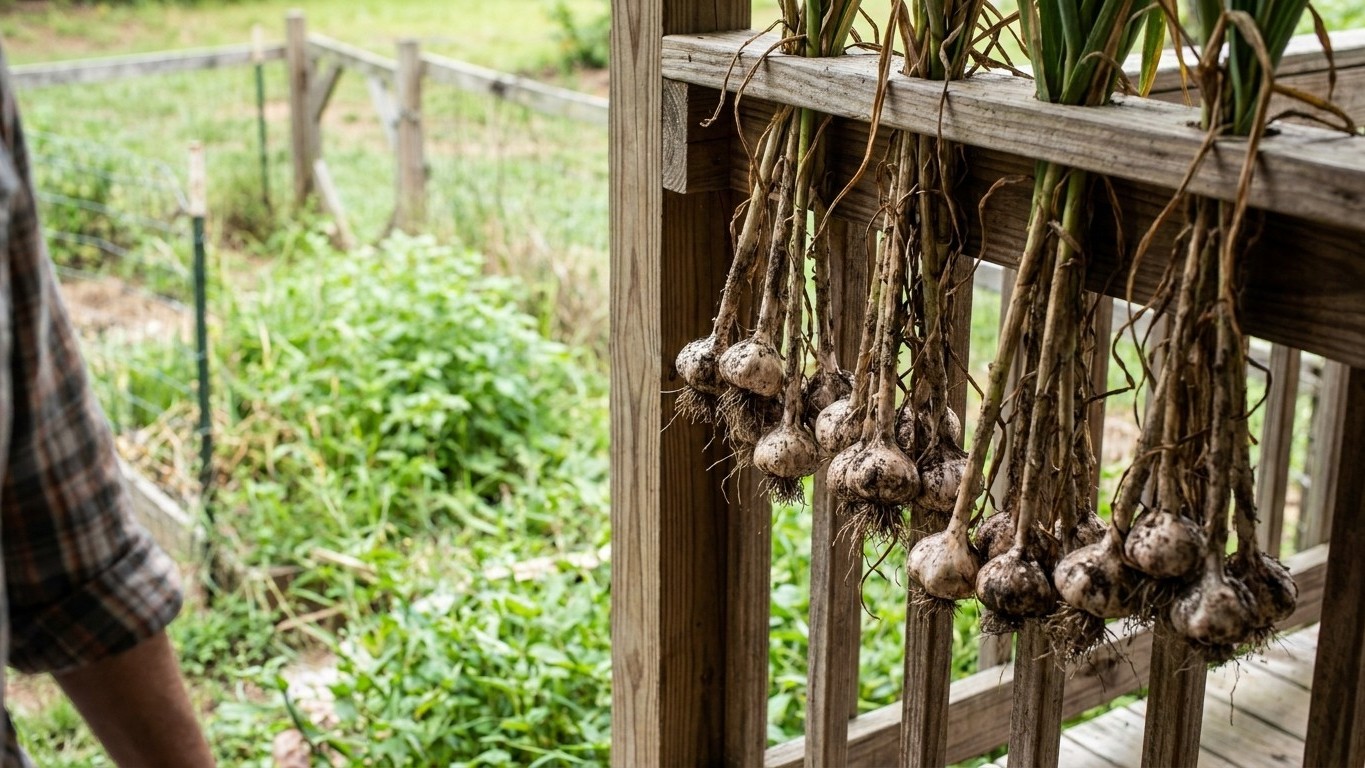
Hang bulbs in loose bunches, or lay them in a single layer on screens, rather than piling them in a basket where air can’t reach the center. Check the necks periodically. A properly cured bulb has a tight, papery neck and a dry outer wrapper. Once cured, trim roots and stems and move bulbs to a cool, dry spot with some air movement for storage. Softneck varieties will hold for noticeably longer in storage than hardneck varieties, one more point in softneck’s favor in this climate.
Local help
For county-level planting dates, soil testing, and advice specific to your part of the state, contact Clemson Cooperative Extension. Its agents can tell you how your county’s frost timing and soil differ from the Charleston-area normals used throughout this guide, and a soil test through their office is the cheapest way to know what your bed actually needs before a single clove goes in.
Common questions
Can I skip refrigerating the cloves and still get a decent crop?
Yes, but expect smaller cloves and less reliable division, especially with a hardneck variety. Softneck varieties like Inchelium Red or Lorz Italian tolerate skipping the fridge step far better than a hardneck does, since they need less chilling to divide in the first place.
What happens if I plant garlic too late in the fall here?
A clove planted too close to the first hard freeze may not root well before the ground firms up, which leaves it more vulnerable to heaving over winter and slower to grow once spring arrives. If you’re past the mid-November end of the usual window, it’s still worth planting rather than waiting for next fall. Just expect a smaller bulb.
Do I have to cut the scapes off my hardneck garlic?
Cutting the scape once it curls redirects the plant’s energy into the bulb instead of the stalk, and most growers get a noticeably larger bulb by removing it. The cut scapes are edible and often used like a mild garlic-flavored green onion.
Can I plant garlic from the grocery store?
You can, but it’s a gamble. Grocery store garlic is often treated to slow sprouting, and it’s rarely labeled by variety, so you have no way to know whether it’s a softneck suited to this climate or a hardneck that needs more cold than South Carolina reliably provides.
Why did my garlic come up as one big round bulb instead of splitting into cloves?
That’s the chilling shortfall in action. The clove didn’t get enough sustained cold after planting to trigger division, whether from a mild winter, late planting, or skipping the refrigeration step for a hardneck variety. It’s still edible, just not useful as seed stock for next year’s planting.