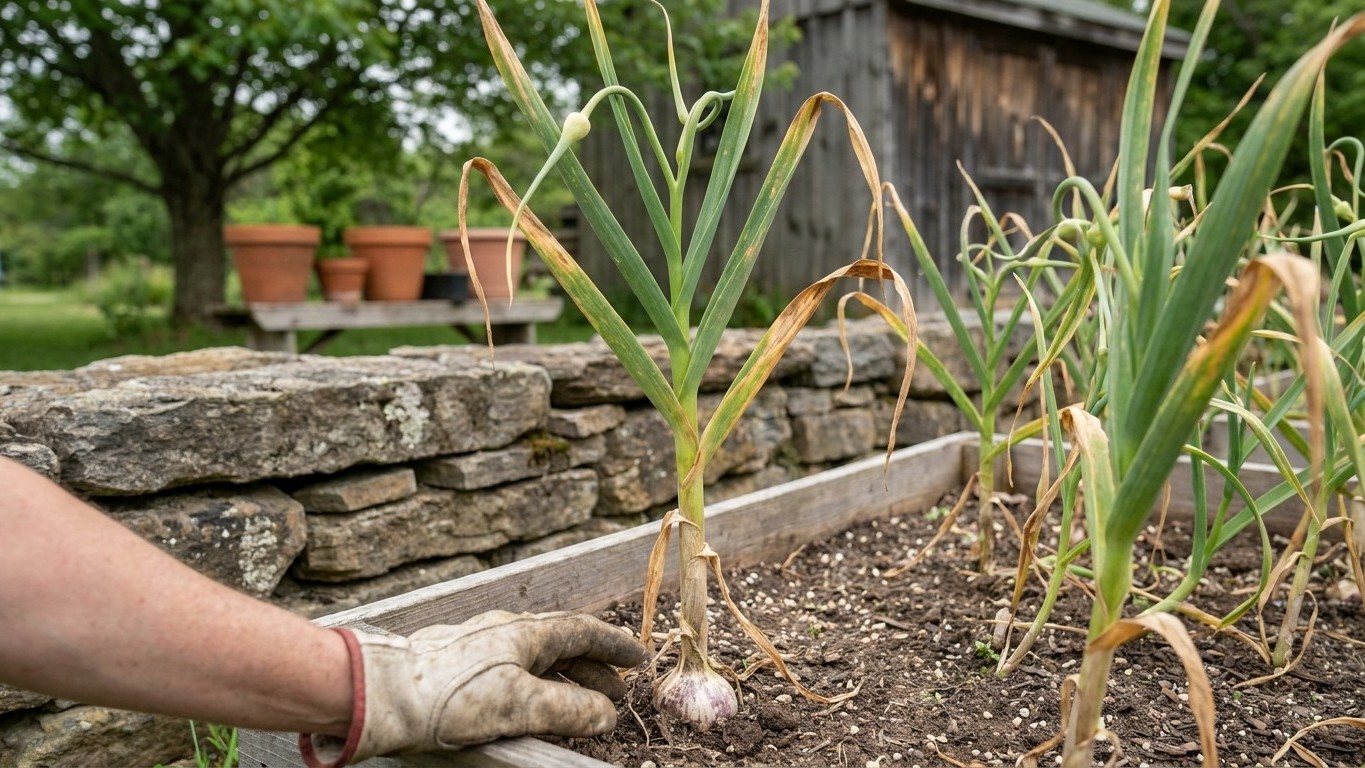

Garlic goes in the ground sometime in mid to late October, and the way to land on the right week is to count backward from your area’s first fall freeze. Pick a date three to four weeks ahead of that freeze, and that’s your planting week. So walk your bed now, loosen the soil, and get it ready to receive cloves before that October window closes on you.
The short answer for Pennsylvania

For most of the state, garlic cloves go into the ground sometime between mid October and late October. That range comes from counting back three to four weeks from the first fall freeze, which NOAA’s National Centers for Environmental Information puts between November 5 and November 16 at Philadelphia, using the station’s 1991-2020 climate normals.
Treat that November window as a midpoint, not a guarantee. A 1991-2020 normal means roughly half the years on record saw frost arrive after November 16, sometimes well after, and half saw it arrive before November 5. Planting on the assumption that frost always lands on the early edge of that window is how a bed ends up rooted too early, pushing green growth that a hard freeze then burns back.
Philadelphia is also the mildest reporting point in the state, so November 5 to November 16 is closer to the late end of Pennsylvania’s frost calendar than to an average anyone else can use directly. A garlic bed north or west of the city is working with a shorter runway, which is why the actual date has to be worked out locally rather than borrowed from one station. Penn State Extension keeps county-level frost information for exactly this reason.
Garlic planted in October spends the winter rooting underground and isn’t lifted until the following summer, so this planting date is really the only decision point in the crop’s whole calendar. If you haven’t settled on a variety yet, our guide to garlic varieties that suit Pennsylvania winters is worth reading before you order cloves, since hardneck and softneck types behave a little differently once they’re in the ground.
Working it out for your own garden
Why three to four weeks, and not more
Garlic needs a real stretch of cold to split a single clove into the several cloves of a mature bulb, a process called vernalization. University of Georgia Extension, in publication C854, sets that requirement at six to eight weeks of soil temperatures below 40°F. Measured at Philadelphia, Pennsylvania’s growing season logs 21.8 weeks with mean temperatures below 40°F, more than double what garlic needs even in the mildest corner of the state. That means the cold requirement is never the limiting factor here. The date you choose is about rooting time before the ground freezes, not about whether winter will be cold enough.
The arithmetic, shown in full
Start from the frost window itself: NOAA’s normals put the first fall freeze at Philadelphia between November 5 and November 16. Garlic wants three to four weeks of rooting time ahead of that freeze, so subtract three to four weeks from each end of the window and you land in the same mid-October to late-October stretch that catalogs already give for the varieties suited to this state. Run the same subtraction against your own county’s frost date, once you’ve pulled it from Penn State Extension, and you get a window built for your garden instead of for Philadelphia’s.
If you haven’t prepped a bed yet, our full guide to growing garlic in Pennsylvania covers soil and spacing, both of which need to be settled before that October week arrives.
Matching a variety to that window
Every garlic variety suited to Pennsylvania’s winters lands in the same mid-October to late-October window, whether it’s a hardneck or a softneck. What differs between them is how they store once they’re lifted the following summer, not the date they go in the ground.
| Variety | Type | Set-out window (Philadelphia-anchored) |
|---|---|---|
| Early Red Italian | Softneck | Mid to late October |
| Inchelium Red | Softneck | Mid to late October |
| Italian Late | Softneck | Mid to late October |
| Lorz Italian | Softneck | Mid to late October |
| Bavarian Purple | Hardneck | Mid to late October |
| Blue Music | Hardneck | Mid to late October |
| Chesnok Red | Hardneck | Mid to late October |
| Duganski | Hardneck | Mid to late October |
| Fall Festival | Hardneck | Mid to late October |
| Georgian Crystal | Hardneck | Mid to late October |
| Georgian Fire | Hardneck | Mid to late October |
| German Red | Hardneck | Mid to late October |
| German White | Hardneck | Mid to late October |
| Ivan | Hardneck | Mid to late October |
Softnecks like Inchelium Red and Lorz Italian tend to cure into bulbs that keep longer in storage, which is part of why they show up more often in braided bunches. Hardnecks make up most of this list because they’re a reliable fit for a state with a real winter, and Pennsylvania’s cold gives them room to spare.
What changes across Pennsylvania
Elevation is the biggest single driver of how much earlier a garden’s date needs to move. The northern tier along the New York border, counties like Erie, Bradford, Tioga and Susquehanna, along with the Allegheny Plateau and the Laurel Highlands in the southwest, sit at higher elevation and hold cold air longer than the Delaware Valley does. NOAA’s 1991-2020 normals show these regions running two to four weeks later than Philadelphia in spring. The same cold air masses that delay their last spring freeze tend to bring their first fall freeze in earlier as well, though NOAA’s published dataset doesn’t give an exact fall figure for those stations the way it does for Philadelphia.
A narrow strip along Lake Erie in the state’s northwest corner behaves differently again. The lake holds summer heat into fall and releases it slowly, which delays the first freeze right along the shoreline even though the surrounding county sits at a latitude that would otherwise argue for an early frost. A garden a few miles inland from the water loses that effect almost entirely.
The southeastern corner, Philadelphia and the surrounding counties of Bucks, Chester, Delaware and Montgomery, is genuinely the mildest part of the state and the region NOAA’s cited normals describe directly. A garlic bed in Pittsburgh, at meaningfully higher elevation and further from any large moderating body of water, is working with a different calendar even though both cities sit in the same state.
None of this changes the arithmetic from the section above, only the frost date that gets fed into it. Pull your own county’s normals from Penn State Extension before you finalize a planting week, rather than assuming Philadelphia’s window applies where you garden.
The mistakes this climate punishes
Planting into warm soil invites disease, not just poor rooting
UC IPM’s Pest Management Guidelines for Onion and Garlic, UC ANR Publication 3453, publish the temperature ranges where several soil-borne garlic pathogens are most active. Measured against Pennsylvania’s growing-season air temperatures near Philadelphia, white rot‘s published 50-75°F range overlaps five months of the season, including September and October, which is exactly when a garlic bed is freshly planted. Fusarium basal rot overlaps four months, also including September.
| Disease | Published range | PA growing-season months inside it | Pathogen |
|---|---|---|---|
| White rot | 50-75°F | 5 (Sept, Oct, Apr, May, June) | Sclerotium cepivorum |
| Fusarium basal rot | 59-90°F | 4 (Sept, May, June, July) | Fusarium oxysporum f. sp. cepae |
| Pink root | 75-85°F (optimum) | 1 (July) | Setophoma terrestris |
| Southern blight | 86-95°F (optimum) | 0 | Sclerotium rolfsii |
Three things matter before reading too much into that overlap. These are published soil-temperature thresholds, not air temperatures, and soil lags air and swings less than air does. A monthly average sitting inside the range doesn’t mean every day that month was inside it. And one weather station doesn’t describe conditions in every Pennsylvania county. None of this means these diseases are absent outside their listed ranges either. Infected seed stock carries them regardless of what the thermometer does, which is why buying certified, disease-tested cloves matters more than timing a planting date around any single pathogen. Avoid replanting garlic into a bed where a previous crop showed rot symptoms, since these pathogens persist in soil for years.
Too shallow or too late to root
The second mistake shows up most in years when frost runs toward the early edge of the range, or in the colder parts of the state described above. A clove planted less than three weeks before hard frost, or set only an inch or two deep, doesn’t have time to grow the root system it needs before the ground freezes. Over a Pennsylvania winter, that shallow, poorly anchored clove is a strong candidate to heave partway out of the soil during a freeze-thaw cycle, exposing it to cold air and drying wind it wasn’t built to handle.
- Plant cloves at least three to four weeks before the local frost midpoint, not the day it arrives
- Set cloves root-end down, deep enough that the tip sits a couple of inches under the soil surface
- Cover the bed with several inches of loose straw mulch once the soil has cooled, and leave it on through winter
Pull the mulch back gradually in spring rather than all at once. A late cold snap can still damage exposed shoots even after winter has broken.
Checking this against your county
Philadelphia’s frost window is a starting point, not the number to plant by if you garden anywhere else in Pennsylvania. Penn State Extension maintains county-level guidance and local offices across the state, and that’s the source to check before locking in a date, especially in the northern tier, the Alleghenies, or right along Lake Erie, where the arithmetic above shifts.
Visit Penn State Extension and search for your county office or regional horticulture program for a frost record closer to your own garden than Philadelphia’s. Take the three-to-four-week rule from this article and apply it to whatever date they give you.
Common questions
What happens if I plant garlic too early in Pennsylvania?
Cloves planted while soil is still warm often push a shoot above ground before winter arrives. That shoot gets damaged or killed by the first hard freeze, which weakens the plant heading into spring even though the clove itself usually survives underground. It also lengthens the time the clove spends in the warm-soil range where diseases like white rot are most active.
Is it too late to Plant Garlic if it’s already November?
If the ground isn’t frozen yet, it’s still worth planting, though the clove will have less time to root before winter sets in. Set it slightly deeper than usual and mulch heavily right away rather than waiting, since a late-planted clove needs the extra insulation more than an on-time one does.
Can I plant grocery store garlic instead of ordering seed garlic?
You can, but most grocery garlic is grown in a different climate and sometimes treated with a sprout inhibitor. It also isn’t tested for the soil-borne diseases described above. Seed garlic from a supplier that tests its stock is the safer route if you want a bed you can keep replanting from for years.
Do hardneck varieties need a colder winter than softneck to do well here?
No. Both types get far more cold than the six to eight weeks University of Georgia Extension says garlic needs to divide into cloves, since Pennsylvania winters run long regardless of which corner of the state you’re in. The practical difference between the two types here is storage life and clove count, not whether either one will get cold enough.
Some gardeners also time this by the Moon: when to plant garlic by the moon, as almanac tradition rather than fact.