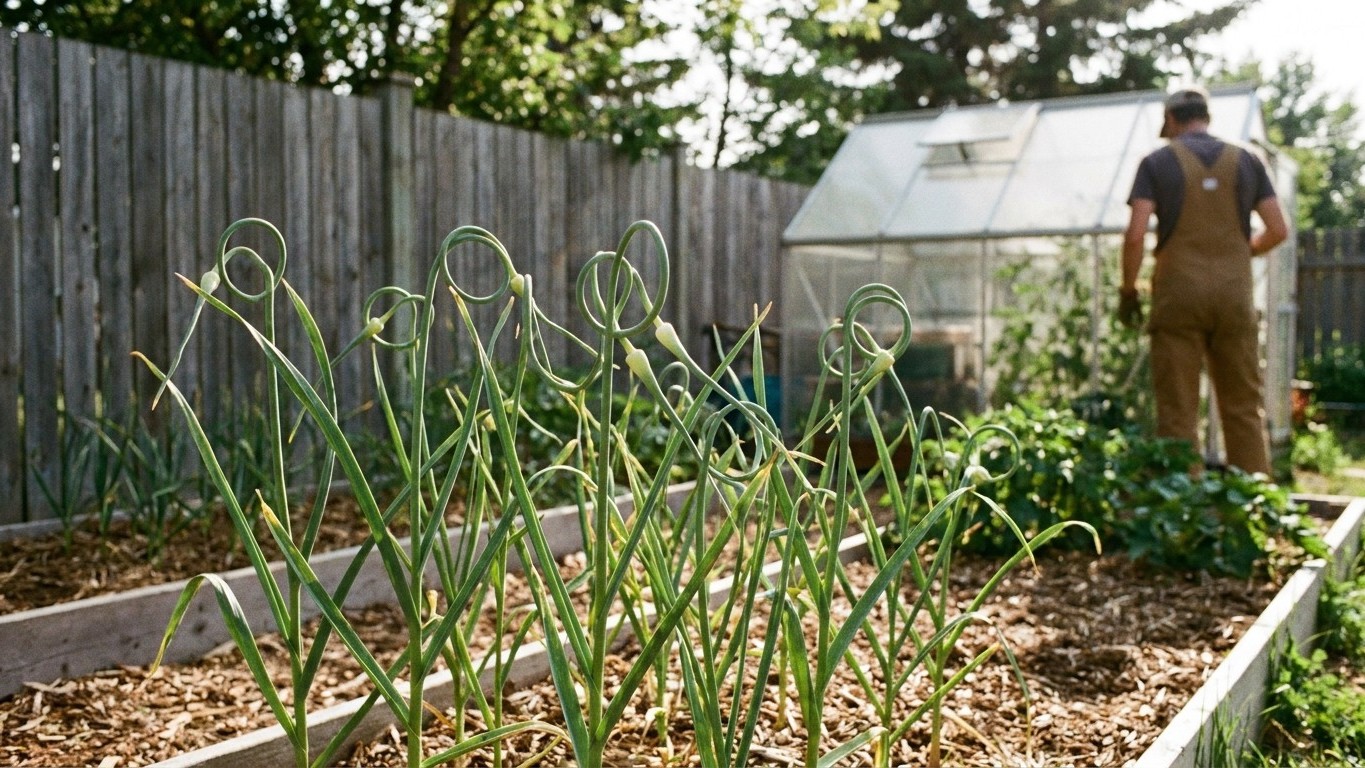

Plant Garlic in Saskatchewan in late August, whatever variety you have chosen. That window is set against the average first fall frost of September 18, recorded at Saskatoon by Environment and Climate Change Canada’s 1981-2010 climate normals. Check your soil is workable and your cloves are separated and ready before that window opens, since garlic planted late has less time to root before the ground locks up.
The short answer for Saskatchewan

Every garlic variety suited to this province, softneck or hardneck, goes into the ground in late August. That is not a guess pulled from a seed catalogue. It is worked back from the average first fall frost recorded at Saskatoon, which Environment and Climate Change Canada’s 1981-2010 climate normals put at September 18, at the SASKATOON SRC station.
Call that a mean, not a promise. Half the years on record at that station saw frost arrive after September 18, and half saw it arrive before. A mean date is a midpoint, never a safe date. If you plant on the assumption that frost always lands on September 18, you will be caught out in every year that runs late, and there are plenty of those.
What the late-August window is really doing is buying garlic enough time to grow roots into soil that is still warm and workable, before the ground cools hard enough to stop root growth altogether. Garlic itself tolerates a light frost on its shoots without damage. The date moves because the target is not the air frost, it is the point at which the soil itself stops giving up new roots, and that point trails the air frost by some weeks. Cloves of Inchelium Red or Duganski set out too late may still survive the winter, but they go into spring with a smaller root system and a slower start than cloves that had those extra weeks.
Working it out for your own garden
Start from the same number everyone in the Saskatoon area starts from: a mean first fall frost of September 18, from Environment and Climate Change Canada’s 1981-2010 normals. Garlic needs several weeks of root growth in soil that has not yet frozen solid, and ground freeze-up trails the first air frost by more than that single date suggests, since soil cools slower than air. Counting back roughly three to four weeks from that September mark lands in late August, which is exactly why every cultivar on the recommended list for this region, from Early Red Italian through to Georgian Fire, is set out in that same window rather than spread across September.
Why the arithmetic stays a range, not a day
Resist the urge to turn “late August” into a single date on the calendar. The frost figure it is counted from is itself an average of thirty years of records at one station, and counting backward from an average only produces another average, wider if anything. Write it down as a range of a few weeks and work within that range according to what your own soil and forecast are doing that particular year, not according to a date fixed months in advance.
Local geography moves the target further still. A large lake nearby, a river valley, or simply a few hundred feet of elevation change can shift the point at which soil stops accepting new root growth by a week or two in either direction from the Saskatoon figure, even within the same general region. None of that is captured in a single climate-normal number from one station. If your garden sits in a low frost pocket, or up on an exposed rise, treat the Saskatoon date as a starting point to adjust from, not as the answer for your own yard.
What changes across Saskatchewan
The Saskatoon figure is a central-prairie number, and the province is not one climate. Ground north of Saskatoon, up toward Prince Albert and into the boreal fringe, runs cooler through the growing season and typically sees its first fall frost earlier than the Saskatoon mean, simply on account of latitude. A grower there working from the Saskatoon date alone is working from a number that is already behind their own season.
South toward the border, around Estevan and the drier southern grain belt, the growing season generally runs longer and the first fall frost tends to hold off later than at Saskatoon, though how much later depends on a station reading from that district. The same caution applies moving east toward the Qu’Appelle valley or west toward the Alberta line: elevation and distance from any moderating water body both push local frost timing around, and a province-wide date is only ever a starting point.
Large water bodies, where they exist in enough volume nearby, tend to hold heat into the fall and can delay the first frost close to their shorelines relative to open, dry ground a short distance away. None of this changes the underlying planting logic. It changes when the late-August window should actually fall for a given garden, which is exactly why the growing garlic in Saskatchewan basics are worth working through before you commit to a date on your own calendar.
The mistakes this climate punishes
Saskatchewan winters are not the risk here. The University of Georgia Extension’s guide to garlic (publication C854) puts the cold requirement for a clove to split properly at six to eight weeks below 40°F, and this region clears that easily, with roughly 34.8 weeks a year averaging below that mark. Under-chilling, the failure that plagues gardeners in mild winter states, is not the mistake that costs a Saskatchewan crop.
The two mistakes that actually cost a crop here
- Planting too late. Cloves set into cooling soil in September instead of late August have measurably less time to grow roots before the ground stops giving them up, and go into winter under-anchored.
- Planting too shallow, with no mulch. A clove sitting near the surface without a few inches of loose straw or leaf mulch over it is exposed to frost heave and to the desiccating effect of open winter wind, regardless of how cold-hardy the variety is.
Disease pressure adds a third layer worth knowing, even though it is not the main failure point. UC IPM’s Pest Management Guidelines for onion and garlic (UC ANR Publication 3453) publish soil-temperature ranges for the fungi that attack garlic, and comparing those ranges against the mean air temperature through a Saskatchewan growing season gives a rough sense of when the risk is elevated, not a forecast of disease.
| Disease | Pathogen | Months in range, Sept to July | What that means |
|---|---|---|---|
| White rot | Sclerotium cepivorum | 4 (Sept, May, June, July) | 1 of those months sits at the published optimum |
| Fusarium basal rot | Fusarium oxysporum f. sp. cepae | 2 (June, July) | Inside the range, not at the optimum |
| Southern blight | Sclerotium rolfsii | 0 | Outside its optimum, which means less active, not absent |
| Pink root | Setophoma terrestris | 0 | Outside its optimum, which means less active, not absent |
Three caveats belong with that table. The published thresholds are soil temperatures and the count above uses air temperature, which lags soil and swings less. A monthly average is not a month spent inside a range, since a month can average a moderate figure while holding both cold and warm days within it. And a count of zero months never means a disease cannot occur, since infected seed stock or a contaminated bed can bring any of these pathogens in regardless of climate. Buying clean seed stock, whichever cultivar you choose from the garlic varieties that suit Saskatchewan winters, matters more here than the calendar does.
Checking this against your county
Saskatoon is one station, and the numbers above come from it alone. For a figure closer to your own county, the Government of Saskatchewan’s agriculture, natural resources and industry service is the place to check before you fix a planting date, since local extension offices track frost patterns and soil conditions at a finer grain than a single provincial climate normal can.
Treat anything you read here as the reasoning to apply, not the final word for your own address. If the extension service publishes a different window for your district, follow that over the Saskatoon-anchored figure in this article.
Common questions
Can I still plant if I miss late August?
You can plant into September, but every week you lose past late August is a week of root growth the clove does not get before the ground cools hard. A slightly later planting usually still produces a bulb the following summer, just a smaller one, and the plant enters winter with less anchoring against frost heave.
Does a heavy snow year make planting date less important?
No. Snow cover insulates the soil once it falls, but it does nothing for the root growth a clove needs to do in the weeks between planting and the ground freezing. That growth happens before any snow arrives, so the planting window is set by soil temperature and daylight in early autumn, not by how much snow falls later.
Should I Plant Garlic in spring instead, to avoid the frost risk?
Spring-planted garlic in this climate generally produces a much smaller bulb, because it misses the autumn root-growth window and often misses part of the cold exposure the clove needs to split properly. Fall planting timed to the late-August window is the standard approach here for that reason.
Do softneck varieties like Lorz Italian need a different date than hardnecks?
No. Every variety on the region’s recommended list, softneck and hardneck alike, is set out in the same late-August window. The difference between types shows up later, in storage life and in whether the plant sends up a flower stalk, not in when the clove goes into the ground.
Some gardeners also time this by the Moon: when to plant garlic by the moon, as almanac tradition rather than fact.