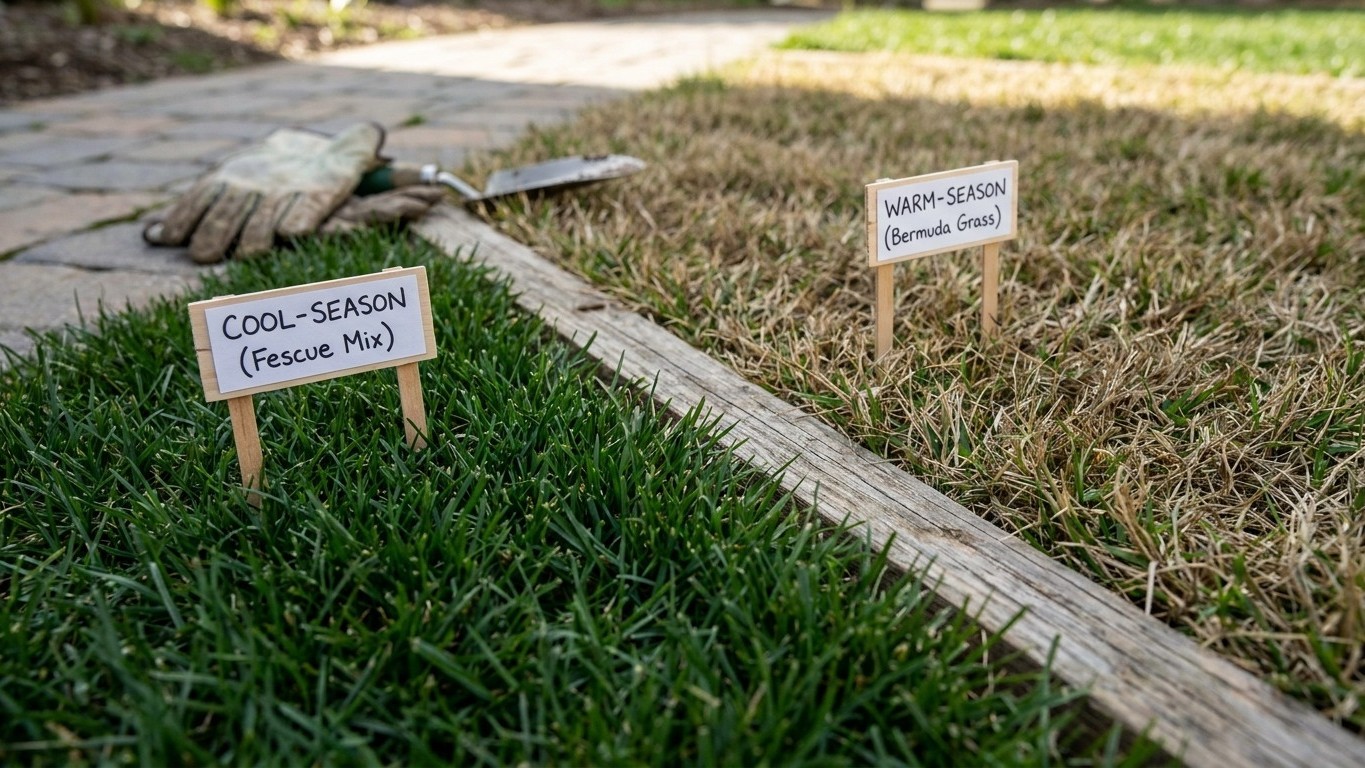

Lawn grasses split into two groups by when they actually grow. Cool-season types, including Kentucky bluegrass, a Perennial Ryegrass lawn, a Rough Bluegrass lawn, fine fescues, and tall fescue, put on most of their growth in spring and fall. Warm-season types, including bermudagrass, zoysiagrass, St. Augustinegrass, centipedegrass, bahiagrass, carpetgrass, and seashore paspalum, grow through summer heat and go dormant in cold weather. Mowing height alone spans from 0.75 inches for bermudagrass up to 4 inches for a Bahiagrass lawn and a St. Augustinegrass lawn, per Clemson Cooperative Extension’s HGIC 1214. Before you do anything else, identify which of the two groups is already growing in your yard, because every mowing and feeding decision that follows depends on it.
Why this matters
A lawn does not show a mowing or species mismatch on the day you make it. It shows up three or four weeks later, when the grass that should be thick and green instead looks thin, scalped, or scorched at the edges, and by then the damage is already set into the root system. Mow a Fine Fescues lawn down to an inch and it will look fine for a week. Then the shaded side of the yard starts thinning out, because fine fescue’s shade tolerance depends on leaf area that mowing just removed.
The reverse mistake is just as common. Letting bermudagrass grow past its 1.5-inch ceiling, per Clemson Cooperative Extension’s HGIC 1214, builds a thatchy, hollow canopy that looks green from the street but goes brown fast under drought stress because the root system never had to work. Matching mowing height to the species you actually have is the single decision with the longest lag between mistake and consequence, which is exactly why it gets skipped.
Wear tolerance carries the same delay. A backyard with kids and a dog needs a grass rated good to excellent for wear, like bermudagrass, a Zoysiagrass lawn, or a Kentucky Bluegrass lawn, and a Tall Fescue lawn also holds up well under regular foot traffic, as does a Carpetgrass lawn in wetter, low-traffic areas, and a Seashore Paspalum lawn handles both traffic and salty coastal soils. Plant something rated poor for wear, like fine fescue or a Centipedegrass lawn, under a swing set and the bare patches will not appear until the traffic has already compacted the soil under them. The fix at that point is soil work, not just reseeding, which is a longer job than getting the species right at planting.
When to do it
Timing follows the grass, not the calendar on the wall, and the two groups run on opposite clocks. Cool-season grasses, fine fescues, Kentucky bluegrass, perennial ryegrass, rough bluegrass, and tall fescue, put down roots and fill in during the cooler shoulder seasons and mostly rest through the heat of summer. Warm-season grasses, bermudagrass, zoysiagrass, St. Augustinegrass, centipedegrass, bahiagrass, carpetgrass, and seashore paspalum, do the opposite: they green up and spread once soil warms and they go dormant at the first hard cold.
Reading the season instead of the date
That means a seeding or renovation job on a cool-season lawn is timed to the plant’s active growth window, and the same job on a warm-season lawn is timed to its own, opposite window. Neither can be given as a fixed date here, because the length and position of those windows shifts by region and by year. The reliable way to time it is to watch the grass itself: cool-season species green up first as temperatures moderate, warm-season species lag behind and green up once soil has warmed through.
Species-specific maintenance calendars exist for exactly this reason. Clemson Cooperative Extension publishes one for each major warm-season type: HGIC 1215 for centipedegrass, HGIC 1216 for bermudagrass, HGIC 1217 for zoysiagrass, HGIC 1218 for St. Augustinegrass, and HGIC 1219 for tall fescue. Each lays out the sequence of tasks, fertilizing, mowing, weed control, in the order the plant’s growth cycle calls for them, rather than by month. Check the calendar for your species, not a generic lawn calendar, and confirm the specific dates for your area with your own state’s extension service, since the same growth stage lands on different weeks from one region to the next. General lawn care basics, covered in Lawn Care, are worth reviewing before you commit to a seeding window either way.
How to do it

Mowing height is the one figure every one of these species has published, and it is also the fastest way to wreck or rescue a lawn, so start there.
| Grass | Season | Mowing height | Shade | Drought | Wear |
|---|---|---|---|---|---|
| Fine Fescue | Cool | 2.5-3.5 in | Excellent | Good | Poor |
| Kentucky Bluegrass | Cool | 2-3 in | Fair | Fair | Good |
| Perennial Ryegrass | Cool | 2-3 in | Fair | Fair | Good |
| Rough Bluegrass | Cool | 2-3 in | Excellent | Poor | Poor |
| Tall Fescue | Cool | 2.5-3.5 in | Good | Fair | Fair |
| Bahiagrass | Warm | 3-4 in | Poor | Excellent | Good |
| Bermudagrass | Warm | 0.75-1.5 in | Very poor | Excellent | Excellent |
| Carpetgrass | Warm | 1-2 in | Fair | Very poor | Poor |
| Centipedegrass | Warm | 1.5-2 in | Fair | Fair | Poor |
| Seashore Paspalum | Warm | 1-1.5 in | Poor to fair | Fair to good | Good |
| St. Augustinegrass | Warm | 2.5-4 in | Excellent | Good | Fair |
| Zoysiagrass | Warm | 0.75-2 in | Excellent | Good | Very good |
Those mowing ranges and tolerance ratings come from Penn State Extension’s Lawn Establishment guide for the cool-season species and from Clemson Cooperative Extension’s HGIC 1214 for the warm-season species. Cut anything toward the top third of its own range if the lawn is under heat or drought stress, since a taller blade shades the soil and slows moisture loss. Never cut more than about a third of the blade length in a single mowing, a rule that holds across every species in that table, and is detailed further in Clemson’s HGIC 1205 mowing guide.
Before you plant or overseed
Match the species to what the site actually offers before you buy seed or sod. A yard with dense shade under mature trees calls for fine fescue or St. Augustinegrass, both rated excellent for shade, not Kentucky bluegrass or bermudagrass, which need more direct sun to hold density. A yard that dries out fast and rarely gets watered points toward bahiagrass or bermudagrass, both rated excellent for drought, over carpetgrass, which Clemson rates very poor for drought. Fertilizing rates and schedules are laid out species by species in Clemson’s HGIC 1201, and none of it is worth doing until you know what you are working with in the soil, which is why a soil test, covered in Soil Testing a Lawn: The Cheapest Thing You Will Ever Do For It, comes before the first bag of fertilizer.
What goes wrong
The most common failure is treating brown as dead. Both cool-season and warm-season grasses go dormant on schedule, cool-season types through summer heat, warm-season types through winter cold, and a dormant lawn that is straw-brown all over usually recovers on its own once conditions turn back in its favor. The mistake is reseeding or ripping out a lawn that was only sleeping. The way to tell dormancy from death is to check for uniform color across the whole lawn and some green at the crown near the soil line. Patchy, uneven browning that follows foot traffic, a drainage line, or a disease pattern is a different problem and needs a closer look, covered in more detail in Lawn Weeds: Identifying the Common Ones Before You Spray, since thin turf is exactly where weeds move in first.
Wrong grass for the site
The second failure is choosing a grass for the label on the bag rather than the site it is going into. Bermudagrass sold as a fast, tough, drought-proof lawn grass is genuinely all of those things in full sun, but Clemson rates it very poor for shade, and a bermudagrass lawn under a stand of oaks will thin out every single year no matter how well it is fed. The tell shows up in early summer, when the shaded third of the yard is visibly less dense than the sunny two-thirds, and by then the shaded turf is already losing the competition to weeds and moss.
The third failure is mowing height drift. Mower decks get set once and left alone for years, while the grass underneath either scalps because the deck sits too low for that species or gets shaggy and thatch-prone because it sits too high. Check the deck height against the published range for your species at least once a season, not just when the lawn already looks wrong, since the visible damage from an incorrect height lags behind the cause by several weeks.
How this changes across the country
A cool-season grower and a warm-season grower are running two different lawns on two different clocks, even if they never leave their own state. Penn State Extension, based in a cool-season region, backs species like Kentucky bluegrass, perennial ryegrass, and the fine fescues, all built to green up and fill in during cooler weather and to tolerate a period of summer dormancy. Clemson Cooperative Extension, based in South Carolina, covers a warm-season lineup instead, bermudagrass, zoysiagrass, centipedegrass, St. Augustinegrass, bahiagrass, carpetgrass, and seashore paspalum, all built to grow through summer heat and go dormant in winter cold.
The transition zone problem
Between those two regions sits what turf specialists call the transition zone, a band of the country where summers are too hot for most cool-season grasses to hold up well and winters are too cold for most warm-season grasses to stay reliably green. Tall fescue, rated good for shade and fair for drought and wear by Clemson Cooperative Extension’s HGIC 1214, is one of the few species commonly grown across that zone because it tolerates both extremes better than most, which is also why it gets its own maintenance calendar, HGIC 1219, separate from the other cool-season species. A homeowner in that band should expect more compromise on any single tolerance trait than a homeowner solidly inside either the cool-season or warm-season regions, and should check with their own state’s extension service for which species its trial data actually favors, since neither a purely cool-season nor a purely warm-season answer fits the zone cleanly.
Common questions
Can I mix cool-season and warm-season grass seed in the same lawn?
You generally should not, because the two groups grow on opposite schedules and one will always be dormant while the other is trying to establish. Overseeding a warm-season lawn with a cool-season grass like perennial ryegrass for winter color is a different, deliberate practice, not a permanent mix, and it needs its own timing separate from either species’ normal calendar.
Why did my new grass look great for a month and then thin out?
That pattern usually points to a mowing height or shade mismatch rather than a seeding failure, since seedlings often look fine until the site’s real conditions, deep shade, heavy foot traffic, or drought, start asserting themselves. Check the mowing height against the published range for that species before assuming the seed itself failed.
Is bermudagrass or zoysiagrass better for a yard with kids and dogs?
Clemson Cooperative Extension rates bermudagrass excellent for wear and zoysiagrass very good, so both hold up to traffic, and the deciding factor is usually shade and mowing height instead. Bermudagrass needs full sun and a very low mowing height of 0.75 to 1.5 inches, while zoysiagrass tolerates more shade and a slightly wider mowing range of 0.75 to 2 inches.
My lawn is all brown right now, did it die?
Probably not. Both cool-season and warm-season grasses go dormant on a predictable seasonal schedule, and uniform brown across the whole lawn with some green still visible at the crown is the normal look of dormancy, not death. Uneven, patchy browning that follows a specific pattern is more likely disease, pests, or a drainage issue and is worth a closer look.