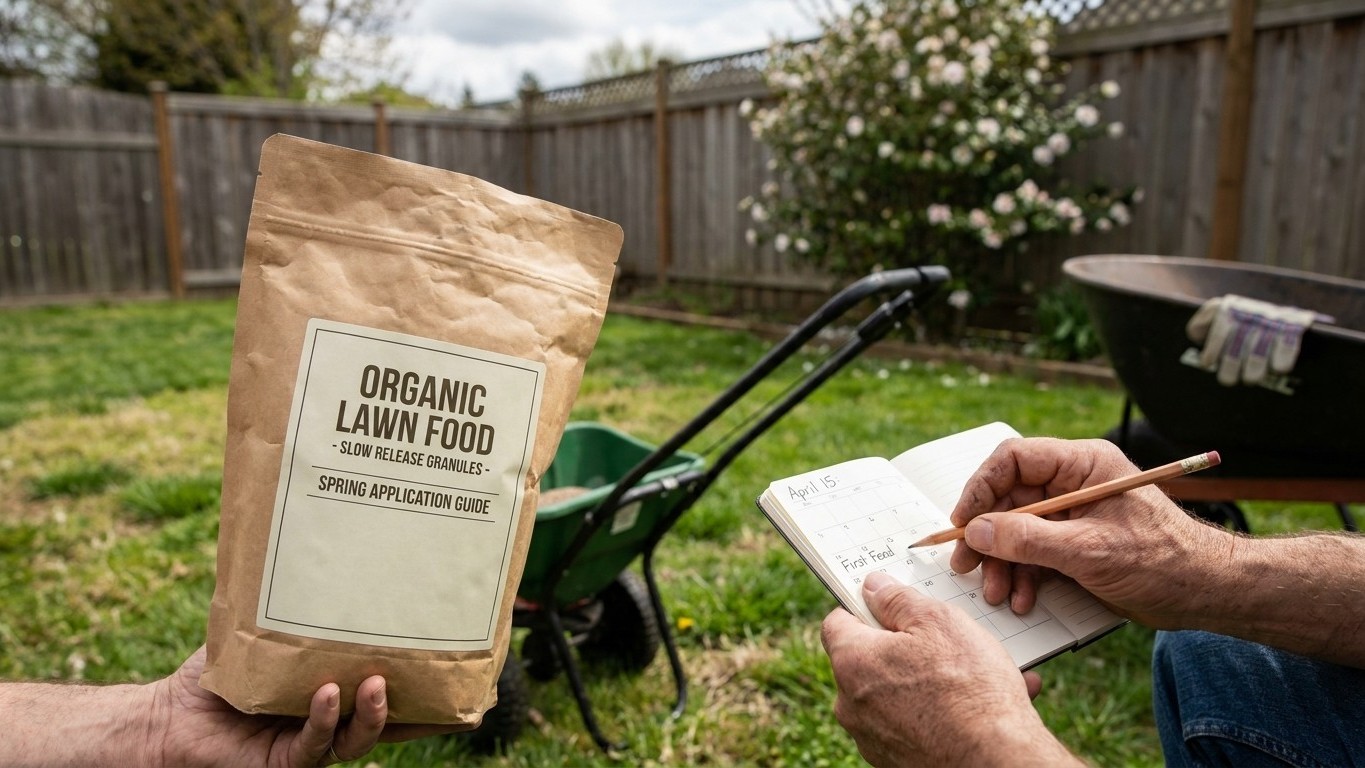

Is your lawn actually growing right now? That’s the only question that decides whether fertilizer helps it or just runs off into the storm drain. Cool-season grass wants its feeding in fall and spring; warm-season grass wants it through the heat of summer, and nothing once it browns down for winter. So before you buy a bag of anything, go figure out which kind of grass is under your feet — the rest of the timing follows straight from that one fact.
Why this matters

A lawn does not show a fertilizing mistake the day you make it. Nitrogen applied to grass that isn’t actively growing sits on the surface, gets rained on, and moves off the lawn before a single root can use it. The mower doesn’t tell you this happened. Three or four weeks later you notice patchy growth, a yellow cast, or weeds moving into thin spots, and by then the window to correct it for that season is closed.
Overfeed at the wrong point in the growth cycle and the grass responds with soft, sappy top growth that outruns its own root system. That growth looks thick and green for a week, then it lodges, mats, and invites brown patch or dollar spot once humidity climbs. Underfeed, or feed a cool-season lawn during the heat of summer when it would rather sit still, and the plant burns through reserves it needs for the season ahead, which shows up as thinning the following year, not this one.
The timing decision matters more than the brand of fertilizer you buy. A basic granular fed at the right point in the grass’s cycle outperforms a premium blend applied when the plant can’t use it. This is also why building routine lawn care around your specific species works better than a generic month-by-month checklist: two neighbors with different grasses can legitimately need opposite things in the same week.
Get the timing wrong for two or three seasons running and the lawn does not recover on its own. It thins, weeds fill the gaps, and what started as a fertilizer problem turns into a full re-establishment job.
When to do it
Grass growth runs on two opposite calendars, and the feeding schedule has to follow whichever one your lawn is on. Cool-season species, Fine Fescues, Kentucky Bluegrass, Perennial Ryegrass, Rough Bluegrass and Tall Fescue among them, do most of their growing in fall and again in spring, and slow down through the heat of summer. Warm-season species, Bahiagrass, Bermudagrass, Carpetgrass, Centipedegrass, Seashore Paspalum, St. Augustinegrass and Zoysiagrass, do the opposite: they push growth through summer heat and go dormant, not dead, once temperatures drop for winter.
That means the two groups are fed on opposite ends of the year. A cool-season lawn takes its main feeding in fall, when the top isn’t growing as fast but the roots are still active, plus a lighter feeding in spring. A warm-season lawn is fed through its active summer stretch and gets nothing once it drops color for winter, because it cannot use nitrogen it has no growth to spend it on.
Clemson’s HGIC publishes a maintenance calendar for each species with the feeding windows worked out for it: HGIC 1215 for Centipedegrass, HGIC 1216 for Bermudagrass, HGIC 1217 for Zoysiagrass, HGIC 1218 for St. Augustinegrass, and HGIC 1219 for Tall Fescue. Those are the calendars to open once you know your species, rather than guessing from a bag label written to suit the whole country.
Fall for a cool-season lawn is also when a lot of thin lawns get overseeded, and it’s worth planning the feeding and the seeding together instead of treating them as two separate trips across the yard.
How to do it
Read the three numbers first
Every fertilizer bag carries three numbers, always in the same order: nitrogen, phosphorus, and potassium, each a percentage of the bag’s total weight. A 100-pound bag marked 20-5-10 holds 20 pounds of nitrogen, 5 pounds of phosphorus, and 10 pounds of potassium, the rest filler and carrier. Nitrogen drives the leaf growth you actually see. Phosphorus and potassium matter more to root development and stress tolerance, and an established lawn generally needs less of both than a new one.
Rates are always given per 1,000 square feet, never per bag and never per acre, so measure your lawn area before you shop rather than guessing at the checkout. Clemson’s HGIC 1201 fact sheet publishes the target nitrogen rate for each species and season. Match your species and time of year to that sheet rather than the generic rate printed on the front of the bag.
Mow before you feed, not after
Mowing height changes how a lawn uses fertilizer. A lawn cut too short has less leaf surface to turn nitrogen into growth, so it wastes more of what you put down. Clemson’s HGIC 1205 fact sheet and its species guidance set out the mowing range for each grass, and matching your mower to that range before a feeding gets more value out of the application.
| Species | Season | Mowing height (in.) |
|---|---|---|
| Fine Fescues | Cool-season | 2.5 to 3.5 |
| Kentucky Bluegrass | Cool-season | 2 to 3 |
| Perennial Ryegrass | Cool-season | 2 to 3 |
| Rough Bluegrass | Cool-season | 2 to 3 |
| Tall Fescue | Cool-season | 2.5 to 3.5 |
| Bahiagrass | Warm-season | 3 to 4 |
| Bermudagrass | Warm-season | 0.75 to 1.5 |
| Carpetgrass | Warm-season | 1 to 2 |
| Centipedegrass | Warm-season | 1.5 to 2 |
| Seashore Paspalum | Warm-season | 1 to 1.5 |
| St. Augustinegrass | Warm-season | 2.5 to 4 |
| Zoysiagrass | Warm-season | 0.75 to 2 |
Source: Penn State Extension’s Lawn Establishment guidance for the cool-season species, and Clemson’s HGIC 1214 fact sheet for the warm-season species.
Spread it evenly, and water it in
A drop or rotary spreader calibrated to the bag’s rate is worth the ten minutes it takes to set up. Overlap your passes by a few inches rather than leaving gaps, since a missed strip shows up weeks later as a pale stripe running across the lawn. Split a heavy feeding into two lighter passes at right angles to each other if the spreader’s lowest setting still looks heavy for the square footage you measured. Water the fertilizer in after spreading unless rain is already forecast, since granules sitting dry on a leaf blade in full sun can scorch the tips.
What goes wrong
Most fertilizing failures trace back to a handful of habits, and none of them show themselves right away.
- Feeding a warm-season lawn in early spring before the soil has warmed, which just feeds the weeds already awake while the grass is still dormant.
- Feeding a cool-season lawn hard through the heat of summer, pushing growth the plant can’t support and inviting disease once humidity rises.
- Guessing at square footage instead of measuring it, which means every rate on the bag is wrong before you even open it.
- Spreading on a windy day, which drifts granules onto the driveway, the sidewalk, and any nearby storm drain instead of the lawn.
- Skipping the calibration check on the spreader, so the actual rate delivered has no relationship to the number on the bag.
The tell that catches most of these in time is a striped lawn: dark green bands where the spreader overlapped, pale bands where it didn’t. That pattern shows up within two to three weeks of the feeding, which is your signal to walk the pattern again next time rather than assume the fertilizer itself failed.
Fertilizer that lands on pavement doesn’t just waste money. It washes into storm drains during the next rain and never benefits the lawn at all. Keeping a clean line between turf and hardscape, the kind of crisp edge covered in edging a lawn, makes it easier to see exactly where the spreader should stop, which cuts down on this kind of overshoot.
Burn is the other common failure, a scorched, straw-colored patch that appears within days on grass fed in full sun without being watered in, and it’s often mistaken for disease rather than the fertilizer application that actually caused it.
How this changes across the country
A grower on cool-season turf, common across the northern states, is fertilizing on a fall-and-spring schedule built around species like Kentucky Bluegrass and Perennial Ryegrass, both rated by Penn State Extension for good wear tolerance but only fair shade and drought tolerance. A grower on warm-season turf, common through the Deep South, is doing the opposite: feeding through summer on species like Bermudagrass or St. Augustinegrass and stopping well before the grass drops color for winter.
South Carolina sits partly in the transition zone, where neither answer fully applies. Clemson’s Cooperative Extension covers both camps directly: HGIC 1214 lists Tall Fescue, a cool-season species, alongside warm-season options like Centipedegrass, Zoysiagrass, and St. Augustinegrass as legitimate choices for the same state, and Clemson maintains a separate feeding calendar for Tall Fescue, HGIC 1219, right next to the warm-season calendars for Centipedegrass, Bermudagrass, Zoysiagrass, and St. Augustinegrass. That’s the clearest sign a state falls in the transition zone: its own extension service runs calendars for both growth patterns instead of just one.
Grass choice inside that zone often comes down to which trait matters most for a given yard. Centipedegrass rates only fair on both shade and drought tolerance by Clemson’s scale, while Zoysiagrass rates excellent on shade and good on drought, which is why species selection matters as much as timing once you’re outside a state that fits neatly into one calendar.
Wherever your lawn sits, the fertilizing schedule has to start from the species growing on it, not from the region on a map. Two houses on the same street can legitimately be on opposite feeding schedules if one kept a patch of Tall Fescue and the other reseeded to Bermudagrass.
Common questions
Can I fertilize my lawn if it’s already brown from dormancy?
You can, but it won’t wake the grass up early. A dormant lawn, whether it’s a warm-season lawn browned off for winter or a cool-season lawn baked by summer heat, isn’t actively growing and can’t use the nitrogen, so it just sits there until growth resumes on its own schedule.
How long after fertilizing can I mow?
Most granular fertilizers are fine to mow over once they’ve been watered in and the lawn has dried, generally within a day or two. Check the specific product label, since slow-release coatings and weed-and-feed combination products sometimes carry their own wait times.
Do I need a starter fertilizer for an established lawn?
No, starter fertilizers are formulated for new seedlings and sod, with a higher phosphorus ratio to support root establishment. An established lawn generally needs less phosphorus, which is one reason to match the bag to Clemson’s HGIC 1201 guidance for your species rather than buying whatever starter blend is on the shelf.
What happens if I skip a feeding for a season?
A single skipped feeding rarely kills a lawn outright, but it shows as slower recovery from wear, a lighter color, and less competition against weeds moving into thin spots. The effect compounds if it happens two seasons running, at which point overseeding may be needed to thicken things back up.