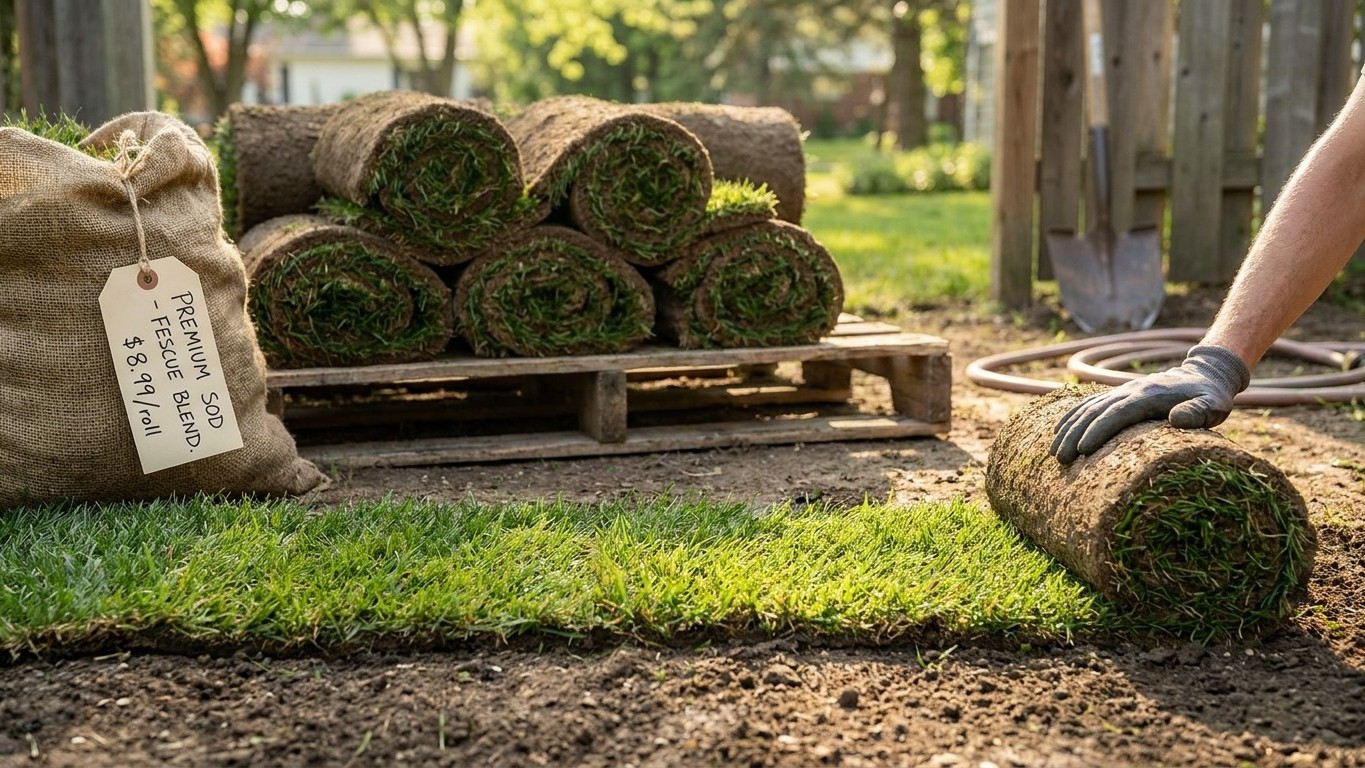

Sod buys you a lawn that looks finished the day it’s laid, instead of the weeks seed needs to fill in from bare dirt. What it costs is a stretch of heavy watering right after installation, while the roots knit into the soil underneath, and a lawn that can look green on top while it’s still failing underneath. Check whether your grass is a cool-season or warm-season type before you order pallets: that single fact decides the only window worth calling the right time to lay it.
Why this matters
Where the failure hides
A newly laid lawn looks like a finished job. That’s the trap. Sod arrives already green and dense, and it can sit on top of bad soil prep or the wrong species for weeks before it shows the damage. By the time roots that never knit into the ground start pulling up in dry patches, or grass that can’t handle the site’s shade or drought thins out, you’re not fixing a lawn anymore. You’re replacing one, and you pay for the labor and material twice.
The species decision is where most of that failure starts. Clemson Cooperative Extension’s HGIC 1214 rates Bermudagrass shade tolerance as very poor and its drought and wear tolerance as excellent, which makes it a strong choice for a sunny yard with kids and dogs and a poor one for anything under a mature oak. St. Augustinegrass sits at the other end, rated excellent for shade and good for drought, but only fair for wear. Lay the wrong one for the site and the lawn doesn’t fail on day one. It fails the first hot, dry month, or the first season the kids start using the yard as a soccer field, whichever comes first.
The other trap is treating sod like it doesn’t need aftercare because it already looks like a lawn. The first few weeks after laying are when the root system is doing all the work, and a lawn that looks fully established on top can still have roots that haven’t reached the soil below it at all.
When to do it
Cool-season versus warm-season
Cool-season and warm-season grasses do their growing in opposite halves of the year, and sod needs to go down while its species is actively rooting, not dormant. Fine Fescue, Kentucky Bluegrass, Perennial Ryegrass, Rough Bluegrass and Tall Fescue are cool-season grasses, according to Penn State Extension’s lawn establishment guidance and Clemson’s HGIC 1214, and these species put on their strongest root growth as temperatures come down out of summer heat and again as they warm out of winter cold. Bahiagrass, Bermudagrass, Carpetgrass, Centipedegrass, Seashore Paspalum, St. Augustinegrass and Zoysiagrass are warm-season grasses, per Clemson’s HGIC 1214, and they root hardest through the warm months and go dormant, not dead, once the ground cools.
That split means the sod trucks that show up in a cool-season state in one part of the year are doing the same job as the ones that show up in a warm-season state in the opposite part of the year. Lay sod outside its rooting season and it can survive on stored moisture for a while before the lack of new root growth catches up with it, which is exactly the kind of failure that looks like a watering problem when it’s really a timing problem.
Every species has its own published maintenance calendar with the tasks that matter month by month: Clemson’s HGIC 1219 for Tall Fescue, HGIC 1216 for Bermudagrass, HGIC 1217 for Zoysiagrass, HGIC 1218 for St. Augustinegrass and HGIC 1215 for Centipedegrass. None of them replace your own lawn care program once the sod is down, but they’re the fastest way to check whether you’re inside that species’ rooting window before you commit to a delivery date.
How to do it

Site prep decides more of the outcome than the sod itself. Grade the area so water runs away from the foundation, break up compacted soil in the top few inches, and rake out rocks and old root mats before a single roll goes down. Clemson Cooperative Extension’s HGIC 1203, Lawn Establishment, covers the soil test and amendment steps in more depth than a delivery day allows for, and it’s worth reading before you schedule the pallets, not after.
Laying the sod
Lay the first row against a straight edge, a driveway or sidewalk works well, and butt each piece tight against the next without stretching it, since stretched sod shrinks back and opens gaps at the seams within days. Stagger the joints row to row the way you’d lay brick, so no four corners meet at one point. On a slope, run the rows across the grade rather than down it, and stake pieces that won’t stay put on their own. Roll the finished lawn once it’s down to press the roots into firm contact with the soil beneath. A piece of sod with an air pocket under it dries out and dies in that one spot even while the rest of the lawn is thriving.
Water immediately after laying and keep the top few inches of soil consistently moist while the roots establish, tapering off once a piece resists a gentle tug. Clemson’s HGIC 1203 and the species-specific maintenance calendars, HGIC 1215 through HGIC 1219, lay out the watering and mowing schedule for the species you’ve chosen, since a Centipedegrass lawn and a Bermudagrass lawn don’t establish on the same clock.
Matching the grass to the mower and the site
Once it’s rooted, mowing height becomes the main lever you control. HGIC 1214 and Penn State Extension publish mowing heights by species, and they vary enough that using the wrong number thins out an otherwise healthy lawn:
| Grass | Season | Mowing height (in) | Shade | Drought | Wear |
|---|---|---|---|---|---|
| Fine Fescue | Cool | 2.5-3.5 | Excellent | Good | Poor |
| Kentucky Bluegrass | Cool | 2-3 | Fair | Fair | Good |
| Perennial Ryegrass | Cool | 2-3 | Fair | Fair | Good |
| Rough Bluegrass | Cool | 2-3 | Excellent | Poor | Poor |
| Tall Fescue | Cool | 2.5-3.5 | Good | Fair | Fair |
| Bahiagrass | Warm | 3-4 | Poor | Excellent | Good |
| Bermudagrass | Warm | 0.75-1.5 | Very poor | Excellent | Excellent |
| Carpetgrass | Warm | 1-2 | Fair | Very poor | Poor |
| Centipedegrass | Warm | 1.5-2 | Fair | Fair | Poor |
| Seashore Paspalum | Warm | 1-1.5 | Poor to fair | Fair to good | Good |
| St. Augustinegrass | Warm | 2.5-4 | Excellent | Good | Fair |
| Zoysiagrass | Warm | 0.75-2 | Excellent | Good | Very good |
Set the mower to the top of that range for the first several cuts on new sod, and never take off more than a third of the blade in one pass. That one-third rule, and how to time the mowing schedule around it, is covered in how to mow a lawn.
What goes wrong
Most sod failures trace back to one of three points: the soil underneath, the water schedule right after laying, or a species picked for the wrong site. Each one hides for a while before it shows.
- Air pockets under the sod: the piece over the gap browns and lifts at the edges while the rest of the lawn stays green, usually visible within the first couple of weeks.
- Seams that shrank open: grass pulls back from a straight gap between pieces, most visible after the first hot, dry stretch.
- Wrong species for the shade: a lawn rated poor or very poor for shade thins from the tree line inward instead of dying all at once.
- Wrong species for wear: bare, compacted strips appear along the paths people actually walk, not where the sod was laid thinnest.
- Mowed too short too soon: scalped patches turn yellow-brown in stripes that match the mower’s wheel track.
The dormant-or-dead test
Brown is not the same as dead. Both cool-season and warm-season species go dormant, cool-season grasses under summer heat stress and warm-season grasses once the ground cools, and a dormant lawn can look identical to a dying one for weeks. The test that actually tells them apart is a tug on a few blades: dormant grass holds its roots, dying grass pulls free with no resistance because the roots never grew into the soil in the first place.
Shade is the failure that gets diagnosed latest, because it takes a full season of leaf cover to show which parts of the yard actually stay shaded and which only look that way in one photo. If large sections of the new lawn are thinning under trees no matter which species you laid, that’s a site problem, not a sod problem, and the fix belongs to growing grass in shade rather than to another pallet of the same grass.
How this changes across the country
The transition zone
A cool-season grower and a warm-season grower are solving different problems with the same word, sod. Pennsylvania, where Penn State Extension is based, sits solidly in cool-season territory: Kentucky Bluegrass, Perennial Ryegrass, Fine Fescue and Rough Bluegrass are the species Penn State’s lawn establishment guidance covers, and all four do their rooting in the cooler shoulder seasons rather than through the heat of summer. South Carolina, where Clemson Cooperative Extension is based, covers the opposite set: Bermudagrass, Centipedegrass, St. Augustinegrass, Zoysiagrass, Bahiagrass, Carpetgrass and Seashore Paspalum, all warm-season species that root hardest through the warm months, per HGIC 1214.
The transition zone, the band of the country where summers run hot enough to stress cool-season grass and winters run cold enough to stress warm-season grass, is where the timing question gets hardest. Neither a straight cool-season nor a straight warm-season calendar fits cleanly, which is exactly why species choice matters more in that band than anywhere else. Tall Fescue’s rating of good for shade and fair for both drought and wear, per Clemson’s HGIC 1214, is one of the reasons it shows up so often in transition-zone lawns instead of the harder-edged bluegrasses and bermudas that dominate to the north and south of it.
Wherever the lawn sits, the species table above still applies. Match the shade, drought and wear ratings to the site first, then let the growing season, not the retail calendar, set the delivery date. A sod farm will cut and ship Bermudagrass in the dead of winter if someone orders it. That doesn’t mean winter is when it roots.
Common questions
Can I lay sod straight over my old lawn without tilling it under?
No. Sod needs bare soil contact to root, and laying it over existing turf or thatch leaves an air gap that the roots can’t cross. Kill or strip the old lawn and work the soil underneath first, following the prep steps in Clemson’s HGIC 1203.
How soon can I walk on or mow new sod?
Wait until a piece resists a firm, gentle tug before you put regular traffic or a mower on it. That’s the sign the roots have actually reached the soil below, rather than a fixed number of days, since it depends on the species and how well the soil was prepped.
Is sod always better than seed?
Not always. Sod gives you an established-looking lawn almost immediately and holds a slope or high-traffic area better while it establishes, but it’s more expensive up front and still needs the same species-matched growing season as seed does to actually root in.
Can I lay sod in the middle of summer or the dead of winter?
You can have it delivered, but that doesn’t mean it will root well. Cool-season species root hardest outside the peak of summer heat, and warm-season species root hardest outside the cold months, so laying sod at the wrong extreme leaves it surviving on stored moisture instead of building new roots.