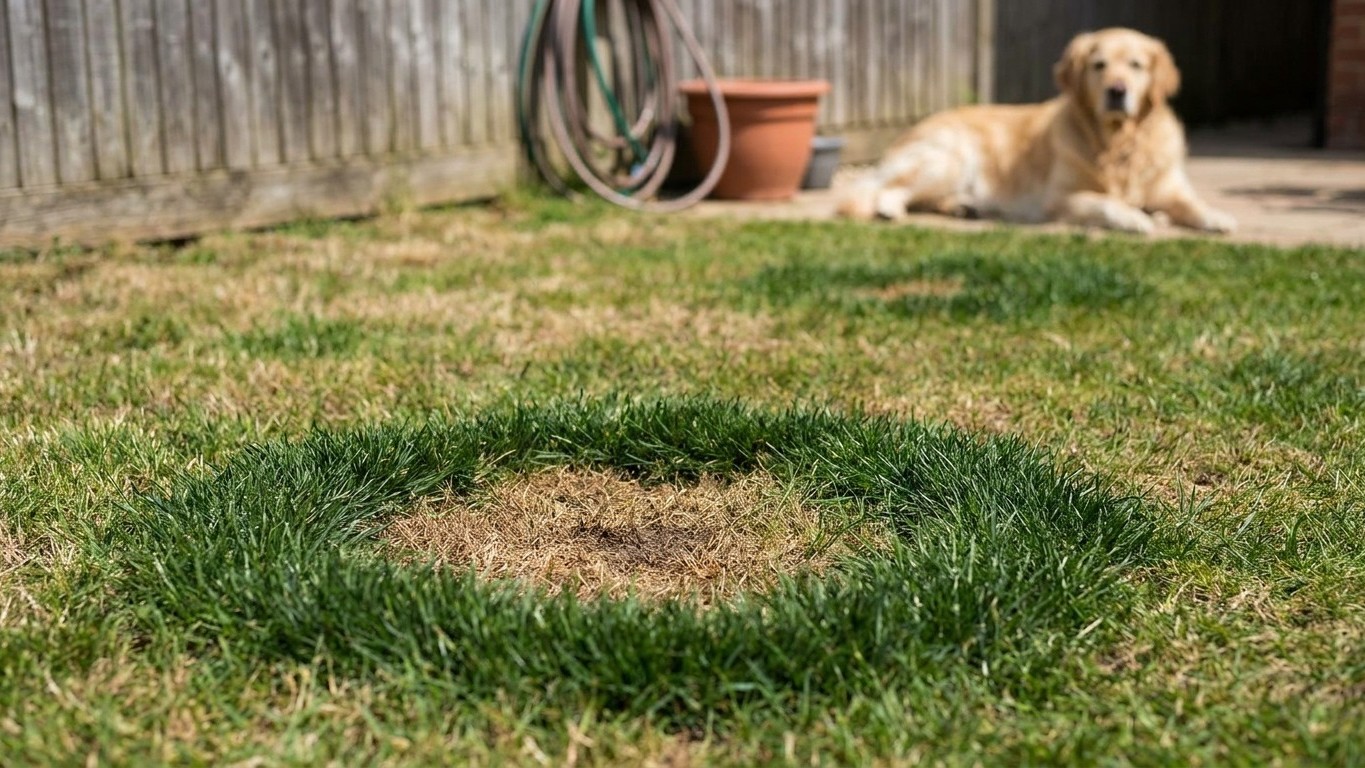

A dog urine spot is a small dead patch, usually round or oval, with a noticeably darker green ring of grass just outside the dead area. The center dies because the urine lands concentrated in one place and the nitrogen in it overwhelms the grass, while the diluted edge of the same puddle gets just enough nitrogen to green up like a light feeding. Flooding the spot with water within a few hours of the dog going is the single action that stops the dead center from forming in the first place.
What you are looking at

The classic dog urine spot is small, usually four to ten inches across, and roughly circular or oval. That shape is the tell. Grass diseases tend to spread in irregular drifts or follow low, wet areas of the yard. Urine spots stay put, roughly the same size they started at, because the dog stood in one place and the damage is fixed by however much liquid hit the ground.
Look at the center first. It will be tan to straw-brown, flat, and the blades will pull away dry and brittle rather than slimy. Around that dead core sits a band of grass that is noticeably darker and often taller than the rest of the lawn, sometimes by a shade or two of green that is obvious even from a few feet away. That ring is doing better than the surrounding turf, not worse, and it will keep growing a bit shaggier until you mow it level with everything else.
Female dogs squat and release a large volume in one spot, which is why their spots tend to have a sharply dead center and a wide green halo. Male dogs marking small amounts against a fence line or shrub often leave only the green ring, with no dead center at all, because the dose per spot never gets high enough to scorch. If you have several dead patches strung along a fence or a path the dog walks daily, that pattern by itself points to urine before you even check anything else. Repeated traffic along the same line can also pack the soil down, which is worth checking with the screwdriver test for compacted soil if the grass along that path stays thin even after you deal with the spots.
What it is not
Grubs feeding on roots produce dead, roundish patches too, and people often assume the dog did it. The difference shows up in your hand, not your eyes. Grab a handful of the dead grass and pull. If it lifts up like a loose rug with no roots holding it, and the soil underneath is loose and chewed-looking, that is grub damage, not urine. Urine-killed grass holds its roots. You can tug at it and the turf stays anchored, because the nitrogen burned the top growth but did not necessarily destroy the root system or the soil structure.
Fungal diseases such as dollar spot or fairy ring also make circular patches, but they lack the dark green halo. A fairy ring often comes with a ring of mushrooms and grass that is uniformly discolored rather than greener at the edge. Dollar spot patches are usually smaller, silver-tan, and show up in clusters across a wider area rather than as isolated single spots tied to where a dog walks.
- Grubs: lifts like carpet, no roots, soil loose underneath
- Fairy ring or dollar spot: no green halo, often mushrooms or multiple small patches
- Drought stress: whole lawn dulls evenly, no single dead center or green ring
- Dog urine: roots hold when pulled, dead center ringed by darker green
General drought stress is the other common mix-up, especially in a lawn that has not been watered in a while. Drought turns the whole lawn a dull gray-green before it browns, evenly, with no isolated dark rings. If you are not sure whether a patch is dormant from lack of water or actually dead, the tug test again settles it: dormant grass, cool-season or warm-season, still holds its roots and its crown, the same as urine-scorched grass does. For the fuller picture on telling a dormant lawn from a dead one, see telling drought dormancy from death.
What actually causes it
Dog urine carries nitrogen, mostly as urea, along with potassium and salts. Grass responds to nitrogen the way it responds to fertilizer generally: a little green it up, a lot burns it. At the center of a urine puddle, the concentration is high enough that it draws water out of the grass cells by osmosis and scorches the tissue, the same mechanical effect as spilling granular fertilizer straight out of the bag onto a lawn. At the outer rim of the same puddle, the urine has been diluted by however much liquid spread outward through the thatch, landing at a concentration closer to a light nitrogen feeding, which is why that band greens up instead of dying.
Why it takes days to show up
The scorch itself happens fast, but you usually do not notice the dead center until a week or two later, once the burned blades finish browning out and the green ring has had time to visibly outgrow the grass around it. This lag is why a lot of people blame the wrong day. If your dog has a regular potty spot, the exact urine event that caused a spot you notice this weekend may have happened well before that, which matters if you are trying to test a new watering habit and want to know whether it is working.
The grass species you have changes how visible and how fast this is. Cool-season lawns of Kentucky Bluegrass or Perennial Ryegrass, rated good for wear by Penn State Extension, tend to recover from urine scorch faster than Fine Fescue, which Penn State rates poor for wear and slower to fill back in. On the warm-season side, Clemson Cooperative Extension’s HGIC 1214 fact sheet rates Zoysiagrass and Bermudagrass excellent for wear, and both recover from a scorched spot faster than Centipedegrass or Carpetgrass, which HGIC rates poor for wear and slow to spread laterally into a bare patch.
Fixing it
Start with the spot itself, not the whole lawn. If you catch the urine within a few hours, before it has soaked in and dried, soaking the area with a hose for thirty seconds dilutes the nitrogen enough that it often never scorches at all. That is prevention more than a fix, but it works on the spots you catch in time.
Once the center has already died
Rake out the dead grass and any dead thatch so seed or new growth can reach soil. Do not fertilize the dead center to speed things up, since that is adding more of the exact input that killed it. Reseed with the same grass species already growing in the rest of your lawn wherever possible, since a patch reseeded with a different species will look and grow differently even after it fills in. Keep the reseeded patch consistently moist while it germinates, then mow it at the height recommended for your species: Kentucky Bluegrass and Perennial Ryegrass at 2 to 3 inches, Tall Fescue at 2.5 to 3.5 inches, per Penn State Extension and Clemson’s HGIC 1214, or 0.75 to 1.5 inches for Bermudagrass and 1.5 to 2 inches for Centipedegrass, per Clemson’s HGIC 1214.
The green ring needs no treatment at all. It is healthy grass, just growing a little faster and darker than its neighbors, and it will blend back in as you mow the lawn on a normal schedule, following the mowing guidance in Clemson’s HGIC 1205 fact sheet on mowing lawns.
Reseeding a handful of small spots costs almost nothing if you already have leftover seed of the right species on hand, just time and water. A more thorough fix, patching several spots with sod cut to match your existing grass, costs more and is worth it mainly if the spots are on a section of lawn that is highly visible or if a large area has been hit at once, such as after boarding several dogs in a small yard.
Keeping it from coming back
The habit that actually prevents dog urine spots is dilution, applied consistently, not any product. Training the dog to a single designated spot, ideally a mulched or gravel area rather than turf, removes the problem from the lawn altogether. If that is not realistic, watering the areas the dog uses most right after each visit is the single most reliable fix, more reliable than any lawn-safe supplement marketed for the purpose, because it addresses the actual mechanism: diluting nitrogen concentration before it reaches scorch level.
Match the grass to the traffic, not just the climate
If your dog has a favorite path or corner that gets hit constantly, consider what grass is actually growing there. St. Augustinegrass and Fine Fescue are rated only fair to poor for wear by Clemson and Penn State respectively, so a heavily used dog run in either of those grasses will show scarring longer than the same run in Bermudagrass or Zoysiagrass, both rated excellent for wear by Clemson’s HGIC 1214. Repeated foot and paw traffic in the same narrow lane also compacts the soil under the grass over time, which slows recovery independent of the urine itself. If regrowth in a well-used path stays thin no matter what you reseed with, that compaction is worth ruling out before you assume the grass species is the problem, and it is worth reading through general lawn problems troubleshooting if more than one symptom is showing up in the same area at once.
Feeding schedule matters too. A lawn that is already pushed hard on nitrogen from its regular fertilizing program has less tolerance left before a urine dose tips a spot into scorch, so keep to the rates on Clemson’s HGIC 1201 fertilizing guidance rather than feeding heavier “to help it recover” after a rough patch of dog traffic.
Common questions
Will the dead spot ever fill back in on its own?
Sometimes, if the grass around the edge is a spreading type like Bermudagrass or Zoysiagrass, both rated excellent for wear by Clemson’s HGIC 1214, since it can grow sideways into the bare patch. Bunch-type grasses like Tall Fescue spread far more slowly and usually need reseeding to fill a bare center in a reasonable time.
Does the sex of the dog change how bad the damage is?
Yes, generally. Females tend to squat and deposit a larger volume in one place, producing a sharper dead center, while males marking small amounts along vertical objects often leave only the green ring with no scorch at all.
Do tomato juice or vinegar in the dog’s water actually stop this?
There is no reliable mechanism for that to work. The damage comes from nitrogen concentration in the urine hitting the grass, not from its acidity, so changing what the dog drinks does not change the chemistry that matters. Diluting the spot with water after the fact is the step that addresses the actual cause.
How long after the accident does the spot actually show up?
Usually a week or two, once the scorched center finishes browning out and the green ring has had time to visibly outgrow the surrounding grass. If you are testing a new habit like immediate watering, give it that long before deciding whether it worked.