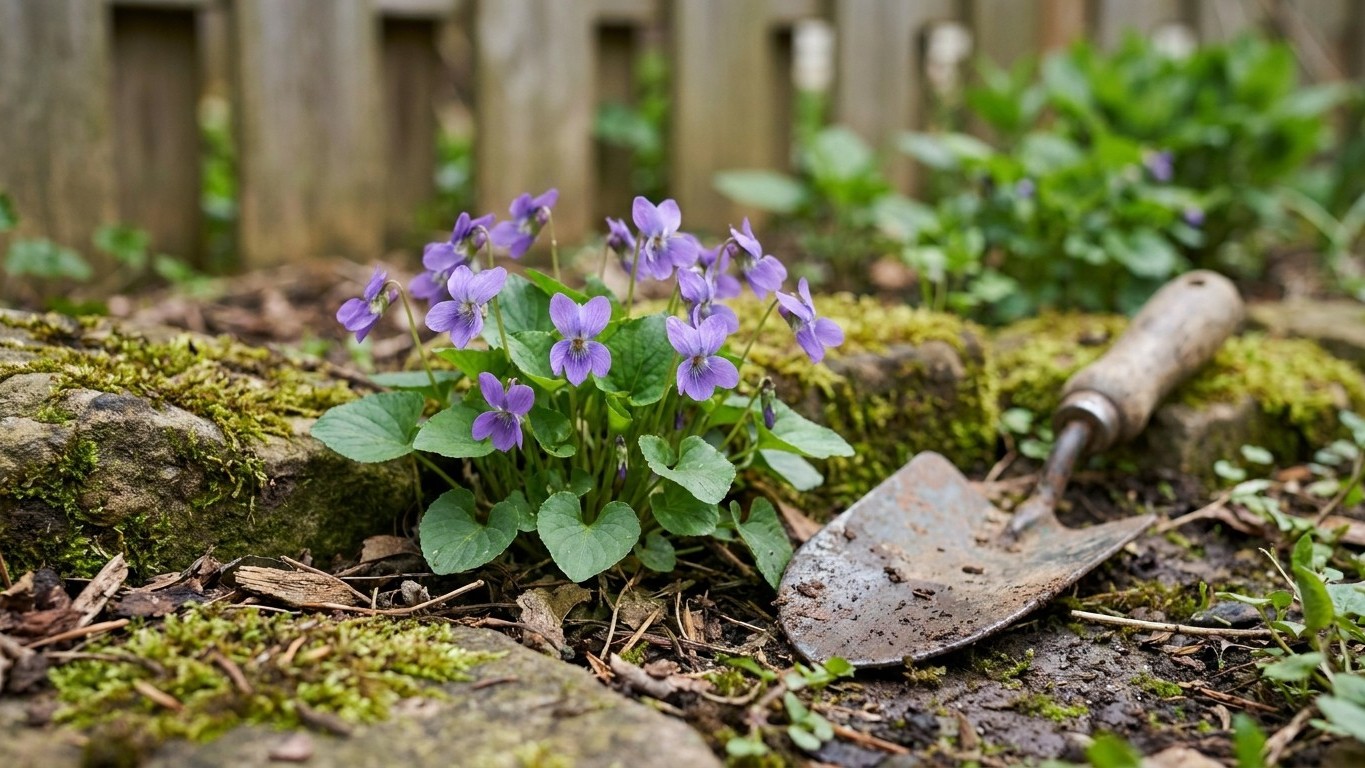

Wild violet earns its reputation the hard way. It spreads by tough rhizomes and by flowers that self-pollinate without ever opening, so a single plant can produce seed even after you think you have stopped it from blooming. Pulling rarely finishes the job, because any root fragment left in the soil regrows into a new plant. Before you spend a season fighting it, confirm you are looking at wild violet and not ground ivy or clover growing in the same shaded, thin patch of lawn.
How to be sure that is what you have

Wild violet grows low and spreads sideways rather than up. Each leaf is heart-shaped with a distinct notch where the stem meets the blade, and the edges are finely scalloped rather than smooth. The leaves stay glossy dark green through most of the growing season and often persist through mild winters, going nearly evergreen in sheltered spots. In spring the plant sends up short flower stalks tipped with five-petaled blooms in purple, blue, white, or a mix of the three, held just above the leaf canopy.
The two plants gardeners mix it up with most are ground ivy (Glechoma hederacea) and white clover (Trifolium repens). Ground ivy also spreads low and thick in shaded, damp turf, but its stems are square in cross-section, its leaves are rounded and scalloped rather than heart-shaped, and crushing a leaf releases a sharp mint smell wild violet never has. White clover shares the same low, mat-forming habit and turns up in the same thin patches, but its leaf is divided into three separate round leaflets rather than one solid blade. The single leaf, undivided and notched at the base, is the detail that rules out both look-alikes at a glance.
Wild violet also produces a second set of flowers later in the season that never open and never show color, self-pollinating right at the soil line, which is why the plant keeps spreading even if you deadhead every spring bloom you can see.
- Leaf: single, heart-shaped, notched at the base, edges finely scalloped
- Growth habit: low rosette spreading by rhizome, not a vine or runner
- Flowers: five petals, purple, blue, or white, on short stalks in early spring
- Stem: round, not square, which rules out ground ivy
- Seasonal look: glossy and semi-evergreen in mild winters, dies back hard in cold ones
Why it is in your lawn
Wild violet does not colonize a healthy, thick stand of turf. It moves into the gaps: the shaded corner under a tree canopy, the low spot that stays damp after rain, the strip along a fence where the mower skips a pass. Thin turf and shade are the two conditions this weed exploits more than any other, because violet tolerates far less light and far more moisture than most lawn grasses need to hold their ground.
Compacted soil compounds the problem. Foot traffic near a patio or along a well-used path packs the soil surface, squeezes out the air pockets grass roots need, and slows drainage, so the grass thins while violet’s shallow, fibrous roots keep working underneath it. Mowing too short adds a second insult. Cutting a cool-season lawn below the range Penn State Extension recommends for fine fescue, Kentucky bluegrass, perennial ryegrass, and rough bluegrass (2 to 3.5 inches, depending on species) weakens the grass canopy and opens the soil surface to light, which is exactly what a violet seedling needs to establish.
The same soggy shade that lets wild violet spread also gives annual bluegrass an opening, since both weeds exploit a thin canopy and lingering moisture rather than any single soil defect. Every one of these conditions is a lawn weeds problem before it is a wild violet problem specifically, and fixing the shade, the compaction, or the drainage does more long-term work than any bottle in the garage.
The window that decides everything
Pre-emergent herbicides are built to stop weed seeds from establishing, and timing them right depends on a signal from the plants around you rather than a date on the calendar. Clemson Cooperative Extension’s HGIC 1219, the Tall Fescue Maintenance Calendar, times the first pre-emergent application in tall fescue lawns to forsythia and dogwood bloom, a cue tied to soil temperature rather than the month printed on a bag of product. That bloom window arrives weeks apart from the Gulf Coast to New England, so a single national date would be wrong for most readers. Check the bloom timing in your own area, or use the crabgrass pre-emergent timing guide for the same soil-temperature cue applied to a weed pre-emergent chemistry actually controls well.
Why pre-emergent misses it
Wild violet is a perennial that already holds ground in your lawn through its rhizome, and it does not depend on fresh seed germinating each spring to keep spreading. A pre-emergent barrier that stops crabgrass or other annual grassy weeds from sprouting does very little against a plant that resprouts from root tissue already established below the soil surface. Some pre-emergent products with residual broadleaf activity can suppress new violet seedlings coming from the self-pollinating flowers, but they leave the established rhizome mat completely untouched.
The real trigger for established plants
For a plant already growing in the lawn, the window that matters is a post-emergent broadleaf herbicide applied to actively growing foliage, not a pre-emergent barrier laid down in advance. Fall applications tend to outperform spring ones on established perennial broadleaf weeds in general, because the plant is moving sugars into its roots ahead of winter and carries the herbicide down along with them. Spring applications, made while the plant is flowering and pushing new leaf growth, are weaker by comparison. Whichever season you choose, treat while daytime temperatures are mild and the foliage is dry, since a wilted or drought-stressed violet takes up far less herbicide than one that is actively growing.
Getting rid of it
Pulling by hand
Hand-pulling can work on a young, isolated plant, but only if you take the whole crown along with as much of the taproot and rhizome as will come loose. Any piece of root left in the soil, even a fragment an inch long, is enough to regrow a new plant, which is why a single afternoon of pulling rarely clears an established patch. Working after rain, when the soil is loose, makes it easier to draw the whole root out rather than snapping it off at the crown. Plan to go back over the same ground every couple of weeks through spring, since you will miss fragments the first time through no matter how careful you are.
Chemical control
When hand-pulling cannot keep up, a post-emergent broadleaf herbicide is the next step, and the active ingredient matters more than the brand name on the jug. Triclopyr, often sold in combination with 2,4-D, dicamba, or mecoprop (MCPP) as a three-way broadleaf mix, gives the most reliable control of established wild violet, though even a well-timed application usually needs a repeat treatment the following season to catch new growth from surviving rhizome. These products kill broadleaf plants and leave grass alone, but that protection does not run in the other direction: some warm-season lawn grasses, particularly St. Augustinegrass and centipedegrass, are sensitive to certain broadleaf herbicides and can be injured by a product that is perfectly safe on a cool-season lawn, especially when it is applied in hot weather. Read the label for your specific grass species before spraying, not just for the weed on it. Several broadleaf herbicide actives are restricted or require a license in some states, so check with your state’s department of agriculture or your local extension office before buying rather than assuming a product sold at the garden center is legal to use as labeled where you live.
Keeping it out
Mowing and feeding
Thick, vigorous turf is the only control that lasts, because it closes the gaps wild violet needs to get a foothold in the first place. Mowing height is the simplest lever most lawns get wrong: a taller cut shades the soil surface, which suppresses violet seedlings and lets existing grass roots grow deeper and more drought-tolerant. Clemson Cooperative Extension’s HGIC 1205, Mowing Lawns, and HGIC 1201, Fertilizing Lawns, both tie cutting height and feeding timing to the specific grass species rather than a single number for every lawn.
Matching turf to the shade
The figures below come from Penn State Extension’s Lawn Establishment guidance for the cool-season grasses and Clemson Cooperative Extension’s HGIC 1214, Selecting a Lawn Grass, for the warm-season ones.
| Grass | Type | Mowing height | Shade tolerance |
|---|---|---|---|
| Fine Fescues | Cool-season | 2.5-3.5 in | Excellent |
| Kentucky Bluegrass | Cool-season | 2-3 in | Fair |
| Perennial Ryegrass | Cool-season | 2-3 in | Fair |
| Tall Fescue | Cool-season | 2.5-3.5 in | Good |
| St. Augustinegrass | Warm-season | 2.5-4 in | Excellent |
| Zoysiagrass | Warm-season | 0.75-2 in | Excellent |
| Centipedegrass | Warm-season | 1.5-2 in | Fair |
If violet keeps showing up in a shaded corner, the fix is usually the grass choice as much as the mowing height. Fine fescue and St. Augustinegrass both carry an excellent shade rating from their respective extension services, while Kentucky bluegrass and perennial ryegrass are only rated fair in shade and will thin out under a canopy no matter how well you feed them, opening the door for violet regardless of how high you mow.
Overseeding a thin, shaded cool-season lawn in early fall, once soil temperatures have dropped from summer highs, thickens the stand before winter and gives grass a head start on any violet seedlings trying to establish in the same bare patches next spring. Clemson’s HGIC 1201, Fertilizing Lawns, ties nitrogen timing to each grass species’ active growth period rather than a fixed date, and feeding on that species-specific schedule builds the root reserves that let turf recover from mowing and crowd out broadleaf weeds instead of losing ground to them season after season.
Common questions
Will regular mowing get rid of it?
No. Wild violet grows as a low rosette that sits below most mower decks, so the blade passes right over it while cutting the grass around it down. Mowing height helps the surrounding turf compete, but it does nothing to the violet plant itself.
Does a vinegar or homemade spray actually kill it?
It burns the leaf tissue you spray, but the root and rhizome underground are untouched, so the plant regrows within a couple of weeks. Homemade acetic acid sprays act as a contact burn, not a systemic herbicide, and wild violet’s waxy leaf surface limits how much even gets absorbed.
Why didn’t my weed-and-feed product touch the violet in my lawn?
Many combination weed-and-feed products are formulated to handle dandelion and clover, and violet’s thick, waxy leaf resists absorbing the same herbicide load that works on those weeds. A product listing triclopyr, or a three-way mix that includes it alongside 2,4-D and dicamba or mecoprop, has a better chance, and even then usually needs a second application.
Does wild violet showing up mean my soil pH is off?
Not particularly. Unlike some lawn weeds that flag acidic or alkaline soil, wild violet is mainly an indicator of shade, moisture, and thin turf rather than pH. A soil test is still worth doing for general lawn health, but treating pH alone will not move an established violet patch.