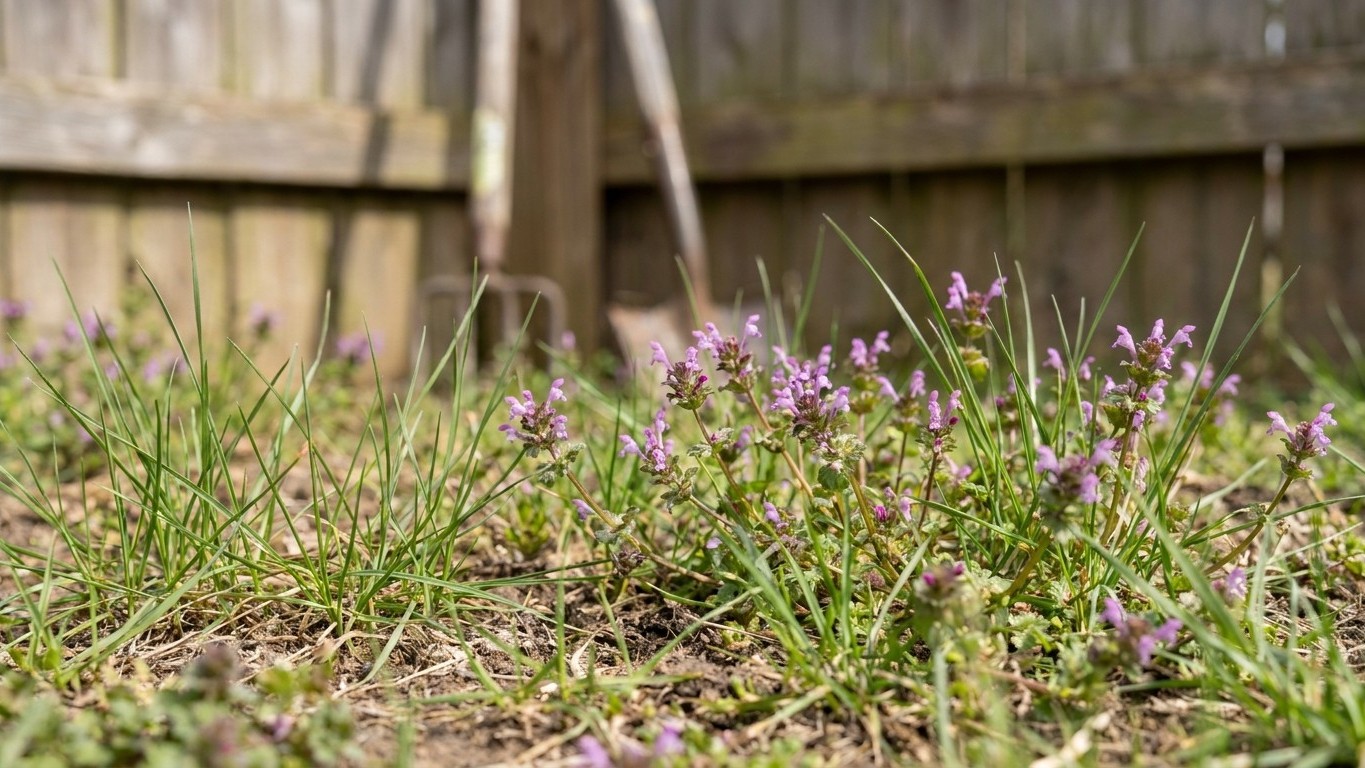

Henbit is a low, sprawling winter annual with square stems and small purple-pink flowers that opens through cracks in a lawn once turf coverage drops enough to let light reach bare soil. The bloom itself is not the damage. It is a signal that grass density fell below the point where the lawn could keep weed seed from germinating. Check your mower height against the correct range for your species, and if you are cutting below the low end of that range, raise the deck before you do anything else.
How to be sure that is what you have

What henbit looks like
Henbit grows low at first, then sends up square stems, a giveaway that it belongs to the mint family. Its leaves are rounded to heart-shaped with scalloped edges, arranged in opposite pairs up the stem. The lower leaves have short stalks, but the upper leaves clasp the stem directly with no stalk at all, which is one of the clearest identifying details on the plant. Small tubular flowers in shades of purple to pink appear in whorls near the top of the stem, usually starting in late winter or early spring in cool-season lawns and continuing through the season wherever winters stay mild. Left alone, a single plant can branch out into a loose mat several inches across, and a thin patch of turf can fill with dozens of them in a few weeks.
Plants it gets mistaken for
Two other low purple-flowered weeds get confused with henbit constantly. Purple deadnettle is the closest lookalike. It also has square stems and purple blooms, but its upper leaves are more triangular, sit on distinct short stalks rather than clasping the stem, and often carry a dusty purple tint toward the top of the plant that henbit’s upper leaves do not have. The other common mix-up is with Creeping Charlie: The Shade Weed That Spreads by Stem, which has rounded, scalloped leaves that look similar at a glance. The difference is in the growth habit: creeping Charlie spreads by trailing stems that root wherever they touch soil, forming a mat that resists pulling, while henbit is an upright, branching annual with a single shallow root system and no creeping stems at all.
Why it is in your lawn
A weed this common rarely shows up on thick, healthy turf. Henbit needs bare or thinned soil exposed to light, and a few conditions create that gap consistently:
- Compacted soil that keeps grass roots shallow and weak
- Mowing below the recommended height for your species
- Thin canopy from shade, drought stress, or wear
- Poor drainage that drowns grass roots in low spots
Cool-season lawns mowed short are especially exposed in fall and winter. Kentucky bluegrass, for example, is recommended to be mowed at 2 to 3 inches by Penn State Extension’s Lawn Establishment guidance, and a lawn kept shorter than that lets more winter light reach the soil surface, which is exactly the gap henbit’s seed needs to germinate. Warm-season lawns face the same problem from a different direction: a dormant St. Augustinegrass or centipedegrass lawn looks brown and bare in winter, but that is dormancy, not death, and the thin canopy still leaves enough open ground for henbit and other winter annuals to establish before the grass greens back up. The weed is a symptom of the gap, not the cause of it. Fixing the mowing height, the drainage, or the compaction that created the gap does more long-term work than any single herbicide application.
The window that decides everything
Pre-emergent timing
Henbit control splits into two very different jobs depending on when you catch it. A pre-emergent herbicide has to go down before the seed germinates, and Clemson Cooperative Extension’s HGIC 1219 Tall Fescue Maintenance Calendar times that application to a visual cue rather than a date: forsythia and dogwood bloom, which mark soil temperatures warming into the range where winter annual weed seed starts to sprout. That bloom trigger arrives weeks apart across the country, so a calendar date from one region tells you almost nothing useful in another. Use the bloom cue itself, or check a maintenance calendar for your own species and region rather than borrowing someone else’s month.
Post-emergent window
Once henbit has already come up and you can see the purple flowers, pre-emergent products are too late. That means catching it as a small, actively growing plant is the more forgiving post-emergent window, since a mature plant that has already flowered and set seed is harder to kill and has already guaranteed a repeat performance next year. The earlier you treat an actively growing plant, the smaller the dose it takes. If you are working out a broader weed calendar for the lawn rather than just this one plant, the general rundown of cool-season and warm-season weed timing in Lawn Weeds is a useful starting point before you narrow in on henbit specifically.
Getting rid of it
Pulling it by hand
Henbit has a shallow, fibrous root system and no rhizomes, so hand pulling works well and the roots do not regrow from broken fragments the way a creeping perennial weed would. Pull after a rain or watering when the soil is soft, and you can usually lift the whole root ball intact. This is the most practical option for a small patch or a lawn with just a handful of plants, and it carries zero risk to the surrounding grass.
Chemical options
For a heavier infestation, post-emergent broadleaf herbicides containing 2,4-D, dicamba, or mecoprop (MCPP), often sold together as a three-way mix, control henbit effectively when applied to small, actively growing plants. These products target broadleaf weeds and leave most established turf grasses unharmed at label rates, but they will not touch grassy weeds, and they can injure or kill ornamental plants and vegetables if drift reaches garden beds. Pre-emergent options such as prodiamine, dithiopyr, or pendimethalin prevent the seed from germinating in the first place, timed to the forsythia and dogwood bloom cue described above. Always read the label for your specific turf species before applying anything, since newly seeded lawns, dormant warm-season grass, and certain species tolerate these actives differently, and several broadleaf and pre-emergent formulations carry state-specific restrictions. Your state’s cooperative extension office can confirm what is currently registered for home use in your area.
Keeping it out
Matching grass to conditions
A dense stand of turf is the only control that keeps working without repeat applications. Three things build that density: mowing at the correct height for your species, fertilizing on the schedule your extension service publishes for that grass, and overseeding bare or thin patches before they turn into open soil. Clemson Cooperative Extension’s HGIC 1201 Fertilizing Lawns and HGIC 1205 Mowing Lawns fact sheets both point to the same underlying idea, that a lawn cut too short or fed at the wrong time thins out and opens the door to whatever weed seed happens to be waiting in the soil. Choosing a grass suited to your site’s shade and traffic in the first place matters just as much as maintaining whatever you already have.
| Species | Season | Mow height | Shade tolerance | Drought tolerance | Wear tolerance |
|---|---|---|---|---|---|
| Fine Fescues | Cool | 2.5-3.5 in | Excellent | Good | Poor |
| Kentucky Bluegrass | Cool | 2-3 in | Fair | Fair | Good |
| Perennial Ryegrass | Cool | 2-3 in | Fair | Fair | Good |
| Rough Bluegrass | Cool | 2-3 in | Excellent | Poor | Poor |
| Tall Fescue | Cool | 2.5-3.5 in | Good | Fair | Fair |
| Bahiagrass | Warm | 3-4 in | Poor | Excellent | Good |
| Bermudagrass | Warm | 0.75-1.5 in | Very poor | Excellent | Excellent |
| Carpetgrass | Warm | 1-2 in | Fair | Very poor | Poor |
| Centipedegrass | Warm | 1.5-2 in | Fair | Fair | Poor |
| Seashore Paspalum | Warm | 1-1.5 in | Poor to fair | Fair to good | Good |
| St. Augustinegrass | Warm | 2.5-4 in | Excellent | Good | Fair |
| Zoysiagrass | Warm | 0.75-2 in | Excellent | Good | Very good |
The cool-season figures above come from Penn State Extension’s Lawn Establishment guidance, and the warm-season figures come from Clemson Cooperative Extension’s HGIC 1214 Selecting a Lawn Grass. A shaded lot planted in bermudagrass will thin out no matter how carefully you mow it, and a heavily trafficked side yard in fine fescue will wear thin the same way. Matching the species to the site is what keeps the canopy dense enough that henbit, along with problems like Wild Violet: The Prettiest Weed and the Hardest to Kill, never gets the bare ground it needs to start.
Common questions
Does henbit kill grass or just grow next to it?
Henbit does not kill grass directly. It simply occupies the bare ground that thin turf left open, and once you thicken the lawn back up it has nowhere left to establish.
Will mowing it down get rid of it?
Mowing removes the flowers but not the root, and a mowed plant can still set seed low to the ground before you notice. Pulling or a targeted herbicide application while the plant is young works far better than repeated mowing.
Is henbit poisonous to pets or livestock?
Check with your veterinarian or a poison control resource before assuming either way if you have grazing animals or pets that chew on lawn weeds.
Can I compost pulled henbit plants?
Yes, as long as the plants have not already flowered and set seed. Composting weeds that have gone to seed risks spreading that seed right back into your garden beds when you use the finished compost.