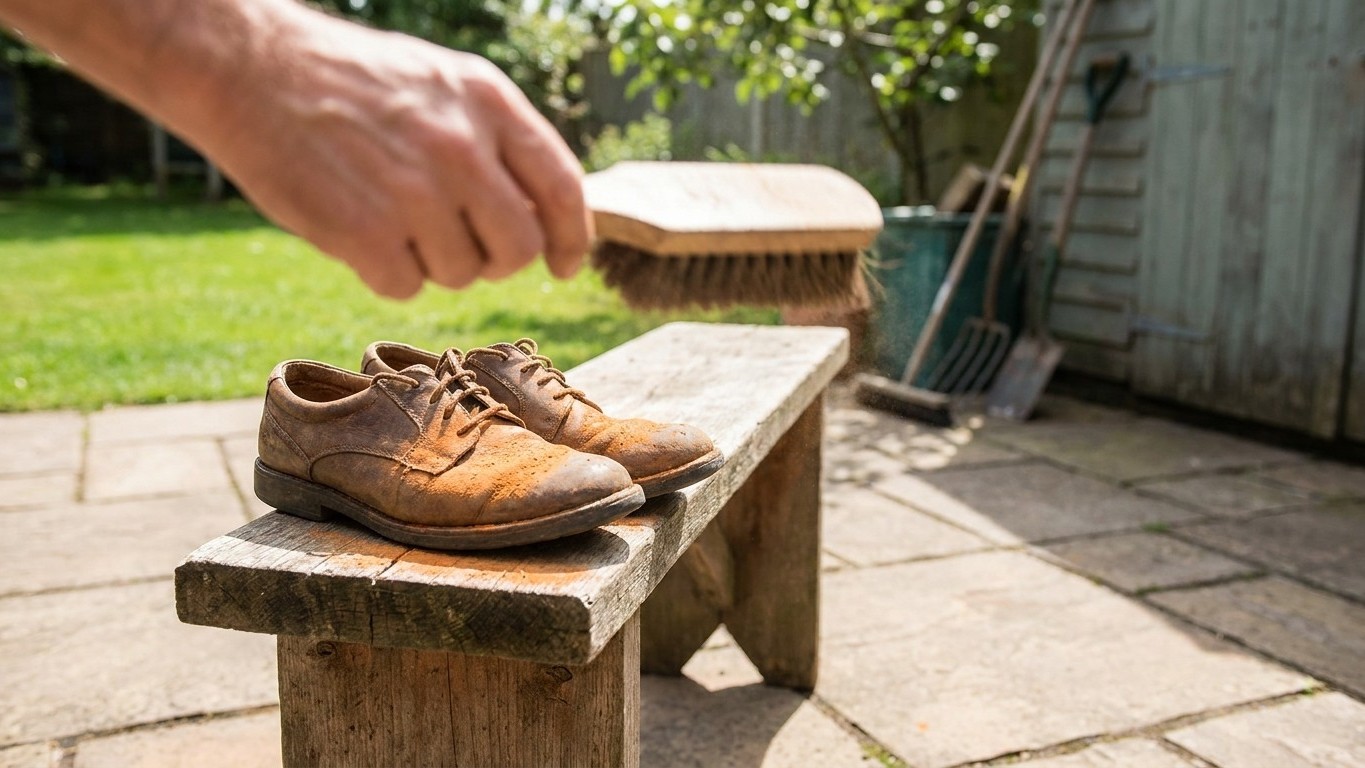

The orange dust on your shoes and mower deck is lawn rust, a fungal disease that coats grass blades in powdery spores. It shows up as a yellow-orange haze over patches of turf, most often in late summer or fall when growth slows down. Pinch a blade and rub it between your fingers. If it leaves an orange smear on your skin, you have confirmed rust and can stop guessing.
What you are looking at

From a few steps back, a rust-affected lawn looks dull and yellow-orange rather than green, as if a light layer of rust-colored dust has settled over the grass. The color is patchy rather than uniform, following the mowing pattern in some cases because the mower spreads spores as it passes. Walk across it in the early morning while the dew is still on, and you will pick up an orange tint on your shoes and pant cuffs.
The blade itself is where you confirm the diagnosis. Look closely and you will see raised, elongated pustules running along the length of the leaf, breaking through the surface in narrow orange-yellow streaks. Each pustule is small, usually under an eighth of an inch, but they cluster in rows and burst open to release a fine powder. That powder is the spore mass, and it is the single detail that separates rust from every other cause of a yellowing lawn. Rub a handful of affected blades between your palms and check for the orange residue.
As the disease progresses, individual blades take on a ragged, frayed look, and severely infected leaves can twist or curl at the tip. The lawn as a whole thins and loses vigor, not because rust kills the grass outright but because heavily infected blades photosynthesize poorly and the plant puts less energy into new growth. The orange dust is the confirming sign, not the yellow patch. A yellow patch alone could be a dozen things. Orange spore powder on your hand is rust and nothing else.
What it is not
A yellow lawn is far more often a watering or mowing problem than a disease, and rust is one of the easier calls to rule in or out once you check for the powder. If you rub a blade and get nothing on your fingers, look elsewhere before treating for disease.
Drought stress turns turf a dull tan-gray rather than orange, and it affects the whole lawn evenly rather than in the patchy, mower-streaked pattern rust produces. Nitrogen deficiency looks similar, a general pale yellow-green over the whole area, uniform rather than blotchy, and it responds to a nitrogen feeding within a couple of weeks in ways rust does not. Mowing too low or with a dull blade shreds leaf tips and leaves a gray-brown, ragged edge, which can be mistaken for disease at a glance but shows no spore powder and no raised pustules under a hand lens.
Dollar spot is a common mix-up in the same cool, slow-growth season rust prefers, but it leaves small, bleached, coin-sized spots with a distinct tan color and a reddish-brown border, not an orange dust. If your lawn shows tight, silver-dollar-sized dead circles instead of a general orange haze, read Dollar Spot: Coin-Sized Bleached Marks on a Hungry Lawn before treating for rust. Fairy ring is another one growers sometimes confuse with a fungal disease of the blade, but that shows up as dark green circles or arcs, sometimes with mushrooms, and is covered separately in Fairy Ring: The Dark Green Circle That Will Not Leave.
The conditions that bring it on
Lawn rust is a disease of slow-growing turf. It takes hold when the grass plant is not putting out new leaf tissue fast enough to outrun the fungus, which is why it shows up on cool-season lawns in late summer and fall rather than during the spring flush. Extended leaf wetness from dew, irrigation late in the day, or a run of humid, overcast weather gives the spores the moisture window they need to infect a blade. Warm days paired with cool nights, common in early autumn, are the classic setup.
Which grasses get hit
Rust is overwhelmingly a cool-season problem. Kentucky bluegrass and perennial ryegrass are the two species most often reported with it, and both happen to be mown at 2 to 3 inches, according to Penn State Extension’s lawn establishment guidance. Fine fescues and rough bluegrass are the same cool-season group and can show rust too, though less often than bluegrass and ryegrass in most lawns. Tall fescue, mown at 2.5 to 3.5 inches per Clemson Cooperative Extension’s HGIC 1214 factsheet, tends to shrug off rust better than the finer-leaved cool-season grasses.
Warm-season lawns are rarely the ones you will see with an orange dust problem. Bermudagrass, zoysiagrass, centipedegrass, St. Augustinegrass, bahiagrass, carpetgrass and seashore paspalum are all warm-season species, and their active growth period runs through the heat of summer rather than the cool, slow-growth stretch that favors rust. If you are mowing a warm-season lawn and see orange powder on your shoes, double check the diagnosis before assuming rust, since it is a much less common finding on those grasses.
What to do now
Most lawns with rust recover on their own once growing conditions improve, and that is worth saying plainly before reaching for a spray. Rust is a symptom of a stressed, slow-growing lawn, and the fastest fix is usually to get the grass growing again, not to kill the fungus.
A light, appropriate nitrogen feeding, timed according to your grass species and Clemson HGIC 1201’s fertilizing guidance, pushes out new leaf tissue faster than the fungus can colonize it, and new growth typically outruns the existing infection within a few mowings. Raise the mower to the top of the recommended range for your species rather than scalping, since a stressed, short-cut lawn is slower to recover. Bag clippings from infected areas for a mowing or two rather than leaving them on the surface, since the clippings carry spores that reinfect the same patch.
Fungicide is rarely justified for a home lawn with rust. The disease is cosmetic in almost every case, the turf is not being killed, and the weather shift that ends the outbreak, cooler nights, drier air, a return of active growth, is coming regardless of what you spray. Reserve a fungicide for a lawn that is thin, stressed, and showing rust across a wide area heading into a season where no relief is likely, and even then treat it as a stopgap while you fix the underlying watering, mowing, or nitrogen habit. Spraying a lawn that is already about to green back up on its own is money spent on the weather, not on the fungus.
Preventing it next season
Rust prevention is almost entirely about keeping the lawn growing steadily rather than reaching for a product after the fact. A few habits do most of the work.
- Water early in the morning, not in the evening, so blades dry out during the day instead of staying wet overnight.
- Mow at the top of the recommended height range for your species rather than the bottom, since a taller, less-stressed leaf resists infection better.
- Keep nitrogen on a steady schedule instead of letting the lawn run hungry through late summer, per Clemson HGIC 1201’s fertilizing timing.
- Improve airflow over dense turf by cutting back overhanging shrubs, since stagnant, humid air near the soil surface is what lets spores linger on the leaf.
Mowing height itself is a species-specific decision, and getting it wrong is one of the most common ways gardeners stress a lawn into a rust outbreak without realizing it. The table below lines up the cool-season species most often affected against their recommended mowing heights, all figures from Penn State Extension’s lawn establishment guidance and Clemson HGIC 1214.
| Species | Mowing height | Shade tolerance | Drought tolerance |
|---|---|---|---|
| Kentucky Bluegrass | 2 to 3 in | Fair | Fair |
| Perennial Ryegrass | 2 to 3 in | Fair | Fair |
| Fine Fescues | 2.5 to 3.5 in | Excellent | Good |
| Rough Bluegrass | 2 to 3 in | Excellent | Poor |
| Tall Fescue | 2.5 to 3.5 in | Good | Fair |
If rust becomes a recurring problem on the same patch of lawn year after year, it is worth reading through the broader picture in Lawn Diseases to see whether a pattern of shade, poor drainage, or compacted soil is setting that spot up to struggle every fall regardless of which fungus shows up first.
Common questions
Will lawn rust kill my grass?
Rarely on its own. It weakens individual blades and slows growth, but the plant usually recovers once conditions favor active growth again. A lawn that is already thin, drought-stressed, or mowed too short going into a rust outbreak is the one at real risk of thinning further.
Can I just mow it off?
Mowing does not cure rust, but bagging the clippings from an infected area for a mowing or two keeps spores from spreading to clean turf nearby. Leaving infected clippings on the surface tends to reinfect the same patch faster.
Is the orange dust harmful to pets or kids?
Lawn rust is a plant pathogen, not a human or animal one, and it is not a known health hazard to people or pets walking across an infected lawn. The main nuisance is the orange residue it leaves on shoes, mower decks, and pant cuffs.
Why does rust show up in the same spot every year?
A recurring spot usually has an underlying stress that never gets fixed, shade, poor airflow, low mowing height, or a nitrogen program that lets the grass run hungry late in the season. Rust just finds the weak spot first. Fixing the habit behind it does more long term than any single treatment.