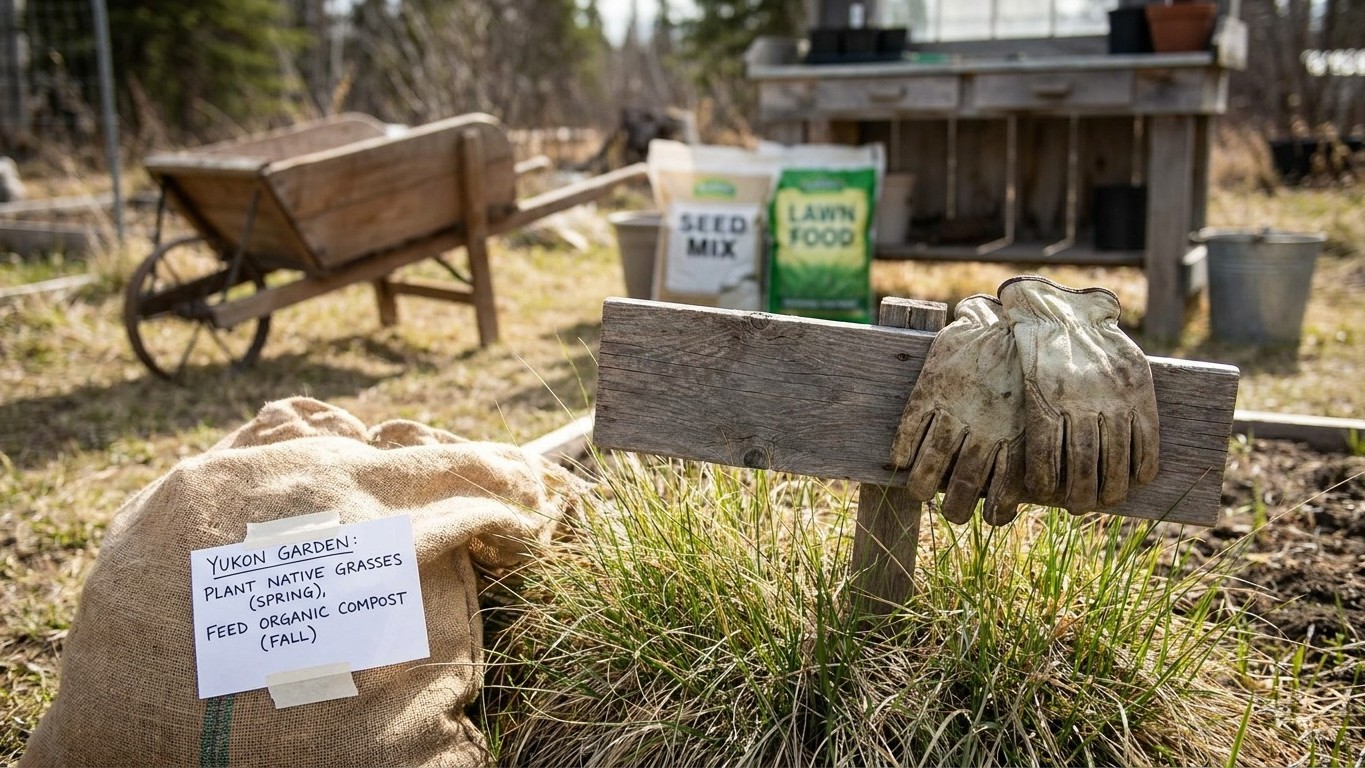

Yukon lawns run on cool-season grass, full stop. Environment and Climate Change Canada’s 1981-2010 climate normals for Whitehorse show zero days a year reaching 90°F and a coldest-month mean minimum of -19.2 °C, numbers that put this territory firmly in cool-season turf country and rule out anything that needs real summer heat to grow. The action that follows: consult The Best Grass Seed for Yukon Lawns and buy a seed blend built around Kentucky bluegrass, fine fescue and perennial ryegrass rather than a single-species bag, and get it into the ground in the second half of summer, not in spring, following The Yukon Lawn Care Calendar, Month by Month.
Which grass belongs in Yukon

The call here is not close. ECCC’s Whitehorse climate normals record 0.0 days a year at or above 90°F and a coldest-month mean minimum of -19.2 °C. The first number rules out anything from the warm-season shelf: Bermudagrass, zoysia and centipede grass all need sustained summer heat to grow, and Whitehorse essentially never delivers it. The second number confirms the call from the other direction, since a winter that averages well below freezing through its coldest month is exactly the range cool-season turf is bred to sit through.
What the numbers rule in
Clemson Cooperative Extension’s HGIC 1214 factsheet, read alongside Penn State Extension’s list of cool-season species, names five grasses that fit this profile: Kentucky bluegrass, tall fescue, fine fescue, perennial ryegrass and rough bluegrass. All five green up and go dormant on the opposite half of the year from a Bermudagrass lawn, which is exactly the pattern a short, cool Yukon summer calls for.
None of the five is a free pass, though, and picking one blind wastes a season of establishment. Each carries a different trade-off in how it spreads, how it handles shade, and how it takes a dry stretch.
| Species | Growth habit | Shade tolerance | Drought tolerance |
|---|---|---|---|
| Kentucky bluegrass | Spreads by rhizomes, self-repairs | Fair | Goes dormant, recovers |
| Tall fescue | Clump-forming, deep roots | Good | Best of the five |
| Fine fescue | Clump-forming, fine leaf | Excellent | Good |
| Perennial ryegrass | Clump-forming, fast to germinate | Poor | Weak |
| Rough bluegrass | Shallow, spreading | Excellent in wet shade | Poor |
Most bagged blends sold as a “cool climate” mix already combine two or three of these, using Kentucky bluegrass to knit the turf together over time and fine fescue or perennial ryegrass to fill in fast while the bluegrass establishes. That is standard cool-season practice everywhere, not a Yukon-specific tweak, so a blend labeled for a northern lawn elsewhere on the continent will generally work here too.
Compare that with a warm-season territory: in Alabama Lawn Care: What to Plant and When to Feed It, the whole calendar runs on Bermudagrass and centipede grass because the summers there deliver the heat this territory simply does not.
When to seed or sod here
Clemson Cooperative Extension’s HGIC 1203 planting guide gives the general cool-season seeding window as mid to late September, timed to that region’s own climate. Yukon runs on a different clock, and the frost record proves it.
Anchoring the window to Whitehorse’s frost date, not a generic month
ECCC’s 1981-2010 climate normals put the average first fall frost at the Whitehorse A station at August 25. That is a mean date, not a guarantee: in roughly half of years the frost arrives later than that, and in the other half sooner, so treat it as the rough centre of a risk window rather than a line you can plant right up against. A cool-season lawn needs several weeks of real growth after seeding before frost stops it, so seeding in September, the month Clemson’s home-region calendar recommends, would mean starting after the frost season here has often already begun. The practical window sits earlier, in high summer, while there are still enough warm, frost-free weeks left for seed to germinate and root before growth shuts down for the year.
Sod carries the same logic without the germination step. It still needs its roots knitted into the soil before hard frost sets in, so the same early timing applies, just with a little more margin, since sod skips the slow seedling stage that seed has to survive.
There is no equivalent spring warm-season planting date to give here, because none of the five recommended species is a warm-season grass. A grower in a transition-zone state such as Kansas Lawn Care: What to Plant and When to Feed It has to weigh both a spring warm-season window and a fall cool-season one and pick a lane for each part of the lawn. Whitehorse never faces that choice. Every recommended species here runs on the same cool-season clock, so the only real decision is how early in summer to get seed into the ground.
The feeding calendar that fits this climate
Nitrogen should follow the grass’s own growing season, not a fixed date on the wall calendar. A cool-season lawn does most of its root growth and carbohydrate storage in fall, which is why the heaviest feeding of the year falls then rather than in spring.
Why the Carolina calendar needs shifting north
Clemson Cooperative Extension’s HGIC 1219 tall fescue maintenance calendar times its main nitrogen applications through September and October, working in split doses of roughly one pound of actual nitrogen per 1,000 square feet per application, weighted toward fall rather than spring. That schedule was built for South Carolina’s longer, milder autumn. Whitehorse’s growing season closes far earlier, with ECCC’s normals putting the mean first frost at August 25, so a Yukon lawn needs its main feeding compressed into one well-timed late-summer application rather than spread across the two-month run Clemson’s calendar assumes.
Read the full tall fescue maintenance calendar for the complete season-by-season rates, and use the month names on it as a guide to sequence rather than literal Yukon dates: feed roughly six weeks before growth is expected to stop for the year, not by the calendar month printed on the page.
Spring feeding matters less here than the calendar’s early-year applications suggest. A heavy dose of nitrogen right after snowmelt pushes soft, fast top growth before the root system has caught up, leaving the lawn more prone to disease than one fed mainly in late summer. A light application once the lawn is fully green and actively growing is enough, and nitrogen should stop well before the lawn is heading into its late-season dormancy, since feeding late pushes tender new growth into the first hard frost.
Warm-season lawns run the opposite pattern, feeding heavily in late spring instead of fall, but that calendar has no application here, since none of the five species recommended for this territory is a warm-season grass.
Mowing height and watering here
Mowing height
Set the mower toward the upper end of each species’ published range rather than the lower one. Kentucky bluegrass generally holds up best mowed around 2.5 to 3.5 inches, fine fescue in about the same range, and tall fescue a little taller at 3 to 4 inches, figures published widely across cool-season turf guidance rather than specific to any one state. Whatever height you settle on, follow the one-third rule: never remove more than a third of the blade in a single cut, so a lawn kept at 3 inches gets mowed again once it reaches roughly 4.5 inches, not after it has grown twice that tall.
Watering
An inch of water a week, from rain and irrigation combined, is the figure most often quoted across cool-season turf guidance, but it assumes a hot, high-evaporation summer that Whitehorse simply does not have. With zero days a year reaching 90°F on ECCC’s normals, evaporation demand through the growing season runs well under that baseline figure, so a lawn watered to the standard inch-a-week rule in this climate is often getting more than it needs. Check the top two inches of soil before watering rather than working from a fixed schedule, and let sandy soil push toward more frequent, lighter watering and heavier clay soil toward less frequent, deeper watering, an adjustment that applies in any climate, not just this one.
What goes wrong on lawns in Yukon

The failures that show up here trace back to a short growing season and a long, hard-frozen winter, not to the heat and humidity problems that dominate lawn care guidance written for warmer states.
Winterkill and crown hydration damage

A thaw-and-refreeze cycle, or a sheet of ice sitting over the lawn for weeks, can suffocate or physically damage the crown, the part just below the soil surface that regrows the whole blade each spring. It shows up in spring as dead-looking streaks or patches, often in low spots where water pooled and then froze, while the rest of the lawn greens up on schedule.
Snow mold

Grass that goes into winter wet, long, or thickly thatched is more prone to snow mold, a fungal disease that appears the moment snow melts as matted, discolored patches. It is usually a cosmetic and structural setback rather than a lawn-ending one, and it is the reason the last mow of the season matters almost as much as the first one in spring.
Slow spring green-up mistaken for die-off

Cool-season turf browns off in extreme cold and can look flattened, straw-colored and lifeless for weeks after the snow is gone, well after nearby trees and perennials have leafed out. That is dormancy, not death. The same grass that looks finished under a layer of dead blades will green up from the crown once the soil itself warms enough for root activity to resume.
Weeds moving into thin turf

Wherever winter damage or slow establishment leaves the turf thin, opportunistic weeds such as dandelion and clover move into the gap faster than the grass can close it, since a short growing season gives a Yukon lawn fewer weeks each year to recover ground on its own.
Local help
For a soil test or advice specific to a given part of the territory, the federal Agriculture and Agri-Food Canada site is the working starting point, since the territorial department’s own site currently blocks automated checks. A soil test is worth doing before assuming any figure in this piece applies unchanged to a particular yard: ground higher than the valley floor, or well north of Whitehorse, runs colder than these normals describe.
Common questions
Can I still grow a warm-season grass like Bermuda if I baby it through winter?
Not reliably. ECCC’s Whitehorse normals show zero days a year reaching 90°F, and Bermudagrass needs sustained heat just to grow, let alone survive a winter with a coldest-month mean minimum of -19.2 °C. Extra winter care can help a struggling warm-season lawn in a milder region, but it cannot manufacture summer heat the climate does not provide.
What if I miss the late-summer seeding window?
Wait for the following summer rather than seeding into fall or winter. A late seeding gives seedlings too little time to root before frost, and seeding into cold, still-thawing spring soil usually germinates unevenly. Overseeding an existing thin lawn is more forgiving than starting bare ground, since established turf shades and protects new seedlings while they root in.
Will new grass survive its first Yukon winter?
Young turf is more vulnerable to winterkill than an established lawn, because its root system and crown reserves are smaller. Seeding as early as possible within the recommended window, rather than at the tail end of it, gives seedlings the longest run of growth before the first frost risk sets in.
Do I need to dethatch every year?
Only if a plug of turf shows a thatch layer thicker than about half an inch between the soil and the green blades. A cool-season lawn growing through a short season generally builds thatch slowly, so an annual dethatch is rarely necessary and can do more harm than good on a lawn that is not overdue for it.
Should I fertilize in spring as well as late summer?
Keep any spring application light, if you use one at all. A heavy dose of nitrogen right after snowmelt pushes soft, fast top growth before the root system has caught up, which leaves the lawn more prone to disease than one fed mainly in late summer, when cool-season grass is already storing energy for the following year.