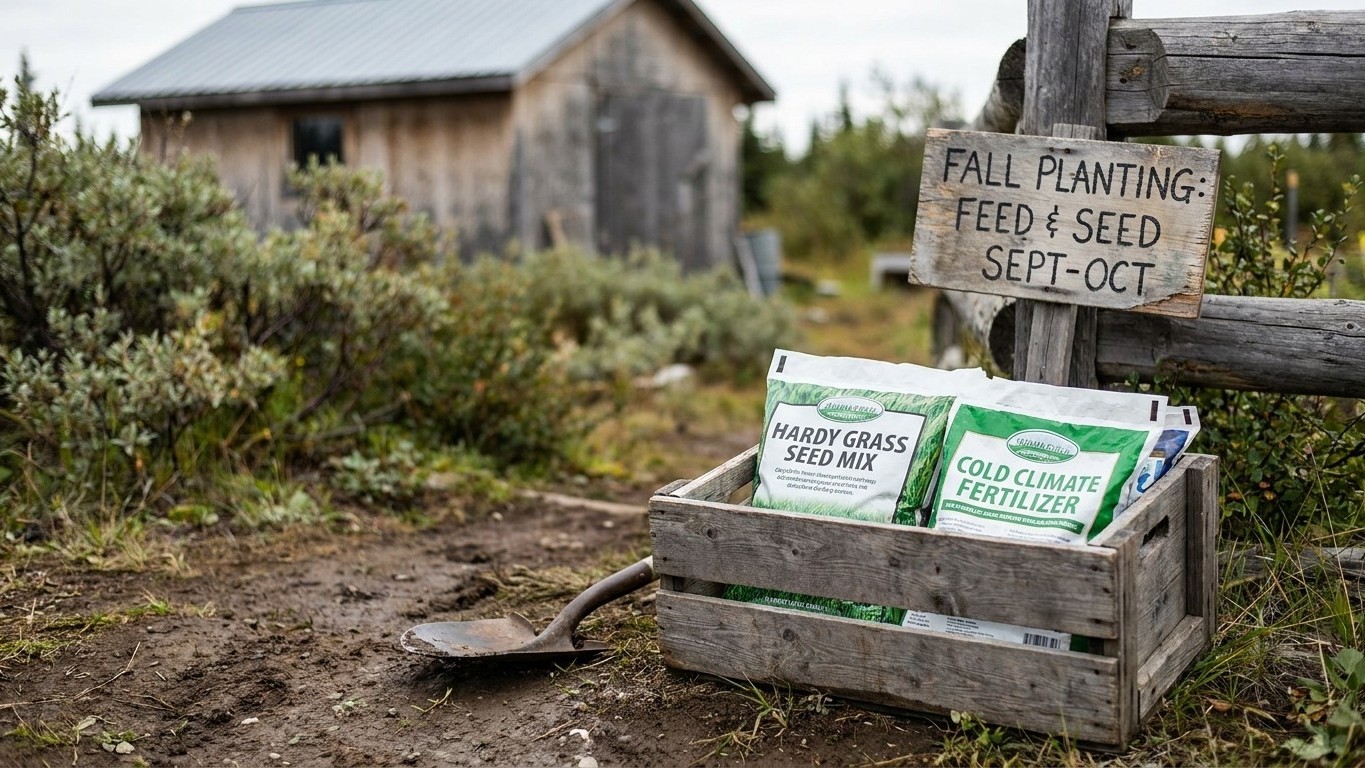

Northwest Territories lawn care means cool-season grass, full stop. Environment and Climate Change Canada’s 1981-2010 climate normals for Yellowknife show zero days a year reaching 90°F and a coldest-month mean daily minimum of -29.5 °C, numbers that rule out any warm-season turf and confirm this is cool-season country from the ground up. Build the lawn around Kentucky Bluegrass, Perennial Ryegrass, or Tall Fescue in the sunniest, most trafficked parts of the yard, and keep Fine Fescues on hand for shaded or dry corners where those three struggle.
Which grass belongs in Northwest Territories

The climate answers the grass question before you pick up a rake. Environment and Climate Change Canada’s 1981-2010 normals for Yellowknife put days above 90°F at zero for the year, which knocks out every warm-season species that needs real summer heat just to grow at all. The same normals put the coldest month’s mean daily minimum at -29.5 °C, a level that would kill Bermudagrass, Zoysia, or St. Augustinegrass outright even if the summers ran warmer. There’s no trade-off to weigh here: this is unambiguously cool-season turf territory, not a transition zone where you’d be splitting the difference between two imperfect options.
The species that actually work are Kentucky Bluegrass, Tall Fescue, Perennial Ryegrass, Fine Fescues, and Rough Bluegrass, the standard cool-season lineup given by Clemson Cooperative Extension and backed by Penn State Extension for northern climates, and detailed further in this Northwest Territories lawn Best grass guide. Kentucky Bluegrass spreads by rhizome and knits a dense, self-repairing turf, which suits open lawn areas that take foot traffic. Tall Fescue roots deeper and tolerates a wider range of soil, useful where topsoil sits thin over rock or gravel. Fine Fescues, a group that includes creeping red, hard, and chewings fescue, handle shade and low fertility better than the others, which makes them the right call for the north side of a house or under spruce. Rough Bluegrass, seeded less often, tolerates wet, shaded ground where the rest struggle.
These figures come from the Yellowknife station specifically. Communities at higher elevation, farther north, or closer to the mountains run colder still, and a lawn started from a Yellowknife-based calendar may need extra weeks of buffer in those places. Treat the Yellowknife numbers as a starting point for the territory, not a fixed rule for every yard in it.
When to seed or sod here
Clemson Cooperative Extension’s general lawn calendar (HGIC 1203) splits seeding by grass type: warm-season lawns go in around May, cool-season lawns go in mid to late September. Northwest Territories lawns are best planned against a dedicated Northwest Territories lawn Calendar, since the region’s short growing season narrows that general window considerably. Lawns here are cool-season, so the September window applies, but it should be anchored to this territory’s own frost pattern rather than a generic month.
Environment and Climate Change Canada’s 1981-2010 normals put the average first fall frost at Yellowknife (station YELLOWKNIFE A) on September 18. That is a mean date, not a guarantee. In roughly half the years on record, frost lands later than that, and in the other half it lands earlier. Seed early enough that grass gets a real growing window before the ground starts to freeze, rather than treating September 18 as a safe cutoff.
Because the average sits in mid-September, the practical seeding window for cool-season grass in this territory falls in the weeks before it, roughly the second half of August into early September, giving seedlings several weeks of cool but unfrozen soil to root before dormancy sets in. Communities north or upland of Yellowknife should close that window earlier, not later.
Compare that to a milder cool-season climate: Nova Scotia Lawn Care: What to Plant and When to Feed It works from a later, longer fall window, because its frost arrives weeks after Yellowknife’s does. The species overlap almost entirely, but the calendar that fits one place runs too late for the other.
Sod, where you can get it, follows the same logic. Lay it while soil is still workable and well before hard frost, since sod needs time to root into the ground before winter dormancy, not just time to look green on the surface.
The feeding calendar that fits this climate
Nitrogen timing follows the grass’s growing season, not the wall calendar. A cool-season lawn like the ones this territory supports does its real growing in spring and fall, with a slowdown through the hottest and coldest stretches, so the heaviest feeding goes down in early fall, while roots and shoots are still active and about to bank energy for winter.
Clemson Cooperative Extension’s Tall Fescue Maintenance Calendar (HGIC 1219) lays out a full-season feeding schedule for that exact species, and it’s worth reading start to finish rather than pulling a single number out of it, since rates shift with the season and with how the lawn was managed the year before.
A commonly used rate for a fall feeding on cool-season turf is around 1 pound of actual nitrogen per 1,000 square feet, applied once the worst of any summer stress has passed and growth is picking back up. A second, lighter application earlier in the growing season is common practice on established lawns, but the fall feeding matters most here, because it’s what carries the grass into winter with something to draw on.
Given how short the growing season runs at this latitude, that fall window is also compressed. There’s less room to fix a missed feeding with a make-up application later, since growth shuts down for winter not long after the average frost date. Reading the full Clemson calendar for tall fescue ahead of the season, rather than after the lawn already looks thin, leaves more room to adjust the rate to your own ground.
Mowing height and watering here
Mowing height
Cool-season species carry their food-making leaf closer to the ground than warm-season grasses do, so they need more leaf left standing after each cut.
| Species | Mowing height | Best suited to |
|---|---|---|
| Kentucky Bluegrass | 2.5-3.5 in | Open, high-traffic lawn areas |
| Perennial Ryegrass | 2.5-3 in | Quick establishment, overseeding |
| Tall Fescue | 3-4 in | Thin or rocky topsoil |
| Fine Fescues | 2.5-3 in | Shade, low-fertility ground |
| Rough Bluegrass | 2-2.5 in | Wet, shaded areas |
Whatever the target height, the one-third rule matters more than the exact number: never remove more than a third of the blade length in a single cut. Scalping a cool-season lawn back hard in one pass stresses the crown and opens the turf to weeds, and it’s a harder mistake to recover from here, given how little growing season is left before frost to bounce back in.
Watering
An inch of water a week, delivered in one or two sessions rather than daily sprinkling, is the standard figure used across cool-season turf guidance generally. What changes that figure locally is soil and daylight rather than heat, since Yellowknife records essentially no days above 90°F and heat stress isn’t the main risk on a lawn here. Many yards in this territory sit on thin soil over rock or gravel, which drains fast and holds little reserve, so watering may need to happen more often even if the total weekly volume stays close to that inch figure. Long summer daylight at this latitude also keeps grass using water for more hours a day than the air temperature alone would suggest, another reason not to assume a cooler climate needs less irrigation outright.
What goes wrong on lawns in Northwest Territories

The failures that show up on a lawn here are shaped by long, hard winters and a short cool summer, not by humid heat. Because Yellowknife averages zero days a year above 90°F, the brown patch and heat-stress diseases that plague southern lawns are rarely the problem in this territory. What replaces them is damage tied to snow cover and deep cold.
Snow mold is the most common winter failure on cool-season lawns kept under long-lying snow: matted, grayish or pinkish patches appear as the snow melts in spring, where turf stayed wet and shaded for months. It usually grows out with the first mowing and a light raking to open the thatch, rather than needing reseeding.
Winterkill is the bigger risk given a coldest-month mean minimum of -29.5 °C at Yellowknife. Grass that goes into winter drought-stressed, cut too short, or left under thin snow cover with no insulation can die outright rather than simply go dormant, and the difference between the two only becomes clear once growth is due to resume in spring.
Brown, dormant-looking turf in late summer is not necessarily dead grass. Cool-season species can shut down growth and lose color through a dry stretch and still green back up once rain or irrigation returns, the same pattern that shows up on other cool-season lawns. For a look at how a similar continental climate handles winterkill and snow mold recovery, see Montana Lawn Care: What to Plant and When to Feed It, since Montana lawns run on much the same cool-season species and face many of the same cold-season failures.
Weed pressure here tends to follow disturbance and thin turf rather than a year-round growing weed population, since the same cold that stresses grass also shuts down most weed growth for a long stretch each year. A lawn thinned by winterkill or snow mold damage gives weeds their opening the following summer, which is one more reason to treat winter survival, not weed control, as the main job on a Northwest Territories lawn.
Local help
For soil testing and advice specific to your community, the Government of Northwest Territories’ agriculture services page is the starting point, since conditions shift enough across the territory that a Yellowknife-based calendar is only ever a working estimate. A soil test before the first feeding season tells you whether the fall nitrogen rate above needs adjusting for what’s already in your own ground, rather than guessing at it.
Common questions
Can I just grow a warm-season grass if I really want something different?
Not outdoors, no. Warm-season species like Bermudagrass or Zoysia need sustained summer heat to grow at all, and Yellowknife’s normals show zero days a year above 90°F. Even where winter cold wouldn’t kill the plant outright, the growing season here is too short and too cool for it to establish or spread.
My lawn is still brown in June, is it dead?
Probably not. A cool-season lawn coming out of a hard winter can look bleached or matted well into early summer, especially where snow mold set in, and it usually greens up once mowing and raking clear the dead surface layer. Give it a few weeks of active growing weather before assuming it needs reseeding.
Is it too late to seed if I missed the late-August window?
It’s a real setback, not necessarily a lost year. Seeding closer to the average September 18 frost date at Yellowknife leaves less time for roots to establish, and seedlings that haven’t rooted well before the ground freezes are more exposed to winterkill. A spring seeding the following year, once soil has warmed and dried enough to work, is often the more reliable fix than pushing a fall seeding too late.
Should I fertilize in spring too, or just in fall?
Fall carries the most weight for cool-season turf in this climate, since it’s what builds the reserves the lawn needs to survive winter. A lighter spring application on an established lawn is common practice, but skipping it costs less than skipping the fall feeding does.
Does the Yellowknife frost date apply to my community?
Only as a starting reference. The September 18 average and the -29.5 °C coldest-month figure both come from the Yellowknife A station, and communities farther north, at higher elevation, or away from the moderating effect of a large lake will run colder and see frost earlier. Treat these figures as the middle of the territory’s range, not a fixed date for wherever you happen to be.