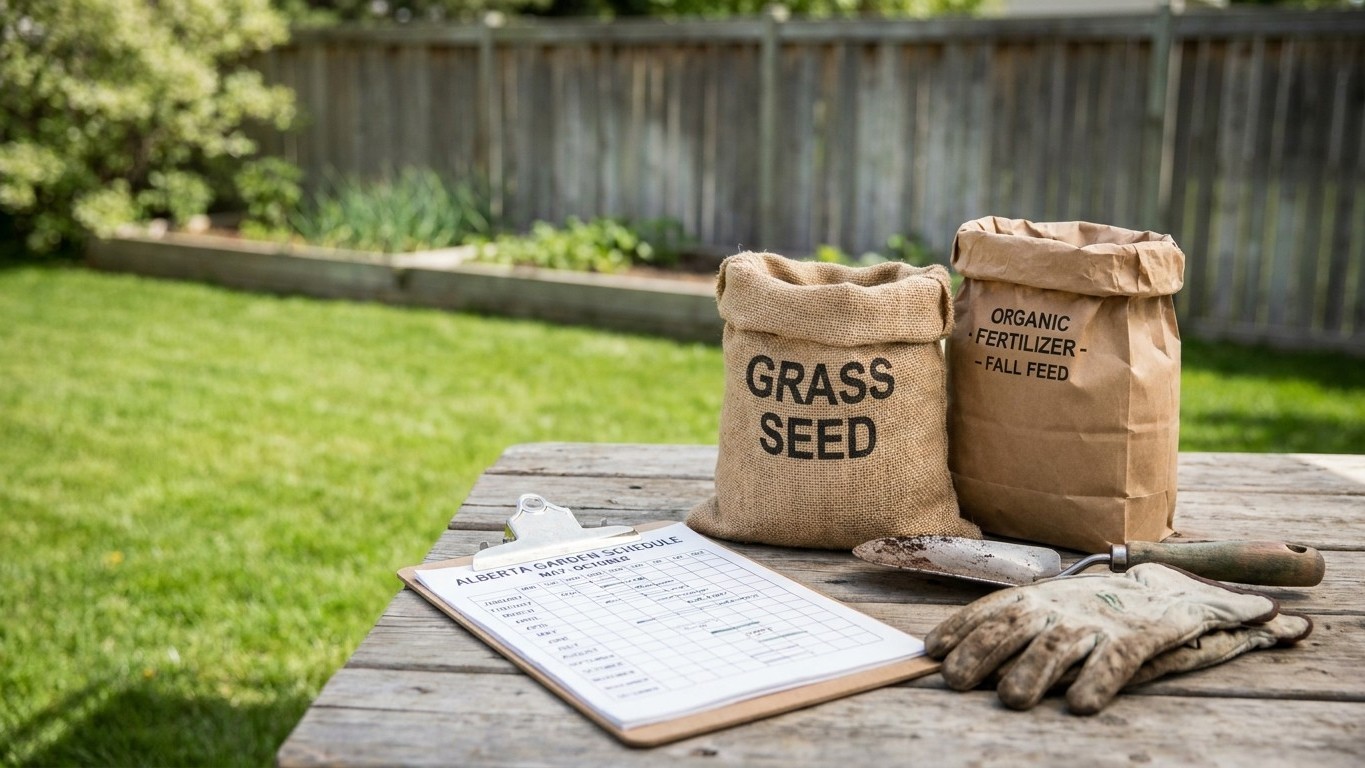

Alberta lawns are cool-season lawns, full stop. ECCC’s 1981-2010 climate normals for the Calgary reference station show zero days a year reaching 90°F and a coldest-month mean minimum of -13.2 °C, a combination that rules out any warm-season grass and points squarely at species bred for cold winters and short summers. Build the lawn around a blend that includes Kentucky bluegrass and fine fescue rather than gambling on a warm-season sod that has no chance of surviving a Calgary winter. For a full breakdown of options, see The Best Grass Seed for Alberta Lawns, and once the grass is chosen, The Alberta Lawn Care Calendar, Month by Month lays out the seasonal maintenance that keeps it healthy.
Which grass belongs in Alberta

Two numbers settle the question before you ever pick up a seed bag. ECCC’s Canadian Climate Normals 1981-2010, measured at the Calgary reference station, show zero days a year at or above 90°F and a mean coldest-month minimum of -13.2 °C. Warm-season grasses like bermudagrass and zoysiagrass need sustained summer heat to grow at all, and they die outright in winters this cold. Neither figure leaves room for debate: this is cool-season turf territory, not a transition zone where the choice is a genuine trade-off.
Clemson Cooperative Extension’s HGIC 1214 factsheet on selecting a lawn grass, cross-referenced with Penn State Extension’s work on cool-season species, names five grasses suited to this climate: Fine Fescues, Kentucky Bluegrass, Perennial Ryegrass, Rough Bluegrass and Tall Fescue. Each behaves differently enough that the choice matters for how the lawn is actually used.
| Grass | Growth habit | Best use in a blend |
|---|---|---|
| Kentucky Bluegrass | Spreads by underground rhizomes, self-repairs bare spots | The main lawn grass where wear recovery matters |
| Fine Fescues | Fine-bladed, tolerates shade and low fertility | Shaded beds under trees, low-input areas |
| Perennial Ryegrass | Bunch-type, germinates fast | Quick cover and overseeding bare patches |
| Tall Fescue | Coarser blade, deep-rooted, tolerates dry spells | Full-sun areas that see heavier foot traffic |
| Rough Bluegrass | Shallow-rooted, prefers constant moisture | Damp, shaded corners where little else grows |
Most seed retailers in the province sell a blended bag rather than a single species, usually a Kentucky bluegrass base with fine fescue and perennial ryegrass mixed in. That blend hedges against the fact that no single cool-season species handles every microclimate in a typical yard, from a sunny south wall to a fence-shaded strip that barely dries out. A homeowner in a colder, higher district facing similarly short summers has the same constraint working further north, and the Alaska Lawn Care: What to Plant and When to Feed It guide covers how that limit plays out at an even shorter growing season.
When to seed or sod here
Clemson Cooperative Extension’s HGIC 1203 factsheet splits the seeding calendar by grass type: warm-season lawns go in around May, cool-season lawns go in mid to late September. Alberta only ever grows the second kind, so the May window in that factsheet simply does not apply here. What does apply is the fall window, and it needs to be anchored to a local date rather than repeated as a generic month.
Anchoring the window to frost
ECCC’s Canadian Climate Normals 1981-2010 put the mean first fall frost at the Calgary Int’l A station on September 16. That is a mean, not a guarantee: in roughly one year out of two, the first frost falls later than that date, and in the other half it falls earlier. Seeding needs enough time before that window closes for new grass to develop real roots, so the safer read of “mid to late September” here is to get seed down at the start of that stretch rather than the end, giving the lawn the longest possible run before the ground cools past the point where cool-season grass keeps growing.
Sod can go down later than seed because it arrives with roots already formed, but it still needs several weeks of active growing weather to knit into the soil before frost settles in for good. Districts north of Calgary, or at higher elevation, typically see that frost arrive earlier than the reference date, which shortens the safe window further. A homestead in the foothills or the Peace Country should treat the mean date as optimistic rather than exact.
Spring seeding is possible for cool-season grass too, and some growers prefer it to avoid weed competition, but the fall window remains the one Clemson’s calendar treats as the priority planting.
The feeding calendar that fits this climate
Nitrogen timing follows the grass’s growing season, not the month on the wall. A cool-season lawn does most of its root growth in fall as soil temperatures drop and top growth slows, which is exactly when it makes the best use of a nitrogen application. A warm-season lawn, by contrast, is fed as it comes out of dormancy in late spring, but that timing has no relevance to an Alberta yard growing Kentucky bluegrass, fine fescue or tall fescue.
Clemson Cooperative Extension’s HGIC 1219 Tall Fescue Maintenance Calendar treats September as the anchor month for feeding a cool-season lawn, calling for the year’s heaviest nitrogen application then, with lighter or no feeding through the heat of summer when the grass is barely growing. The calendar does not hand out one blanket rate for every yard. It ties actual pounds of nitrogen per 1,000 square feet to a soil test, because a lawn that is already nitrogen-rich from years of over-feeding needs less than a thin, patchy one starting from bare dirt.
That is the reason a soil test matters more than a bag rate printed on fertilizer packaging. Buying fertilizer by the recommended-looking number on the front of the bag, without knowing what the soil already holds, is the single most common way homeowners over-apply nitrogen on a lawn that did not need it.
Mowing height and watering here
Mowing
Cool-season grasses like the Kentucky bluegrass and tall fescue blends common in Alberta are mowed taller than warm-season turf, and the deck should sit near the upper end of whatever range the seed label or grass supplier recommends for that species. The rule that matters more than any single height is the one-third rule: never remove more than a third of the blade in a single pass. Scalping a cool-season lawn back hard in one cut stresses the crown and opens the door to the weed and disease problems covered below.
Watering
An inch of water a week, delivered in one or two deep sessions rather than daily light sprinkling, is the commonly cited baseline for an established cool-season lawn. What moves that figure here is the province’s low humidity and the drying effect of chinook winds, which pull moisture out of turf and soil faster than a calm, humid climate would. A lawn on sandy or gravelly soil, common on river-terrace lots around Calgary, drains faster still and may need water more often even if the weekly total stays close to the same figure. A newly seeded lawn from the September window above needs far more frequent, shallow watering than an established one, since germinating seed dries out and dies within hours if the surface crusts over.
What goes wrong on lawns in Alberta

Winter injury, not summer fungus
Because Calgary’s normals show no days above 90°F, the humid-heat diseases that plague turf further south and east, brown patch chief among them, are rarely the problem here. What actually damages Alberta lawns happens in winter: desiccation from dry chinook winds blowing over turf with no snow cover to protect it, and crown hydration injury when a lawn breaks dormancy during a mid-winter warm spell and then refreezes hard. Both show up in spring as dead-looking patches that were, in fact, killed months earlier.
Dormancy mistaken for death
A cool-season lawn that browns off in a dry summer stretch is very often dormant, not dead. It has shut down growth to survive the dry spell and will typically green back up with the return of cooler, wetter weather in fall, the same window that suits reseeding thin spots. Digging up a brown patch to “fix” it in July, before giving it a chance to recover on its own, is one of the more common and avoidable mistakes on lawns in this climate.
Snow mould after a heavy snow year
A lawn buried under snow for months, especially if that snow sits on unraked leaf litter or overly long grass going into winter, is prone to snow mould once the melt exposes matted, grey or pink patches in the grass. Growers dealing with the opposite problem, a wetter and milder coastal climate where fungal pressure runs through summer rather than under snow, will recognize a very different set of risks: the British Columbia Lawn Care: What to Plant and When to Feed It guide covers that side of the country’s turf disease pressure in more detail.
Local help
A soil test settles the fertilizer rate question raised above far better than guesswork, and county-level advice can catch problems specific to a district that a province-wide guide cannot. Alberta’s Agriculture and Irrigation ministry is the right place to start looking for soil testing options and local extension contacts before the next feeding or seeding window comes around.
Common questions
Can I plant a warm-season grass like zoysia in Alberta if I baby it?
No. ECCC’s climate normals for Calgary show a coldest-month mean minimum of -13.2 °C, well below what any warm-season grass survives, and no amount of winter protection changes that outcome reliably. Stick with the cool-season species named above.
Why did my new grass seed not come up this fall?
The most common cause is seeding too close to the mean first fall frost date rather than at the start of the September window, leaving too little time for germination before soil temperatures dropped. A hard, crusted seedbed from infrequent watering is the second most common cause.
My lawn is brown by August, is it dying?
Almost certainly not. Cool-season grass in this climate goes dormant under dry conditions and typically recovers once cooler, wetter fall weather returns, which is also the better time to reseed any patch that does not bounce back.
Should I feed my lawn in spring as soon as it greens up?
Light spring feeding is common, but the heaviest application belongs in fall, following the timing in Clemson’s tall fescue maintenance calendar. Heavy spring nitrogen pushes fast top growth at the expense of the root development the lawn needs to survive next winter.
Do I need to dethatch or rake before winter?
Clearing fallen leaves and matted grass before snow settles in reduces the risk of snow mould developing under cover through winter. A final mow at a slightly lower height than the summer setting, still respecting the one-third rule over a couple of passes, helps prevent matting as well.