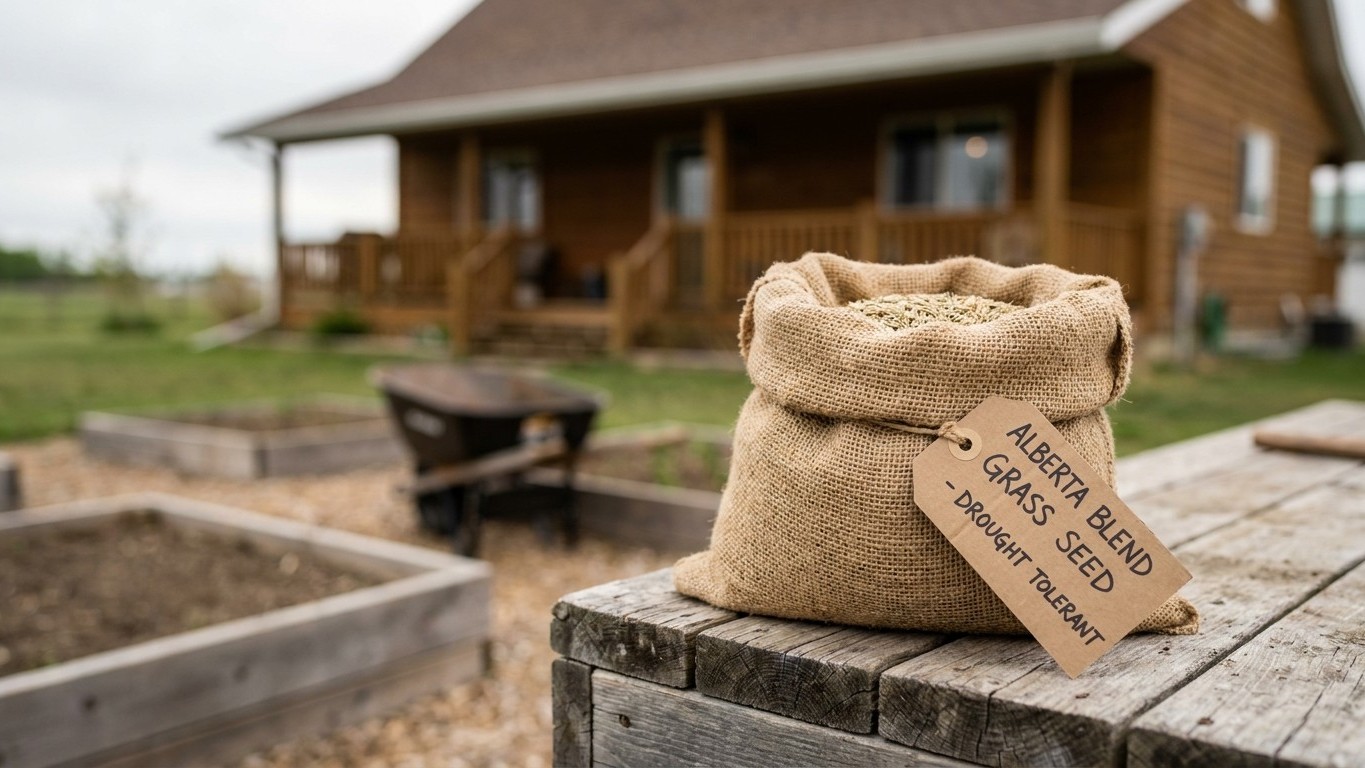

Bermudagrass and Zoysia, the grasses that fill southern seed catalogs, are the first two names you can cross off an Alberta shopping list — neither one lives through a winter here. What’s left is a shortlist of five cool-season species, and the right one for your yard isn’t a matter of brand or price but of sun, drainage, and how hard the kids and dogs use the lawn. A front yard baking in full sun wants something different than a shaded strip under a spruce tree.
The short answer for Alberta
The reference climate zone that The Homestead Post assigns to this territory, based on Calgary’s climate normals, is cool. That means every warm-season lawn grass sold in southern nurseries, from Bermudagrass to Zoysia, will not survive an Alberta winter and should not be considered here. The five species that do belong on an Alberta seed tag, per Clemson Cooperative Extension’s HGIC 1214 lawn selection guide and Penn State Extension’s cool-season species profiles, are Kentucky Bluegrass, Fine Fescues, Perennial Ryegrass, Tall Fescue and Rough Bluegrass.
Which of those five actually performs on your property depends on three things: how much direct sun the lawn gets, how well the soil drains, and how much foot traffic it takes. A full-sun, well-used front yard does best with a bluegrass-heavy blend, often cut with a smaller share of perennial ryegrass to speed up germination while the bluegrass fills in underneath. A shaded side yard under mature spruce or poplar, where grass has always struggled, is a better fit for fine fescue or, in a consistently damp shaded corner, rough bluegrass. Tall fescue earns its place where the ground dries out fast and you would rather water less than mow a perfect surface.
None of the five is a universal winner, and a bag labeled simply “premium lawn mix” tells you nothing until you read the percentages on the back. Look for the actual species names on the label and match them against what your yard offers, not what the picture on the bag promises.
Working through the year

Environment and Climate Change Canada’s 1981-2010 climate normals for station CALGARY INT’L A put the average first fall frost at September 16. That figure is a mean, not a guarantee: in roughly half of all years the first frost lands later than that date, and in the other half it lands earlier. Counting back six to eight weeks from mid-September puts the best seeding window for cool-season grass at roughly late July through early August, giving seedlings enough warm soil to root before the ground cools. Spring seeding is possible too, but the window between soil warming and summer heat stress is shorter, and young grass competes harder with weeds that got a head start over winter.
Ranking the five by what they cost you
| Species | Establishment speed | Sun / shade fit | What you give up |
|---|---|---|---|
| Kentucky Bluegrass | Slow, needs steady moisture while rooting | Full sun to light shade | Patience during the first season |
| Perennial Ryegrass | Fast, often used to hold soil while bluegrass fills in | Full sun | Weaker long-term cold hardiness than bluegrass |
| Fine Fescues | Moderate | Shade, dry poor soil | Thins under heavy foot traffic or full summer sun |
| Tall Fescue | Moderate to fast | Full sun, tolerates drought | Grows in bunches, so bare patches need reseeding rather than filling on their own |
| Rough Bluegrass | Moderate | Damp shade only | Thins out fast if the soil dries or the light increases |
Clemson Cooperative Extension’s Tall Fescue Maintenance Calendar, HGIC 1219, lays out mowing height and nitrogen timing month by month for that one species, which is worth reading if tall fescue is part of your mix. Its calendar dates are built around a South Carolina season, though, and do not transfer to Alberta directly since a maintenance calendar is written per species, not per state. For the same tasks mapped against Alberta’s own season, the Alberta Lawn Care Calendar, Month by Month walks through mowing, feeding and overseeding by month instead. If you are starting a lawn from bare soil for the first time, the groundwork in Alberta Lawn Care covers soil prep and grading before any seed goes down, and skipping that step is the reason a lot of first-year lawns come up patchy no matter which species was in the bag.
What changes across Alberta
Every figure in this article comes from Environment and Climate Change Canada’s station at Calgary International Airport, and Calgary is not the whole province. Land west of the city, into the foothills and toward the mountain parks, sits at meaningfully higher elevation and runs a shorter, cooler growing season than the Calgary normals describe, which means the seeding window there closes earlier than the late July to early August figure calculated above.
Southern Alberta, including the Calgary area itself, also gets periodic chinook winds through winter, warm spells that can melt snow cover and expose dormant cool-season turf to dry, mild air in the middle of January. That does not kill an established lawn outright, but it adds a stress that a lawn further north, under steadier snow cover, does not face.
North of Calgary, toward the Peace River region and other northern districts, the frost-free season runs shorter again, and a seeding window built on the Calgary Sept. 16 mean would likely need to shift earlier there rather than later. None of these adjustments are numbers this page can hand you, since the only station cited here is Calgary’s. Treat the figures above as a starting midpoint and adjust toward earlier dates the further you are from Calgary in elevation or latitude.
The mistakes this climate punishes
Seeding too close to frost
Seeding in early September and expecting a full lawn by winter is the single most common failure in this climate. A seedling needs several weeks of active growth before it can handle freezing, and Environment and Climate Change Canada’s own figure for Calgary, an average first frost of September 16, is a midpoint, not a deadline reserved for late sowers. The damage shows up the following spring as bare, thin patches where the newest seedlings never rooted deep enough to survive.
Mowing too short in summer heat
Cool-season turf that gets scalped during a hot, dry stretch browns off fast, and a lot of homeowners read that browning as a dead lawn and tear it out. It is not dead. Cool-season grass goes dormant under summer drought stress and greens back up once temperatures drop and moisture returns, the same way it browns under a hard frost rather than dying from one. Cutting shorter than the grass wants during a heat spell just removes the leaf area the plant needs to recover, and that damage shows within one or two weeks of the short cut, not immediately.
Feeding late and heavy before winter
A heavy nitrogen application timed too close to dormancy pushes soft, late top growth instead of the root development the lawn actually needs going into winter. That soft growth is more vulnerable to snow mold, and the damage from it does not appear until the following spring, as gray or pink patches under the last melting snow.
Expecting tall fescue to self-repair

Tall fescue is a bunch-type grass, not a spreading one, so a bare patch in a tall fescue lawn stays bare until it is reseeded by hand. Homeowners used to a bluegrass lawn’s rhizomes filling in worn spots on their own get caught out by this, usually along a path or a gate where traffic wears the same strip every year.
Checking this against your county
Alberta is a large province, and every figure on this page is anchored to one weather station at Calgary. Before you commit to a seeding date or a species mix, check current guidance from Alberta Agriculture and Irrigation, the provincial service, which can point you toward conditions closer to your own district rather than the Calgary normals used here.
If you are unsure whether your property runs ahead of or behind the Calgary window, a local garden center or the provincial service is a faster answer than guessing from elevation alone.
Common questions
Can I just use a warm-season grass and cut it short over winter?
No, warm-season species like Bermudagrass or Zoysia do not survive an Alberta winter regardless of how they are managed going into it. They belong to the opposite season classification and will die out over the cold months rather than going dormant and returning, which is the difference between the two grass categories.
Is Kentucky Bluegrass or Tall Fescue better for a Calgary-area yard?

It depends on how much you’re willing to water. Kentucky Bluegrass self-repairs and handles cold better long term, but needs more consistent moisture through summer, while Tall Fescue tolerates dry stretches better but leaves bare patches that only reseeding will fix.
My lawn turned brown in August, did it die?
Probably not. Cool-season grass in this zone goes dormant and browns under summer drought stress the same way it does after the first hard frost, and it typically greens back up once cooler, wetter weather returns rather than needing to be replaced.
When is it too late to seed in the fall?
There is no fixed cutoff, but seeding needs to happen early enough for several weeks of active growth before the ground freezes for good. Since Calgary’s average first frost of September 16 is only a midpoint from Environment and Climate Change Canada’s normals, and frost arrives later than that in half of all years, seeding late in that window is a gamble rather than a plan.