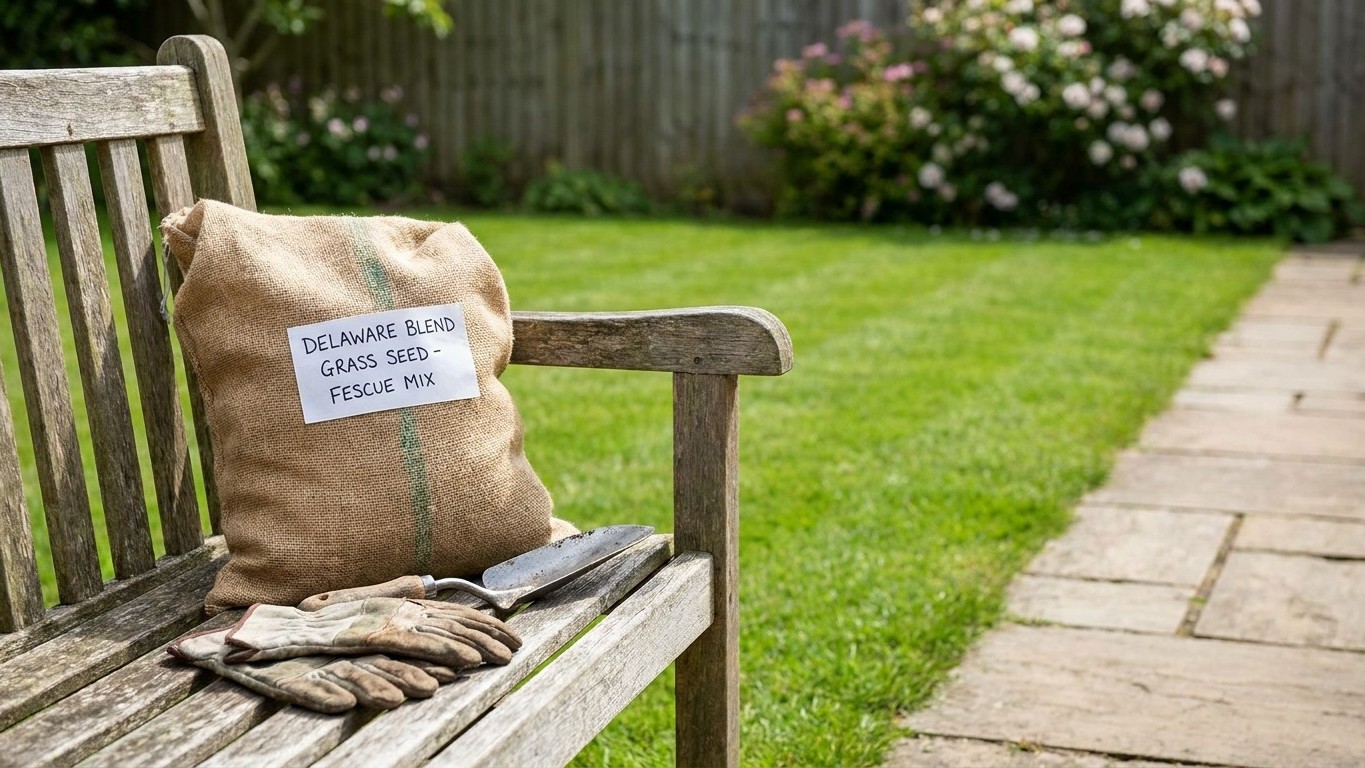

Delaware sits in the cool-season turf zone, and that single classification decides almost everything else in this guide. Bermudagrass, zoysia, centipede, St. Augustine — all wrong tools here, built for a longer hot season and a milder winter than this state reliably gives. Tall fescue is the strongest default for sunny Delaware lawns, its deep roots riding out dry summer stretches that stress Kentucky bluegrass and perennial ryegrass. Fine fescues cover the shade tall fescue can’t.
The short answer for Delaware
Delaware sits in the cool-season turf zone, the classification The Homestead Post assigns by reading climate data against the season tolerances Clemson Cooperative Extension publishes in HGIC 1214. That means the grasses bred for southern lawns, Bermudagrass, zoysia, centipede and St. Augustine, are the wrong tool here. They need a long hot season to establish and a mild winter to stay green, and Delaware doesn’t reliably supply either. The five species that do work are tall fescue, Kentucky bluegrass, perennial ryegrass, fine fescues (creeping red, chewings and hard fescue) and rough bluegrass, all named by Clemson HGIC 1214 and Penn State Extension as cool-season turfgrasses.
Among those five, tall fescue is the strongest default choice for a Delaware lawn that gets any real sun, because its deep root system rides out dry summer stretches better than Kentucky bluegrass or perennial ryegrass can. Kentucky bluegrass fills in bare spots on its own through underground rhizomes, something tall fescue cannot do, but it also needs more water and more nitrogen to look as good. Fine fescues take the shade tall fescue struggles with, and rough bluegrass is a narrow specialist for wet, shaded turf that nothing else on this list tolerates.
Seed timing matters as much as species. NOAA’s 1991-2020 climate normals, measured at the Wilmington station (USW00013781), put the first fall freeze there between October 26 and November 7, and that frost range anchors the whole seeding calendar for cool-season grass. Seed too close to it and young grass won’t root deeply enough before winter. Seed in spring instead and the same young grass hits Delaware’s summer heat before its root system can handle it. The one decision that depends on where you actually live is how much earlier or later than Wilmington your own county turns cold, which changes how far back from that window you should plan to seed.
Working through the year

None of the five cool-season species is free. Picking one means accepting a trade-off, and the right call depends on how much sun the lawn gets, how much water you’re willing to give it, and how much traffic it takes.
What each species costs you
| Species | Sun needs | Heat/drought tolerance | Shade tolerance | Trade-off |
|---|---|---|---|---|
| Tall Fescue | Full sun to light shade | Best of the five | Moderate | Coarser blade, doesn’t spread on its own to fill bare spots |
| Kentucky Bluegrass | Full sun | Weak in a hot, dry summer | Poor | Highest water and nitrogen demand of the five |
| Perennial Ryegrass | Full sun to light shade | Moderate | Poor | Germinates fast but doesn’t spread, mainly used to overseed |
| Fine Fescues | Shade to part sun | Weak in full-sun heat | Best of the five | Thins out under heavy foot traffic |
| Rough Bluegrass | Shade | Weak | Best in wet shade | Only useful in damp, shaded spots nothing else tolerates |
When to seed, feed and mow
Because tall fescue is the species most Delaware lawns actually run, Clemson Cooperative Extension’s HGIC 1219 Tall Fescue Maintenance Calendar is the schedule to follow if that’s your grass, and it works on the same cool-season logic whether the lawn sits in South Carolina or Delaware: fall is the growing season that matters, not spring. Counting back six to eight weeks, the usual establishment window for cool-season seed, from Wilmington’s first fall frost of October 26 to November 7 puts the safest seeding stretch somewhere between late August and late September. Seed any later and the grass won’t have rooted deeply enough before frost. Seed earlier and it will spend its first weeks fighting late-summer heat instead of growing roots.
HGIC 1219 also sets tall fescue’s mowing height, its fall nitrogen applications and its pre-emergent timing for crabgrass; the exact rates shift slightly by region, so check the calendar itself rather than relying on a number lifted out of context. In general terms, the pattern for all five cool-season species is the same: raise the mower deck through summer heat instead of scalping it, put the bulk of the year’s nitrogen down in fall rather than spring, and aerate and overseed in that same fall window so new seed has bare soil contact before the cold sets in. For the fuller month-by-month version of this schedule, The Delaware Lawn Care Calendar, Month by Month lays out each task in order.
Many bagged blends sold for Delaware lawns mix tall fescue with a small share of Kentucky bluegrass or perennial ryegrass rather than a single species alone. The bluegrass fraction spreads by rhizome to knit torn or bare patches that tall fescue can’t repair on its own, and the ryegrass fraction germinates fast to hold soil while the slower tall fescue catches up. Read the tag on any blend before buying, since the ratio of species is what determines how the lawn actually behaves once it’s established, not just the names printed on the front of the bag.
What changes across Delaware
Delaware is a small state, but it isn’t climatically flat. The frost figures above come from NOAA’s station at Wilmington, in northern New Castle County, and the rest of the state runs on a different clock. Sussex County, at the southern end of the state along the Atlantic coast and Delaware Bay, sits closer to open water, which tends to push the first fall frost later than Wilmington’s and stretches the growing season a little longer. Inland spots in western New Castle County and the Piedmont ground near the Pennsylvania line run the opposite direction, often turning cold before Wilmington does.
Kent County, in the middle of the state, sits between those two patterns and tracks closer to Wilmington’s numbers than either coastal Sussex or the Piedmont edge, but it’s still worth checking independently rather than assuming. None of this changes which of the five cool-season species will grow, since the whole state sits in the same cool-season zone. It changes only the calendar, how many days on either side of Wilmington’s late-October to early-November window a given county should plan around for seeding, feeding and the first fall mowing.
Soil plays a role too. The sandy, fast-draining soils common closer to the Delaware Bay dry out faster in a summer dry spell than the heavier clay-loam soils found further inland, which matters more for tall fescue and Kentucky bluegrass than for the fine fescues, since the first two lean harder on stored soil moisture to get through August. A lawn on sandy coastal soil is a stronger case for the deeper-rooted tall fescue over Kentucky bluegrass, not a weaker one, since fescue’s root system reaches further down for whatever moisture is there.
The mistakes this climate punishes
Delaware’s swing between summer humidity and a real winter freeze is what makes certain shortcuts expensive. Each of these shows up on the lawn weeks after the mistake was made, not the day of, which is why it’s easy to blame the wrong cause.
- Seeding cool-season grass in late spring or summer. The seed germinates fine in warm soil, but the seedling has no root depth before Delaware’s hot, humid stretch arrives, and it dies back in July looking like a disease problem rather than a timing mistake.
- Feeding heavily in spring instead of fall. A spring nitrogen push forces top growth right before the plant needs to be building roots for summer stress, leaving a lawn that looks great in May and struggles by August.
- Cutting too short going into summer. A scalped tall fescue or Kentucky bluegrass lawn loses the leaf area it needs to shade its own root zone, and the damage shows up as thinning three to four weeks into a hot, dry spell, not right after the mow.
- Planting a warm-season grass like Bermudagrass or zoysia. Both need a long hot season to establish and go dormant, tan-brown, at the first real cold. In a cool-season climate like Delaware’s they can stay brown for months longer than the cool-season species growing right beside them, which just keep going through fall.
- Skipping fall aeration and overseeding. Thin spots that go into winter thin come out of winter thin, since cool-season grass does its real recovery growth in fall, not spring.
The common thread is timing against the wrong season. Every one of these mistakes would be the right call on a warm-season lawn further south. Delaware just isn’t that lawn, whatever a bag of Bermuda seed at the hardware store might imply.
Checking this against your county
The frost dates and seeding windows above come from one station in Wilmington, and they’re a starting point, not a guarantee for your yard. The University of Delaware Cooperative Extension keeps county-level guidance and can confirm how much earlier or later your own soil, elevation and distance from the coast run the clock. If you haven’t already worked through the basics of watering, mowing and feeding a Delaware lawn, Delaware Lawn Care is the place to start before layering species selection and a seeding date on top of it.
Common questions
Can I just plant a warm-season grass like Zoysia and skip all this?
You can plant it, but it will spend a large part of the year brown and dormant in a cool-season climate like Delaware’s, since it needs a long hot season and mild winter the state doesn’t reliably give it. Zoysia and Bermudagrass are built for the transition and warm-season zones further south, not for the cool-season species list Clemson HGIC 1214 and Penn State Extension give for Delaware.
What if I missed the fall seeding window, can I seed in spring instead?
You can, but expect a weaker result. Spring-seeded cool-season grass has to establish roots and then immediately face Delaware’s summer heat, instead of building roots through the mild fall and winter, so most growers get better results waiting for the next fall than gambling on a spring seeding.
Is a grass seed blend better than a single species?
For most Delaware lawns, yes, particularly a blend that pairs tall fescue with a smaller share of Kentucky bluegrass or perennial ryegrass. The bluegrass fraction spreads to repair bare or torn patches on its own, which straight tall fescue cannot do.
How do I know which species is already growing in my lawn?
Check the blade width and growth habit in early spring. Tall fescue has a wider, coarser blade and grows in clumps, Kentucky bluegrass has a narrower blade with a boat-shaped tip and spreads by rhizome, and fine fescues have the narrowest, thread-like blades of the group. If you’re not sure, University of Delaware Cooperative Extension can help identify what’s already established before you decide what to overseed with.