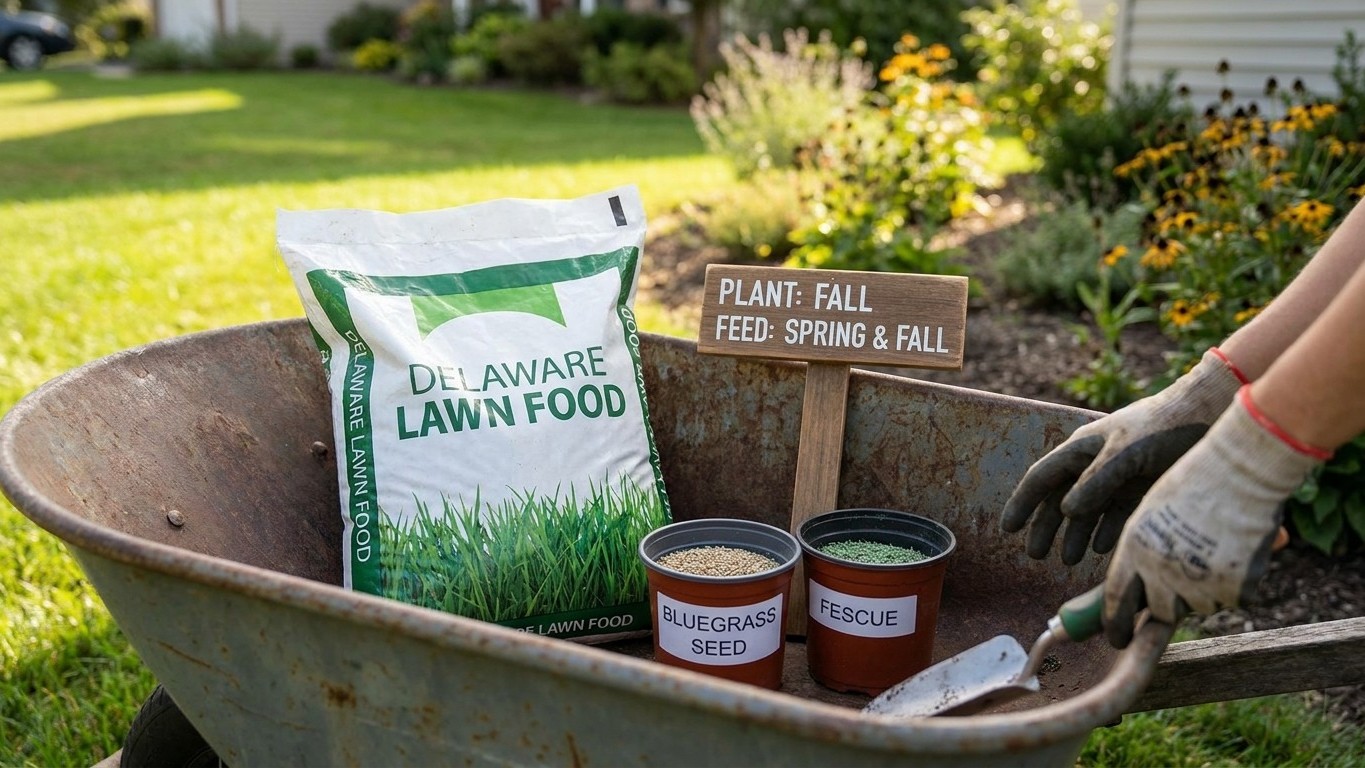

Delaware lawn care means growing a cool-season grass and feeding it on a cool-season schedule. At the reference station in Wilmington, NOAA’s 1991-2020 climate normals show only 17.6 days a year reaching 90°F or higher and a coldest-month mean minimum of 24.6°F, too mild a summer to hold a warm-season lawn and too cold a winter for one to survive. Pick a tall fescue or fine fescue blend suited to your yard’s sun exposure now, and mark your calendar for a September feeding rather than a spring one.
Which grass belongs in Delaware

Your lawn should be growing tall fescue or a fine fescue blend, and you should feed it in September, not spring. Delaware’s summers aren’t hot enough, and its winters aren’t mild enough, for anything else to survive here — the whole yard lives or dies on that one fact. So walk your property this weekend, note which parts sit in full sun and which stay shaded under trees, and pick your Delaware lawn Best grass and your bag of fertilizer with the Delaware lawn Calendar‘s September planting window in mind, not today’s.
The recommended cool-season species for this climate, per HGIC 1214 and Penn State Extension, are Tall Fescue, Kentucky Bluegrass, Perennial Ryegrass, Fine Fescues and Rough Bluegrass. Each does a different job in the yard, so the choice comes down to sun exposure and how much traffic the lawn takes, not the climate itself since all five tolerate Delaware’s winters and summers about equally well.
| Species | Sun/shade | Drought tolerance | Best use |
|---|---|---|---|
| Tall Fescue | Full sun to light shade | Good, deep-rooted | General lawns, kids and pets |
| Kentucky Bluegrass | Full sun | Moderate, needs irrigation | Dense, self-repairing turf |
| Perennial Ryegrass | Full sun | Weak in heat or drought | Quick cover, overseeding |
| Fine Fescues | Shade tolerant | Good in dry shade | Under trees, low-traffic areas |
| Rough Bluegrass | Moist shade | Poor in dry conditions | Damp, shaded low spots |
Because Delaware’s summer heat load is so modest by NOAA’s own count, a homeowner does not need to weigh a warm-season and a cool-season choice against each other the way a grower further south does. Gardeners in Florida Lawn Care: What to Plant and When to Feed It face the opposite problem, choosing among grasses that would simply die here every winter. States that sit squarely between the two climates have a harder call to make, as laid out in Missouri Lawn Care: What to Plant and When to Feed It, but Delaware, at least at the Wilmington reference point, is not one of them.
When to seed or sod here
Clemson Cooperative Extension’s HGIC 1203 sets the general rule: warm-season grasses go into the ground around May, and cool-season grasses go in during mid to late September. Since Delaware is cool-season territory, only the September window applies here, and it should be anchored to the actual frost date rather than to the calendar month alone.
Working back from frost
NOAA’s 1991-2020 normals put the first fall frost at the Wilmington-area station (USW00013781) somewhere between October 26 and November 7. A cool-season lawn needs roughly six to eight weeks of growing weather before the ground goes cold, to let new grass build enough root before winter. Counting back from that frost range lands the practical seeding window in early to mid-September for most Delaware yards near the coast.
That window moves. Suburban and rural gardens away from the airport station typically see their first frost one to two weeks earlier than the Wilmington figure, and more at higher elevation inland. If your county extension office or your own frost records run earlier than the range above, move your seeding date earlier to match, not later.
Spring seeding is possible but riskier here. A ryegrass or fescue seeded in April has to establish before summer heat and any of those 17.6 days above 90°F arrive, and young turf handles that stress far worse than an established stand does. Fall seeding gives roots a full cool season to grow before the lawn ever meets a hot day.
The feeding calendar that fits this climate
Nitrogen timing follows the grass’s growing season, not the wall calendar. A cool-season lawn grows hardest in spring and fall and coasts through summer, so the heaviest feeding belongs in September, right around the same window as seeding, with a lighter follow-up feeding later in fall. Feeding a cool-season lawn heavily in late spring or summer pushes soft growth right before the stress season and does the lawn no favors.
Clemson Cooperative Extension publishes the full month-by-month breakdown for this exact situation in HGIC 1219, the Tall Fescue Maintenance Calendar, which lays out how many pounds of actual nitrogen per 1,000 square feet to apply at each point in the season and which feedings can be skipped on a lower-maintenance lawn. Because Delaware and South Carolina share the same cool-season fescue biology even though their frost dates differ, the calendar’s sequence of feedings applies here, and only the exact dates need to be shifted to Delaware’s own frost window as described above.
Skip a spring nitrogen feeding on a fescue or bluegrass lawn unless a soil test specifically calls for it. Spring growth on a cool-season lawn is already strong without added nitrogen, and the fertilizer is better saved for the fall root-building window where it actually helps the plant get through winter.
Mowing height and watering here
Mowing height
Tall fescue and Kentucky bluegrass both do best cut around 3 inches, fine fescues can run slightly lower at 2.5 to 3 inches, and perennial ryegrass tolerates a bit shorter at 2 to 3 inches. Whatever the species, follow the one-third rule: never remove more than a third of the blade height in a single pass. Cutting a 3-inch lawn down to an inch and a half in one mow shocks the plant and opens the door to the disease problems covered below.
Raise the deck even higher through the hottest stretch of summer, since taller grass shades its own roots and soil, which matters more here during those 17.6 average days a year above 90°F than most people expect from a state with a fairly short hot season.
Watering
An inch of water a week, from rain or irrigation combined, is the common figure for a cool-season lawn in active growth. A few things push that figure around in Delaware specifically. The sandy soils common in southern Delaware drain fast and need water split into two applications a week rather than one long soak, where a heavier clay loam near Wilmington can often go longer between waterings. Humid stretches raise the risk of fungal disease if you water in the evening, so water in the early morning instead, giving the grass blades time to dry before nightfall.
What goes wrong on lawns in Delaware

The failures that show up here follow directly from the climate, not from lawn care in general. A humid Delaware summer, even a mild one by the 90°F-day count, brings enough moisture and warmth together to favor brown patch, a fungal disease that shows up as ragged brown circles in fescue and ryegrass during the wettest, warmest weeks.
A hot, dry stretch produces a different-looking failure. Cool-season grass goes dormant and browns off as a survival response to heat and lack of rain, and it is easy to mistake that dormancy for a dead lawn. The grass is very often alive at the crown and will green back up once cooler, wetter weather returns, so resist the urge to reseed a dormant lawn in the middle of a dry August.
A mild winter, meanwhile, means cool-season weeds like chickweed and henbit never fully stop growing, since Delaware’s winter lows rarely stay cold enough for long enough to knock them back completely. That gives them a head start on spring competition against the turf.
- Ragged brown circles in warm, humid weather: likely brown patch, not drought
- Whole lawn browning in a dry August: likely summer dormancy, not death
- Green winter weeds that never quit: a mild-winter weed problem, treat before spring growth resumes
Local help
A soil test is the fastest way to stop guessing at fertilizer rates and pH corrections, and county-level advice on timing and disease pressure varies enough within Delaware that it’s worth checking locally rather than relying on a single reference-city figure. The University of Delaware Cooperative Extension runs soil testing and county offices that can confirm frost dates, disease pressure and feeding schedules for your specific county.
Common questions
Can I plant Bermuda or zoysia in Delaware?
Not reliably. NOAA’s 1991-2020 normals put Wilmington’s coldest-month minimum at 24.6°F, cold enough to kill or badly thin most warm-season lawns over a typical winter, which is why the recommended species for this state are all cool-season.
Is it too late to seed if I missed the September window?
You can still seed into early October in most years, but germination and root growth slow as the season cools, and the margin for error shrinks the closer you get to the first fall frost range at Wilmington of October 26 to November 7. Waiting until spring is usually the safer bet if you’ve missed fall by more than a couple of weeks.
Why is my whole lawn brown in July even though I’m watering?
Cool-season grass often goes dormant in hot, dry stretches as a survival strategy rather than dying outright. Pull back a section of turf and check the crowns near the soil line. If they’re still white or pale green rather than black and mushy, the lawn is dormant, not dead, and will recover with cooler, wetter weather.
Do I need to fertilize in spring at all?
Usually not much. A cool-season lawn already grows vigorously in spring without added nitrogen, and the more useful feeding happens in fall when the plant is building roots for winter, so save most of your fertilizer budget for September rather than April.
My neighbor’s zoysia lawn looked great last year. Why did it die this winter?
Zoysia and other warm-season grasses can survive a mild winter in Delaware and then get killed outright by a harder one, since the state’s winter lows sit right at the edge of what those species can tolerate. A cool-season lawn doesn’t carry that risk from one winter to the next.