
Ohio gardeners can expect the striped cucumber beetle to appear as soon as soil temperatures climb into the 55-60°F range, usually in late April in the southern part of the state and into mid-May farther north. That timing lines up almost exactly with when cucumber, squash, and melon seedlings break ground, which is precisely the problem. The beetle doesn’t just chew leaves. It carries a bacterial disease that can wipe out a cucumber patch before the plants ever produce fruit.
What the Striped Cucumber Beetle Looks Like

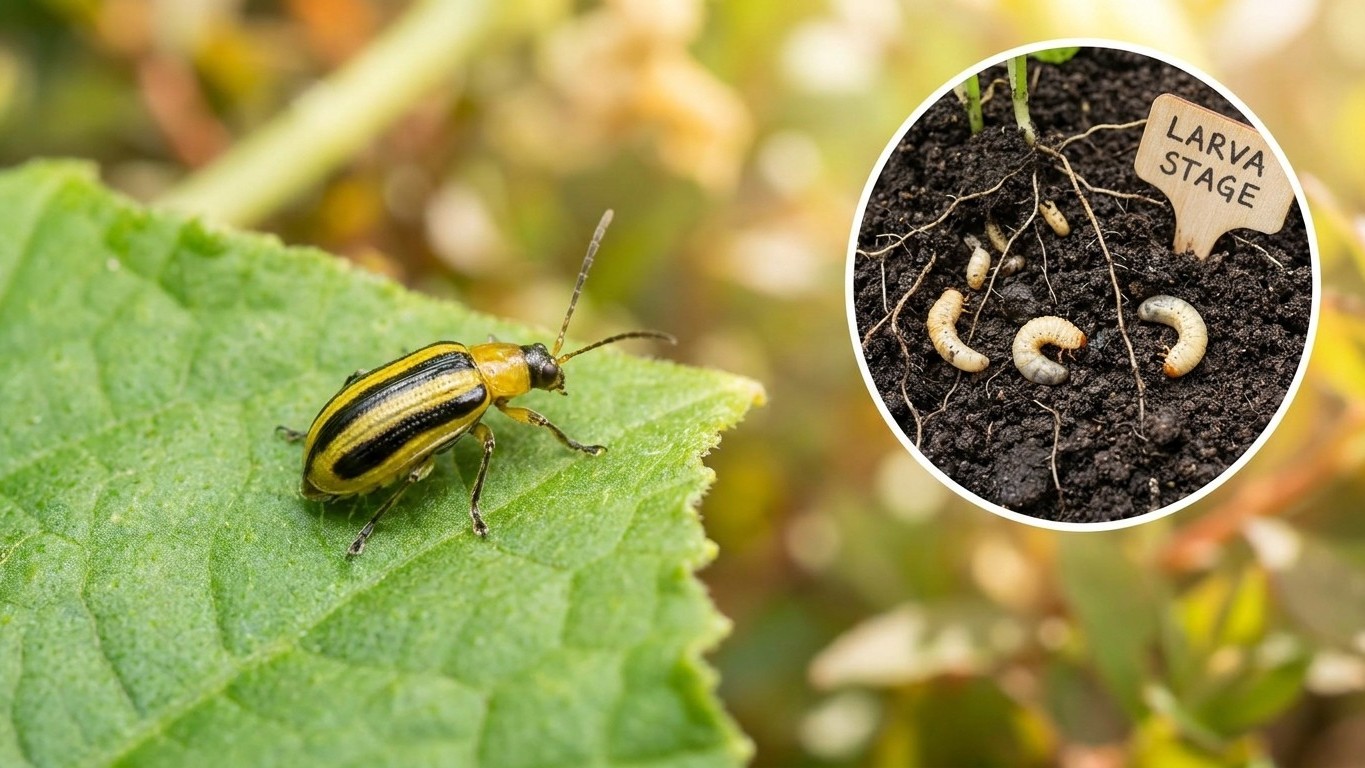
Adults are small, about a fifth of an inch long, with a yellow body marked by three bold black stripes running down the wing covers. A related pest, the spotted cucumber beetle, is similar in size but wears black dots instead of stripes and tends to be less aggressive toward seedlings. Both belong to the cucurbit-feeding beetle group, but in Ohio the striped species is the one growers report most often because it targets young plants so heavily.
The larvae look nothing like the adults. They’re slender, cream-colored grubs that live underground and chew on roots and the base of stems. Home gardeners rarely see the larval stage directly, but its damage shows up as stunted, wilted plants even when the foliage above ground looks untouched by beetles.
When It Shows Up in Ohio
Striped cucumber beetles overwinter as adults, tucked into leaf litter, grassy field edges, or the soil near old cucurbit plantings. They don’t fly in from somewhere else each spring. They simply wake up nearby and head straight for the nearest cucumber, squash, pumpkin, or melon plant. That’s why beetle pressure tends to be worse in gardens planted in the same spot year after year, and why a field near a wooded fence row often sees earlier, heavier activity than an open plot.
In central Ohio, extension reports typically place the first significant beetle activity in the first two weeks of May, right as direct-seeded cucurbits emerge or transplants go into the ground. A second, smaller wave of adults appears in July and August as the summer generation matures, though this later population causes less damage since plants are bigger and better able to tolerate feeding.
Cool, wet springs can push emergence back by a week or two, while an early warm spell can bring beetles out before some gardeners have even finished planting. Watching soil temperature is a better guide than watching the calendar. Once soil hits the mid-50s consistently, it’s time to start scouting seedlings daily.
Why the First Three Weeks Matter Most
Cotyledons and the first true leaves are soft and low in defensive compounds, making them the beetle’s preferred meal. A handful of adults can strip a seedling’s growing point in a day or two, killing the plant outright. Established plants with five or six true leaves tolerate the same beetle numbers with barely a dent in yield. That narrow window, roughly the first three weeks after emergence, is when control decisions matter most.
Why It’s More Than a Chewing Pest
The real damage isn’t the leaf holes. It’s bacterial wilt, caused by the bacterium Erwinia tracheiphila, which the beetle carries in its gut and spreads through feeding wounds. Cucumbers and muskmelons are highly susceptible. A single infected beetle feeding on a young cucumber plant can introduce enough bacteria to clog the plant’s water-conducting tissue within days.
Symptoms start small: one leaf or one vine wilts during the heat of the day and doesn’t recover overnight. Within a week or two, the wilting spreads to the whole plant. A simple field test confirms it. Cut a wilted stem near the base and slowly pull the two halves apart. If sticky, white bacterial ooze stretches into a thin string between the cut ends, bacterial wilt is the culprit, not drought stress or root rot.
Squash and pumpkin varieties are far less prone to bacterial wilt than cucumbers and melons, which changes how growers should think about beetle thresholds depending on what they’re growing. A few beetles wandering through a pumpkin patch aren’t an emergency. The same number on a young cucumber seedling can be.
Effective Controls That Actually Work
Timing and physical barriers do more heavy lifting against this pest than most home remedies. The goal is protecting seedlings through that vulnerable early stage, then easing off once plants are established and flowering.
Row Covers Timed to Flowering
Floating row covers placed over cucurbit beds at planting keep beetles off seedlings completely. The catch is timing removal correctly. Covers need to come off once flowers appear, since cucumbers, squash, and melons rely on bees for pollination and a sealed cover blocks that access. Removing covers a few days before the first blooms open, once plants have several true leaves and can better withstand light feeding, strikes a workable balance.
Trap Crops and Delayed Planting
Blue Hubbard squash is unusually attractive to cucumber beetles compared with cucumbers and melons. Planting a small border of Hubbard squash around the main crop, and treating that border with an insecticide if beetle numbers spike, can pull beetles away from the plants you actually care about harvesting. Delaying planting by even one to two weeks past the typical local emergence window sometimes lets the worst of the early beetle push pass before seedlings are in the ground, though this trades off against a shorter growing season.
Reflective and Straw Mulch
Silver reflective plastic mulch disrupts the beetle’s ability to locate host plants visually, cutting colonization rates in research trials on cucumbers and squash. A thick layer of straw mulch works through a different mechanism, providing habitat for ground beetles and other predators that eat cucumber beetle eggs and larvae in the soil.
When Insecticides Make Sense
For cucumbers and melons, where bacterial wilt risk is high, many Ohio extension guides suggest treating once beetle counts approach roughly one beetle per plant during the seedling stage. Squash and pumpkin, being far more wilt-tolerant, can generally handle four or five beetles per plant before treatment becomes worthwhile. Options range from kaolin clay particle film, which makes leaves unappealing without killing beneficial insects, to pyrethrin-based sprays for organic growers, to systemic seed treatments or soil-applied insecticides for transplants heading into high-pressure fields. Whatever the choice, spraying during early morning or evening when bees aren’t actively foraging protects pollinators once flowering starts.
Rotating cucurbits to a different part of the garden each year, rather than planting cucumbers in the same bed season after season, reduces the population of overwintering adults that emerge right next to a fresh food source. It’s a low-cost habit that compounds over several seasons, even if it won’t eliminate beetle pressure from neighboring wild edges or a neighbor’s untreated patch.
Ohio’s beetle populations vary noticeably by region and even by microclimate within a county, with river-bottom gardens and sites near brushy field edges typically seeing heavier early pressure than exposed hilltop plots. Checking seedlings every day or two during the first three weeks after emergence, rather than relying on a fixed spray schedule, remains the most reliable way to catch a beetle problem before it turns into a bacterial wilt outbreak.
Related guides
- Striped cucumber beetle in Michigan: When It Shows Up and What Stops It
- Striped cucumber beetle in Kentucky: When It Shows Up and What Stops It
- Striped cucumber beetle in Ontario: When It Shows Up and What Stops It
- Striped cucumber beetle in Prince Edward Island: When It Shows Up and What Stops It
- Striped cucumber beetle in Indiana: When It Shows Up and What Stops It
- Striped cucumber beetle in Manitoba: When It Shows Up and What Stops It