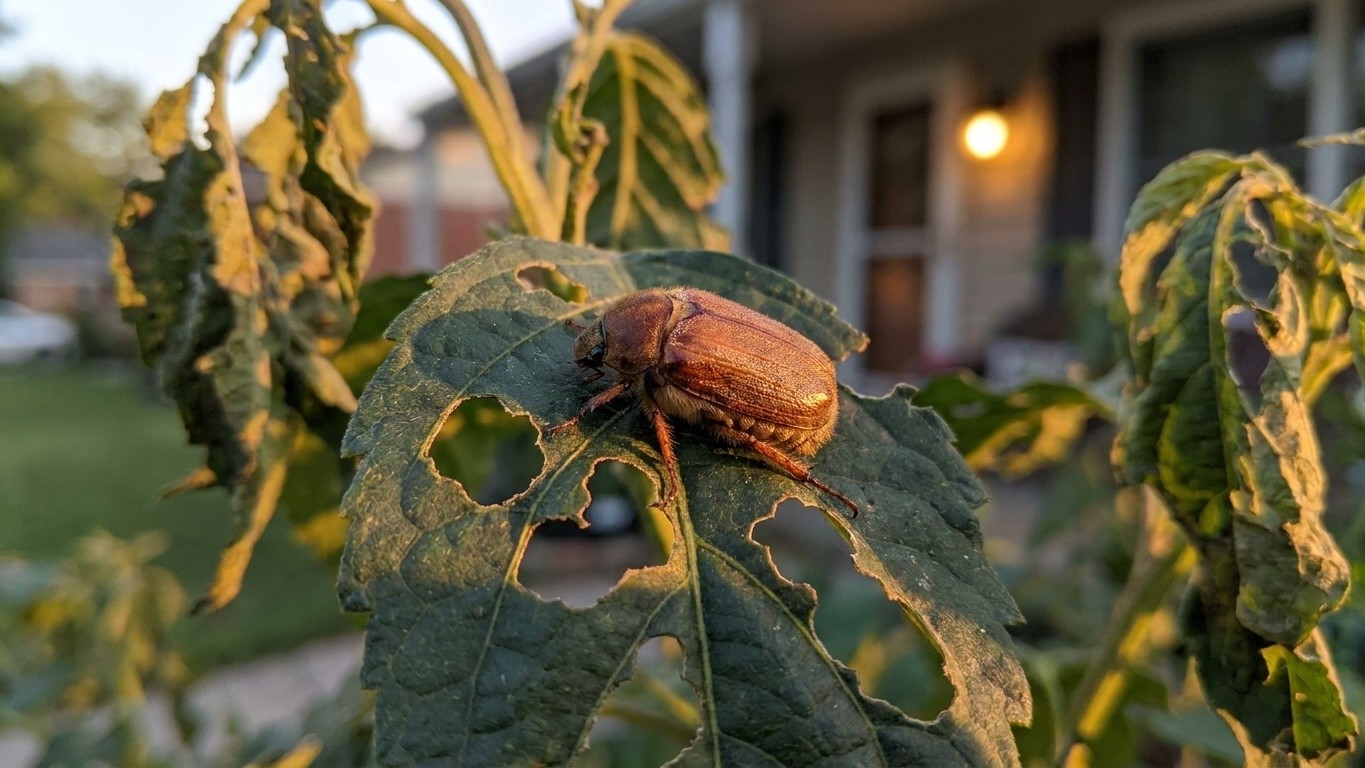

Asiatic garden beetles show up in Quebec gardens from late June through September, with the heaviest activity happening on warm, humid nights in July and August. They fly to porch lights, chew ragged holes in leaves and flowers, and lay eggs that become the lawn-damaging grubs of the following spring. Reducing outdoor lighting at night and treating lawns for grubs in early fall are the two moves that make the biggest dent in a population once it’s established.
A Beetle That Hitchhiked Across Two Countries

The Asiatic garden beetle (Maladera formosae, sometimes still listed under its older name Maladera castanea) isn’t native to North America. It arrived from East Asia in the early 20th century, likely in soil around imported plants, and got its first documented foothold in New Jersey. From there it crept north along the Eastern Seaboard for decades, showing up in Vermont, New York, and New Hampshire before crossing into southern Quebec. Border regions like the Eastern Townships and the Montérégie sit close enough to those infested U.S. states that the beetle’s spread north was more a matter of time than surprise.
Identifying one is straightforward once you know what to look for. Adults are small, roughly the size of a lentil, and colored a uniform cinnamon or chestnut brown with a slight velvety sheen. That’s a useful distinction from the Japanese beetle, which is larger and shows the classic metallic green head with copper wing covers. Asiatic garden beetles also skip the daytime feeding frenzy Japanese beetles are known for. They’re nocturnal, hiding in mulch, thatch, or loose soil during daylight hours and only coming out to feed and mate after dark.
The Quebec Timeline: When to Expect Them
Southern Quebec gets one generation of this beetle per year, and the cycle runs on a predictable clock. Grubs that fed on grass roots the previous fall overwinter in the soil, then resume feeding and pupate as the ground warms in spring. Adults emerge from the soil starting in June, with the population building to a peak in mid-to-late July and staying active into September before the first hard frosts shut things down.
Nighttime is when the trouble starts. The beetles fly toward artificial light sources, which is why homeowners often notice a sudden cluster of unfamiliar brown beetles around a porch bulb, a garage light, or a lit window on a summer evening. They mate and feed under cover of darkness, then burrow back into loose soil, mulch beds, or lawn thatch before sunrise, which makes them harder to spot and treat than a beetle that stays out in the open all day.
Egg-laying happens through the summer months, with females depositing eggs in soil near turf roots. Those eggs hatch into grubs that spend the rest of the season and the following spring feeding underground, setting up next year’s adult population before the current one even finishes its run.
What the Damage Actually Looks Like
Adults and grubs cause two different kinds of damage, and recognizing which one you’re dealing with changes the response.
Foliage and Flower Damage
Adult beetles feed on more than 100 plant species, but they show a clear preference for certain garden favorites: roses, dahlias, asters, chrysanthemums, and the foliage of many ornamental shrubs. Feeding shows up as irregular holes chewed between leaf veins, sometimes advancing to skeletonized leaves where only the veins remain. Flower petals get similarly ragged, and heavily hit dahlias or roses can look shredded by late summer. Vegetable gardens aren’t immune either; beans and other tender crops can take a hit if the beetle population is heavy nearby.
Lawn and Root Damage
The grub stage is where the real turf damage happens. Larvae feed on grass roots through fall and again in spring, and enough of them in one area can produce the same kind of irregular brown patches homeowners associate with Japanese beetle or European chafer grubs. A simple check is to cut a one-square-foot section of turf at the edge of a suspicious brown patch and peel it back. Finding more than 8 to 10 C-shaped white grubs in that square foot is generally considered enough to justify treatment.
What Actually Stops It
Control works best when it targets both life stages, because knocking down adults without addressing grubs (or vice versa) just resets the clock for next year.
Cut the Light Attraction
Since the beetles are drawn to artificial light, the single easiest change is swapping white or blue-toned porch and landscape bulbs for warm-toned LED or yellow “bug light” bulbs, which are far less attractive to night-flying insects. Turning off unnecessary exterior lighting during peak beetle season, or switching to motion-activated fixtures instead of lights left on all night, cuts down significantly on how many beetles end up congregating near the house and garden beds closest to it.
Hand-Removal After Dark
Because these beetles feed at night and hide during the day, handpicking is more effective after sunset with a flashlight than during daylight hours when the insects are already tucked into mulch or soil. Dropping collected beetles into a bucket of soapy water is enough to kill them without chemicals, and doing this a few nights in a row during peak activity in July can noticeably reduce feeding pressure on prized plants like roses or dahlias.
Manage the Grub Stage in the Lawn
For lawns showing grub damage, timing matters more than product choice. Treatments aimed at young grubs work best when applied in late summer to early fall, before the larvae grow large and move deeper into the soil for winter. Beneficial nematodes, applied to moist soil, offer a biological option that targets grubs directly without broad-spectrum chemical exposure in the yard. Where infestations are heavy and biological controls aren’t enough, soil-applied insecticides labeled for white grub control, applied at the label’s specified timing, remain the more reliable chemical option; spring treatments are generally less effective because grubs are larger and more tolerant by then.
Keep the Lawn Itself Less Inviting
Healthy, well-maintained turf recovers from light grub feeding far better than stressed lawns do, and it’s also somewhat less attractive to egg-laying females in the first place. Mowing at a taller height (roughly 3 to 3.5 inches for most cool-season grasses grown in Quebec), watering deeply but infrequently rather than with frequent shallow sprinkles, and avoiding excess thatch buildup all make the root zone less hospitable to developing grubs.
A Detail Worth Knowing
One thing that surprises a lot of gardeners: pheromone traps marketed for Japanese beetles do essentially nothing for Asiatic garden beetles, because the two species respond to completely different chemical cues. Hanging a Japanese beetle trap in a yard dealing with Asiatic garden beetle damage won’t catch the culprit and may even draw in unrelated pests. If a trap-and-identify approach is the goal, a light trap set up specifically to sample nighttime flying insects, checked and emptied each morning, gives a far more accurate read on how many Asiatic garden beetles are actually active in a given yard.