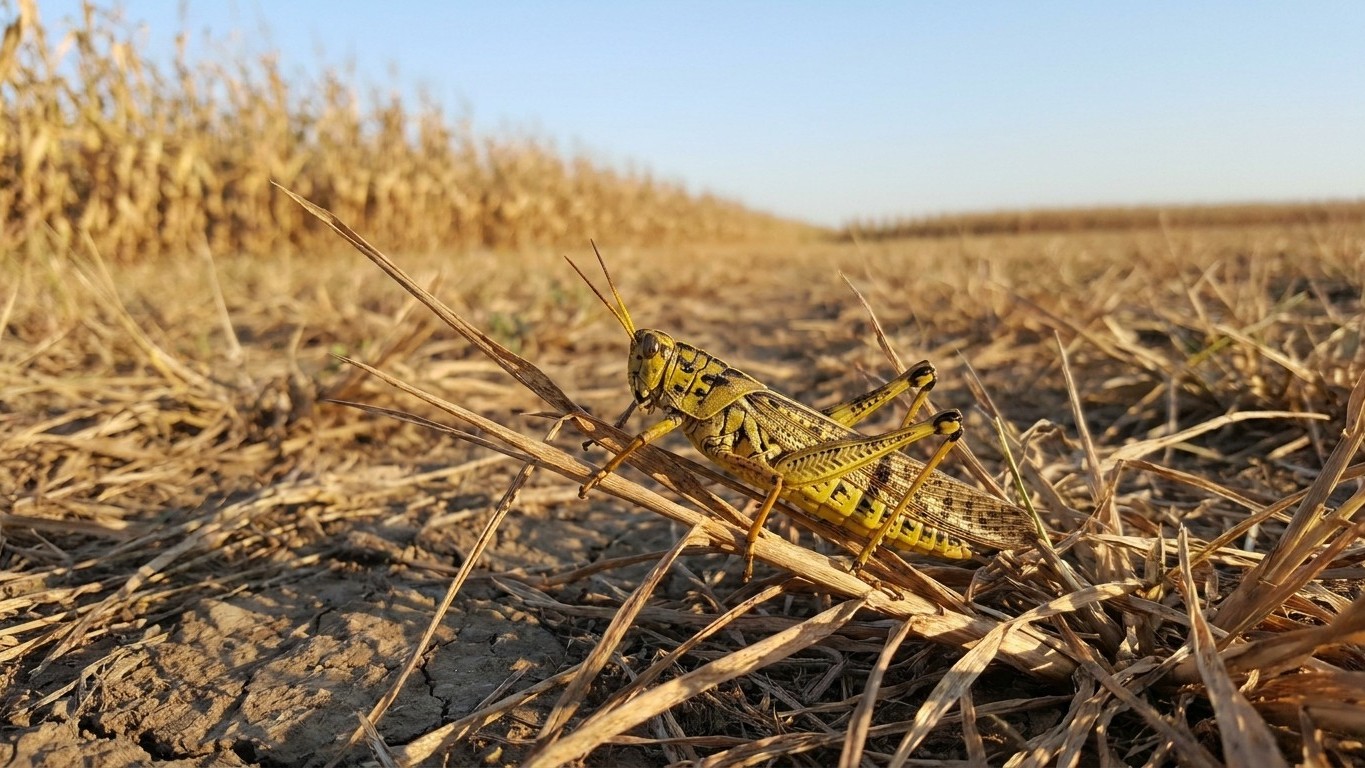

Grasshopper season in Iowa typically ramps up in late June, peaks through July and August, and tapers off after the first hard frost, usually in October. Populations swing hard from year to year depending on how dry the previous fall was, since drought conditions favor egg survival. When outbreaks hit, they hit fast, and Iowa row crops, pastures, and home gardens all take the impact within the same stretch of weeks.
Which Grasshoppers Actually Cause Problems in Iowa

Iowa hosts more than a dozen grasshopper species, but three do almost all the economic damage. The differential grasshopper (Melanoplus differentialis) is the big one farmers watch for, a robust yellow-and-black insect that favors corn and soybean field edges before moving into the interior rows. The redlegged grasshopper (Melanoplus femurrubrum) is smaller and more common in pastures and hayfields, often the species homeowners notice jumping through lawns near field borders. The two-striped grasshopper (Melanoplus bivittatus) rounds out the trio, preferring lush, weedy areas like ditches and unmowed fence lines.
Telling them apart matters less than most guides suggest. What matters is timing and density. Iowa State University Extension entomologists track grasshopper populations through late-summer roadside surveys, counting nymphs and adults per square yard along field margins. A count above eight to ten per square yard in field borders is generally the threshold where economic damage to adjacent crops becomes likely.
When Grasshoppers Show Up in Iowa (Month by Month)
Eggs laid in soil the previous fall survive the winter and hatch when soil temperatures warm consistently, usually between mid-May and early June depending on the region. Northern Iowa counties run about a week or two behind southern counties in a typical spring.
Here’s how the season generally unfolds across the state:
- May: Egg hatch begins in southern Iowa; nymphs are tiny and stay close to hatching sites, often in fence rows and field edges with bare, undisturbed soil.
- June: Nymphs grow through several molts, becoming more mobile and starting to move into crop fields and gardens as vegetation nearby gets grazed down.
- July: Most grasshoppers reach adulthood. This is when wing development lets them travel farther, and it’s the month feeding damage becomes most visible on soybean leaves and garden vegetables.
- August: Peak population and peak appetite. Adult females are feeding heavily to build up energy for egg-laying, which means this month brings the heaviest crop and landscape damage.
- September into October: Egg-laying happens in undisturbed soil, roadsides, and field margins. Activity drops off sharply after the first frost kills adult grasshoppers, though eggs remain safely buried until next spring.
A dry autumn followed by a dry spring is the combination that predicts a bad grasshopper year. Moisture kills eggs and young nymphs through fungal pathogens that thrive in wet soil; drought removes that natural check entirely. Iowa saw this pattern play out with elevated grasshopper pressure following the drought stretches earlier in the decade, particularly across the western third of the state.
Why Iowa’s Landscape Feeds the Problem
Grasshoppers don’t distribute evenly across the state. They cluster where three things line up: undisturbed soil for egg-laying, weedy or grassy vegetation for nymphs to feed on early, and proximity to crop fields they can move into once they’re mobile adults.
That combination describes an enormous share of rural Iowa. Roadside ditches, terrace edges, waterways, and fence lines that don’t get tilled or regularly mowed are exactly the habitat grasshopper females prefer for laying eggs. A single female can lay dozens of eggs in a pod buried an inch or two below the surface, and those pods survive winter freezes without trouble. Come spring, the field bordering that ditch becomes ground zero.
Conservation Reserve Program acreage, no-till buffer strips, and grassed waterways, all valuable for soil and water conservation, unintentionally create ideal grasshopper nurseries. This isn’t a reason to till everything under; it’s a reason for targeted monitoring of those specific edges rather than blanket treatment of entire fields.
Urban and Suburban Exposure
Homeowners in towns bordering farmland, or in newer subdivisions built on former agricultural ground, see grasshopper pressure spike in years when nearby fields or CRP land produce heavy populations. Grasshoppers move in waves looking for food once their original habitat gets grazed down or harvested, and a well-watered suburban vegetable garden or ornamental bed looks like a buffet by comparison. This migration pattern explains why some homeowners get blindsided in late July even though they never noticed a grasshopper problem in June.
What Actually Stops Grasshoppers in Iowa
Control strategy depends heavily on scale. What works for 500 acres of soybeans doesn’t make sense for a quarter-acre vegetable garden, and vice versa.
For Home Gardens and Small Properties
Physical barriers work well at small scale. Floating row covers over vegetable beds block grasshoppers from reaching young plants during the vulnerable nymph stage in June, though covers need to come off once pollination-dependent crops like squash and cucumbers start flowering.
Nosema locustae, a naturally occurring protozoan pathogen sold as a bait product, targets grasshopper nymphs specifically and is applied early in the season, ideally in June while populations are still young and concentrated. It’s slower-acting than a chemical spray, taking two to three weeks to reduce populations noticeably, but it’s compatible with organic gardening and doesn’t harm pollinators or beneficial insects.
For gardeners who want a faster response once adults are already established and feeding heavily, insecticidal soap and pyrethrin-based sprays labeled for grasshoppers offer quicker knockdown, though repeat applications are usually necessary since these products break down quickly and don’t affect grasshoppers migrating in from elsewhere after treatment.
Reducing weedy, overgrown areas directly adjacent to garden beds removes egg-laying habitat before it becomes a problem. Keeping grass mowed short along garden borders and fence lines through late summer and fall, when females are actively seeking soil to lay in, cuts down on the population that hatches right next door the following spring.
For Farms and Larger Acreage
Iowa State University Extension recommends scouting field margins starting in late May, since that’s where nymphs concentrate before dispersing. Catching an outbreak at the nymph stage, before wings develop and grasshoppers can fly, is dramatically more effective than waiting until adults are already spread across the interior of a field.
When counts justify treatment, border sprays targeting just the field edge, rather than the entire field, often provide sufficient control since that’s where the concentration is highest early in the season. This approach also cuts input costs and reduces impact on beneficial insects working the rest of the field.
Registered insecticides labeled for grasshopper control in field crops include products in the pyrethroid and carbamate classes; specific product selection should follow current Iowa State University Extension recommendations, since labeled uses and pre-harvest intervals change and vary by crop.
Natural Predators Help, But Don’t Solve Outbreaks
Birds, particularly killdeer and various sparrows, along with predatory ground beetles and spiders, all take a bite out of grasshopper populations naturally. Blister beetles are a lesser-known predator of grasshopper egg pods, feeding on eggs underground during their larval stage. None of these natural controls move fast enough to stop an outbreak already in progress, but they matter over multiple years, which is one more argument against blanket pesticide use on non-problem acres that would otherwise support these predator populations.
Monitoring Ahead of Next Season
The clearest predictor of next year’s grasshopper pressure is what’s happening in fields and margins right now, in late August and September. High adult counts and heavy egg-laying activity this fall are the strongest signal that next spring will bring another active season in the same locations.
Iowa State University Extension’s field crop entomology program publishes periodic pest updates during the growing season that include grasshopper population trends by region, useful for anyone deciding whether next year calls for early monitoring or can be handled with a wait-and-see approach. Checking those updates in early spring, before nymphs hatch, gives homeowners and growers a head start on deciding where to focus attention rather than reacting after damage is already visible.
Related guides
- Grasshoppers in South Dakota: When It Shows Up and What Stops It
- Grasshoppers in Montana: When It Shows Up and What Stops It
- Grasshoppers in New Mexico: When It Shows Up and What Stops It
- Common stalk borer in Iowa
- Lily leaf beetle in Iowa
- Grasshoppers in Wyoming: When It Shows Up and What Stops It
- Grasshoppers in Utah: When It Shows Up and What Stops It