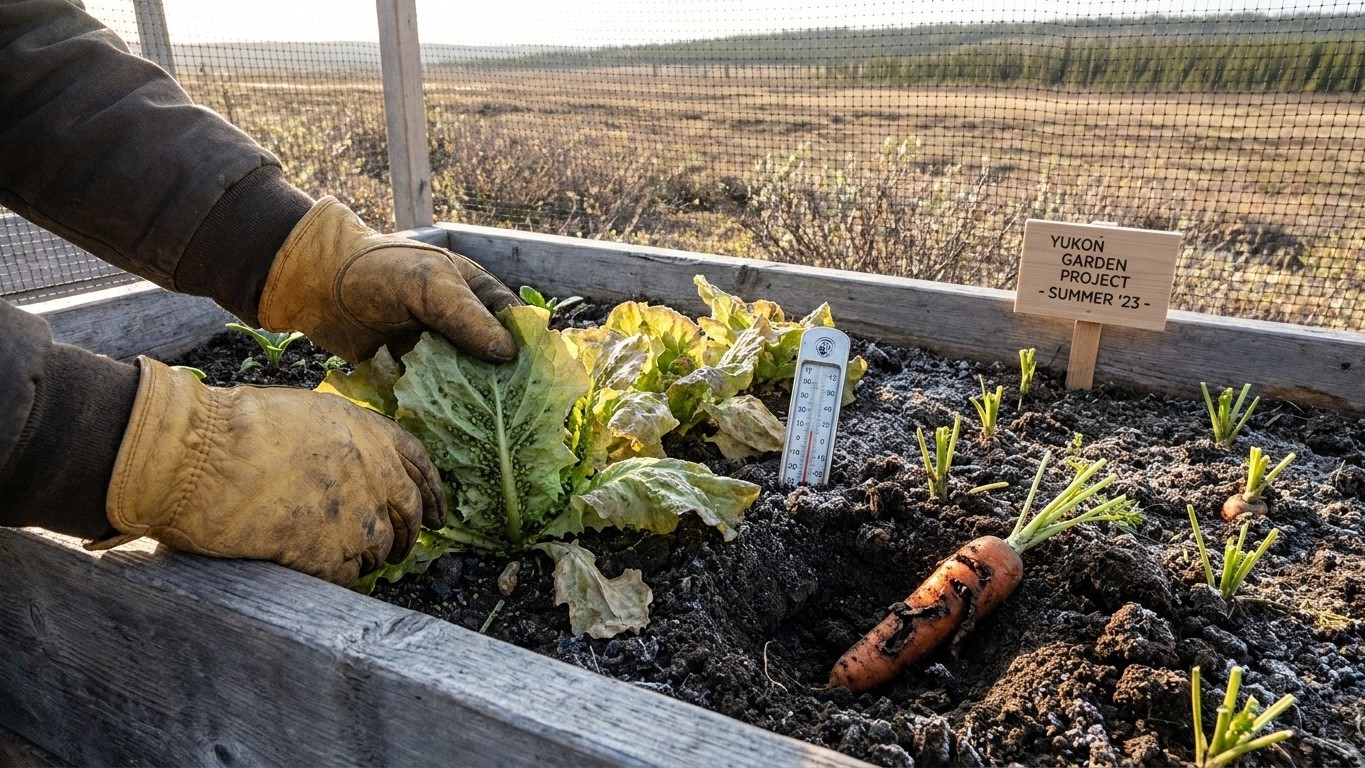

Yukon’s brutal winters do half the pest control work before a single seed goes in the ground. Cold snaps that dip past minus 40 wipe out overwintering insect populations that would otherwise build up year after year, which is why gardeners in Whitehorse and Dawson City deal with a shorter pest list than growers in warmer climates. But a short list isn’t a clean one. Root maggots, Aphids in Yukon, Cutworms in Yukon, Slugs in Yukon, the Spruce beetle in Yukon, and a handful of hungry mammals still find their way into raised beds and greenhouses every summer, and the compressed growing season means damage happens fast once pests do show up.
The territory shares more with Alaska’s interior than with anywhere in the Lower 48, and gardeners in similar cold, dry, short-season zones (think Fairbanks, or high-elevation spots in Montana and Wyoming) will recognize almost every pest on this list. Understanding the timing matters more here than in milder climates, because a two-week delay in spotting a problem can mean the difference between a minor nibbled leaf and a wiped-out crop.
Most of the Yukon falls into Canadian plant hardiness zones 0 through 2, with Whitehorse hovering around zone 1b to 2a depending on the specific valley and its exposure to wind. That’s roughly equivalent to interior Alaska, and colder than all but the harshest pockets of the continental United States. Winter temperatures that stay below freezing for six months at a stretch kill off insect eggs and larvae that survive just fine in a Zone 5 or 6 garden further south.
The growing season itself runs short, often from late May to early September, but it comes with an odd advantage: nearly 20 hours of daylight around the summer solstice. Plants grow fast under that much light, and so do the pests that feed on them, once they get established. A cabbage maggot infestation that might take three weeks to become obvious in a temperate climate can visibly stunt a row of brassicas in Yukon in under ten days, simply because everything, pest and plant, is racing against a compressed calendar.
Soil conditions add another layer. Much of the territory sits on permafrost or near-permafrost ground, which keeps soil temperatures cold and slows the decomposition that would otherwise bury pest eggs deep enough to freeze out. Shallow, cold soil actually protects certain larvae closer to the surface where insulating snow cover keeps them from the deepest freezes.
The Pests Most Likely to Show Up in a Yukon Garden

Five insect pests account for the vast majority of complaints from Yukon gardeners, according to extension-style guidance distributed through territorial agriculture programs. Each one has adapted to the same short, intense season the plants depend on.
Root Maggots (Cabbage and Onion Maggot)
Root maggots in Yukon are consistently named as the top pest problem for Yukon vegetable growers, particularly anyone growing brassicas (cabbage, broccoli, turnips, radishes) or onions. The adult flies lay eggs at the base of young plants in late May and June, and the larvae tunnel into roots, causing wilting that looks like drought stress at first. By the time a gardener pulls a plant and finds the tunneled, slimy root, the damage is done for that crop.
Because the flies are drawn to the smell of disturbed soil and specific host plants, timing transplants to avoid the first egg-laying wave (typically right after the last frost) reduces exposure. Floating row covers placed immediately after transplanting, sealed at the edges with soil, physically block the adult flies from reaching the stems at all.
Aphids
Aphids show up on nearly everything, from peas to kale to greenhouse tomatoes, and they multiply fast once temperatures climb into the 60s and 70s. In Yukon’s brief but intense summer heat, a small aphid colony can explode within a week. They cluster on new growth and the undersides of leaves, leaving a sticky residue (honeydew) that can attract sooty mold.
A strong jet of water knocks most aphid populations down significantly, and repeating that every few days during an outbreak often controls them without any spray at all. Ladybugs and lacewings, which do overwinter in the territory in small numbers, provide natural backup if gardeners avoid broad-spectrum insecticides that would kill the predators along with the pest.
Cutworms
Cutworms are the larvae of certain moth species, and they do their damage at night, chewing through the stems of young seedlings right at soil level. A gardener who plants a row of transplants one evening and finds half of them toppled over by morning has almost certainly met a cutworm. They’re most active in late spring, right as seedlings go into the ground, which makes early June the highest-risk window in most Yukon gardens.
A simple physical barrier stops them cold: a toilet paper tube or a strip of cardboard pushed an inch into the soil around each stem keeps the larvae from reaching it. This works because cutworms rarely climb, they simply crawl along the surface until they hit a stem.
Slugs
Slugs are less of a universal problem in Yukon than in wetter coastal climates, since the territory’s overall low humidity works against them. But in irrigated raised beds, greenhouse floors, and shaded, moist corners of a yard, they still turn up, particularly in cooler, wetter summers. Slug damage shows up as ragged holes in leafy greens and a telltale slime trail.
Because slugs need moisture to survive, reducing evening watering and clearing away dense mulch near vulnerable crops removes the habitat they depend on. Shallow dishes of beer set at soil level remain one of the most reliably effective traps, drowning slugs that are drawn to the yeast.
Earwigs
Earwigs get an unfair reputation, since they’re actually beneficial predators of aphids and other soft-bodied insects for much of the season. But in large numbers they’ll also chew ragged holes in lettuce, dahlias, and other tender plants, especially late in the summer when their populations peak. Rolled, damp newspaper or a section of hose left on the ground overnight attracts them, and the traps can be shaken out and emptied each morning.
Vertebrate Pests: Voles, Ground Squirrels, and Hares
Insects aren’t the only threat to a Yukon garden. Arctic ground squirrels and voles tunnel through raised beds and gnaw at root vegetables, sometimes clearing out an entire row of carrots or potatoes overnight. Snowshoe hares, which cycle through boom-and-bust population swings roughly every eight to eleven years, can strip young shrubs and vegetable seedlings bare during peak years, a well-documented pattern in northern wildlife research.
Hardware cloth buried at least six inches deep around raised beds stops burrowing rodents from tunneling in from below, while a simple 2-foot fence keeps most hares out of a vegetable patch. During hare population peaks, some gardeners in the territory report needing taller fencing or netting over especially vulnerable young transplants.
Greenhouse Pests: A Different Set of Problems
Because the outdoor season is so short, many Yukon gardeners rely heavily on hoop houses and greenhouses to grow tomatoes, peppers, and cucumbers that wouldn’t otherwise mature in time. That warmer, more stable environment creates ideal conditions for pests that rarely survive outdoors in the territory, particularly whiteflies and spider mites.
Whiteflies cluster on the undersides of leaves and scatter in a small white cloud when disturbed, a telltale sign that’s hard to miss once an infestation takes hold. Spider mites, by contrast, are nearly invisible to the naked eye, but the fine webbing and stippled, bronzed leaves they leave behind give them away. Both pests thrive in the dry, warm air of an enclosed greenhouse, and both spread fast without natural predators to keep them in check.
Yellow sticky traps hung near plant height catch adult whiteflies before populations build, and increasing humidity slightly (a light misting in the morning) makes greenhouse conditions less favorable for spider mites, which prefer hot, dry air above nearly everything else.
Timing a Season Around Pest Pressure
Because Yukon’s growing season is so short, timing matters more than in almost any other climate. Root maggot flies emerge and lay eggs in late May through June, right when transplants go in the ground, making that window the highest-priority period for row covers. Cutworm damage peaks in the same early window. Aphids and spider mites build through the warmest stretch of summer, typically mid-June through July, when daylight and heat both push insect reproduction into overdrive. Earwigs and hare damage tend to intensify later in the season, from August into early September, as populations that built up all summer reach their peak numbers right before the first frost shuts everything down.
Watching for pests in that order, rather than treating the whole season as one undifferentiated stretch, lets a gardener put protective measures like row covers and traps in place before damage happens instead of after.
Yukon’s short season is unforgiving in one specific way: there’s rarely time for a second planting if the first one fails to a pest outbreak. That reality, more than any single insect, is what pushes most experienced growers in the territory toward prevention (row covers, physical barriers, early monitoring) over waiting to react once damage is already visible.
Related Pest to Watch For
Yukon gardeners who live near or within spruce stands have another pest worth tracking alongside the ones covered above. The spruce beetle page walks through why late May through July is the critical window, since that’s when adult beetles leave dead or dying spruce and fly off to find new trees to infest. It also gets into the insect behind the damage, Dendroctonus rufipennis, and how long it’s been an active concern in the territory. If you’ve got spruce on or near your property, it’s worth reading before the emergence window opens each year, since the timing described there lines up closely with early-season garden work — you’re often outside checking beds and borders right when the beetles are on the move. Knowing what to look for on nearby trees can save you from a bigger problem spreading toward anything you’ve planted close to a spruce line.