
Maine tomato pests move on a schedule set by the state’s short, cool season. NOAA’s NCEI 1991-2020 climate normals put the last spring freeze at Portland between April 22 and May 1, and the first fall freeze between October 9 and October 21, and pest activity fills the months in between in a fairly predictable order. Check the plants that survived the coldest nights first.
What this comes down to in Maine

Six insects account for nearly all the tomato damage reported around Portland, and they show up in roughly the order below rather than all at once. The pest you find in early June is rarely the pest you find in August, so timing the check to the calendar narrows the search fast. None of these are unique to Maine, but the state’s compressed growing season means each one has a shorter window to do damage, which cuts both ways for the gardener.
Cutworms

These show up right at transplant, before the last frost date has fully passed. A cutworm severs a young stem at the soil line overnight, and you’ll find the seedling lying flat with no chewing higher up the plant. A cardboard collar pushed an inch into the soil around each transplant stops this cold and costs nothing.
Flea beetles

Flea beetles hit seedlings and young transplants in the first few weeks after setting out, while leaves are still soft. Damage looks like the leaf was hit with birdshot: dozens of tiny round holes rather than large chewed sections. Established plants usually outgrow it, but a floating row cover over young transplants keeps the beetles off until the plant toughens up.
Aphids

Aphids appear anytime from late spring through the whole season, clustering on new growth and the undersides of leaves. Look for curled or yellowing leaf tips and a sticky film called honeydew, sometimes followed by a black sooty mold growing on that residue. A hard spray of water knocks down a light infestation, and insecticidal soap handles the rest.
Colorado potato beetle

This one turns up in early to midsummer, often moving over from a nearby potato patch. Both the striped adult and the humpbacked red larva chew ragged holes straight through leaves and can strip a plant fast if the population builds. Hand-picking both stages into a bucket of soapy water works well on a home scale, since populations of this beetle in Maine are notorious for resistance to several insecticides.
Tarnished plant bug

Active from early to midsummer, this bug feeds on flower buds and young fruit, causing catfacing, deformed fruit with scarred, puckered skin near the blossom end. The insect itself is fast and drops off the plant the moment it’s disturbed, which makes it easy to miss. Keeping nearby weeds mowed removes the alternate hosts it breeds in before moving to the tomatoes.
Tomato hornworm

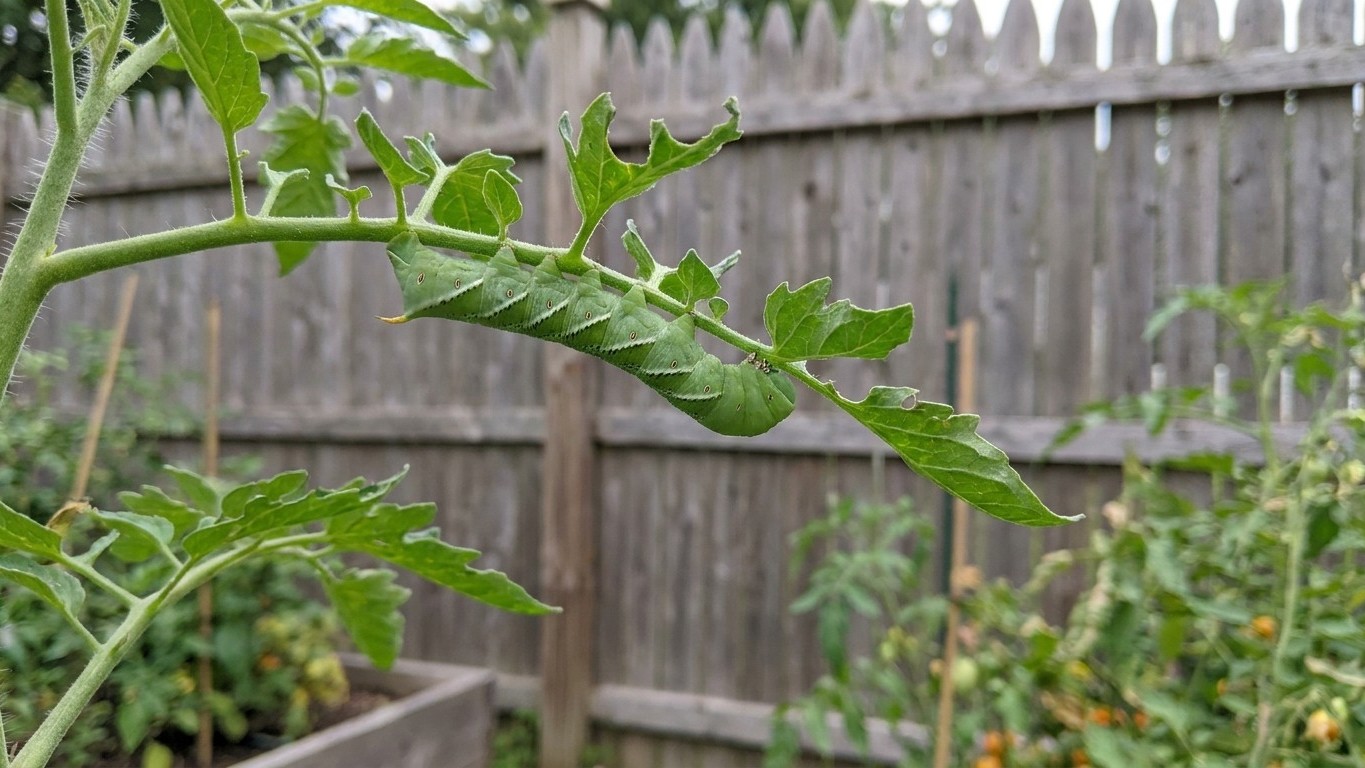
Hornworms show up from midsummer into early fall, feeding on foliage and sometimes green fruit. They’re large enough to strip whole branches in a couple of nights, yet their green coloring blends into the plant so well that the first sign is often a trail of dark droppings on the leaves below. Hand-picking at dusk, when they’re most active, is the most reliable control.
Working it out for your own garden
Diagnosis starts with three questions: what does the damage look like, what part of the plant is hit, and what time of season is it. A severed seedling in late May points to cutworms. Shot-hole leaves on a two-week-old transplant point to flea beetles. Sticky, curled new growth in July points to aphids. Ragged chewed leaves with a striped beetle nearby in June or July points to Colorado potato beetle. Deformed, puckered fruit near the blossom end points to tarnished plant bug. Stripped branches with dark droppings on the leaves below, from midsummer on, point to hornworm.
A quick reference table
| Pest | Typical timing | Telltale sign | First check |
|---|---|---|---|
| Cutworms | At transplant | Stem severed at soil line | Feel soil at base for larva |
| Flea beetles | First 2-3 weeks | Shot-hole leaves | Tap leaf, watch for jumping |
| Aphids | Late spring onward | Sticky, curled new growth | Check undersides of tips |
| Colorado potato beetle | Early to midsummer | Ragged chewed leaves | Look for striped adults, red larvae |
| Tarnished plant bug | Early to midsummer | Puckered, scarred fruit | Check nearby weeds for the bug |
| Hornworm | Midsummer to fall | Stripped branches, dark droppings | Scan foliage below damage at dusk |
This is a diagnostic tool, not a spray schedule. Confirm the insect or its damage before treating anything, since a beetle mistaken for a beneficial or a bug mistaken for a harmless visitor wastes time and, if you spray, kills off predators that would otherwise handle the problem for you. Anyone still working out when to set plants out in the first place should start with Tomato Planting Dates in Maine: Counting Back From Your Frost Window, since transplant timing determines how much of the cutworm and flea beetle window a young plant actually sits through.
What changes across the state
Portland sits at the mild, early end of Maine’s growing conditions, and the state’s USDA hardiness range of 3b to 6a spans a lot of ground between there and the northern counties. A gardener near the coast gets a longer stretch of warm weather on both ends of the season, which means more time for aphids and Colorado potato beetle to run through additional generations before frost shuts things down.
Inland and northern Maine warm up later in spring and cool off earlier in fall, per NOAA’s NCEI normals, which compresses the whole pest calendar into a shorter middle stretch. Cutworm and flea beetle pressure at transplant still shows up on roughly the same relative timing, just shifted later on the calendar to match a later average transplant date. Hornworm populations, which need a run of warm weeks to complete their life cycle, tend to be lighter in the coldest inland pockets simply because there’s less season for them to build numbers in.
Elevation and proximity to open water both nudge these figures further. A garden in a low frost pocket or at higher elevation can run noticeably colder than the reference figures suggest, delaying pest arrival by a week or more in either direction depending on the year. None of this changes which pests to expect, only when in the season each one is likely to peak.
The mistakes this state punishes

The most common error is treating a warm stretch in April as the start of the season and setting transplants out before the soil has actually warmed. Cold, wet soil stresses young plants and makes them far more vulnerable to cutworm damage in the first two weeks, exactly when the plant has the least ability to recover. Wait for the soil itself to warm, not just the air.
The second is choosing a long-season variety without accounting for how much of the growing window a Maine plant actually gets. A tomato that needs 85 days from transplant, like Amish Paste, leaves less slack for a season interrupted by pest damage or a slow, cool stretch than one that matures in 55 to 60 days. If pest pressure knocks a long-season plant back in July, there may not be enough season left to recover fruit before the first fall freeze. The Tomato Varieties That Ripen in Time in Maine page works through which cultivars carry enough margin to absorb a setback.
The third mistake is scouting too late for Colorado potato beetle. Because the larvae start on the lowest leaves, a gardener who only checks the top growth misses the first generation until it’s already large enough to defoliate a plant. Check the undersides of the bottom leaves specifically, starting in early summer, rather than waiting for visible damage higher up.
Checking this against your county
Every figure above is anchored to Portland. A garden two hours north or inland will see the same pests on a shifted calendar, and the only way to pin that down for a specific address is to ask locally. The University of Maine Cooperative Extension keeps county-level guidance and can confirm what’s actually being reported nearby in a given year. Anyone still setting up the basics of the crop should start with growing tomatoes in Maine before troubleshooting pests on plants that haven’t been sited or spaced correctly in the first place.
Common questions
Do I need to spray every year even if I don’t see pests?
No. Spraying without a confirmed pest kills off the predators that would otherwise keep aphids and small caterpillar populations in check on their own. Scout first, treat only what you actually find.
Why did my tomatoes get hornworms two years in a row?
Hornworm moths overwinter as pupae in the soil, so a garden that had them one year is a likely spot for them again the next. Tilling the soil in fall after cleanup exposes overwintering pupae to birds and cold, which cuts down the following year’s population.
Are ladybugs going to eat my aphids for me?
Sometimes, but not reliably enough to count on. Ladybug larvae are effective aphid predators, but a purchased batch of adults often flies off before laying eggs on your plants, so treat any natural predator activity as a bonus rather than a plan.
Is it too late to deal with cutworms once the plant is already up and growing?
Mostly yes. Cutworms do their damage in the first couple of weeks after transplant, and a plant that’s grown past that stage with a woody enough stem is largely past the risk. If you lost a seedling to cutworms, replace it and protect the new one with a collar rather than treating the whole bed.