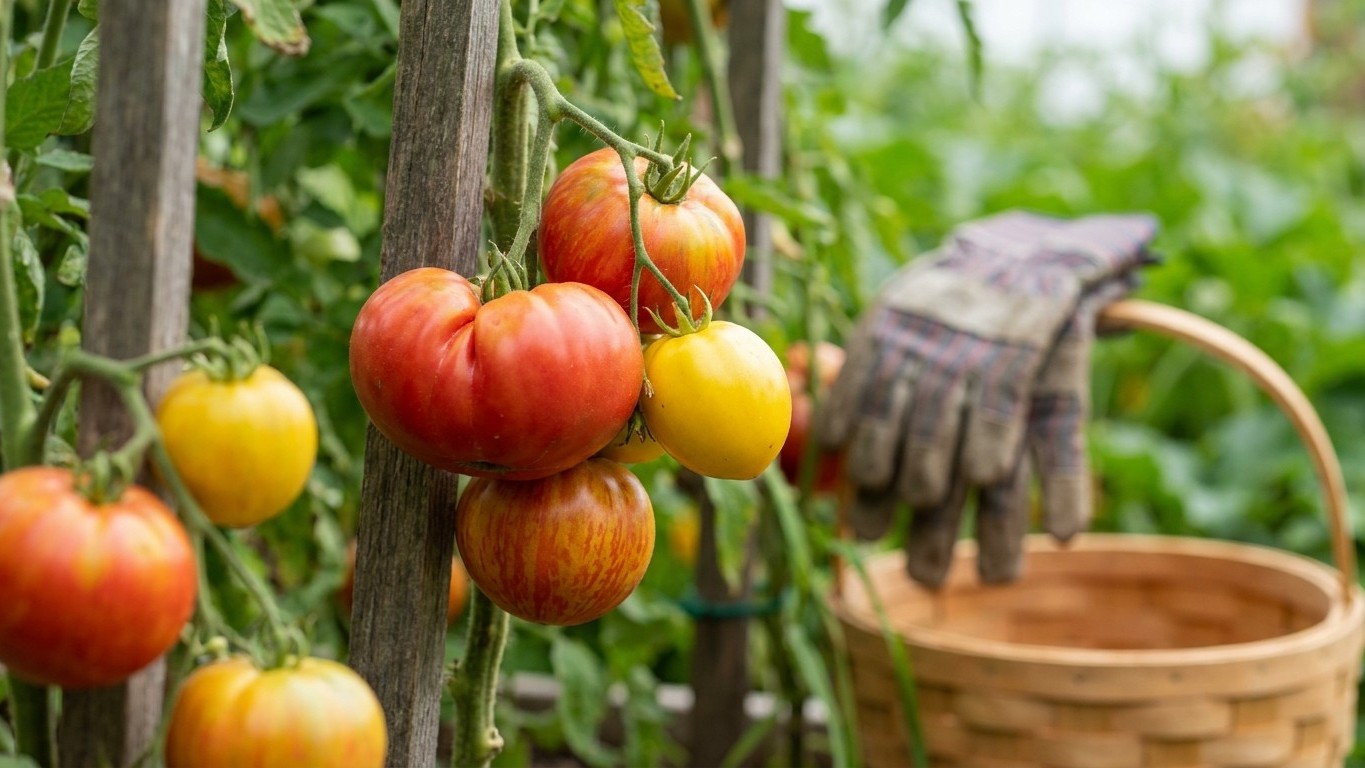

Most catalogue tomatoes ripen fine in Iowa, but only if you check days-to-maturity against the local frost window before you buy the seed packet. Near Des Moines, NOAA’s 1991-2020 climate normals put the last spring freeze at April 12 to April 24 and the first fall freeze at October 14 to October 25, a frost-free stretch of roughly six months. Pick anything under about 78 days to maturity and you’re safely inside that window in most years. Anything longer needs a closer look at the math below before it goes in the cart.
What this comes down to in Iowa

Every cultivar on a seed rack lists a days-to-maturity number, and that number is what decides whether it fits inside the Des Moines-area frost window described above. The shorter that number, the more room you have for a cold spring, a slow-to-warm garden bed, or a July hailstorm that sets the plant back two weeks. The varieties below are ordered from shortest season to longest, so you can see where your own tolerance for risk runs out.
Sakura

Sakura needs about 55 days from transplant, the shortest on this list, and produces small red cherry tomatoes for snacking and salads. Set out late April to early May, it’s typically ripening by early July and still carries about 104 days of cushion before the average first fall frost, the widest margin of any cultivar named here.
Sun Gold

Sun Gold runs 57 days to maturity and gives sweet, thin-skinned orange cherry tomatoes in long clusters. It resists Tobacco Mosaic Virus and one race of Fusarium Wilt, both rated High, and with the same late April to early May transplant window it ripens early July with about 102 days of margin left before frost.
Jasper

Jasper matures in about 60 days and produces small, glossy red cherry tomatoes. It carries High resistance to Late Blight, which matters in a wet Iowa August, and finishes early July with roughly 99 days of margin, comfortably inside the season.
Amalfi

Amalfi takes about 68 days and is a determinate paste tomato, useful if you want a compact plant and a concentrated harvest for sauce rather than a vine that keeps producing all season. It carries Intermediate resistance to both Early and Late Blight, ripens mid July, and leaves about 91 days before frost.
Cherokee Purple

Cherokee Purple needs about 72 days and is the classic dusky-purple heirloom slicer, prized for flavor rather than disease resistance since it carries none of the coded resistances on this list. Transplanted late April to early May, it ripens mid July with roughly 87 days of margin, still well clear of the fall frost window.
Big Beef Plus

Big Beef Plus also runs about 72 days and gives large, smooth red beefsteak fruit for slicing, backed by resistance to nematodes, Gray Leaf Spot and Tomato Mosaic Virus. It ripens mid July from the same transplant window and carries the same 87-day cushion as Cherokee Purple, a useful pairing if you want one disease-resistant hybrid and one heirloom in the same bed.
Celebrity Plus
Celebrity Plus takes about 78 days and is a determinate variety, meaning it sets most of its crop in a shorter window rather than producing steadily all season, useful for canning in one or two big pushes. It ripens late July with about 81 days of margin before frost, the point where the cushion starts to matter more if your spring runs late.
Amish Paste
Amish Paste is the longest-season cultivar on this list at about 85 days, an heirloom paste tomato with dense flesh good for sauce. Even so, from a late April to early May transplant it’s typically ripening by early August with 74 days of margin before the average Des Moines-area frost, the tightest cushion of any variety named here but still workable in most years.
| Variety | Days to maturity | Growth habit | Best for | Margin before frost |
|---|---|---|---|---|
| Sakura | 55 | Indeterminate | Snacking, salads | 104 days |
| Sun Gold | 57 | Indeterminate | Snacking, salads | 102 days |
| Jasper | 60 | Indeterminate | Snacking, blight-prone gardens | 99 days |
| Amalfi | 68 | Determinate | Sauce, compact space | 91 days |
| Cherokee Purple | 72 | Indeterminate | Slicing, flavor | 87 days |
| Big Beef Plus | 72 | Indeterminate | Slicing, disease pressure | 87 days |
| Celebrity Plus | 78 | Determinate | Canning in batches | 81 days |
| Amish Paste | 85 | Indeterminate | Sauce, long harvest | 74 days |
Working it out for your own garden
The method matters more than any single number, because a cold spring or a move across the state changes the arithmetic without changing the logic. Start from the transplant date the frost window allows, add the cultivar’s days-to-maturity, and compare the result against the first fall frost range. Once you’ve hardened off transplants as covered in growing tomatoes in Iowa, this is the calculation that tells you whether the variety in your hand is a safe bet or a gamble.
Counting forward from transplant
Take Cherokee Purple as the worked example. It goes in the ground late April to early May, and its 72 days to maturity land the first ripe fruit in mid July. Counting from mid July to the October 14 to October 25 fall frost range gives roughly 87 days of cushion, matching the figure in the table above. That gap is what absorbs a cool June, a bout of blossom drop in a hot week, or a transplant that sat in the tray an extra few days.
Where a long-season variety runs out of room
Now run the same math on a hypothetical 95-day heirloom slicer, longer than anything named above. In a normal year, a late April to early May transplant plus 95 days still ripens in mid to late August, leaving several weeks before the Des Moines-area frost window. But Iowa State Extension’s county-level figures, drawn from 1950-2021 data, run about four days later in spring and ten days earlier in fall than the airport station NOAA uses, so a cold, wet spring that pushes transplanting into mid-May combined with an early county frost can compress that cushion from ten-plus weeks down to three or four. That’s the point where a long-season variety stops being a comfortable choice and starts being a bet on the weather.
What changes across the state
The Des Moines-area figures above are a starting point, not a statewide truth. Iowa spans USDA hardiness zones 4b to 6a on the 2023 Plant Hardiness Zone Map, colder in the north and milder in the south, and that spread alone shifts both ends of the frost window by more than a week in either direction.
North versus south
A garden near the Minnesota border sits in the colder end of that zone range and typically sees a later last spring frost and an earlier first fall frost than Des Moines, which shortens the safe season for anything past the mid-season cultivars on the table above. A garden in the state’s southern tier usually gets the opposite: an earlier spring thaw and a later fall frost, which gives a longer-season variety like Amish Paste more real margin than the Des Moines figures suggest. Elevation and river valleys matter too, since low-lying ground and frost pockets near creek bottoms can run several degrees colder on a clear, still night than a garden on a ridge a mile away, regardless of what the regional average says. Iowa has no large lake or coastline to moderate these swings the way some states do, so the north-south gradient across the state is the dominant factor, more than any local body of water.
The mistakes this state punishes

Common missteps
The most expensive mistake is planting into cold soil right after a warm stretch in late April, because a few warm days do not mean the soil four inches down has caught up, and a transplant that sits in cold, wet ground stalls for a week or two before it even starts counting toward its days-to-maturity. The second is picking an 85-day-plus variety for a garden in the state’s northern tier, where the effective season runs shorter than the Des Moines figures, without first checking a local frost record. The third is losing track of when foliar disease pressure typically shows up late in the season. Tomato Pests in Iowa: Which Ones Actually Show Up Here covers that timing in detail, and it’s worth reading before a long-season paste tomato is sitting in the ground for an extra month of exposure. None of these mistakes show up at planting time, they show up in September, when there’s no more season left to fix them.
Checking this against your county
Before you commit a long-season cultivar to the ground, check your county extension office through Iowa State University Extension and Outreach for a local frost record, and cross it against the Tomato Planting Dates in Iowa: Counting Back From Your Frost Window page for the arithmetic worked out step by step. A statewide range tells you what’s possible. A county figure tells you what’s likely.
Common questions
Can I still grow Amish Paste if I’m north of Des Moines?
Probably, but check a local frost record first. Amish Paste’s 74-day margin is calculated from the Des Moines-area figures, and a northern Iowa garden with a shorter season could see that cushion shrink to two or three weeks in a cold year.
Do determinate varieties ripen faster than indeterminate ones?
Not necessarily faster, but more concentrated. Celebrity Plus and Amalfi are both determinate and set most of their crop in a shorter window, which suits canning, while an indeterminate variety like Sun Gold keeps producing steadily until frost.
What if my transplants go in later than late April?
Push every date in this article forward by however many days you’re late. A cultivar with 99 days of margin, like Jasper, absorbs a two-week delay easily. One with 74 days of margin, like Amish Paste, has much less room to spare.
Are days-to-maturity numbers on seed packets exact?
No, they’re counted from transplant under average conditions and typically vary by a week or two depending on the season’s heat and sunlight. Treat the number as a guide for comparing varieties against each other, not a guaranteed harvest date.